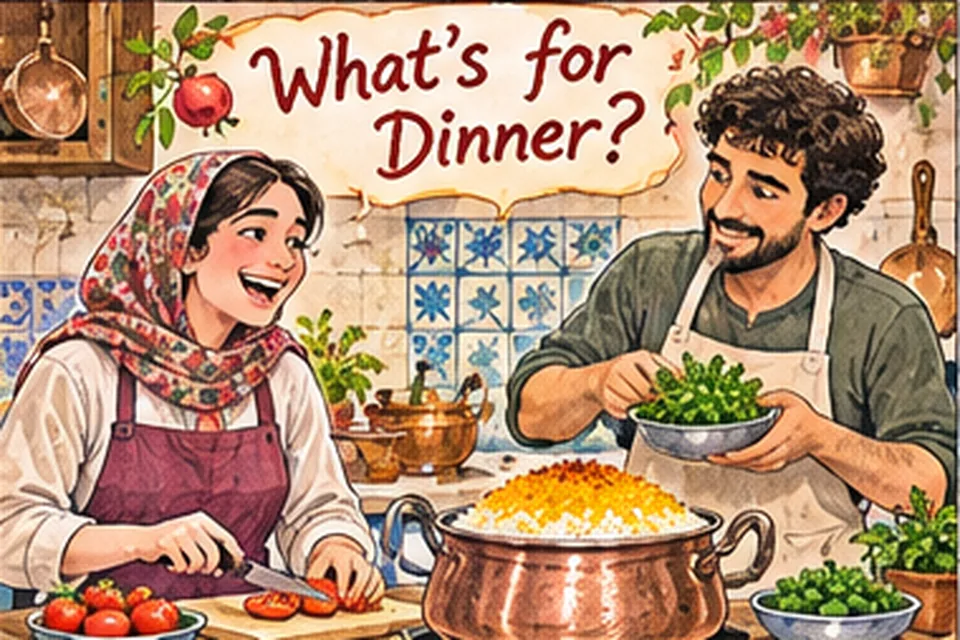
A short spoken Persian dialogue about finding something to eat at home, with translation,
speaking
| English | Pronunciation | Persian | ||
| Peyman: | What is there to eat? | /chizi hast bokhorim?/ | چیزی هست بخوریم؟ | :پیمان |
| Neda: | Let me chek. Cheese, egg,jam | /bezâr bebinam/ /panir,tokhme morgh, morabâ…/ |
بزار ببینم پنیر، تخممرغ، مربا … |
:ندا |
| Peyman: | Is that all? I am in the mood for sandwich. | /hamash hamin? Man delam sândevich mikhâd/ | همش همین؟ من دلم ساندویچ میخواد | :پیمان |
| Neda: | You can go out and buy it. | /mitoni beri biron bekhari/ | میتونی بری بیرون بخری | :ندا |
| Peyman: | Good idea, I do it. | /fekre khobiye, hamin kâr ro mikonam/ | فکر خوبیه، همین کار رو میکنم | :پیمان |
A short spoken Persian dialogue about finding something to eat at home, with translation, food words, colloquial forms and a quiz.
Finding something to eat at home
Peyman is hungry and asks Neda what there is to eat. She lists what is in the kitchen, but Peyman really wants a sandwich, so Neda suggests he go out and buy one. The conversation is relaxed and colloquial, the way family members or roommates talk at home.
Pay attention to the phrase دلم … میخواد (delam … mikhâd). Literally it means "my heart wants …", and it is the everyday way to say you feel like having or doing something.
The dialogue
| Speaker | Persian | Pronunciation | English |
|---|---|---|---|
| Peyman | چیزی هست بخوریم؟ | /chizi hast bokhorim?/ | Is there anything to eat? |
| Neda | بذار ببینم… پنیر، تخممرغ، مربا… | /bezâr bebinam… panir, tokhm-e morgh, morabbâ…/ | Let me see… cheese, eggs, jam… |
| Peyman | همش همین؟ من دلم ساندویچ میخواد. | /hamash hamin? man delam sândevich mikhâd./ | Is that all? I feel like a sandwich. |
| Neda | میتونی بری بیرون بخری. | /mituni beri birun bekhari./ | You can go out and buy one. |
| Peyman | فکر خوبیه، همین کار رو میکنم. | /fekr-e khubiye, hamin kâr ro mikonam./ | Good idea, that's what I'll do. |
Key words and phrases
| Persian | Pronunciation | English |
|---|---|---|
| چیزی | /chizi/ | something, anything |
| خوردن | /khordan/ | to eat |
| بذار ببینم | /bezâr bebinam/ | let me see |
| پنیر | /panir/ | cheese |
| تخممرغ | /tokhm-e morgh/ | egg |
| مربا | /morabbâ/ | jam |
| همش همین؟ | /hamash hamin?/ | is that all? |
| دلم … میخواد | /delam … mikhâd/ | I feel like …, I crave … |
| ساندویچ | /sândevich/ | sandwich |
| بیرون | /birun/ | out, outside |
| خریدن | /kharidan/ | to buy |
| فکر خوبیه | /fekr-e khubiye/ | that's a good idea |
| همین کار رو میکنم | /hamin kâr ro mikonam/ | that's just what I'll do |
Spoken vs written Persian
In everyday speech, Persian shortens many words and changes some vowels. The table puts the colloquial forms from this dialogue next to the forms you would see in writing or hear in formal speech.
| Spoken form | Spoken → written pronunciation | Written form (meaning) |
|---|---|---|
| بذار | /bezâr → begozâr/ | بگذار (let) |
| همش | /hamash → hame-ash/ | همهاش (all of it) |
| میخواد | /mikhâd → mikhâhad/ | میخواهد (wants) |
| میتونی | /mituni → mitavâni/ | میتوانی (you can) |
| فکر خوبیه | /fekr-e khubiye → fekr-e khubi ast/ | فکر خوبی است (it is a good idea) |
| رو | /ro → râ/ | را (object marker) |
Usage and culture notes
تخممرغ (tokhm-e morgh) is literally "hen's egg", and it is the normal word for an egg you eat.
دلم … میخواد can be followed by a thing or by a verb in the subjunctive: دلم چای میخواد (delam châyi mikhâd), "I feel like some tea", or دلم میخواد بخوابم (delam mikhâd bekhâbam), "I feel like sleeping".
In میتونی بری بیرون بخری, the verbs after "can" are in the subjunctive (beri, bekhari), and in speech they simply follow one another without و ("and").
More words for food at home
Here are a few more everyday words you will hear when people talk about what to eat at home. The first two are spoken forms.
| Persian | Pronunciation | English |
|---|---|---|
| گشنمه | /goshname/ | I'm hungry |
| تشنمه | /teshname/ | I'm thirsty |
| چی داریم؟ | /chi dârim?/ | what do we have? |
| یخچال | /yakhchâl/ | refrigerator |
| نون | /nun/ | bread (written: نان, nân) |
| صبحونه | /sobhune/ | breakfast (written: صبحانه, sobhâne) |
| هیچی | /hichi/ | nothing |
Try it yourself: tell someone you are hungry, ask what there is, and say you feel like eating rice (برنج, berenj) or bread and cheese.
Practice
-
What three foods does Neda find?
Show answer
Cheese, eggs and jam (panir, tokhm-e morgh, morabbâ).
-
What does Peyman feel like eating?
Show answer
A sandwich: man delam sândevich mikhâd. من دلم ساندویچ میخواد
-
What is the written form of بذار? بذار
Show answer
begozâr, spelled بگذار.
-
Say in Persian: "I feel like pizza."
Show answer
delam pitzâ mikhâd. دلم پیتزا میخواد
-
How do you say "Good idea" in spoken Persian?
Show answer
fekr-e khubiye. فکر خوبیه
Previous: Persian Conversation 25. Next: Persian Conversation 27. Review the sounds in the Persian pronunciation guide.


Take this lesson further
Study with the book
Farsi Conversations: Learn the Most Common Words and Phrases Farsi Speakers use Every Day
This free lesson is part of Farsi conversation lessons. The book puts the whole series in one printable PDF you can study offline.
Serious about Persian? Get all 30 of our Persian learning books for $199.99 (55% less than buying them one by one).
Free Persian Starter Kit (PDF)
The Persian alphabet chart and the 101 most common Persian words with pronunciation, in one printable PDF. You also get a one-time 15% code for any of our books.
We will email you new lessons and book news from Learn Persian Online. Unsubscribe any time.Free: 100 Core Persian Words + 20 Survival Phrases
Get the 14-page printable Starter Pack (all 32 letters, a 7-day reading plan, 100 core words and 20 survival phrases) and a short 5-email course. Free.