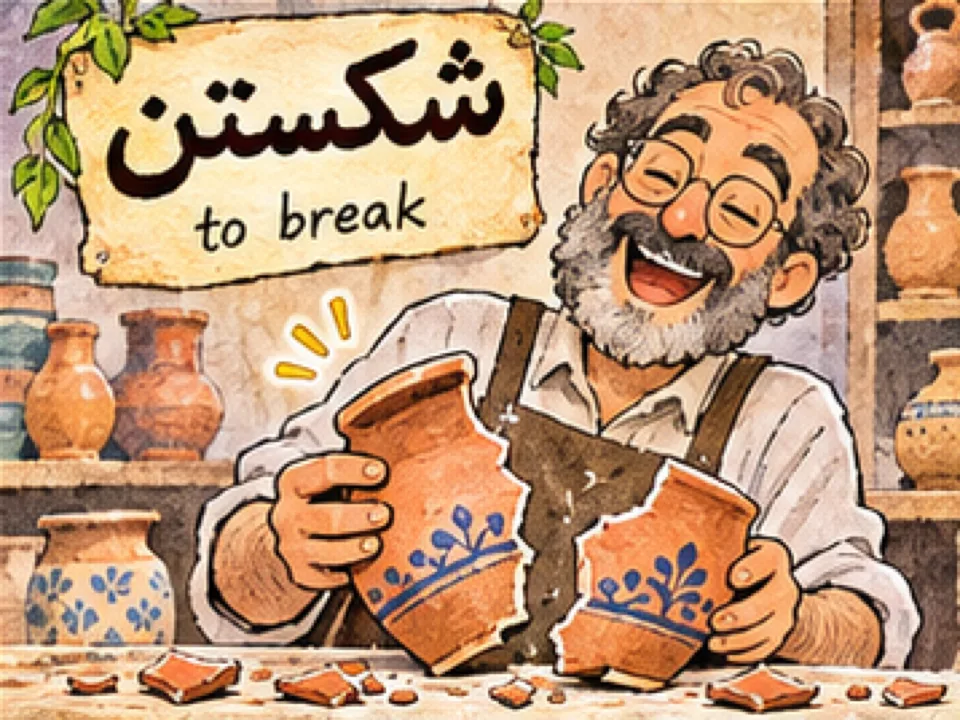
200 Most Common Persian Verbs
شِکَستَن
Watch and listen to Reza Nazari explain this verb. More in the free 200 Persian Verbs video course.
Break – Disobey
مُتَرادِفِ فارسی: خُرد کَردَن
مُتَضادِ فارسی: چَسباندَن
:صَرف
گُذَشتِه: شِکَستَم – شِکَستی – شِکَست – شِکَستیم – شِکَستید – شِکَستَند
حال: می شِکَنَم – می شِکَنی – می شِکَنَد – می شِکَنیم – می شِکَنید – می شِکَنَند
:مِثال
.مَن شیشِه خانِه را با توپ شِکَستَم
.لیوان اُفتاد وَ شِکَست
شکستن (shekastan) means "to break" in Persian. Here are its stems, full conjugation, examples with English, common phrases and a short quiz.
How to use شکستن (shekastan)
شکستن means "to break" and is both transitive and intransitive: لیوان را شکستم, "I broke the glass", and لیوان شکست, "the glass broke". Its present stem is شکن (shekan): میشکنم (mishekanam). A causative شکاندن (shekândan) also exists and is common in speech for the transitive sense.
Many figurative uses follow English closely: دل کسی را شکستن ("to break someone's heart"), رکورد را شکستن ("to break the record"), قانون را شکستن ("to break the law"). The noun شکست (shekast) means "defeat, failure", and شکست خوردن (shekast khordan) is "to be defeated, to fail".
Verb stems
| Infinitive | شکستن | /shekastan/ | to break |
|---|---|---|---|
| Past stem | شکست | /shekast/ | used for past tenses |
| Present stem | شکن | /shekan/ | used for present, subjunctive and imperative |
Conjugation of شکستن
| Person | Simple past | Present | Future | Subjunctive |
|---|---|---|---|---|
| من I |
شکستم /shekastam/ |
میشکنم /mishekanam/ |
خواهم شکست /khâham shekast/ |
بشکنم /beshekanam/ |
| تو you (sg.) |
شکستی /shekasti/ |
میشکنی /mishekani/ |
خواهی شکست /khâhi shekast/ |
بشکنی /beshekani/ |
| او he / she |
شکست /shekast/ |
میشکند /mishekanad/ |
خواهد شکست /khâhad shekast/ |
بشکند /beshekanad/ |
| ما we |
شکستیم /shekastim/ |
میشکنیم /mishekanim/ |
خواهیم شکست /khâhim shekast/ |
بشکنیم /beshekanim/ |
| شما you (pl./polite) |
شکستید /shekastid/ |
میشکنید /mishekanid/ |
خواهید شکست /khâhid shekast/ |
بشکنید /beshekanid/ |
| آنها they |
شکستند /shekastand/ |
میشکنند /mishekanand/ |
خواهند شکست /khâhand shekast/ |
بشکنند /beshekanand/ |
Negative and imperative
| Persian | Pronunciation | English |
|---|---|---|
| نشکستم | /nashekastam/ | I did not break |
| نمیشکنم | /nemishekanam/ | I do not break / I am not breaking |
| بشکن! | /beshekan!/ | Break (it)! (to one person) |
| بشکنید! | /beshekanid!/ | Break (it)! (to several people, or politely) |
| نشکن! | /nashekan!/ | Don't break (it)! |
The examples above, translated
| Persian | Pronunciation | English |
|---|---|---|
| من شیشه خانه را با توپ شکستم. | /man shishe-ye khâne râ bâ tup shekastam./ | I broke the window of the house with the ball. |
| لیوان افتاد و شکست. | /livân oftâd va shekast./ | The glass fell and broke. |
| مادر گفت: به گلدان دست نزن میشکنی. | /mâdar goft: be goldân dast nazan, mishekani./ | Mother said, "Don't touch the vase, you'll break it." |
More example sentences
| Persian | Pronunciation | English |
|---|---|---|
| گوشیام از دستم افتاد و صفحهاش شکست. | /gushi-am az dastam oftâd va safhe-ash shekast./ | My phone fell from my hand and its screen broke. |
| این قوری را نشکن، خیلی قدیمی است. | /in ghuri râ nashekan, kheyli ghadimi ast./ | Don't break this teapot, it's very old. |
| او دل مرا شکست. | /u del-e marâ shekast./ | He broke my heart. |
| شیشهها در زلزله شکستند. | /shishe-hâ dar zelzele shekastand./ | The windows broke in the earthquake. |
Common phrases
| Persian | Pronunciation | English |
|---|---|---|
| دل کسی را شکستن | /del-e kasi râ shekastan/ | to break someone's heart, to hurt someone's feelings |
| شکست خوردن | /shekast khordan/ | to be defeated, to fail |
| رکورد شکستن | /rekord shekastan/ | to break a record |
| شکستنی | /shekastani/ | fragile |
In spoken Persian
In Tehran speech شکوندن (shekundan, from شکاندن) is often used for breaking something: لیوانو شکوندم (livâno shekundam), "I broke the glass". For things that break by themselves, شکست (shekast) stays the same. The present sounds like میشکنه (mishkane).
Watch out for
- The same verb works with or without an object, so watch for را: شیشه را شکست (he broke the window) vs. شیشه شکست (the window broke).
- Note: the page lists "Disobey" as a meaning. شکستن has that sense only in phrases like قانون را شکستن (to break the law); on its own it means "to break".
Practice
-
Translate into Persian: "The cup broke."
Show answer
fenjân shekast. فنجان شکست.
-
Make this sentence negative: من لیوان را شکستم.
Show answer
man livân râ nashekastam. من لیوان را نشکستم.
-
What does this sentence mean? دلش را شکستی.
Show answer
You hurt his feelings (you broke his heart).
Related verbs in this course
This is lesson 147 of 200 Most Common Persian Verbs. For the sounds used in the pronunciation guide, see Persian pronunciation.
.مادَر گُفت: بِه گُلدان دَست نَزَن می شِکَنی


Take this lesson further

Study with the book
200 Absolutely Essential Persian Verbs
This free lesson is part of 200 Most Common Persian Verbs. The book puts the whole series in one printable PDF you can study offline.
Serious about Persian? Get all 30 of our Persian learning books for $199.99 (55% less than buying them one by one).
Free Persian Starter Kit (PDF)
The Persian alphabet chart and the 101 most common Persian words with pronunciation, in one printable PDF. You also get a one-time 15% code for any of our books.
We will email you new lessons and book news from Learn Persian Online. Unsubscribe any time.Free: 100 Core Persian Words + 20 Survival Phrases
Get the 14-page printable Starter Pack (all 32 letters, a 7-day reading plan, 100 core words and 20 survival phrases) and a short 5-email course. Free.
Practise with free Persian games