Farsi vs Urdu: How the Two Languages Are Related and How They Differ
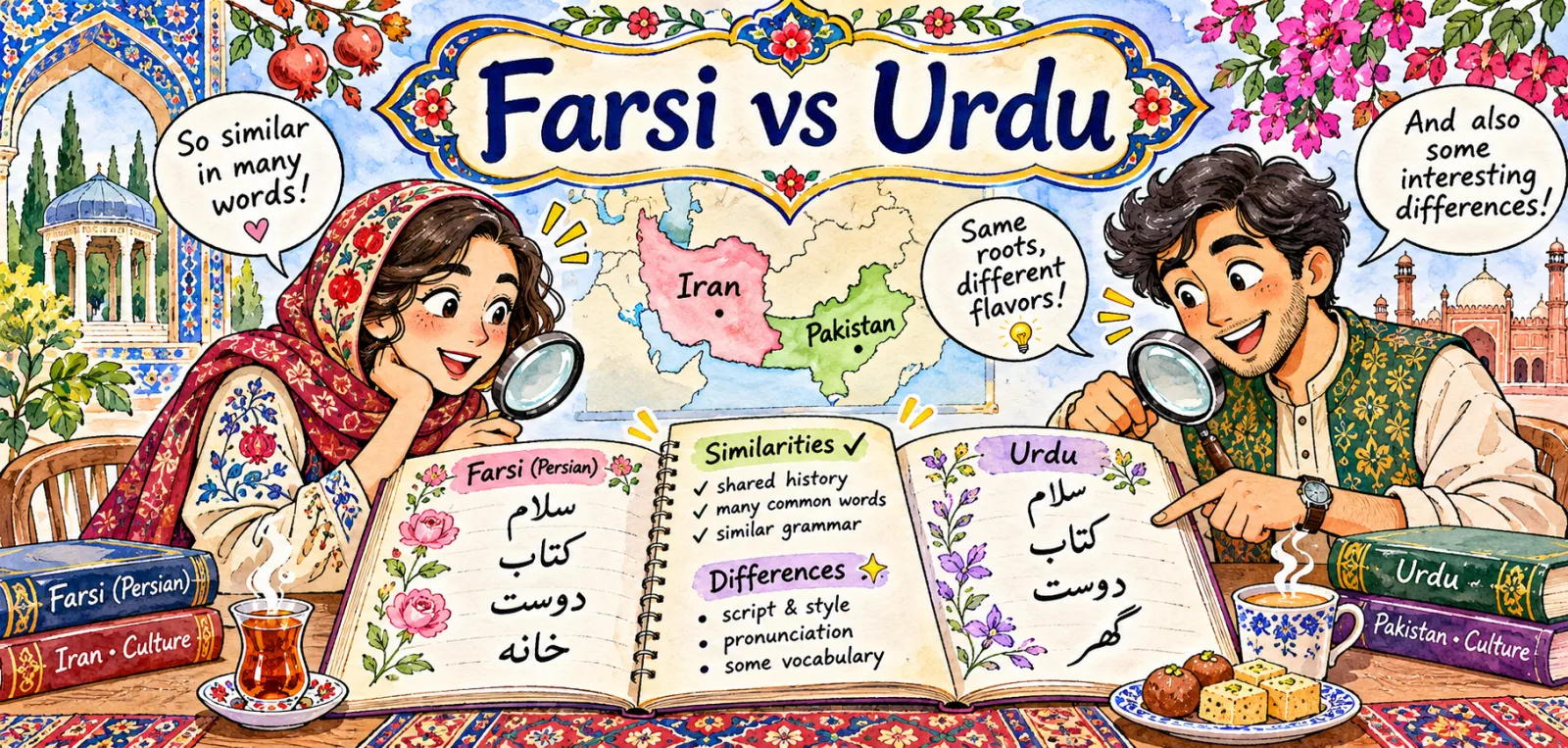
Farsi (Persian) and Urdu are two different languages, not two dialects of one. Persian is an Iranian language spoken in Iran, Afghanistan and Tajikistan; Urdu is an Indo-Aryan language, close to Hindi, spoken mainly in Pakistan and India. They share a writing system and thousands of words, such as کتاب (ketâb, book) and دوست (dust, friend), but their grammar differs and speakers cannot simply understand each other.
If you speak Urdu and want to learn Persian, or you are deciding which of the two to study, this guide walks through what really connects them, where they part ways, and what that means for a learner. Persian examples come with transliteration, and Urdu examples with a simple romanization, so you can compare them side by side.
Farsi vs Urdu at a glance
| Farsi (Persian) | Urdu | |
|---|---|---|
| Name in the language | فارسی (fârsi) | اردو (urdu) |
| Language family | Indo-European, Iranian branch | Indo-European, Indo-Aryan branch |
| Closest relatives | Dari, Tajik, Kurdish, Pashto (more distantly) | Hindi (nearly the same in everyday speech), Punjabi |
| Where it is official | Iran (as Farsi), Afghanistan (as Dari), Tajikistan (as Tajik, in Cyrillic) | Pakistan (national language), India (one of the recognized official languages) |
| Script | Perso-Arabic, 32 letters, usually printed in Naskh style | Perso-Arabic with extra letters, usually printed in Nastaliq style |
| Word order | Subject, object, verb | Subject, object, verb |
| Small linking words | Prepositions before the noun (be, az, dar) | Postpositions after the noun (ko, se, mein) |
| Grammatical gender | None | Masculine and feminine |
| Shared vocabulary | Large: Urdu took in many Persian words, plus Arabic words that came through Persian | |
| Mutual understanding | Partial at best: words are recognized, conversation is not | |
How Farsi and Urdu are related
Both languages belong to the Indo-Iranian group of the Indo-European family, so they are distant cousins in the same way English and Russian are. That old family link explains why some basic words look alike, especially numbers and pronouns. But the very close resemblance people notice today, the shared literary vocabulary, comes from history, not from common descent.
Persian in South Asia
Persian arrived in the Indian subcontinent with Turkic and Persianate rulers from the 11th century onward. Under the Delhi Sultanate and then the Mughal Empire, Persian was the language of the court, government, law, letters and high literature. Officials, poets and scholars across North India wrote in Persian for centuries, and many Indian-born poets became famous Persian writers.
Meanwhile, ordinary people spoke the local vernacular of the Delhi region. Over time that everyday language absorbed a huge amount of Persian vocabulary, along with Arabic and some Turkic words that came mostly through Persian. This Persianized vernacular, written in the Persian alphabet, became Urdu. Its name is usually traced to a Turkic word for an army camp; in Persian, too, اردو (ordu) still means “camp,” as in a school or summer camp.
In 1837 the British East India Company replaced Persian as the official language of administration and the courts, and Urdu and English took over much of its role in North India. Persian slowly faded as a spoken language there, but it left Urdu with its script, its poetic forms such as the ghazal, and a large share of its vocabulary.
Poets who wrote in both
Two of the most loved Urdu poets also wrote in Persian. Mirza Ghalib (19th century) composed a Persian divan alongside his famous Urdu ghazals. Muhammad Iqbal, the national poet of Pakistan, wrote much of his poetry in Persian, and Iranians know and read him as اقبال لاهوری (Eghbâl-e Lâhuri, Iqbal of Lahore). If you love Urdu poetry, Persian opens the door to the classics those poets grew up on, from Hafez to Rumi. See some genuine lines in our post on real Rumi quotes in Persian.
Script: same alphabet, different look
Urdu is written in an extended form of the Persian alphabet, which itself is the Arabic alphabet with four extra letters (پ p, چ ch, ژ zh, گ g). So an Urdu reader already knows almost every Persian letter, and a Persian reader can sound out most Urdu words. Both are written right to left, and both usually leave short vowels unwritten. If you are starting from zero, our Persian alphabet guide covers all 32 letters.
Letters Urdu adds
Urdu needs letters for sounds Persian does not have, mainly the retroflex consonants (made with the tongue curled back) and aspirated consonants (with a puff of air). These do not exist in Persian:
| Urdu letter | Sound | Example (Urdu) |
|---|---|---|
| ٹ | retroflex t | ٹوپی (topi, cap) |
| ڈ | retroflex d | ڈاک (dâk, mail) |
| ڑ | retroflex flap r | بڑا (barâ, big) |
| ں | nasal n (nun ghunna) | ہوں (hun, am) |
| ے | long e at the end of a word (bari ye) | ہے (hai, is) |
| ھ | marks aspiration (do-chashmi he) | گھر (ghar, house) |
Urdu also writes the “h” sound at the end and middle of words with a slightly different letter, ہ, where Persian uses ه. For a Persian learner who reads Urdu, the main adjustment is the other way round: you simply never use these letters in Persian.
Naskh vs Nastaliq
Nastaliq is not a separate script; it is a style of handwriting and type, the flowing, slanted one developed by Persian calligraphers. Urdu books and newspapers are normally printed in Nastaliq. Persian uses Nastaliq for poetry, calligraphy, signs and wedding cards, but everyday Persian print (newspapers, websites, schoolbooks) is usually in the more upright Naskh style. So the same alphabet can look quite different on an Iranian news site and a Pakistani one. This is a good reason for Urdu readers to practice reading Persian print early. You can test yourself with the Persian alphabet quiz.
Shared vocabulary: words you already know
This is where Urdu speakers get a real head start. Thousands of Urdu words, especially in formal, religious, legal and poetic language, are Persian or came through Persian. They are spelled the same or almost the same, but often pronounced differently.
| Persian | Pronunciation (Persian) | Urdu pronunciation | English |
|---|---|---|---|
| دوست | dust | dost | friend |
| کتاب | ketâb | kitâb | book |
| زندگی | zendegi | zindagi | life |
| دل | del | dil | heart |
| دنیا | donyâ | duniyâ | world |
| شهر | shahr | shahar | city |
| آسمان | âsemân | âsmân | sky |
| خدا | khodâ | khudâ | God |
| مشکل | moshkel | mushkil | difficult; problem |
| خوش | khosh | khush | happy, pleasant |
| هفته | hafte | hafta | week |
| سال | sâl | sâl | year |
| بازار | bâzâr | bâzâr | market |
| زبان | zabân | zabân | language; tongue |
| میز | miz | mez | table |
| پرنده | parande | parinda | bird |
Hear a few in Persian: دوست کتاب زندگی
Why the vowels sound different
Notice the pattern: Urdu dost, mez, sher where Persian has dust, miz, shir. Older Persian had long “ō” and “ē” vowels. Urdu, like Dari in Afghanistan, kept them, while the Persian of Iran merged them into “u” and “i.” So شیر is sher (lion) in Urdu but shir in Tehran, where it means both “lion” and “milk.” Persian also pronounces short vowels a little differently: Urdu kitâb, khudâ and mushkil become ketâb, khodâ and moshkel. Learn the Iranian pronunciation from the start; it is the first thing that marks you as an Urdu speaker.
Everyday phrases both languages use
Several greetings will feel familiar. Both say سلام (salâm) for hello, and خداحافظ (Persian khodâhâfez, Urdu khudâ hâfiz) for goodbye. مبارک (mobârak, Urdu mubârak) means “congratulations” or “happy …” in both. But “thank you” differs: Urdu speakers say shukriya, while Iranians mostly say مرسی (mersi) or the more formal ممنون (mamnun). Our guides to hello in Persian and thank you in Persian cover the everyday forms.
False friends: same word, different meaning
Shared words are a gift, but some of them changed meaning on the way. These are the ones that trip up Urdu speakers most:
| Word | Meaning in Persian | Meaning in Urdu | What to say in Persian instead |
|---|---|---|---|
| شادی | shâdi: joy, happiness | shâdi: wedding | wedding: عروسی (arusi) |
| خانه | khâne: house, home | khânâ: food (khâna as “house” survives only in compounds such as kutub-khâna, library) | food: غذا (ghazâ) |
| گلاب | golâb: rosewater | gulâb: rose | rose: گل سرخ (gol-e sorkh) or رز (roz) |
| کرسی | korsi: a low heated table covered with a quilt, used in winter | kursi: chair | chair: صندلی (sandali) |
| خوب | khub: good | khub: a lot, thoroughly (“khub khâo,” eat well) | a lot: خیلی (kheyli) |
| آب و هوا | âb-o havâ: weather | âb-o-havâ: climate | climate: اقلیم (eghlim) |
Listen to the Persian words: شادی عروسی صندلی
Flashcards: Persian meaning of familiar words
joy (not “wedding”)
wedding
house, home
food
chair
rosewater
very, a lot
weather
Grammar: where Farsi and Urdu really differ
Vocabulary makes the two languages look close on paper. Grammar is why they still sound foreign to each other. The everyday core of Urdu (its verbs, pronouns and small grammar words) is Indo-Aryan and shared with Hindi, not with Persian.
Same sentence, two languages
| English | Persian | Urdu |
|---|---|---|
| My name is Ali. | اسم من علی است. esm-e man Ali ast. (spoken: اسمم علیه. esmam Aliye.) |
میرا نام علی ہے۔ merâ nâm Ali hai. |
| This book is very good. | این کتاب خیلی خوب است. in ketâb kheyli khub ast. |
یہ کتاب بہت اچھی ہے۔ yeh kitâb bahut achchhi hai. |
| I am going home. | من به خانه میروم. man be khâne miravam. (spoken: دارم میرم خونه. dâram miram khune.) |
میں گھر جا رہا ہوں۔ main ghar jâ rahâ hun. |
Hear the Persian: این کتاب خیلی خوب است من به خانه میروم
Only “book” (کتاب) and “Ali” overlap; the verbs, the word for “very,” and the word for “home” are all different. That is the typical picture.
The main differences
- Verbs are completely different. Persian رفتن (raftan, to go), آمدن (âmadan, to come), کردن (kardan, to do) versus Urdu jânâ, ânâ, karnâ. Persian verbs take personal endings (miravam, miravi, miravad); see how to conjugate Persian verbs.
- No gender in Persian. Urdu changes adjectives and verbs for masculine and feminine (achchhâ / achchhi, jâtâ hun / jâti hun). Persian never does, and even او (u) means both “he” and “she.” For Urdu speakers this makes Persian easier.
- Prepositions vs postpositions. Persian puts the small word first: به خانه (be khâne, to home), از ایران (az Irân, from Iran). Urdu puts it after: ghar ko, Irân se.
- Linking nouns and adjectives. Persian joins a noun to its adjective or owner with the ezâfe: کتاب خوب (ketâb-e khub, a good book), اسم من (esm-e man, my name). Urdu normally puts the adjective first (achchhi kitâb) and uses kâ/ki/ke for possession. Urdu knows the ezâfe only from Persian-style titles and names, such as Nishân-e-Haider or Tehreek-e-Insaf. Our guide to the ezâfe in Persian explains it fully.
- Object marker. Persian marks a definite object with را (râ, spoken ro/o) after it; Urdu uses ko.
- No ergative “ne” in Persian. Urdu says “main ne khânâ khâyâ” in the past tense with a special marker; Persian just says من غذا خوردم (man ghazâ khordam, I ate food), with the same subject form as in the present.
- Sounds. Persian has no retroflex t/d/r and no aspirated bh, ph, gh-h sounds, but it has خ (kh) and غ/ق (gh) used constantly, and its long â is rounded, close to the vowel in “law.”
Numbers: old cousins
The numbers show the ancient family link: similar, but not borrowed.
| Number | Persian | Pronunciation (Persian) | Urdu |
|---|---|---|---|
| 1 | یک | yek | ek |
| 2 | دو | do | do |
| 3 | سه | se | tin |
| 4 | چهار | chahâr | châr |
| 5 | پنج | panj | pânch |
| 6 | شش | shesh | chhe |
| 7 | هفت | haft | sât |
| 8 | هشت | hasht | âth |
| 9 | نه | noh | nau |
| 10 | ده | dah | das |
Practice the rest with our Persian numbers lesson.
Try it: say it the Persian way
An Urdu speaker wants to say “My friend’s wedding is next week” in Persian, and is tempted to use shâdi. What is the right word for “wedding,” and how is “friend” pronounced in Tehran? Think first, then check.
Wedding is عروسی (arusi); شادی (shâdi) means joy in Persian. Friend is دوست, pronounced dust, not dost. The full sentence: عروسی دوستم هفتهی بعد است (arusi-ye dustam hafte-ye ba’d ast; spoken: arusi-ye dustam hafte-ye ba’de).
Can Farsi and Urdu speakers understand each other?
Not in normal conversation. An Iranian and a Pakistani who speak only their own languages will catch individual nouns and adjectives, greetings and religious expressions, but not the sentences that hold them together, because the verbs and grammar words differ. Spoken Tehrani Persian, with its shortened forms (میرم miram for میروم miravam), is harder still.
The picture improves with formal and written language. An educated Urdu reader can often follow the gist of a Persian headline or a line of classical poetry, because those draw on the shared literary vocabulary. Pakistan’s national anthem is famous for being written in such Persianized Urdu that Persian speakers can follow much of it. In short:
- Reading: partial, best with formal texts and poetry.
- Listening: low; you hear familiar words without the meaning of the sentence.
- Speaking: not possible without learning Persian grammar and verbs.
Persian is related much more closely to Dari and Tajik, which are varieties of the same language; see Farsi vs Persian vs Dari vs Tajik. And if you wonder why both Persian and Urdu contain so many Arabic words without being Arabic, read Farsi vs Arabic.
Learning Persian as an Urdu speaker
Urdu speakers are among the luckiest Persian learners. Here is how to use your advantages and avoid the common traps.
Your head start
- You can already read the alphabet, so you can skip straight to reading practice.
- You recognize a large share of Persian nouns and adjectives, especially formal ones.
- Persian grammar has no gender and very regular verb endings, so it is simpler than Urdu grammar.
- Poetry, the ghazal and many idioms will feel familiar.
Common mistakes to avoid
- Urdu vowels: say dust, miz, khodâ, ketâb, not dost, mez, khudâ, kitâb.
- False friends: shâdi, khâne, kursi/korsi and golâb from the table above.
- Too formal or old-fashioned words: some Persian words in Urdu are literary or out of use in modern Iran. Check new words in our Persian dictionary and learn the everyday spoken form too.
- Urdu letters: do not write ے or ہ in Persian; use ی and ه.
- Word order of adjectives: in Persian the adjective comes after the noun with the ezâfe (ketâb-e khub).
Farsi or Urdu: which should you learn?
Neither language is objectively easier for an English speaker. Persian has simpler grammar (no gender, regular verbs); Urdu has a bigger alphabet and the gender system, but its spoken form also gets you Hindi conversation. The right choice depends on your goal.
Which language fits your goal?
Learn the language your family speaks. If your relatives are from Iran, Afghanistan or Tajikistan, that is Persian (as Farsi, Dari or Tajik). If they are from Pakistan or North India, it is Urdu, which also lets you talk with Hindi speakers.
Persian. Hafez, Rumi, Saadi and Khayyam wrote in it, and Urdu poetry grew out of the Persian tradition. Learning Persian lets you read both the classics and the Persian work of Ghalib and Iqbal.
Choose by region: Persian for Iran, Afghanistan, Tajikistan and the Iranian diaspora; Urdu (with Hindi) for Pakistan, India and the large South Asian communities worldwide.
Persian is a natural next language for you. You already have the script and much of the vocabulary; focus on Persian verbs, the ezâfe, Iranian pronunciation and the false friends in this guide. Start with our free Persian lessons for beginners.
Practice: Persian or Urdu?
In Persian, “wedding” is عروسی (arusi) is wedding; شادی (shâdi) is joy in Persian.
In Persian, “food” is غذا (ghazâ) is food; خانه (khâne) means house.
To say “a good book” in Persian: ketâb-e The adjective follows the noun with the ezâfe: کتاب خوب (ketâb-e khub).
In Tehran, دوست (friend) is pronounced Iranian Persian says dust; dost is the Urdu (and Dari) pronunciation.
“From Iran” in Persian: ایراناز ایران (az Irân). Persian puts the preposition first; Urdu would say Irân se.
The Persian word for “chair” is صندلی (sandali) is a chair; کرسی (korsi) is a heated low table.
Which letter is used in Urdu but never in Persian? ٹ (retroflex t) is an Urdu letter; پ and چ are shared.
Quick quiz: Farsi vs Urdu
1. Which statement about Persian and Urdu is true?
- Urdu is a dialect of Persian
- They belong to unrelated language families
- Both are Indo-European, but Persian is Iranian and Urdu is Indo-Aryan
- Persian developed from Urdu
Why
They are separate languages in two branches of the Indo-Iranian group.
2. Why does Urdu have so many Persian words?
- Urdu and Persian were once the same language
- Persian was the language of the court and government in Mughal-era India
- Iran ruled Pakistan in the 20th century
- Persian borrowed them from Urdu
Why
Centuries of Persian as the language of power and culture filled the local vernacular with Persian words.
3. What does شادی (shâdi) mean in Persian?
- Joy, happiness
- Wedding
- Food
- Chair
Why
In Urdu it means wedding; in Persian the wedding is عروسی (arusi).
4. Nastaliq is…
- A separate alphabet used only for Urdu
- The Urdu word for Persian
- An extra Urdu letter
- A calligraphic style of the Perso-Arabic script
Why
Urdu prints in Nastaliq; Persian print usually uses Naskh, with Nastaliq for poetry and calligraphy.
5. Which grammar feature does Persian lack?
- Verb endings for person
- Grammatical gender
- Subject-object-verb order
- The ezâfe
Why
Persian has no masculine and feminine forms; Urdu does.
6. How is “a good book” said in Persian?
- khub ketâb
- ketâb khub ast-e
- ketâb-e khub
- achchhi kitâb
Why
Noun first, then the ezâfe -e, then the adjective. Achchhi kitâb is Urdu.
7. Can Persian and Urdu speakers hold a normal conversation without learning each other’s language?
- No; they recognize words but not the grammar and verbs
- Yes, easily
- Only in writing, never in speech
- Yes, but only about religion
Why
Shared vocabulary helps with formal reading, but everyday speech is not mutually intelligible.
8. Which poet wrote in both Persian and Urdu and is known in Iran as Eghbâl-e Lâhuri?
- Hafez
- Saadi
- Rumi
- Muhammad Iqbal
Why
Iqbal wrote much of his poetry in Persian; Hafez, Saadi and Rumi wrote in Persian only.
Common questions
Is Urdu derived from Persian?
No. Urdu grew out of the Indo-Aryan speech of the Delhi region, the same base as Hindi. It took a large part of its vocabulary, its script and its poetic forms from Persian, but its grammar and everyday core are its own.
Can a Pakistani understand Farsi?
Partly. A Pakistani who knows Urdu will recognize many Persian words and can often get the gist of formal or poetic Persian, but will not follow ordinary spoken Persian without study. Many Pakistanis learn Persian quickly because of this head start.
Is Farsi easy to learn for Urdu speakers?
Easier than for most learners. The alphabet is almost the same, much of the vocabulary is shared, and Persian has no grammatical gender. The work is in learning Persian verbs, the ezâfe, Iranian pronunciation and the false friends.
Do Urdu and Farsi use the same alphabet?
Nearly. Urdu uses the Persian alphabet plus letters for its own sounds, such as ٹ, ڈ, ڑ, ں, ے and ھ. Urdu is usually printed in Nastaliq, Persian in Naskh.
How much of Urdu vocabulary is Persian?
There is no exact figure. Older estimates put the Persian and Arabic share at roughly a quarter of the dictionary, and the share is much higher in formal, legal and poetic Urdu than in everyday speech.
Which is older, Persian or Urdu?
Persian. Old Persian inscriptions go back about 2,500 years, and New Persian, the language of Hafez and modern Iran, was already a major literary language a thousand years ago. Urdu took shape as a literary language much later, in the centuries of Persian rule in India.
Learn Persian with our bestseller
Serious about Persian? Get all 30 of our Persian learning books for $199.99 (55% less than buying them one by one).
Free Persian Starter Kit (PDF)
The Persian alphabet chart and the 101 most common Persian words with pronunciation, in one printable PDF. You also get a one-time 15% code for any of our books.
We will email you new lessons and book news from Learn Persian Online. Unsubscribe any time.Free Persian Starter Pack: Alphabet + 100 Core Words
Get the 14-page printable Starter Pack (all 32 letters, a 7-day reading plan, 100 core words and 20 survival phrases) and a short 5-email course. Free.
by: Learn Persian Online Team about (category: Blog)



What people say about "Farsi vs Urdu: How the Two Languages Are Related and How They Differ"?
No one replied yet.