Hafez Quotes: 25 Famous Lines in Persian, With Meaning and Source
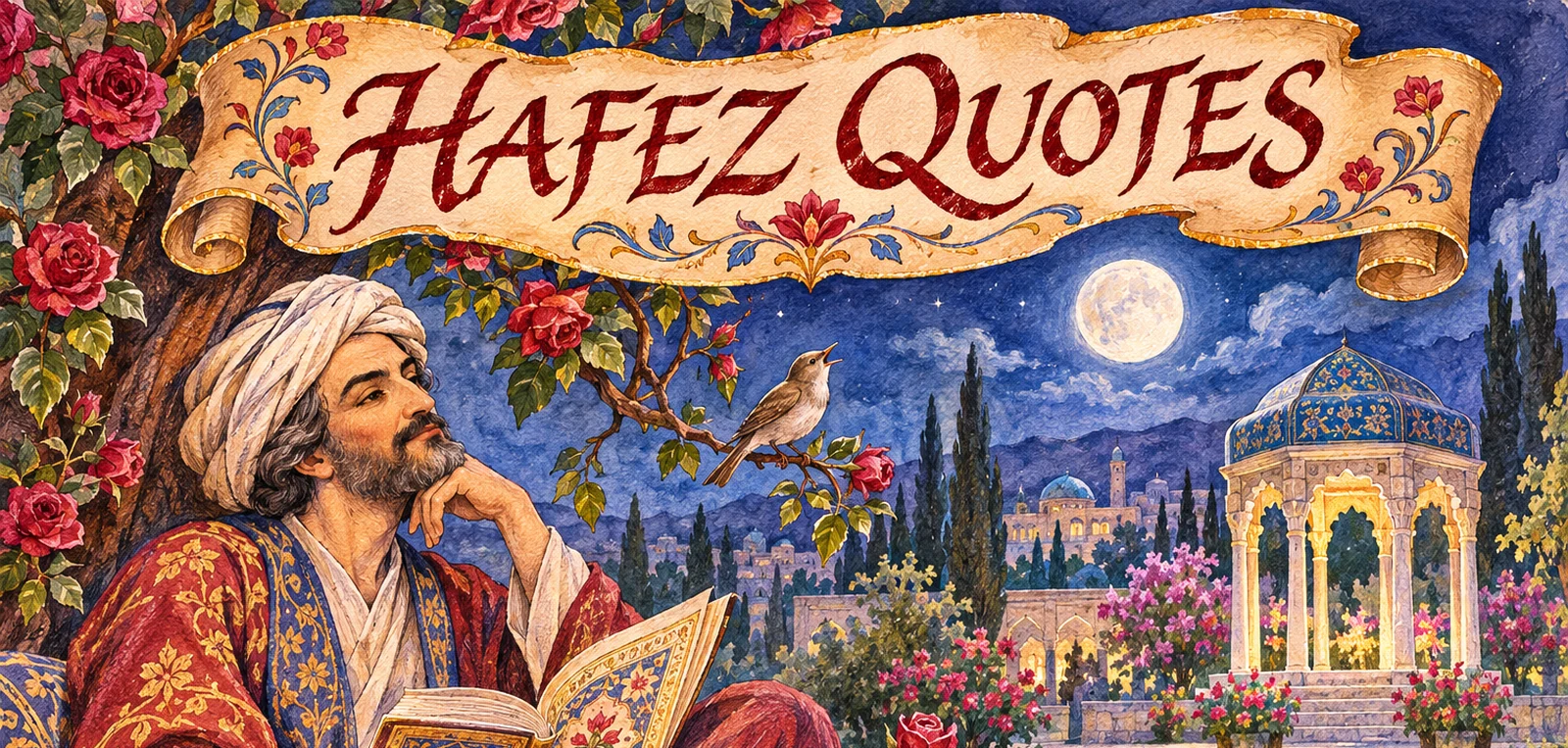
The most famous Hafez quote is the opening line of his Divan: الا یا ایها الساقی ادر کأسا و ناولها / که عشق آسان نمود اول ولی افتاد مشکلها (alâ yâ ayyoha-s-sâghi, ader ka’san va nâvelhâ / ke ‘eshgh âsân nemud avval vali oftâd moshkel-hâ), “Cupbearer, pass the cup around and hand it to me, for love looked easy at first, but then the troubles came.”
Below are 25 genuine Hafez lines like it, grouped by theme. Most “Hafez quotes” you see on English quote sites have no Persian original at all. Every line on this page was checked word for word against the standard text of the Divan on Ganjoor, the online library of Persian poetry that Iranians use every day, and each one carries its ghazal number there so you can read the whole poem. The English translations are our own. They stay close to the Persian so you can see what each word is doing, which matters if you are learning the language.
Famous Hafez quotes at a glance
These are the lines Iranians quote in conversation, write in cards, put on wedding invitations and post on social media. Each is explained further down the page. “G” is the ghazal number on Ganjoor.
| Persian | English (our translation) | Theme | Source |
|---|---|---|---|
| که عشق آسان نمود اول ولی افتاد مشکلها | Love looked easy at first, but then the troubles came | Love | Divan, G1 |
| در ازل پرتو حسنت ز تجلی دم زد | In the beginning your beauty’s light shone out | Love | Divan, G152 |
| یک قصه بیش نیست غم عشق | The sorrow of love is only one story | Love | Divan, G39 |
| از صدای سخن عشق ندیدم خوشتر | I found nothing sweeter than the sound of love’s words | Love | Divan, G178 |
| هرگز نمیرد آن که دلش زنده شد به عشق | One whose heart has come alive with love never dies | Love | Divan, G11 |
| دست از طلب ندارم تا کام من برآید | I will not stop seeking until my wish comes true | Love | Divan, G233 |
| دل میرود ز دستم صاحبدلان خدا را | My heart is slipping away; for God’s sake, you who have hearts | Love | Divan, G5 |
| گفتم غم تو دارم گفتا غمت سرآید | I said, “I grieve for you.” She said, “Your grief will end.” | Love | Divan, G231 |
| یوسف گمگشته بازآید به کنعان غم مخور | Lost Joseph will come back to Canaan; do not grieve | Hope | Divan, G255 |
| دائماً یکسان نباشد حال دوران غم مخور | The times never stay the same; do not grieve | Hope | Divan, G255 |
| رسید مژده که ایام غم نخواهد ماند | Good news has come: the days of sorrow will not last | Hope | Divan, G179 |
| صبر و ظفر هر دو دوستان قدیماند | Patience and victory are old friends | Hope | Divan, G232 |
| شب تاریک و بیم موج و گردابی چنین هایل | A dark night, fear of the waves, and such a terrible whirlpool | Hardship | Divan, G1 |
| با دوستان مروت با دشمنان مدارا | Kindness to friends, tolerance to enemies | Wisdom | Divan, G5 |
| درخت دوستی بنشان که کام دل به بار آرد | Plant the tree of friendship; it bears the heart’s desire | Wisdom | Divan, G115 |
| عیب رندان مکن ای زاهد پاکیزهسرشت | Do not blame the free spirits, you pure-natured ascetic | Wisdom | Divan, G80 |
| هر کسی آن درود عاقبت کار که کشت | In the end everyone reaps what they sowed | Wisdom | Divan, G80 |
| غلام همت آنم که زیر چرخ کبود | I am the servant of the one who, under the blue sky, is free | Wisdom | Divan, G37 |
| سالها دل طلب جام جم از ما میکرد | For years my heart asked me for Jamshid’s cup | Wisdom | Divan, G143 |
| حدیث از مطرب و می گو و راز دهر کمتر جو | Talk of music and wine; look less for the secret of time | Wine and life | Divan, G3 |
| بیا که قصر امل سخت سستبنیادست | Come, the palace of hope stands on weak foundations | Wine and life | Divan, G37 |
| فلک را سقف بشکافیم و طرحی نو دراندازیم | Let us split the roof of the sky and lay a new design | Wine and life | Divan, G374 |
| آسمان بار امانت نتوانست کشید | The heavens could not carry the burden of trust | Mystical | Divan, G184 |
| جنگ هفتاد و دو ملت همه را عذر بنه | Forgive the quarrel of the seventy-two sects | Mystical | Divan, G184 |
| اگر آن ترک شیرازی به دست آرد دل ما را | If that Shirazi beauty takes my heart in hand | Shiraz | Divan, G3 |
| خوشا شیراز و وضع بیمثالش | How lovely is Shiraz, beyond compare | Shiraz | Divan, G279 |
A note on numbering: the numbers follow Ganjoor. Printed editions of the Divan do not all agree on the order or the exact number of ghazals, so a poem may carry a different number in your book.
Who was Hafez?
Hafez, written حافظ (hâfez), was a poet from Shiraz in southern Iran. His full name was Khwâje Shams-od-Din Mohammad. He was born in Shiraz early in the 14th century (the exact year is unknown; scholars suggest dates between about 1315 and 1325) and died there in 1389 or 1390. Unlike Saadi or Rumi, he seems to have spent almost his whole life in his home city, and he praises it again and again.
His pen name is a title: a حافظ is someone who knows the whole Quran by heart, and Hafez says in his own poems that he did. He lived through a stormy time, as one ruler of Shiraz replaced another, and his poems mention several of the princes and ministers he wrote for.
His collection of poems, the دیوان حافظ (divân-e hâfez), holds about 500 ghazals plus a smaller number of other poems. It was gathered after his death; tradition says by his friend Mohammad Golandâm. Iranians give Hafez the title لسانالغیب (lesân-ol-gheyb), “the tongue of the unseen,” because his lines seem to speak to each reader’s own situation. His tomb, the حافظیه (hâfeziye), is a garden in Shiraz where people still gather to read his poems, and 20 Mehr in the Iranian calendar (around October 11 or 12) is marked every year as Hafez Day. For a reading text about him in simple Persian, try our Persian reading lesson on Hafez, and for his city, the reading lesson on Shiraz.
The ghazal in one minute
Almost every famous Hafez quote comes from a غزل (ghazal), a short lyric poem. Knowing its shape makes the lines easier to read:
- A ghazal is made of couplets, each called a بیت (beyt). Each half-line is a مصراع (mesrâ’).
- Every couplet ends in the same rhyme, often followed by a repeated word or phrase, the ردیف (radif). In ghazal 255 the radif is غم مخور (gham makhor), “do not grieve.”
- Each couplet can stand on its own, which is why single lines travel so well as quotes.
- In the last couplet the poet usually names himself, so the word حافظ appears near the end of most of his ghazals.
Hafez quotes about love
Love, عشق (‘eshgh), is the center of the Divan. Hafez’s beloved can be read as a person, as God, or as both at once, and Iranians enjoy that the poems never settle the question.
1. Love looked easy at first
الا یا ایها الساقی ادر کأسا و ناولها / که عشق آسان نمود اول ولی افتاد مشکلها
alâ yâ ayyoha-s-sâghi, ader ka’san va nâvelhâ / ke ‘eshgh âsân nemud avval vali oftâd moshkel-hâ
“O cupbearer, pass the cup around and hand it to me, for love looked easy at first, but then the troubles came.” (Divan, ghazal 1)
The first half-line is in Arabic, a playful opening for a Persian book. The second half is pure Persian and is the part people quote, often just عشق آسان نمود اول on its own, when a relationship or a project turns out to be harder than expected.
2. Love was born at the beginning of time
در ازل پرتو حسنت ز تجلی دم زد / عشق پیدا شد و آتش به همه عالم زد
dar azal partow-e hosnat ze tajalli dam zad / ‘eshgh peydâ shod-o âtash be hame ‘âlam zad
“In the beginning before time, the light of your beauty shone out in a flash; love appeared, and set the whole world on fire.” (Divan, ghazal 152)
ازل (azal) is eternity with no beginning. This is the mystical reading of love at its clearest: creation itself starts with beauty showing itself and love catching fire.
3. One story, never repeated
یک قصه بیش نیست غم عشق وین عجب / کز هر زبان که میشنوم نامکرر است
yek ghesse bish nist gham-e ‘eshgh, v-in ‘ajab / k-az har zabân ke mishenavam nâmokarrar ast
“The sorrow of love is only one story, and the wonder is that from every tongue I hear it, it never sounds repeated.” (Divan, ghazal 39)
Many people quote this as یک نکته بیش نیست (“only one point”), but the standard text reads یک قصه (yek ghesse), “one story.”
4. The sweetest sound
از صدای سخن عشق ندیدم خوشتر / یادگاری که در این گنبد دوار بماند
az sedâ-ye sokhan-e ‘eshgh nadidam khoshtar / yâdegâri ke dar in gonbad-e davvâr bemând
“Of all the keepsakes left under this turning dome of the sky, I have found nothing sweeter than the sound of the words of love.” (Divan, ghazal 178)
5. Love makes you immortal
هرگز نمیرد آن که دلش زنده شد به عشق / ثبت است بر جریدهٔ عالم دوام ما
hargez namirad ân ke delash zende shod be ‘eshgh / sabt ast bar jaride-ye ‘âlam davâm-e mâ
“One whose heart has come alive with love never dies; our lasting is written in the record of the world.” (Divan, ghazal 11)
It is a favorite line for gravestones and memorial notices in Iran.
6. I will not give up
دست از طلب ندارم تا کام من برآید / یا تن رسد به جانان یا جان ز تن برآید
dast az talab nadâram tâ kâm-e man barâyad / yâ tan resad be jânân yâ jân ze tan barâyad
“I will not stop seeking until my wish comes true: either my body reaches the beloved, or my soul leaves my body.” (Divan, ghazal 233)
Notice the wordplay between جانان (jânân, “beloved”) and جان (jân, “soul, life”). Iranians use the first half-line on its own for any stubborn goal.
7. My heart is slipping away
دل میرود ز دستم صاحبدلان خدا را / دردا که راز پنهان خواهد شد آشکارا
del miravad ze dastam, sâheb-delân, khodâ râ / dardâ ke râz-e penhân khâhad shod âshkârâ
“My heart is slipping out of my hands; you who have hearts, for God’s sake help. Alas, the hidden secret is about to come out.” (Divan, ghazal 5)
دل از دست رفتن (del az dast raftan), “the heart going out of one’s hands,” is still the everyday Persian way to say you have fallen for someone.
8. “I grieve for you”
گفتم غم تو دارم گفتا غمت سرآید / گفتم که ماه من شو گفتا اگر برآید
goftam gham-e to dâram, goftâ ghamat sar âyad / goftam ke mâh-e man sho, goftâ agar bar âyad
“I said, ‘I grieve for you.’ She said, ‘Your grief will come to an end.’ I said, ‘Be my moon.’ She said, ‘If it rises.'” (Divan, ghazal 231)
The whole ghazal is a dialogue, and it plays on برآمدن (bar âmadan), which means both “to rise” (of the moon) and “to come true” (of a wish). Persian has no “he” or “she,” so the beloved’s gender is open; English forces a choice.
If you want to say these feelings in everyday Persian rather than in verse, see how to say I love you in Persian.
Flashcards: key words in Hafez
love
heart
sorrow, grief
beloved, friend
cupbearer, wine-pourer
wine (poetic)
free spirit who scorns hypocrisy
ascetic, outwardly pious man
Hafez quotes about hope and patience
These are the lines Iranians send to a friend going through a hard time. Several are so well known that people only need to say the first few words.
9. Lost Joseph will come back
یوسف گمگشته بازآید به کنعان غم مخور / کلبهٔ احزان شود روزی گلستان غم مخور
yusof-e gom-gashte bâz âyad be kan’ân, gham makhor / kolbe-ye ahzân shavad ruzi golestân, gham makhor
“Lost Joseph will come back to Canaan; do not grieve. The house of sorrows will one day become a rose garden; do not grieve.” (Divan, ghazal 255)
The “house of sorrows” is where Jacob mourned his lost son Joseph. The story ends with father and son together again, which is the whole point: what is lost can return.
10. The times do not stay the same
دور گردون گر دو روزی بر مراد ما نرفت / دائماً یکسان نباشد حال دوران غم مخور
dowr-e gardun gar do ruzi bar morâd-e mâ naraft / dâeman yeksân nabâshad hâl-e dowrân, gham makhor
“If the turning sky did not go our way for a day or two, do not grieve: the state of the times is never the same for long.” (Divan, ghazal 255)
11. Sorrow will not last
رسید مژده که ایام غم نخواهد ماند / چنان نماند، چنین نیز هم نخواهد ماند
resid mojde ke ayyâm-e gham nakhâhad mând / chonân namând, chonin niz ham nakhâhad mând
“Good news has come: the days of sorrow will not last. That did not last, and this will not last either.” (Divan, ghazal 179)
The second half-line works like the English “this too shall pass,” and many Iranians use it in exactly that way.
12. Patience and victory
صبر و ظفر هر دو دوستان قدیماند / بر اثر صبر نوبت ظفر آید
sabr-o zafar har do dustân-e ghadim-and / bar asar-e sabr nowbat-e zafar âyad
“Patience and victory are old friends; after patience, victory’s turn comes.” (Divan, ghazal 232)
13. Those on the shore cannot know
شب تاریک و بیم موج و گردابی چنین هایل / کجا دانند حال ما سبکباران ساحلها
shab-e târik-o bim-e mowj-o gerdâbi chonin hâyel / kojâ dânand hâl-e mâ sabok-bârân-e sâhel-hâ
“A dark night, fear of the waves, and a whirlpool this terrible: how could those travelling light on the shore know how we feel?” (Divan, ghazal 1)
People quote the second half-line when someone who has never faced a problem gives easy advice about it.
Try it: comfort a friend with Hafez
A friend has failed an exam and feels the world is against them. Which two words, repeated at the end of every couplet of ghazal 255, would you send? Say them out loud first, then check.
غم مخور (gham makhor), “do not grieve.” You could send the whole couplet: دور گردون گر دو روزی بر مراد ما نرفت / دائماً یکسان نباشد حال دوران غم مخور. In everyday speech the same idea is غصه نخور (ghosse nakhor), “don’t worry.”
Hafez quotes about wisdom and living well
14. The peace of both worlds
آسایش دو گیتی تفسیر این دو حرف است / با دوستان مروت با دشمنان مدارا
âsâyesh-e do giti tafsir-e in do harf ast / bâ dustân morovvat, bâ doshmanân modârâ
“Peace in this world and the next comes down to these two words: kindness to friends, tolerance to enemies.” (Divan, ghazal 5)
This may be the most practical line Hafez wrote. مروت (morovvat) is generous, decent behavior; مدارا (modârâ) is putting up with people patiently instead of fighting them.
15. Plant the tree of friendship
درخت دوستی بنشان که کام دل به بار آرد / نهال دشمنی برکن که رنج بیشمار آرد
derakht-e dusti benshân ke kâm-e del be bâr ârad / nahâl-e doshmani barkan ke ranj-e bi-shomâr ârad
“Plant the tree of friendship, for it bears the fruit of the heart’s desire; pull up the sapling of enmity, for it brings endless pain.” (Divan, ghazal 115)
16. Do not judge others
عیب رندان مکن ای زاهد پاکیزهسرشت / که گناه دگران بر تو نخواهند نوشت
‘eyb-e rendân makon ey zâhed-e pâkize-seresht / ke gonâh-e degarân bar to nakhâhand nevesht
“Do not find fault with the free spirits, you pure-natured ascetic; the sins of others will not be written against your name.” (Divan, ghazal 80)
17. Everyone reaps what they sow
من اگر نیکم و گر بد تو برو خود را باش / هر کسی آن درود عاقبت کار که کشت
man agar nikam-o gar bad, to boro khod râ bâsh / har kasi ân deravad ‘âghebat-e kâr ke kesht
“Whether I am good or bad, you go and mind yourself; in the end everyone reaps what they sowed.” (Divan, ghazal 80)
Lines 16 and 17 come from the same ghazal and show a favorite Hafez target: the زاهد (zâhed), the outwardly pious man who judges everyone else. Hafez sides with the رند (rend), the free spirit who has no time for show.
18. Free of every attachment
غلام همت آنم که زیر چرخ کبود / ز هر چه رنگ تعلق پذیرد آزادست
gholâm-e hemmat-e ânam ke zir-e charkh-e kabud / ze har che rang-e ta’allogh pazirad âzâd ast
“I am the servant of the spirit of the one who, under the blue wheel of the sky, is free of everything that takes on the color of attachment.” (Divan, ghazal 37)
آزادست is the poetic spelling of آزاد است (âzâd ast), “is free.”
19. What you seek is already yours
سالها دل طلب جام جم از ما میکرد / وآنچه خود داشت ز بیگانه تمنا میکرد
sâl-hâ del talab-e jâm-e jam az mâ mikard / v-ân-che khod dâsht ze bigâne tamannâ mikard
“For years my heart asked me for Jamshid’s cup, begging strangers for what it already had.” (Divan, ghazal 143)
The جام جم (jâm-e jam) is the legendary cup of King Jamshid in which the whole world could be seen. The point: the wisdom you look for outside is already inside you.
Wine, the cupbearer and the passing of time
Hafez is full of wine, taverns and cupbearers, and readers have argued for centuries about what they mean. One reading takes them as symbols: wine is divine love or spiritual ecstasy, the tavern is the place where false piety is dropped, and the پیر مغان (pir-e moghân), the old tavern keeper, is a spiritual guide. Another reading takes the wine as real and Hafez as a poet of earthly pleasure who mocks hypocrites. Most Iranian readers hold both at once, and that double meaning is a large part of his charm. Persian poetry uses می (mey) and باده (bâde) for wine; the everyday word is شراب (sharâb).
20. Do not try to solve the riddle of the world
حدیث از مطرب و می گو و راز دهر کمتر جو / که کس نگشود و نگشاید به حکمت این معما را
hadis az motreb-o mey gu-vo râz-e dahr kamtar ju / ke kas nagoshud-o nagoshâyad be hekmat in mo’ammâ râ
“Talk of the musician and wine, and look less for the secret of time; no one has solved this riddle with reason, and no one ever will.” (Divan, ghazal 3)
21. Life is built on wind
بیا که قصر امل سخت سستبنیادست / بیار باده که بنیاد عمر بر بادست
biyâ ke ghasr-e amal sakht sost-bonyâd ast / biyâr bâde ke bonyâd-e ‘omr bar bâd ast
“Come, the palace of hope stands on very weak foundations; bring wine, for the foundation of life is built on the wind.” (Divan, ghazal 37)
Listen to the sound play: باده (bâde, wine) and باد (bâd, wind), بنیاد (bonyâd, foundation) twice. بر باد (bar bâd), “on the wind,” still means “ruined” in modern Persian.
22. Let us lay a new design
بیا تا گل برافشانیم و می در ساغر اندازیم / فلک را سقف بشکافیم و طرحی نو دراندازیم
biyâ tâ gol barafshânim-o mey dar sâghar andâzim / falak râ saghf beshkâfim-o tarhi now darandâzim
“Come, let us scatter roses and pour wine into the cup; let us split the roof of the sky and lay down a new design.” (Divan, ghazal 374)
طرحی نو درانداختن (tarhi now darandâkhtan), “to lay a new design,” is a common phrase in Persian speeches and headlines about new beginnings, and this couplet is a natural choice for a New Year card.
Mystical Hafez: the burden of trust
23. The heavens could not carry it
آسمان بار امانت نتوانست کشید / قرعهٔ کار به نام من دیوانه زدند
âsemân bâr-e amânat natavânest keshid / ghor’e-ye kâr be nâm-e man-e divâne zadand
“The heavens could not carry the burden of the trust, so they drew the lot in the name of mad me.” (Divan, ghazal 184)
This echoes a Quranic verse in which the heavens, the earth and the mountains decline to carry God’s “trust,” and humans accept it. Hafez takes the human side with a wry smile: only someone “mad” would agree.
24. Forgive the quarrel of the seventy-two sects
جنگ هفتاد و دو ملت همه را عذر بنه / چون ندیدند حقیقت ره افسانه زدند
jang-e haftâd-o do mellat hame râ ‘ozr beneh / chon nadidand haghighat rah-e afsâne zadand
“Excuse all the seventy-two sects their quarrels: because they did not see the truth, they took the road of myth.” (Divan, ghazal 184)
“Seventy-two sects” was a traditional way to say “all the religious factions.” The line is often quoted as a plea for tolerance.
Hafez and Shiraz
25. The Turk of Shiraz
اگر آن ترک شیرازی به دست آرد دل ما را / به خال هندویش بخشم سمرقند و بخارا را
agar ân tork-e shirâzi be dast ârad del-e mâ râ / be khâl-e hendu-yash bakhsham samarghand-o bokhârâ râ
“If that Shirazi beauty takes my heart in hand, for the dark mole on that face I would give away Samarkand and Bukhara.” (Divan, ghazal 3)
In classical poetry ترک (tork) is a stock word for a fair, beautiful and often cruel beloved, not a statement about ethnicity. A well-known story, told long after Hafez’s time and probably invented, has the conqueror Timur scolding Hafez for giving away his great cities for a mole. Hafez answers that this kind of generosity is why he is so poor.
Hafez also wrote the city’s best-known praise: خوشا شیراز و وضع بیمثالش / خداوندا نگه دار از زوالش (khoshâ shirâz-o vaz’-e bi-mesâlash / khodâvandâ negah dâr az zavâlash), “How lovely is Shiraz, beyond compare; Lord, keep it from decline” (Divan, ghazal 279).
How Iranians use Hafez today
For most Iranians Hafez is not a school subject but a household book. Many homes keep a copy of the Divan within reach, and some families place it on the Nowruz سفره هفتسین (sofre-ye haft-sin).
- Fâl-e Hâfez. The best-known custom is فال حافظ (fâl-e hâfez): you make a wish or ask a question silently, open the Divan at random, and read the ghazal as an answer. Our step-by-step guide to fal-e Hafez explains how it is done and what people say.
- Yalda Night. On the longest night of the year families stay up late and read Hafez together; see our guide to Shab-e Yalda.
- Everyday speech. Half-lines like غم مخور, دل میرود ز دستم or طرحی نو دراندازیم turn up in conversation, songs, headlines and text messages, often without anyone naming the poet.
- Music. Classical Persian singers have set Hafez’s ghazals to music for centuries, and modern pop singers still do.
Hafez’s fame also reached Europe early. Goethe read him in German translation and answered with his own collection of poems, the West-östlicher Divan (1819).
Fake Hafez quotes: what to watch out for
If you search for Hafez quotes in English, most of what you find did not come from Hafez. Lines such as “Fear is the cheapest room in the house,” “Your heart and my heart are very, very old friends,” and the poem in which the sun never says to the earth “You owe me” come from books by the American poet Daniel Ladinsky, such as I Heard God Laughing (1996) and The Gift (1999). Ladinsky does not read Persian and describes his books as “renderings” or interpretations rather than translations. Scholars of Persian have pointed out that these poems cannot be matched to anything in the Divan, so they are best read as Ladinsky’s own poems inspired by Hafez.
A few quick ways to check a “Hafez quote”:
- Ask for the Persian. A real quote has a Persian original you can find on Ganjoor. If no one can give you the Persian, be suspicious.
- Look at the form. Hafez wrote rhymed, metered couplets full of roses, nightingales, wine, the beloved’s curls and the cupbearer. Casual modern free verse with jokes about God is not his style.
- Check the wording. Even real lines get changed. As we saw above, یک قصه بیش نیست غم عشق is often misquoted as یک نکته.
The same problem affects Rumi; see our list of real Rumi quotes in Persian, with sources and the best-known fakes.
Tips for reading Hafez in Persian
Hafez is harder than Saadi, but a few habits make his lines open up:
- Learn the short forms. ز is az (from), گر is agar (if), کز is که + از, and وین is و + این. Verbs often drop the mi- prefix: نمیرد (namirad) means “does not die.”
- Supply the ezâfe. Poetry does not write it, so جام جم is read jâm-e jam and حال ما is hâl-e mâ. Our guide to ezâfe in Persian covers the rules.
- Look words up. Many words in Hafez are still in use; check them in our online Persian dictionary.
- Read out loud. The meter carries the meaning. Use the Listen buttons, then repeat each line until it sounds natural.
- Read whole ghazals. Once a line clicks, open the full poem. Our collection of Persian poems is a good next step, and if you want the entire Divan with facing English, The Complete Ghazals of Hafez in Persian and English has every ghazal.
Practice: complete the famous lines
که آسان نمود اول ولی افتاد مشکلهاعشق (‘eshgh), love: “love looked easy at first” (ghazal 1).
یوسف گمگشته بازآید به غم مخورJoseph returns to Canaan (کنعان, kan’ân), his father’s home (ghazal 255).
صبر و هر دو دوستان قدیماندظفر (zafar), victory: patience and victory are old friends (ghazal 232).
با دوستان مروت با مدارادشمنان (doshmanân), enemies: tolerance toward enemies (ghazal 5).
به خال هندویش بخشم سمرقند و راSamarkand and Bukhara (بخارا, bokhârâ), the two great cities he would give away (ghazal 3).
یک بیش نیست غم عشقThe standard text has قصه (ghesse), “story”; نکته is a common misquote (ghazal 39).
فلک را سقف بشکافیم و طرحی دراندازیمطرحی نو (tarhi now), a new design (ghazal 374).
Quick quiz: Hafez quotes
1. In which city did Hafez live and die?
- Isfahan
- Konya
- Shiraz
- Nishapur
Why
Hafez was born in Shiraz, spent nearly his whole life there, and is buried in the Hafeziye garden in the city.
2. What does the title “hâfez” mean?
- Singer
- Someone who knows the Quran by heart
- Wine-pourer
- Poet of Shiraz
Why
A hâfez is a person who has memorized the whole Quran, which Hafez says he did.
3. What do Iranians do in a fâl-e Hâfez?
- Open the Divan at random and read the ghazal as an answer to a wish
- Recite the whole Divan in one night
- Write a ghazal in Hafez’s style
- Visit his tomb once a year
Why
You make a wish, open the Divan at random and read the poem as guidance.
4. Which phrase is repeated at the end of every couplet of the “Lost Joseph” ghazal?
- دل میرود
- طرحی نو
- با دوستان
- غم مخور
Why
غم مخور (gham makhor), “do not grieve,” is the radif of ghazal 255.
5. According to Hafez, the peace of both worlds comes down to kindness to friends and what toward enemies?
- Silence
- Tolerance (مدارا)
- Revenge
- Distance
Why
با دوستان مروت با دشمنان مدارا: kindness to friends, tolerance to enemies (ghazal 5).
6. “Fear is the cheapest room in the house” is:
- A line from Hafez’s first ghazal
- A Persian proverb
- From Daniel Ladinsky’s books, with no known Persian original
- A line by Saadi
Why
It comes from Ladinsky’s English “renderings,” which cannot be matched to the Divan.
7. In the line about Samarkand and Bukhara, what would Hafez give the cities away for?
- A mole on the beloved’s face
- A cup of wine
- A night in Shiraz
- A single rose
Why
به خال هندویش بخشم سمرقند و بخارا را: for the dark mole (خال, khâl) of the beloved.
8. In a ghazal, where does the poet usually put his own name?
- In the title
- In the first line
- In the middle couplet
- In the last couplet
Why
The pen name normally appears in the closing couplet, which is why حافظ shows up near the end of most of his ghazals.
Ready for more? Try our Persian poetry quiz on Hafez, Rumi, Saadi and Khayyam.
Common questions
What is Hafez’s most famous quote?
The opening of his Divan is the best known: که عشق آسان نمود اول ولی افتاد مشکلها, “love looked easy at first, but then the troubles came” (ghazal 1). Close behind are یوسف گمگشته بازآید به کنعان غم مخور (ghazal 255) and the Samarkand and Bukhara line (ghazal 3).
What did Hafez say about love?
Love is his main subject. He calls it the sweetest sound left under the sky (ghazal 178), says that one whose heart has come alive with love never dies (ghazal 11), and traces it back to the beginning of time, when beauty showed itself and love set the world on fire (ghazal 152).
Are Daniel Ladinsky’s Hafez poems real?
Not as translations. Ladinsky does not read Persian and calls his books renderings or interpretations. Scholars have not been able to match these poems to the Persian Divan, so popular lines such as “Fear is the cheapest room in the house” should not be quoted as Hafez.
Does Hafez really write about wine?
Yes, often. Readers disagree on whether the wine is literal or a symbol of divine love and spiritual freedom, and many Iranians read it both ways. What is clear is that Hafez uses the tavern and the wine-drinker to mock religious hypocrisy.
When did Hafez live?
Hafez lived in Shiraz in the 14th century. He was born early in the century (the year is uncertain) and died in 1389 or 1390. His tomb, the Hafeziye, is in Shiraz, and Iranians mark Hafez Day on 20 Mehr, around October 11 or 12.
Why is Hafez so popular in Iran?
His language is musical and easy to memorize, his couplets fit almost any situation, and his mix of love, wit and spiritual depth speaks to very different readers. Many families keep his Divan at home and consult it for a fâl-e Hâfez on Yalda Night, at Nowruz, or whenever they face a decision.
Learn Persian with our bestseller
Serious about Persian? Get all 30 of our Persian learning books for $199.99 (55% less than buying them one by one).
Free Persian Starter Kit (PDF)
The Persian alphabet chart and the 101 most common Persian words with pronunciation, in one printable PDF. You also get a one-time 15% code for any of our books.
We will email you new lessons and book news from Learn Persian Online. Unsubscribe any time.Love Persian poetry? Learn to read it: free Starter Pack
Get the 14-page printable Starter Pack (all 32 letters, a 7-day reading plan, 100 core words and 20 survival phrases) and a short 5-email course. Free.
by: Learn Persian Online Team about (category: Blog)


What people say about "Hafez Quotes: 25 Famous Lines in Persian, With Meaning and Source"?
No one replied yet.