Omar Khayyam Quotes: 25 Famous Rubaiyat in Persian, With Translations
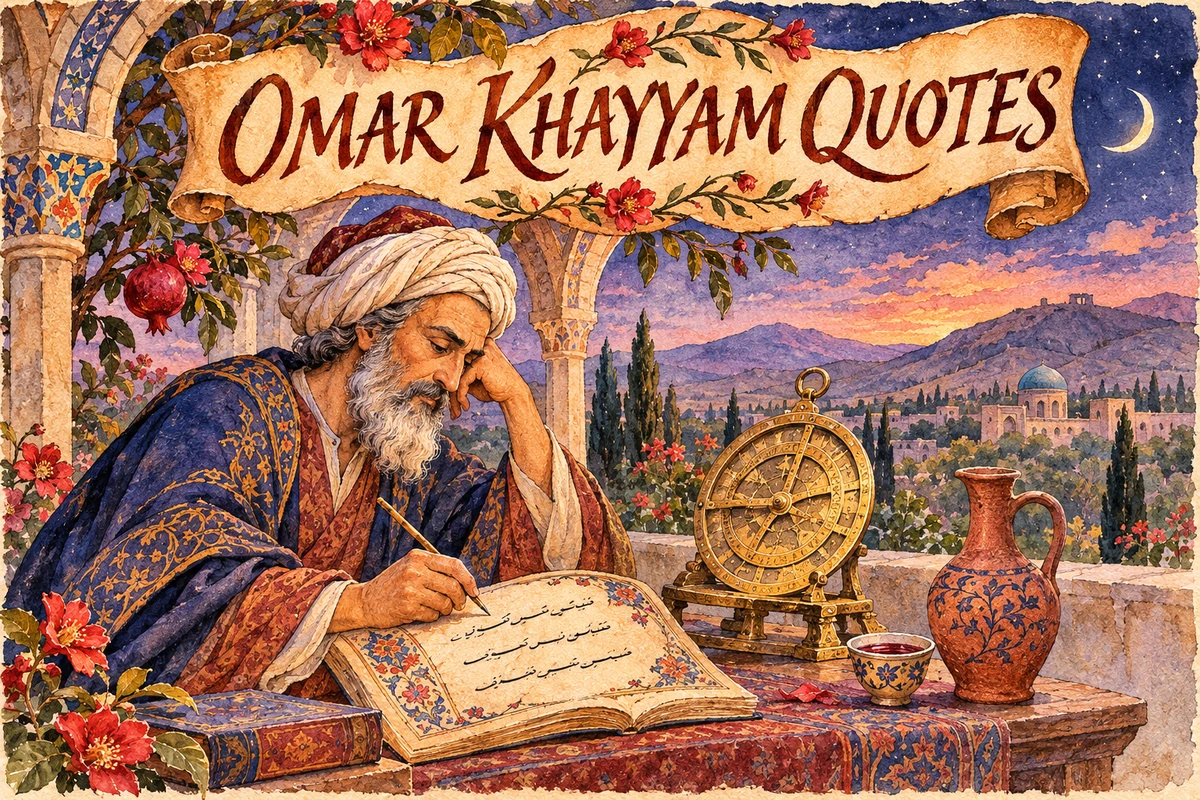
Omar Khayyam’s most quoted lines are his rubaiyat (quatrains), such as این قافلهٔ عمر عجب میگذرد (in qâfele-ye ‘omr ‘ajab migozarad), “This caravan of life passes strangely fast.” Below are 25 famous quatrains in the original Persian, each checked against the standard text, with pronunciation, our own close translation, and the matching lines in FitzGerald’s English version where there is one.
Most quote sites list Khayyam only in English, and almost always in Edward FitzGerald’s Victorian version, which is a free re-creation rather than a translation. Others mix in lines he never wrote. Here you get the Persian itself. Unless marked otherwise, every quatrain follows the edition by Mohammad Ali Foroughi and Ghasem Ghani, the text most Iranians read and the one used on the Persian poetry library Ganjoor, and each one carries its number in that edition so you can look it up.
Famous Omar Khayyam quotes at a glance
If you only want the best-known lines, start here. Each is explained, with all four lines, further down the page.
| Persian | Pronunciation | English (our translation) | Theme |
|---|---|---|---|
| این قافلهٔ عمر عجب میگذرد | in qâfele-ye ‘omr ‘ajab migozarad | This caravan of life passes strangely fast | Seize the moment |
| حالی خوش باش و عمر بر باد مکن | hâli khosh bâsh-o ‘omr bar bâd makon | Be happy now, and do not throw your life to the wind | Seize the moment |
| می نوش به ماهتاب ای ماه که ماه / بسیار بتابد و نیابد ما را | mey nush be mahtâb, ey mâh, ke mâh / besyâr betâbad-o nayâbad mâ râ | Drink in the moonlight, my moon, for the moon will shine many times and not find us | Time and death |
| اسرار ازل را نه تو دانی و نه من | asrâr-e azal râ na to dâni-yo na man | The secrets of eternity: you do not know them, nor do I | The great questions |
| کاین آمدن از کجا و رفتن به کجاست | k-in âmadan az kojâ-vo raftan be kojâst | Where is this coming from, and where is this going to? | The great questions |
| از خاک در آمدیم و بر باد شدیم | az khâk dar âmadim-o bar bâd shodim | We came up out of dust and went off on the wind | Knowledge and its limits |
| هر بند گشاده شد بجز بند اجل | har band goshâde shod be-joz band-e ajal | Every knot came undone, except the knot of death | Knowledge and its limits |
| این کوزه چو من عاشق زاری بودهست | in kuze cho man ‘âsheg-e zâri bude-st | This jug, like me, was once a lovesick lover | Clay and the potter |
| ای بس که نباشیم و جهان خواهد بود | ey bas ke nabâshim-o jahân khâhad bud | Long after we are gone, the world will still be here | Time and death |
| کهآواز دهل شنیدن از دور خوش است | k-âvâz-e dohol shenidan az dur khosh ast | A drum sounds lovely only from far away | Doubt and wit |
Who was Omar Khayyam?
Omar Khayyam, in Persian عمر خیام (‘omar-e khayyâm), and in Iran usually حکیم عمر خیام (hakim ‘omar-e khayyâm, “the sage Omar Khayyam”), was born in Nishapur, in the region of Khorasan in northeastern Iran, in 1048. He died there in the early twelfth century; the usual date is 1131, though some scholars place it a few years earlier. The name Khayyam means “tent-maker,” probably his family’s trade.
In his own lifetime he was famous as a scientist, not a poet:
- Mathematics. His Treatise on Algebra classified cubic equations and solved them geometrically, using intersecting curves (conic sections). It is one of the major works of medieval mathematics.
- Astronomy and the calendar. Under the Seljuk sultan Malik-Shah he worked at the observatory in Isfahan and helped create the Jalali calendar, introduced in 1079. It was remarkably accurate, and the solar calendar Iran uses today is its descendant.
- Philosophy. He wrote short treatises on philosophy and was known as a follower of Avicenna (Ibn Sina).
His tomb in Nishapur is a modern white monument designed by the architect Houshang Seyhoun, with his quatrains carved in a lattice of tile and stone. If you want to read about him in easy Persian, our Persian reading lesson on Omar Khayyam is written for intermediate learners.
What is a rubai? Reading Khayyam’s form
A رباعی (robâ’i) is a four-line poem; the plural is رباعیات (robâ’iyyât), which English spells “Rubaiyat.” So “The Rubaiyat of Omar Khayyam” simply means “the quatrains of Omar Khayyam.” The form has a fixed meter and rhymes AABA: lines 1, 2 and 4 rhyme, and line 3 usually does not. Each quatrain is complete in itself, which is why Khayyam’s poems work so well as quotes.
Look at the first quatrain on this page. Lines 1, 2 and 4 end in عجب, طرب and شب (‘ajab, tarab, shab): that is the rhyme. After each rhyme comes the same refrain, میگذرد (migozarad, “passes”). A repeated word after the rhyme is called a ردیف (radif), and it is one of the most typical sounds of Persian poetry.
Khayyam’s Persian is old but plain. A few classical forms you will meet below:
| In the poems | Pronunciation | Modern Persian | Meaning |
|---|---|---|---|
| ز | ze | از (az) | from, of |
| چو | cho | چون (chon) | like; since |
| دی | di | دیروز (diruz) | yesterday |
| بودهست | bude-st | بوده است (bude ast) | has been, was |
| کآن / کاین | k-ân / k-in | که آن / که این (ke ân / ke in) | for that / for this |
| می | mey | شراب (sharâb) | wine |
| شدن | shodan | رفتن (raftan) | to go (old meaning) |
Be careful with می: as the separate word mey it means “wine,” but as the prefix mi- (written می, joined with a half-space) it marks the present tense, as in میگذرد (migozarad). Our guide to the ezafe in Persian explains the -e / -ye links you will see in every line, such as gham-e fardâ, “worry about tomorrow.”
25 famous rubaiyat in Persian, with translation
For each quatrain: the Persian, a pronunciation guide, our own English translation (kept close to the Persian rather than rhymed), the source, and a short note. The pronunciation follows classical reading, which is how Iranians recite poetry, so you will see forms like mey and khori rather than everyday speech.
Seize the moment
The theme Khayyam is most loved for: life is short, yesterday and tomorrow are out of reach, so live this breath well.
1. “This caravan of life passes strangely fast”
این قافلهٔ عمر عجب میگذرد
دریاب دمی که با طرب میگذرد
ساقی غم فردای حریفان چه خوری
پیش آر پیاله را که شب میگذرد
in qâfele-ye ‘omr ‘ajab migozarad
dar-yâb dami ke bâ tarab migozarad
sâghi, gham-e fardâ-ye harifân che khori
pish âr piyâle râ ke shab migozarad
This caravan of life passes strangely fast;
catch a moment that passes in joy.
Cupbearer, why worry about your friends’ tomorrow?
Bring the cup, for the night is passing.
Source: Rubaiyat, Foroughi–Ghani edition, no. 66. Probably the most recited Khayyam quatrain in Iran. Notice the rhyme: عجب، طرب، شب (‘ajab, tarab, shab), each followed by the same refrain میگذرد (migozarad, “passes”).
2. “Be happy now”
از دی که گذشت هیچ از او یاد مکن
فردا که نیامدهست فریاد مکن
بر نامده و گذشته بنیاد مکن
حالی خوش باش و عمر بر باد مکن
az di ke gozasht hich az u yâd makon
fardâ ke nayâmade-st faryâd makon
bar nâmade-o gozashte bonyâd makon
hâli khosh bâsh-o ‘omr bar bâd makon
Yesterday is gone: do not dwell on it.
Tomorrow has not come: do not cry out over it.
Build nothing on what is gone or not yet here;
be happy now, and do not throw your life to the wind.
Source: Rubaiyat, Foroughi–Ghani edition, no. 136. The clearest statement of Khayyam’s “live now” idea. دی (di) is the old word for “yesterday”; today Iranians say دیروز (diruz). The last line, حالی خوش باش (hâli khosh bâsh, “be happy now”), is often quoted on its own.
3. “Let us treasure this one breath of life”
ای دوست بیا تا غم فردا نخوریم
وین یک دم عمر را غنیمت شمریم
فردا که ازین دیر فنا درگذریم
با هفتهزارسالگان سربهسریم
ey dust, biyâ tâ gham-e fardâ nakhorim
v-in yek dam-e ‘omr râ ghanimat shomarim
fardâ ke az in deyr-e fanâ dar-gozarim
bâ haft-hezâr-sâlegân sar-be-sarim
Friend, come, let us not worry about tomorrow,
and let us treasure this one breath of life.
Tomorrow, when we pass out of this house of passing things,
we will be even with those who died seven thousand years ago.
Source: Rubaiyat, Foroughi–Ghani edition, no. 121. غم چیزی را خوردن (gham-e chizi râ khordan, literally “to eat the grief of something”) is still the normal way to say “to worry about something”: غم نخور (gham nakhor), “don’t worry.” FitzGerald kept the “Sev’n thousand Years.”
4. “Spend a moment in joy”
برخیز و مخور غم جهان گذران
بنشین و دمی به شادمانی گذران
در طبع جهان اگر وفایی بودی
نوبت به تو خود نیامدی از دگران
barkhiz-o makhor gham-e jahân-e gozarân
beneshin-o dami be shâdmâni gozarân
dar tab’-e jahân agar vafâyi budi
nowbat be to khod nayâmadi az degarân
Get up, and do not grieve for this passing world;
sit down and pass a moment in joy.
If the world had any loyalty in its nature,
your turn would never have come from those before you.
Source: Rubaiyat, Foroughi–Ghani edition, no. 138. A neat word game: گذران (gozarân) means “passing” in the first line and “spend (time)” in the second.
5. “The day that has not come, and the day that is gone”
این یک دو سه روز نوبت عمر گذشت
چون آب به جویبار و چون باد به دشت
هرگز غم دو روز مرا یاد نگشت
روزی که نیامدهست و روزی که گذشت
in yek do se ruz nowbat-e ‘omr gozasht
chon âb be juybâr-o chon bâd be dasht
hargez gham-e do ruz marâ yâd nagasht
ruzi ke nayâmade-st-o ruzi ke gozasht
My turn at life, these two or three days, has passed
like water down a stream, like wind across the plain.
Two days have never made me grieve:
the day that has not come, and the day that is gone.
Source: Rubaiyat, Foroughi–Ghani edition, no. 18. FitzGerald’s famous “like Water… like Wind” image echoes the second line.
Try it: translate a half-line
Try to translate حالی خوش باش yourself, using the word list above. Say it out loud first, then check.
hâli khosh bâsh: “be happy now.” حالی (hâli) is an old word for “now, at this moment,” خوش (khosh) means “happy, pleasant,” and باش (bâsh) is the imperative of بودن (budan, “to be”). You still hear خوش باش (khosh bâsh) today, as a friendly “enjoy yourself.”
Time, death and the moon
6. “The moon will shine many times and not find us”
چون عهده نمیشود کسی فردا را
حالی خوش دار این دل پر سودا را
می نوش به ماهتاب ای ماه که ماه
بسیار بتابد و نیابد ما را
chon ‘ohde nemishavad kasi fardâ râ
hâli khosh dâr in del-e por-sowdâ râ
mey nush be mahtâb, ey mâh, ke mâh
besyâr betâbad-o nayâbad mâ râ
Since no one can promise you tomorrow,
keep this restless heart happy now.
Drink wine in the moonlight, my moon, for the moon
will shine many times and not find us.
Source: Rubaiyat, Foroughi–Ghani edition, no. 2. A play on ماه (mâh), which means both “moon” and “a beautiful beloved.” FitzGerald turned this into his “Ah, Moon of my Delight,” one of the closest matches in his whole version.
7. “Before the grass comes up out of your dust”
ای دل چو زمانه میکند غمناکت
ناگه برود ز تن روان پاکت
بر سبزه نشین و خوش بزی روزی چند
زآن پیش که سبزه بردمد از خاکت
ey del, cho zamâne mikonad ghamnâkat
nâgah beravad ze tan ravân-e pâkat
bar sabze neshin-o khosh bezi ruzi chand
z-ân pish ke sabze bar-damad az khâkat
Heart, since the times keep making you sad,
and one day your pure soul will suddenly leave your body,
sit on the grass and live well for a few days,
before the grass comes up out of your dust.
Source: Rubaiyat, Foroughi–Ghani edition, no. 13. بزی (bezi) is an old imperative of زیستن (zistan, “to live”): “live.”
8. “Who will look at the grass that grows from our dust?”
ابر آمد و باز بر سر سبزه گریست
بی بادهٔ گلرنگ نمیباید زیست
این سبزه که امروز تماشاگه ماست
تا سبزهٔ خاک ما تماشاگه کیست
abr âmad-o bâz bar sar-e sabze gerist
bi bâde-ye golrang nemibâyad zist
in sabze ke emruz tamâshâgah-e mâst
tâ sabze-ye khâk-e mâ tamâshâgah-e kist
The cloud came and wept again over the grass;
one should not live without rose-red wine.
This grass is what we sit and look at today;
who will look at the grass that grows from our dust?
Source: Rubaiyat, Foroughi–Ghani edition, no. 8. A spring poem, and a favorite around Nowruz, when Iranians go out to sit on the new grass.
9. “The world will still be here”
ای بس که نباشیم و جهان خواهد بود
نی نام ز ما و نی نشان خواهد بود
زین پیش نبودیم و نبد هیچ خلل
زین پس چو نباشیم همان خواهد بود
ey bas ke nabâshim-o jahân khâhad bud
ni nâm ze mâ-vo ni neshân khâhad bud
zin pish nabudim-o nabod hich khalal
zin pas cho nabâshim hamân khâhad bud
Long after we are gone, the world will still be here,
with no name of ours and no trace of us.
Before this we did not exist, and nothing was missing;
after this, when we are gone, it will be just the same.
Source: Rubaiyat, Foroughi–Ghani edition, no. 64. خواهد بود (khâhad bud, “will be”) is the formal future tense, still used in writing today.
The great questions: where from, where to?
Khayyam asks the questions religion and philosophy claim to answer, and refuses to pretend he knows.
10. “The secrets of eternity”
اسرار ازل را نه تو دانی و نه من
وین حرف معما نه تو خوانی و نه من
هست از پس پرده گفتوگوی من و تو
چون پرده برافتد نه تو مانی و نه من
asrâr-e azal râ na to dâni-yo na man
v-in harf-e mo’ammâ na to khâni-yo na man
hast az pas-e parde goft-o-gu-ye man-o to
chon parde bar-oftad na to mâni-yo na man
The secrets of eternity: you do not know them, nor do I.
This riddle: you cannot read it, nor can I.
Behind the curtain there is talk of you and me;
when the curtain falls, neither you will remain, nor I.
Source: Sadegh Hedayat’s selection Taraneh-ha-ye Khayyam, no. 7 (it is not among the 178 quatrains of the Foroughi–Ghani edition). One of the best-known Khayyam quatrains in Iran. FitzGerald’s “There was the Door to which I found no Key; / There was the Veil through which I might not see” is close to it in spirit.
11. “Where is this coming from, and where is this going to?”
در دایرهای که آمد و رفتن ماست
او را نه بدایت نه نهایت پیداست
کس مینزند دمی در این معنی راست
کاین آمدن از کجا و رفتن به کجاست
dar dâyere-i ke âmad-o raftan-e mâst
u râ na bedâyat na nehâyat peydâst
kas minazanad dami dar in ma’ni râst
k-in âmadan az kojâ-vo raftan be kojâst
This circle of our coming and going
shows no beginning and no end.
No one says one true word on this question:
where is this coming from, and where is this going to?
Source: Rubaiyat, Foroughi–Ghani edition, no. 34. The questions از کجا (az kojâ, “from where”) and به کجا (be kojâ, “to where”) are everyday Persian; see our guide to question words linked below.
12. “What my coming and my going were for”
از آمدنم نبود گردون را سود
وز رفتن من جلال و جاهش نفزود
وز هیچ کسی نیز دو گوشم نشنود
کاین آمدن و رفتنم از بهر چه بود
az âmadanam nabud gardun râ sud
v-az raftan-e man jalâl-o jâhash nafzud
v-az hich kasi niz do gusham nashenud
k-in âmadan-o raftanam az bahr-e che bud
My coming brought the turning heavens no profit,
and my going will add nothing to their glory.
And my two ears have never heard from anyone
what my coming and my going were for.
Source: Rubaiyat, Foroughi–Ghani edition, no. 60. گردون (gardun, “the turning one”) is a poetic word for the sky and for fate.
13. “Not to come, not to go, and not to be”
گر آمدنم به خود بدی نآمدمی
ور نیز شدن به من بدی کی شدمی
به زان نبدی که اندر این دیر خراب
نه آمدمی نه شدمی نه بدمی
gar âmadanam be khod bodi nâmadami
v-ar niz shodan be man bodi key shodami
beh z-ân nabodi ke andar in deyr-e kharâb
na âmadami, na shodami, na bodami
If my coming had been up to me, I would not have come;
and if going were up to me, why would I ever go?
Nothing could have been better, in this ruined inn,
than not to come, not to go, and not to be.
Source: Rubaiyat, Foroughi–Ghani edition, no. 174. The endings -i on آمدمی (âmadami) and شدمی (shodami) are an old way to say “would have.” شدن (shodan) here keeps its old meaning “to go,” not today’s “to become.”
14. “The road is neither that one nor this”
قومی متفکرند اندر ره دین
قومی به گمان فتاده در راه یقین
میترسم از آن که بانگ آید روزی
کای بیخبران راه نه آن است و نه این
ghowmi motefakkerand andar rah-e din
ghowmi be gomân fetâde dar râh-e yaghin
mitarsam az ân ke bâng âyad ruzi
k-ey bikhabarân, râh na ân ast-o na in
Some people are lost in thought on the road of faith;
some have fallen into guesswork on the road to certainty.
I fear that one day a voice will call out:
“You who know nothing, the road is neither that one nor this.”
Source: Rubaiyat, Foroughi–Ghani edition, no. 143. بیخبر (bikhabar) literally means “without news,” that is, “unaware.” It is still common in everyday speech.
Knowledge and its limits
Coming from one of the great scientists of his age, these lines have a special edge.
15. “We came up out of dust, and went off on the wind”
یک چند به کودکی به استاد شدیم
یک چند به استادی خود شاد شدیم
پایان سخن شنو که ما را چه رسید
از خاک در آمدیم و بر باد شدیم
yek chand be kudaki be ostâd shodim
yek chand be ostâdi-ye khod shâd shodim
pâyân-e sokhan shenow ke mâ râ che resid
az khâk dar âmadim-o bar bâd shodim
For a while, as children, we went to a teacher;
for a while we were pleased with our own mastery.
Hear how the story ends, what became of us:
we came up out of dust, and went off on the wind.
Source: Rubaiyat, Foroughi–Ghani edition, no. 134. FitzGerald’s “Myself when young did eagerly frequent / Doctor and Saint” grew out of this quatrain.
16. “Every knot came undone, except the knot of death”
از جرم گل سیاه تا اوج زحل
کردم همه مشکلات کلی را حل
بگشادم بندهای مشکل به حیل
هر بند گشاده شد بجز بند اجل
az jerm-e gel-e siyâh tâ owj-e zohal
kardam hame moshkelât-e kolli râ hal
bogshâdam bandhâ-ye moshkel be heyal
har band goshâde shod be-joz band-e ajal
From the body of black clay up to the height of Saturn
I solved every great problem there is.
I untied the hardest knots with clever skill;
every knot came undone, except the knot of death.
Source: Rubaiyat, Foroughi–Ghani edition, no. 119. A fitting poem for a mathematician and astronomer. FitzGerald: “Up from Earth’s Centre through the Seventh Gate / I rose, and on the Throne of Saturn sate.”
17. “They told a bedtime story, and fell asleep”
آنان که محیط فضل و آداب شدند
در جمع کمال شمع اصحاب شدند
ره زین شب تاریک نبردند برون
گفتند فسانهای و در خواب شدند
ânân ke mohit-e fazl-o âdâb shodand
dar jam’-e kamâl sham’-e ashâb shodand
rah zin shab-e târik nabordand borun
goftand fasâne-i-o dar khâb shodand
Those who became oceans of learning and culture,
who shone like candles among their learned friends,
found no way out of this dark night:
they told a bedtime story, and fell asleep.
Source: Rubaiyat, Foroughi–Ghani edition, no. 54. Some popular versions end the third line with به روز (be ruz, “to daylight”). The standard text has برون (borun, “out”).
18. “The least I can do is know who I am”
دشمن به غلط گفت که من فلسفیام
ایزد داند که آنچه او گفت نیام
لیکن چو در این غمآشیان آمدهام
آخر کم از آنکه من بدانم که کیام
doshman be ghalat goft ke man falsafi-am
izad dânad ke ânche u goft ni-am
likan cho dar in gham-âshiyân âmade-am
âkhar kam az ân-ke man bedânam ke ki-am
My enemy was wrong to say I am a philosopher;
God knows I am not what he said.
But since I have come into this nest of sorrow,
the least I can do is know who I am.
Source: Rubaiyat, Foroughi–Ghani edition, no. 129. In Khayyam’s day “philosopher” could be an accusation of unbelief, which makes this one of the few quatrains that sound like they answer his critics.
Flashcards: key words in Khayyam’s poems
clay jug, pitcher
wine (literary)
a breath; a moment
tomorrow
yesterday (literary; everyday دیروز diruz)
dust, earth, soil
grass, new green shoots
cupbearer, the one who pours the wine
cup, bowl
lifetime, life
sorrow, worry
the appointed hour of death
Clay, jugs and the potter
Khayyam loves one image above all: the clay of a wine jug was once a human being, and our own dust will one day be clay in the potter’s hands. Remember it when you read the next four.
19. “This jug, like me, was once a lovesick lover”
این کوزه چو من عاشق زاری بودهست
در بند سر زلف نگاری بودهست
این دسته که بر گردن او میبینی
دستیست که بر گردن یاری بودهست
in kuze cho man ‘âsheg-e zâri bude-st
dar band-e sar-e zolf-e negâri bude-st
in daste ke bar gardan-e u mibini
dasti-st ke bar gardan-e yâri bude-st
This jug, like me, was once a lovesick lover,
caught in the curls of a beautiful one’s hair.
This handle you see around its neck
was once an arm around a lover’s neck.
Source: Rubaiyat, Foroughi–Ghani edition, no. 15. The pun is دسته / دست (daste, “handle” / dast, “hand, arm”). The clay of the jug was once a human body, an image Khayyam returns to again and again.
20. “Where is the potter, the jug buyer, the jug seller?”
در کارگه کوزهگری رفتم دوش
دیدم دو هزار کوزه گویا و خموش
ناگاه یکی کوزه برآورد خروش
کو کوزهگر و کوزهخر و کوزهفروش
dar kârgah-e kuze-gari raftam dush
didam do hezâr kuze guyâ-vo khamush
nâgâh yeki kuze bar-âvard khorush
ku kuze-gar-o kuze-khar-o kuze-forush
Last night I went into a potter’s workshop
and saw two thousand jugs, some speaking, some silent.
Suddenly one jug cried out:
“Where is the potter, the jug buyer, the jug seller?”
Source: Rubaiyat, Foroughi–Ghani edition, no. 117. The potter, the buyer and the seller have all turned to clay themselves. FitzGerald built a whole section of his poem, which he called the “Kuza-Nama” (Book of Pots), out of quatrains like this one.
21. “That dust, too, was once a lovely face”
هر ذره که در خاک زمینی بودهست
پیش از من و تو تاج و نگینی بودهست
گرد از رخ نازنین به آزرم فشان
کآن هم رخ خوب نازنینی بودهست
har zarre ke dar khâk-e zamini bude-st
pish az man-o to tâj-o negini bude-st
gard az rokh-e nâzanin be âzarm fashân
k-ân ham rokh-e khub-e nâzanini bude-st
Every speck in the soil of this earth
was a crown or a royal ring before you and me.
Brush the dust from a lovely face gently,
for that dust, too, was once a lovely face.
Source: Rubaiyat, Foroughi–Ghani edition, no. 50. Many websites print the first line as هر ذره که بر روی زمینی بودهست and give a different second line. The text above is the standard edition.
22. “It grew from the dust of a tulip-cheeked beauty”
هر سبزه که بر کنار جویی رستهست
گویی ز لب فرشتهخویی رستهست
پا بر سر سبزه تا به خواری ننهی
کآن سبزه ز خاک لالهرویی رستهست
har sabze ke bar kenâr-e juyi roste-st
guyi ze lab-e fereshte-khuyi roste-st
pâ bar sar-e sabze tâ be khâri nanahi
k-ân sabze ze khâk-e lâle-ruyi roste-st
Every blade of grass that grows beside a stream
seems to have sprung from the lips of someone angelic.
Do not step on the grass without care,
for it grew from the dust of a tulip-cheeked beauty.
Source: Rubaiyat, Foroughi–Ghani edition, no. 51. لالهرو (lâle-ru, “tulip-faced”) is a classical way to say “beautiful,” because of the red cheeks.
Wine, paradise and wit
Wine runs through the quatrains. Readers have argued for centuries about whether it is literal or a mystical symbol, as it often is in Persian poetry. Read on the page, Khayyam’s wine mostly sounds real: a pleasure you can hold now, set against promises you cannot check.
23. “A drum sounds lovely only from far away”
گویند کسان بهشت با حور خوش است
من میگویم که آب انگور خوش است
این نقد بگیر و دست از آن نسیه بدار
کهآواز دهل شنیدن از دور خوش است
guyand kasân behesht bâ hur khosh ast
man miguyam ke âb-e angur khosh ast
in naghd begir-o dast az ân nesye bedâr
k-âvâz-e dohol shenidan az dur khosh ast
People say paradise with its houris is lovely;
I say the juice of the grape is lovely.
Take this cash, and let go of that credit:
a drum sounds lovely only from far away.
Source: Rubaiyat, Foroughi–Ghani edition, no. 41. The last line is a Persian proverb in its own right, used when something seems attractive only because you have not seen it up close. نقد (naghd, “cash”) and نسیه (nesye, “on credit”) are everyday shop words. In the last line, کهآواز is read as one word, k-âvâz.
Two more that belong in any list of Khayyam quotes: the first is behind some of the most famous lines in English poetry.
24. “A loaf of the finest wheat”
گر دست دهد ز مغز گندم نانی
وز می دو منی ز گوسفندی رانی
با لالهرخی و گوشهٔ بستانی
عیشی بود آن نه حد هر سلطانی
gar dast dahad ze maghz-e gandom nâni
v-az mey do mani, ze gusfandi râni
bâ lâle-rokhi-yo gushe-ye bostâni
‘eyshi bovad ân na hadd-e har soltâni
If I can have a loaf of the finest wheat,
two measures of wine, and a leg of lamb,
with a tulip-cheeked companion in a corner of a garden,
that is a pleasure beyond the reach of any sultan.
Source: Rubaiyat, Foroughi–Ghani edition, no. 175. This is one of the Persian quatrains behind FitzGerald’s most famous lines, the loaf of bread, the jug of wine “and Thou.” من (man) here is an old unit of weight, not the pronoun “I.”
25. “Your happy heart is my bride price”
میخوردن و شادبودن آیین من است
فارغبودن ز کفر و دین دین من است
گفتم به عروس دهر کابین تو چیست
گفتا دل خرم تو کابین من است
mey khordan-o shâd budan âyin-e man ast
fâregh budan ze kofr-o din din-e man ast
goftam be ‘arus-e dahr, kâbin-e to chist
goftâ del-e khorram-e to kâbin-e man ast
Drinking wine and being glad: that is my creed.
Being free of both unbelief and faith: that is my faith.
I asked the Bride of the World, “What is your bride price?”
She said, “Your happy heart is my bride price.”
Source: Rubaiyat, Foroughi–Ghani edition, no. 45. کابین (kâbin) is the marriage gift a groom pledges to the bride. Notice the double meaning of دین (din, “religion”), used twice in the second line.
Practice: complete Khayyam’s lines
این قافلهٔ عمر عجب میگذرد (migozarad), “passes,” the refrain of the whole quatrain.
از دی که گذشت هیچ از او مکنیاد مکن (yâd makon), “do not remember, do not dwell on it.”
حالی خوش باش و عمر بر مکنبر باد کردن (bar bâd kardan), “to throw to the wind, to waste.”
اسرار ازل را نه تو دانی و نه The quatrain is built on نه تو … و نه من (na to … va na man), “neither you nor I.”
دیدم دو هزار گویا و خموشTwo thousand jugs (کوزه, kuze), some talking, some silent.
دستیست که بر گردن بودهستThe handle was once an arm around a lover’s (یار, yâr) neck.
از خاک در آمدیم و بر شدیمFrom dust (خاک) to wind (باد): the end of “We came to a teacher.”
FitzGerald’s Rubaiyat vs the Persian
Most English speakers know Khayyam through Edward FitzGerald, an English poet who published “The Rubaiyat of Omar Khayyam” in 1859 and revised it four times. His first edition had 75 quatrains; later ones had 110 and then 101. It became one of the most popular poems in English, and phrases from it, like “the Moving Finger writes,” passed into the language.
FitzGerald did not translate quatrain by quatrain. He combined ideas from several Persian poems, changed the order to tell a story from dawn to night, and added images of his own. Some of his stanzas follow a single Persian quatrain closely; others have no single Persian source at all. So when a site quotes “Omar Khayyam” in rhymed Victorian English, it is quoting FitzGerald’s poem inspired by Khayyam. Here is how some famous English lines line up with the Persian on this page:
| FitzGerald (short quote) | Persian quatrain on this page | How close? |
|---|---|---|
| “Ah, Moon of my Delight” | چون عهده نمیشود کسی فردا را (no. 6 above) | Close: same moon pun and the moon that will not find us |
| “A Book of Verse—and Thou” | گر دست دهد ز مغز گندم نانی (no. 24) | Loose: bread, wine and a companion are Khayyam’s; the book of verse is FitzGerald’s |
| “Myself when young did eagerly frequent / Doctor and Saint” | یک چند به کودکی به استاد شدیم (no. 15) | Close in idea |
| “Up from Earth’s Centre through the Seventh Gate” | از جرم گل سیاه تا اوج زحل (no. 16) | Close: Saturn and the one knot left untied |
| “Yesterday’s Sev’n thousand Years” | ای دوست بیا تا غم فردا نخوریم (no. 3) | Close in the final line |
| “There was the Door to which I found no Key” | اسرار ازل را نه تو دانی و نه من (no. 10) | Similar in spirit |
| “The Moving Finger writes” | No single quatrain | FitzGerald’s own image of fate, drawn from the general idea of the “pen of destiny” in Persian poetry |
None of this makes FitzGerald worse as a poet. It just means that if you want Khayyam himself, you need the Persian, or a translation that stays close to it.
Did Khayyam really write all these quatrains?
This is the big question behind every list of Khayyam quotes. Over the centuries, more than a thousand quatrains were attributed to him; collections of a few hundred to over a thousand exist. Many are certainly by other poets. Quatrains that turn up under several poets’ names are known as “wandering quatrains.”
The problem is the sources. Khayyam was known in his lifetime as a scientist, and the earliest writers to quote his poetry lived decades after his death: the theologian Fakhr al-Din Razi quotes one quatrain, and Najm al-Din Razi quotes two in a Sufi book written about a century later. The oldest securely dated manuscript of his quatrains, kept at the Bodleian Library in Oxford, was copied in Shiraz in 1460, more than three centuries after he died.
Scholars have tried to separate the real from the attributed. The writer Sadegh Hedayat accepted only 14 quatrains as certain, and published a wider selection of 143 he thought were likely. Foroughi and Ghani accepted 178, which is why the numbers on this page go up to 178. The honest summary: nobody can prove that any single quatrain is Khayyam’s, but the ones on this page are the core that editors and Iranian readers have long accepted as his voice.
Quotes that are not Khayyam
Watch out for English one-liners such as “Be happy for this moment. This moment is your life.” It is shared everywhere under Khayyam’s name, but we could not find any Persian quatrain that says this; at best it is a modern paraphrase of the idea in quatrains like “Be happy now” above. Quote sites also mix in sentences written about Khayyam by other authors. A simple test: if a “Khayyam quote” has no Persian original and no quatrain behind it, treat it as unverified.
How Iranians use Khayyam today
- As proverbs. آواز دهل شنیدن از دور خوش است (âvâz-e dohol shenidan az dur khosh ast, “a drum sounds lovely from far away”) is an everyday saying, used when something looks attractive only from a distance.
- At gatherings. Lines like این قافلهٔ عمر عجب میگذرد are recited among friends and Khayyam’s quatrains are a classic of Persian singing.
- In spring. His grass and cloud poems are often quoted around Nowruz, the Persian New Year.
- On Khayyam Day. Iran marks 18 May (28 Ordibehesht in the Iranian calendar), the traditional date of his birth, as a day in his honor, with events at his tomb in Nishapur.
Iranian students read Khayyam at school alongside Ferdowsi, Saadi, Hafez and Rumi. If you enjoyed these, try our real Rumi quotes in Persian and the guide to fal-e Hafez, the custom of opening Hafez’s Divan for a reading of your fortune. Our collection of Persian poems has more to read.
How to read Khayyam in Persian yourself
The quatrains are short, so they are a good first step into real Persian literature. A simple method:
- Learn the script first. If you are not there yet, our Persian alphabet guide takes you through all 32 letters.
- Take one quatrain a week. Read the Persian aloud with the pronunciation line, then without it.
- Look up each word in our online Persian dictionary, and note which ones are old (like دی, di) and which are still everyday words (like فردا, fardâ).
- Memorize it. Iranians love hearing a learner recite a Khayyam quatrain, and four lines are easy to keep.
- Type it out on the online Persian keyboard to practice spelling, including the half-space in words like میگذرد.
For a whole book of quatrains with the Persian, a phonetic reading and an English translation side by side, see A Cup of Forbidden Wine: Khayyam’s Rubaiyat with Phonetics, or our Rubaiyat of Khayyam in Farsi with English translation.
Quick quiz: Omar Khayyam and his rubaiyat
1. What does the word “rubaiyat” mean?
- Songs of wine
- Quatrains (four-line poems)
- Letters to a friend
- Proverbs
Why
رباعیات (robâ’iyyât) is the plural of رباعی (robâ’i), a four-line poem.
2. Where was Omar Khayyam born?
- Shiraz
- Isfahan
- Nishapur
- Tabriz
Why
He was born in Nishapur, in Khorasan, and is buried there.
3. In his own lifetime, Khayyam was best known as…
- a mathematician and astronomer
- a court poet
- a Sufi teacher
- a historian
Why
His fame then rested on his algebra and his work on the Jalali calendar.
4. Which rhyme pattern does a rubai usually follow?
- ABAB
- AABB
- ABBA
- AABA
Why
Lines 1, 2 and 4 rhyme; line 3 usually does not.
5. In “این کوزه چو من عاشق زاری بودهست”, what was the jug’s handle once?
- A king’s crown
- An arm around a lover’s neck
- A flower
- A potter’s hand
Why
دستیست که بر گردن یاری بودهست: “was once an arm around a lover’s neck.”
6. What does دی (di) mean in Khayyam’s poems?
- Wine
- Night
- Yesterday
- Heart
Why
دی is the old word for “yesterday”; today Iranians say دیروز (diruz).
7. How many quatrains did Sadegh Hedayat consider certainly Khayyam’s?
- 14
- 75
- 178
- More than 1,000
Why
Hedayat accepted only 14 as certain, and selected 143 as likely.
8. FitzGerald’s “A Book of Verse, and Thou” loosely echoes a quatrain about…
- the potter’s workshop
- the secrets of eternity
- the moon
- bread, wine and a companion in a garden
Why
گر دست دهد ز مغز گندم نانی: bread, wine, a leg of lamb and a beautiful companion.
9. The proverb “آواز دهل شنیدن از دور خوش است” means…
- Music is best at night
- A drum sounds lovely only from far away
- Listen before you speak
- Wine is better than paradise
Why
It describes something that seems attractive only from a distance.
Want more? Try the Persian poetry quiz.
Common questions
What is Omar Khayyam’s most famous quote?
In Iran, probably این قافلهٔ عمر عجب میگذرد (in qâfele-ye ‘omr ‘ajab migozarad), “This caravan of life passes strangely fast,” or اسرار ازل را نه تو دانی و نه من (asrâr-e azal râ na to dâni-yo na man), “The secrets of eternity: you do not know them, nor do I.” In English, the best-known lines are FitzGerald’s “A Book of Verse, and Thou” and “The Moving Finger writes.”
What is the Rubaiyat of Omar Khayyam about?
Each quatrain stands alone, but the same themes return: life is short, so enjoy the present moment; nobody knows where we come from or where we go; the learned are no wiser about death than anyone else; and our bodies return to dust, which becomes clay, grass and wine jugs. Wine is the great symbol of living in the moment.
Did Omar Khayyam really write the Rubaiyat?
Some of it, almost certainly, but no one knows exactly which quatrains. More than a thousand have been attributed to him, the earliest quotations appear decades after his death, and the oldest dated manuscript is from 1460. Editors accept between a handful and a few hundred as genuine; the 178 of the Foroughi–Ghani edition are the standard text in Iran.
Is FitzGerald’s Rubaiyat an accurate translation?
Not in the modern sense. FitzGerald wrote a free English poem: he merged quatrains, reordered them and added his own images. A few stanzas are close to a single Persian quatrain, such as “Ah, Moon of my Delight.” For Khayyam’s actual words you need the Persian or a close translation like the ones on this page.
Was Omar Khayyam a Sufi or an atheist?
Scholars disagree. Some readers take the wine and the tavern as Sufi symbols; others read the quatrains as skeptical, even irreverent, about religious promises. What the poems attributed to him clearly share is doubt about anyone who claims to know the secrets of creation, and a strong love of this life.
How do you say Omar Khayyam in Persian?
عمر خیام, pronounced ‘omar-e khayyâm, with the ezafe -e linking the two names. Iranians often add the title حکیم (hakim), “sage.”
Learn Persian with our bestseller
Serious about Persian? Get all 30 of our Persian learning books for $199.99 (55% less than buying them one by one).
Free Persian Starter Kit (PDF)
The Persian alphabet chart and the 101 most common Persian words with pronunciation, in one printable PDF. You also get a one-time 15% code for any of our books.
We will email you new lessons and book news from Learn Persian Online. Unsubscribe any time.Love Persian poetry? Learn to read it: free Starter Pack
Get the 14-page printable Starter Pack (all 32 letters, a 7-day reading plan, 100 core words and 20 survival phrases) and a short 5-email course. Free.
by: Learn Persian Online Team about (category: Blog)


What people say about "Omar Khayyam Quotes: 25 Famous Rubaiyat in Persian, With Translations"?
No one replied yet.