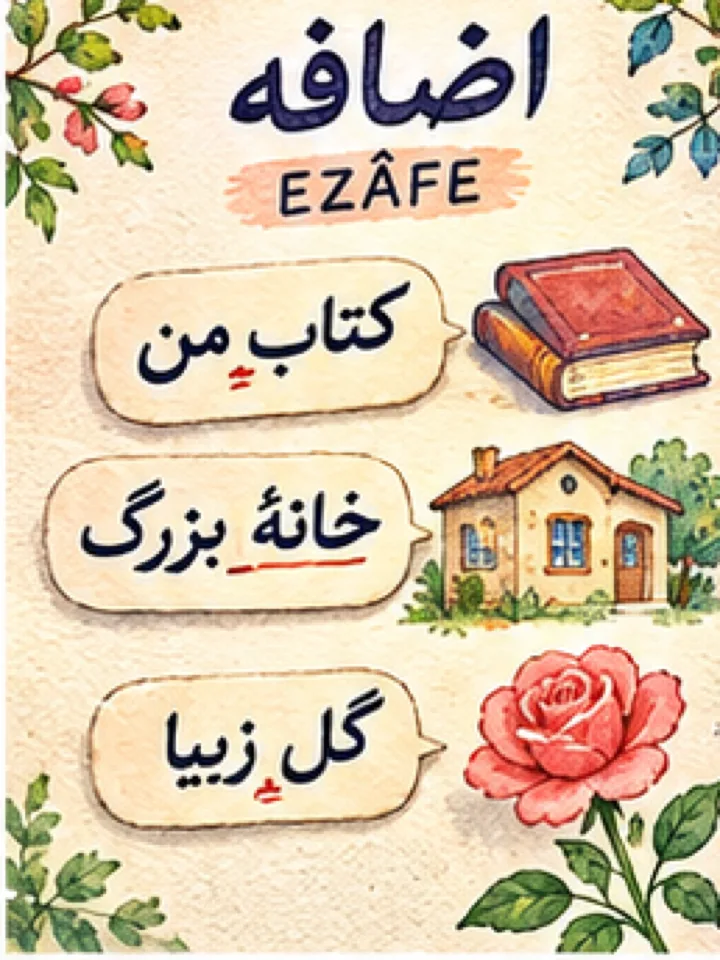
Understand the Persian ezâfe (-e / -ye): how it shows possession, links nouns to adjective
Genitive حَرفِ اضافه
Genitive sounds “e” as “e” in “men”. It shows the possessive. Genitive is also used to connect two words.
| مدادِ شُما | /medâde shomâ/ | Your pencil |
| کِتابِ مَن | /ketâbe man/ | My book |
| پولِ آنها | /pule ânhâ/ | Their money |
| اُستادِ فارسی | /ostâde fârsi/ | Farsi teacher |
– Genitive after vowels: “ی” is used as a genitive after vowels:
| دانِشجویِ زَبانِ فارسی | /dâneshjuye zabâne fârsi/ | Farsi student |
| بَچه ی مَن | /bacheye man/ | My child |
Understand the Persian ezâfe (-e / -ye): how it shows possession, links nouns to adjectives, and how it is written after vowels, with examples.
The ezâfe: the little -e that links words
The ezâfe (in Persian اضافه, ezâfe) is a short vowel -e that links a noun to the word that follows and describes it. English often uses "of" or "'s" for the same job: کتابِ من (ketâb-e man) is "the book of me", that is, "my book". The ezâfe is one of the most frequent sounds in Persian, but it is usually not written, so learners must learn to hear and add it.
When to use the ezâfe
- Possession: خانهی سارا (khâne-ye sârâ), "Sara's house"; مدادِ شما (medâd-e shomâ), "your pencil".
- Noun + adjective. Persian adjectives come after the noun: کتابِ خوب (ketâb-e khub), "a good book".
- Noun + noun: استادِ فارسی (ostâd-e fârsi), "Persian teacher"; شهرِ تهران (shahr-e tehrân), "the city of Tehran".
- After many place words: زیرِ میز (zir-e miz), "under the table"; کنارِ در (kenâr-e dar), "next to the door".
- In chains, each word takes an ezâfe except the last: دوستِ خوبِ من (dust-e khub-e man), "my good friend".
How the ezâfe is formed
The sound depends on how the first word ends. After a consonant it is a plain -e, usually not written (a kasra can show it in teaching texts). After a vowel a y sound is added: -ye.
| Example | Pronunciation | Rule |
|---|---|---|
| کتابِ من | /ketâb-e man/ | after a consonant: -e (my book) |
| دانشجوی ایرانی | /dâneshju-ye irâni/ | after u: write ی, say -ye (Iranian student) |
| آقای رضایی | /âghâ-ye rezâyi/ | after â: write ی, say -ye (Mr. Rezaei) |
| خانهی من | /khâne-ye man/ | after silent ه: write ی after a half-space, say -ye (my house) |
| صندلیِ آبی | /sandali-ye âbi/ | after -i: nothing extra is written, say -ye (blue chair) |
After a silent ه you will also see the small hamze form خانهٔ من. Both spellings are standard.
The page's examples, explained
| Persian | Pronunciation | English |
|---|---|---|
| مدادِ شما | /medâd-e shomâ/ | your pencil (possession) |
| کتابِ من | /ketâb-e man/ | my book (possession) |
| پولِ آنها | /pul-e ânhâ/ | their money (possession) |
| استادِ فارسی | /ostâd-e fârsi/ | Persian teacher (noun + noun) |
| دانشجوی زبانِ فارسی | /dâneshju-ye zabân-e fârsi/ | student of the Persian language (two links) |
| بچهی من | /bache-ye man/ | my child (after silent ه) |
More examples
| Persian | Pronunciation | English |
|---|---|---|
| خانهی بزرگ | /khâne-ye bozorg/ | a big house |
| پدرِ سارا | /pedar-e sârâ/ | Sara's father |
| دوستِ خوبِ من | /dust-e khub-e man/ | my good friend |
| چایِ داغ | /chây-e dâgh/ | hot tea |
| شهرِ تهران | /shahr-e tehrân/ | the city of Tehran |
| زیرِ میز | /zir-e miz/ | under the table |
| اسمِ شما چیست؟ | /esm-e shomâ chist?/ | What is your name? |
| ماشینِ قرمزِ برادرم | /mâshin-e ghermez-e barâdaram/ | my brother's red car |
| کلاسِ فارسی کجاست؟ | /kelâs-e fârsi kojâst?/ | Where is the Persian class? |
Ezâfe in spoken Persian
The ezâfe is pronounced the same way in speech. For possession with pronouns, though, spoken Persian often prefers the short possessive endings: کتابم (ketâbam), "my book", instead of کتابِ من. You will learn these endings in a later lesson; both are correct.
Common mistakes
- Forgetting the ezâfe: کتاب من read as ketâb man sounds broken. Say ketâb-e man.
- Putting the adjective first, as in English: say ماشینِ نو (mâshin-e no), "a new car", not نو ماشین.
- Adding an ezâfe to the last word of a chain: دوستِ خوبِ من ends in man, with no -e.
- Forgetting the y sound after vowels: dâneshju-ye, not dâneshju-e.
- Previous: present tense of "to have" (lesson 5)
- Next: present tense of "to be" (lesson 7)
- Persian grammar lessons
Practice
-
Say "my teacher" using the ezâfe.
Show answer
ostâd-e man استادِ من
-
How do you pronounce {{خانهی شما}}? خانهی شما
Show answer
khâne-ye shomâ, "your house"
-
Translate: "a big city".
Show answer
shahr-e bozorg شهرِ بزرگ
-
Which words take an ezâfe in {{کتاب جدید سارا}}? کتاب جدید سارا
Show answer
ketâb-e jadid-e sârâ: ketâb and jadid take -e, sârâ does not. "Sara's new book".
-
Is the ezâfe usually written in ordinary Persian text?
Show answer
No. It is normally not written after a consonant; you add it when you read.
See all the lessons in this series on the Persian grammar page.


Take this lesson further

Study with the book
Farsi Grammar in Use: For Beginners
This free lesson is part of Persian grammar lessons. The book puts the whole series in one printable PDF you can study offline.
Serious about Persian? Get all 30 of our Persian learning books for $199.99 (55% less than buying them one by one).
Free Persian Starter Kit (PDF)
The Persian alphabet chart and the 101 most common Persian words with pronunciation, in one printable PDF. You also get a one-time 15% code for any of our books.
We will email you new lessons and book news from Learn Persian Online. Unsubscribe any time.Free: Persian Alphabet + 100 Core Words (PDF)
Get the 14-page printable Starter Pack (all 32 letters, a 7-day reading plan, 100 core words and 20 survival phrases) and a short 5-email course. Free.