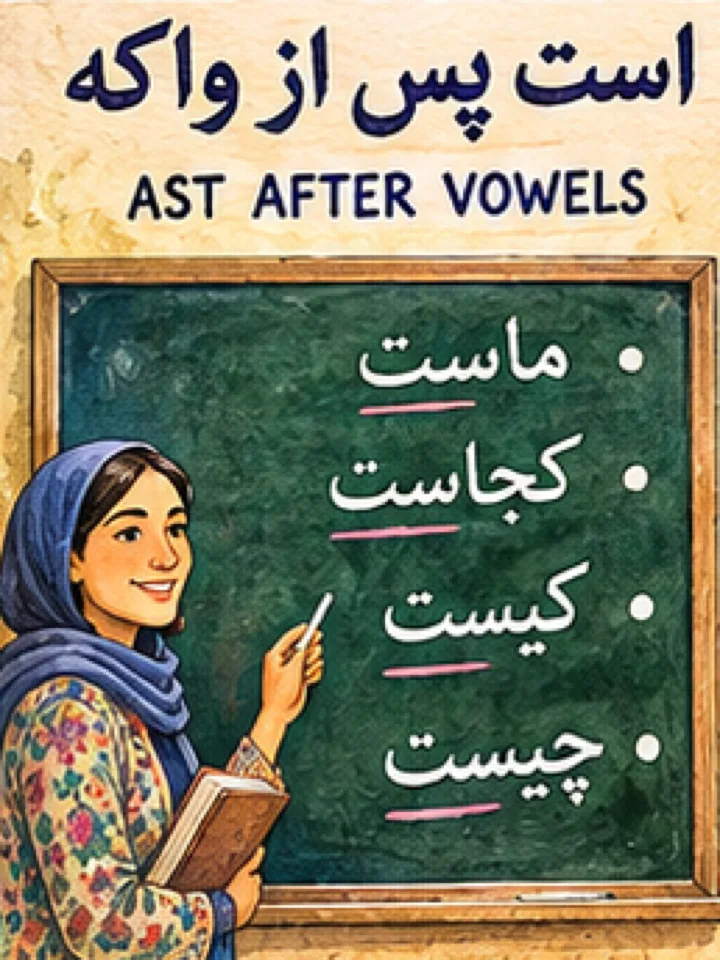
Learn when the a of است drops after a vowel (mâst, kojâst, kist), when it stays, and how “
“است” after vowels
“ا” of “است” is removed after vowels in reading and sometimes in writings.
| this is our book | این دَفتَرِ ما اَست ⇐ این دَفتَرِ ماست |
| she/he is iranian | او ایرانی اَست ⇐ او ایرانیست |
| who is he/she | او کی اَست؟ ⇐ او کیست |
Exercise: remove “”است and write.
1.او دانشجو است.
2. این میزِ ما است
3. او استادِ ما است.
4. او کی است؟
5. آن کتاب ما است.
6. استادِ ما کی است؟
Learn when the a of است drops after a vowel (mâst, kojâst, kist), when it stays, and how "is" sounds in spoken Persian, with examples.
"Ast" after vowels
The word است (ast), "is", is pronounced as a separate word after a consonant: این کتاب است (in ketâb ast). After a word ending in a long vowel, however, its first sound disappears and the rest joins the word: ما است (mâ ast) becomes ماست (mâst). This happens in speech all the time and very often in writing, too.
The rule, by final sound
| Change | Pronunciation | Note |
|---|---|---|
| ما است ← ماست | /mâ ast → mâst/ | after â: our / it is ours |
| کجا است ← کجاست | /kojâ ast → kojâst/ | after â: where is |
| دانشجو است ← دانشجوست | /dâneshju ast → dâneshjust/ | after u: is a student |
| او است ← اوست | /u ast → ust/ | after u: it is him / her |
| کی است ← کیست | /ki ast → kist/ | after i: who is |
| چه است ← چیست | /che ast → chist/ | what is (a fixed form) |
| ایرانی است | /irâni ast/ | after other -i words: usually written separately |
| خسته است | /khaste ast/ | after silent ه: always written separately |
So the contraction is regular after â and u, and in the fixed question words کیست and چیست. With other words ending in -i the joined spelling ایرانیست exists, but the separate ایرانی است is the usual standard today. After a silent ه (as in خسته, خانه) the a is never dropped in writing. After a consonant nothing changes.
The page's examples, explained
| Persian | Pronunciation | English |
|---|---|---|
| این دفترِ ماست. | /in daftar-e mâst./ | This is our notebook. |
| او ایرانی است. / او ایرانیست. | /u irâni ast. / u irânist./ | He / She is Iranian. |
| او کیست؟ | /u kist?/ | Who is he / she? |
More examples
| Persian | Pronunciation | English |
|---|---|---|
| خانهی ما اینجاست. | /khâne-ye mâ injâst./ | Our house is here. |
| ایستگاه کجاست؟ | /istgâh kojâst?/ | Where is the station? |
| این چیست؟ | /in chist?/ | What is this? |
| آن مرد کیست؟ | /ân mard kist?/ | Who is that man? |
| این ماشین مالِ اوست. | /in mâshin mâl-e ust./ | This car is his / hers. |
| برادرم دانشجوست. | /barâdaram dâneshjust./ | My brother is a student. |
| این شهر خیلی زیباست. | /in shahr kheyli zibâst./ | This city is very beautiful. |
| کتابِ من آنجاست. | /ketâb-e man ânjâst./ | My book is over there. |
| مشکل همینجاست. | /moshkel haminjâst./ | The problem is right here. |
A fun detail: ماست (mâst) is also the Persian word for "yogurt". Context always makes clear which one is meant.
Spoken Persian
In Tehran speech "is" is usually just -e after a consonant: خوبه (khube), "it's good". After â the ending stays -s or -st: کجاست؟ (kojâs?), "where is it?". After u and i it becomes -e: دانشجوئه (dâneshju-e), ایرانیه (irâniye), "he / she is Iranian".
Common mistakes
- Contracting after a consonant: کتابست is not standard; write کتاب است.
- Contracting after a silent ه: write خسته است, never خستست.
- Saying ki ast in a normal question. Native speakers say kist or, in speech, کیه؟ (kiye?).
- Thinking the contraction changes the meaning. ماست and ما است mean the same; only the sound is shorter.
Do the exercise on this page, then compare your work with the answer page.
Practice
-
Shorten: {{آن خانهی شما است.}} آن خانهی شما است.
Show answer
ân khâne-ye shomâst: "That is your house." آن خانهی شماست.
-
Shorten: {{دانشگاه کجا است؟}} دانشگاه کجا است؟
Show answer
dâneshgâh kojâst? "Where is the university?" دانشگاه کجاست؟
-
Can you shorten {{او خسته است}}? او خسته است
Show answer
No. After a silent ه the a of ast stays in writing.
-
Translate: "What is your name?"
Show answer
esm-e shomâ chist? اسم شما چیست؟
-
How do people say "Who is it?" in spoken Persian?
Show answer
kiye? کیه؟
See all the lessons in this series on the Persian grammar page.
Answer key
Do the exercises above first, then check your answers here.
- او دانشجوست. 2. این میز ماست. 3. او استاد ماست. 4. آن کتاب ماست. 5. استاد ما کیست؟
All six answers to the lesson 8 exercise on joining است after vowels, with the reason for each, translations and three extra practice items.
Lesson 8 exercise: the answers explained
The task is to drop the a of است and join it to the word before. This works when that word ends in â or u, and in the fixed question کیست (kist), "who is". Here are all six sentences.
| Answer | Pronunciation | English |
|---|---|---|
| ۱. او دانشجوست. | /1. u dâneshjust./ | He / She is a student. |
| ۲. این میزِ ماست. | /2. in miz-e mâst./ | This is our table. |
| ۳. او استادِ ماست. | /3. u ostâd-e mâst./ | He / She is our teacher. |
| ۴. او کیست؟ | /4. u kist?/ | Who is he / she? |
| ۵. آن کتابِ ماست. | /5. ân ketâb-e mâst./ | That is our book. |
| ۶. استادِ ما کیست؟ | /6. ostâd-e mâ kist?/ | Who is our teacher? |
Why each answer is right
- 1. دانشجو ends in the vowel u, so دانشجو است becomes دانشجوست.
- 2. The last word before "is" is ما, ending in â: ما است → ماست. میز takes an ezâfe because ما describes it: miz-e mâ, "our table".
- 3. Same pattern: استادِ ما است → استادِ ماست.
- 4. کی (ki), "who", plus است gives the fixed form کیست. The original answer key skips this sentence.
- 5. کتابِ ما است → کتابِ ماست. With the ezâfe it means "That is our book".
- 6. A question again: کی است → کیست. The word order stays the same as in the statement; only the question mark and your voice change.
In conversation
In everyday speech you would hear دانشجوئه (dâneshju-e) for sentence 1, این میزِ ماست (in miz-e mâs) for 2, and استادمون کیه؟ (ostâdemun kiye?), "Who's our teacher?", for 6.
Quick recap
است loses its a after â and u (ماست، کجاست، دانشجوست) and in کیست and چیست. After a consonant or a silent ه it stays a separate word.
Practice
-
Shorten: {{این خانهی شما است.}} این خانهی شما است.
Show answer
in khâne-ye shomâst: "This is your house." این خانهی شماست.
-
Shorten: {{این چه است؟}} این چه است؟
Show answer
in chist? "What is this?" این چیست؟
-
Shorten: {{رستوران کجا است؟}} رستوران کجا است؟
Show answer
resturân kojâst? "Where is the restaurant?" رستوران کجاست؟


Take this lesson further

Study with the book
Farsi Grammar in Use: For Beginners
This free lesson is part of Persian grammar lessons. The book puts the whole series in one printable PDF you can study offline.
Serious about Persian? Get all 30 of our Persian learning books for $149.00 (55% less than buying them one by one).
Free Persian Starter Kit (PDF)
The Persian alphabet chart and the 101 most common Persian words with pronunciation, in one printable PDF. You also get a one-time 15% code for any of our books.
We will email you new lessons and book news from Learn Persian Online. Unsubscribe any time.Free: Persian Alphabet + 100 Core Words (PDF)
Get the 14-page printable Starter Pack (all 32 letters, a 7-day reading plan, 100 core words and 20 survival phrases) and a short 5-email course. Free.