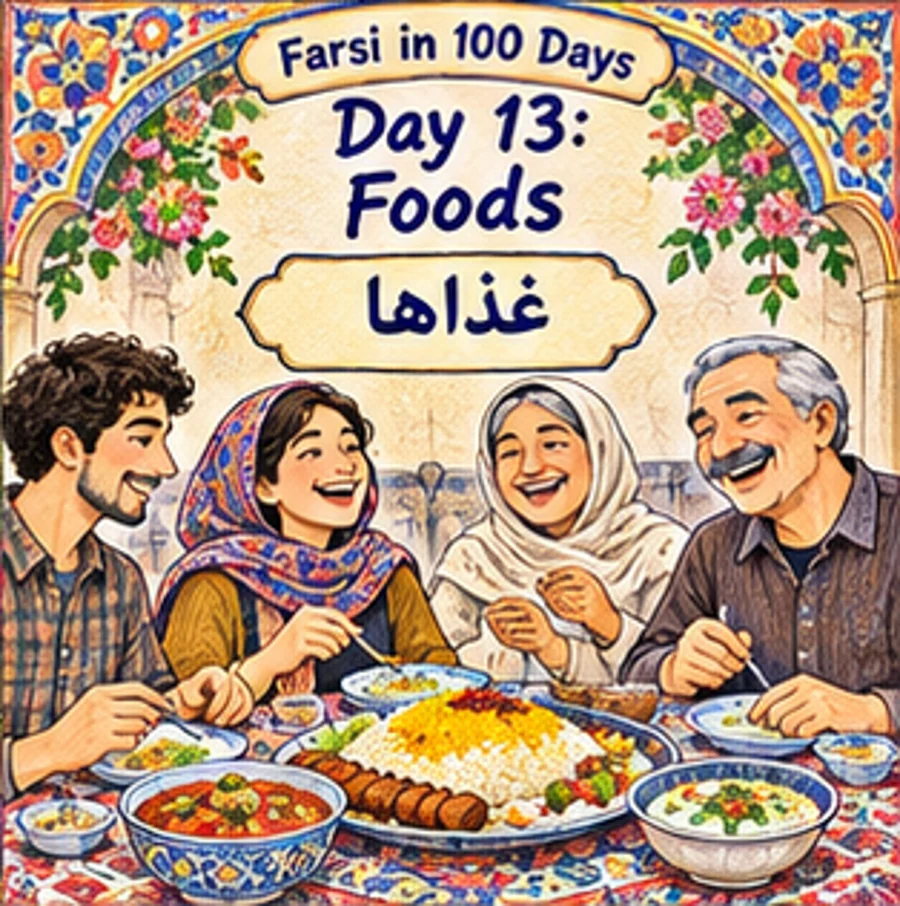
Day 13 of Learn Farsi in 100 Days, our free step-by-step Persian course: Foods. The lesson has four parts, with every Persian word in Persian script, pronunciation and English, and each part ends with a quick check.
Part 1Grammar and conversation
Day 13, Part 1 shows how to make sentences with the present subjunctive negative, as in نمیخواهم بروم (nemikhâham beravam, I don’t want to go), and a dinner conversation with phrases like مهمان من (mehmân-e man, my treat) and هر کسی پول خودش را حساب کند (each person pays for themselves).
Grammar: negative sentences with the present subjunctive
Sentences with the present subjunctive (حال التزامی, hâl-e eltezâmi) usually have two verbs: a main verb such as خواستن (khâstan, to want), باید (bâyad, must) or توانستن (tavânestan, can), followed by the subjunctive. To make the sentence negative, make the first verb negative with نـ (na-/ne-): میخواهم becomes نمیخواهم (nemikhâham), باید becomes نباید (nabâyad). The second verb stays in the subjunctive with بـ (be-).
Examples
I don’t want to go.
I must not sleep.
You can’t help.
Conversation: Who pays for dinner?
| Speaker | Persian | English and pronunciation |
|---|---|---|
| Armin آرمین | من خیلی گرسنه هستم، وقت شام است. | I am starving. It’s time for dinner. man kheyli gorosne hastam, vaght-e shâm ast. |
| Daniyal دانیال | نظرت چیست برای شام به یک همبرگر فروشی برویم؟ | How about going to a hamburger place for dinner? nazaret chist barâ-ye shâm be yek hamberger-forushi beravim? |
| Armin آرمین | باشه، ولی مهمان من. | OK, but it’s my treat. bâshe, vali mehmân-e man. |
| Daniyal دانیال | نه تو هفتهی قبل هم ناهار را حساب کردی. | No, you treated me to lunch last week, too! na to hafte-ye ghabl ham nâhâr râ hesâb kardi. |
| Armin آرمین | میخواهی هر کسی پول خودش را حساب کند؟ | How about going Dutch? mikhâhi har kasi pul-e khodash râ hesâb konad? |
| Daniyal دانیال | بسیار خوب. | OK. besyâr khub. |
Quick check
- How do you say “I don’t want to go” in Persian?
Show answer
نمیخواهم بروم (nemikhâham beravam) - In a negative subjunctive sentence, which verb gets the negative prefix?
Show answer
The first verb, e.g. نباید بخوابم (nabâyad bekhâbam, I must not sleep). - What does مهمان من (mehmân-e man) mean when paying for a meal?
Show answer
It’s my treat (literally, “my guest”).
Part 2Speech vs. writing, grammar and word of the day
Day 13, Part 2 compares spoken and written forms such as نمیتونم (nemitunam, I can’t) and چطوره؟ (chetore?, how is it?), explains the two ways to show possession, کتاب من (ketâb-e man) and کتابم (ketâbam, my book), and gives the word of the day, دریا (daryâ, sea).
Speech vs. writing
In speech, است (ast) and هستید (hastid) are shortened and attached to the word before (چطوره for چطور است, با محبتید for با محبت هستید), â before n becomes u (نمیتونم), and separate pronouns are often replaced by endings (به نظرت for به نظر تو). The spoken form is first in each pair.
| Spoken | Written | English |
|---|---|---|
| به نظرت. be nazaret. | به نظر تو. be nazar-e to. | in your opinion |
| با محبتید. bâ mohabbatid. | با محبت هستید. bâ mohabbat hastid. | You are kind. |
| چطوره؟ chetore? | چطور است؟ chetor ast? | How is it? / How about it? |
| مزاحمتان. mozâhemetân. | مزاحم شما. mozâhem-e shomâ. | (I’m) bothering you. |
| نمیتونم. nemitunam. | نمیتوانم. nemitavânam. | I can’t. |
| بشم. besham. | بشوم. beshavam. | (that) I become |
Grammar: possessive pronouns
Persian shows possession in two ways. The separate form puts the noun first, adds the ezâfe -e, and then the pronoun: کتاب من (ketâb-e man, my book), میز تو (miz-e to, your table). The joined form attaches one of six endings directly to the noun: -am, -at, -ash, -emân, -etân, -eshân, so کتاب من can also be کتابم (ketâbam).
| Persian | Pronunciation | English |
|---|---|---|
| کتابم | ketâbam | my book |
| کتابت | ketâbat | your book |
| کتابش | ketâbash | his/her book |
| کتابمان | ketâbemân | our book |
| کتابتان | ketâbetân | your (plural/polite) book |
| کتابشان | ketâbeshân | their book |
Examples
my book (separate pronoun)
your table (separate pronoun)
Word of the day: دریا (daryâ)
Meaning: sea
Fish live in the sea. I like seafood.
Quick check
- How do you say “my book” with a joined possessive ending?
Show answer
کتابم (ketâbam) - What is the written form of the spoken نمیتونم (nemitunam)?
Show answer
نمیتوانم (nemitavânam), “I can’t” - What does غذای دریایی (ghazâ-ye daryâyi) mean?
Show answer
seafood
Part 3Foods, common phrases and idiom of the day
Day 13, Part 3 adds more food words such as جوجه کباب (juje kabâb, chicken kebab) and سینهی مرغ (sine-ye morgh, chicken breast), polite phrases like ببخشید که دیر آمدم (bebakhshid ke dir âmadam, sorry I’m late), and the idiom کسی را آدم کردن (to teach someone manners).
Foods
| Persian | Pronunciation | English |
|---|---|---|
| بیف استراگانف | bif estrâgânof | beef stroganoff |
| گوشت سینه | gusht-e sine | brisket |
| چیزبرگر | chizberger | cheeseburger |
| سینهی مرغ | sine-ye morgh | chicken breast |
| بال جوجه | bâl-e juje | chicken wings |
| گوشت با استخوان | gusht bâ ostokhân | bone-in meat, chop |
| برشتوک | bereshtuk | cornflakes |
| قلوه | gholve | kidneys |
| رشته فرنگی | reshte farangi | noodles, spaghetti |
| پنکیک | pankeyk | pancake |
| جوجه کباب | juje kabâb | chicken kebab (grilled chicken) |
| سینهی بوقلمون | sine-ye bughalamun | turkey breast |
Common phrases
| Persian | Pronunciation | English |
|---|---|---|
| ببخشید که دیر آمدم. | bebakhshid ke dir âmadam. | Sorry I’m late. |
| دفعهی بعد جبران میکنم. | daf’e-ye ba’d jobrân mikonam. | I’ll make it up to you next time. |
| شما خیلی با محبت هستید. | shomâ kheyli bâ mohabbat hastid. | You’re very kind. |
Idiom of the day
کسی را آدم کردن.
kasi râ âdam kardan.
Word for word: to make someone a human being
Meaning in Persian: کسی را تنبیه کردن. کسی را مجازات کردن.
Meaning: To discipline someone; to punish someone.
English equivalent: To teach someone manners.
Quick check
- What is the Persian for “chicken wings”?
Show answer
بال جوجه (bâl-e juje) - How do you say “Sorry I’m late” in Persian?
Show answer
ببخشید که دیر آمدم (bebakhshid ke dir âmadam) - What does کسی را آدم کردن (kasi râ âdam kardan) mean?
Show answer
to discipline or punish someone, to teach someone manners
Part 4Reading and vocabulary
Day 13, Part 4 is a reading about Iran’s geography: its two seas, the Alborz and Zagros mountain ranges (رشته کوه, reshte kuh) and its neighbors (همسایه, hamsâye), plus vocabulary such as ساحل (sâhel, beach), ادویه (adviye, spice) and کشور (keshvar, country).
Reading: Iran between two seas
کشور ایران بین دو دریای کاسپین و دریای پارسی قرار دارد. دریای پارسی در جنوب ایران است. دریای کاسپین در شمال ایران قرار دارد.
The country of Iran lies between two seas, the Caspian Sea and the Persian Gulf. The Persian Gulf is in the south of Iran. The Caspian Sea is in the north of Iran.
ایران دارای دو رشته کوه است. رشته کوه البرز و رشته کوه زاگرس.
Iran has two mountain ranges: the Alborz range and the Zagros range.
بیش از ۶۰ درصد جمعیت ایران به زبان فارسی صحبت میکنند. ایران با کشورهای ترکیه، آذربایجان، افغانستان، ارمنستان، ترکمنستان و عراق همسایه است.
More than 60 percent of Iran’s population speak Persian. Iran is a neighbor of Turkey, Azerbaijan, Afghanistan, Armenia, Turkmenistan and Iraq.
Vocabulary
| Persian | Pronunciation | English |
|---|---|---|
| نظر دادن | nazar dâdan | to comment, to give an opinion |
| آلرژی | âlerzhi | allergy |
| تنبیه کردن | tanbih kardan | to punish |
| آدم | âdam | human, person |
| کسی | kasi | someone |
| لحظه | lahze | moment |
| مزاحم | mozâhem | annoying, a bother |
| دفعه | daf’e | time (occasion) |
| جبران کردن | jobrân kardan | to compensate, to make up for |
| دیر | dir | late |
| ببخشید | bebakhshid | sorry, excuse me |
| شاه ماهی | shâh mâhi | herring |
| اختاپوس | okhtâpus | octopus |
| اردک ماهی | ordak mâhi | pike |
| ساحل | sâhel | beach |
| رشته کوه | reshte kuh | mountain range |
| ماسه | mâse | sand |
| نمک | namak | salt |
| ادویه | adviye | spice |
| درصد | darsad | percent |
| موج | mowj | wave |
| طعمه | to’me | bait |
| دام | dâm | trap |
| مجازات کردن | mojâzât kardan | to punish |
| همسایه | hamsâye | neighbor |
| کافه | kâfe | cafe |
| چای | chây | tea |
| آرد | ârd | flour |
| کشتی | keshti | ship |
| قایقران | ghâyeghrân | boatman |
| غواص | ghavvâs | diver |
| شنا کردن | shenâ kardan | to swim |
| پیادهروی | piyâde-ravi | walking |
| بیش از | bish az | more than |
| قاشق | ghâshogh | spoon |
| بشقاب | boshghâb | plate |
| کشور | keshvar | country |
Quick check
- Which two mountain ranges does Iran have?
Show answer
The Alborz (البرز, alborz) and the Zagros (زاگرس, zâgros). - Where is the Caspian Sea in relation to Iran?
Show answer
In the north: دریای کاسپین در شمال ایران قرار دارد (daryâ-ye kâspiyan dar shomâl-e irân gharâr dârad). - What does همسایه (hamsâye) mean?
Show answer
neighbor
Take this lesson further

Study with the book
Learn Farsi in 100 Days: The Ultimate Crash Course to Learning Farsi Fast
This free lesson is part of Learn Farsi in 100 Days. The book puts the whole series in one printable PDF you can study offline.
Serious about Persian? Get all 30 of our Persian learning books for $199.99 (55% less than buying them one by one).
Free Persian Starter Pack: Alphabet + 100 Core Words
Get the 14-page printable Starter Pack (all 32 letters, a 7-day reading plan, 100 core words and 20 survival phrases) and a short 5-email course. Free.
Free. Every morning: that day’s four videos and the full lessons, with every Persian word, its pronunciation and its English meaning. Stop or pause with one click.