

 Farsi Reading Bundle
234 pages · Printable PDF · Instant download
- Instant downloadYours right after checkout
- Secure checkoutCard (Stripe) or PayPal
- Read anywherePhone, tablet or computer, or print it

Paperback sold separately. As an Amazon Associate I earn from qualifying purchases.
Buy 2 or more books and save up to 25% at checkout.
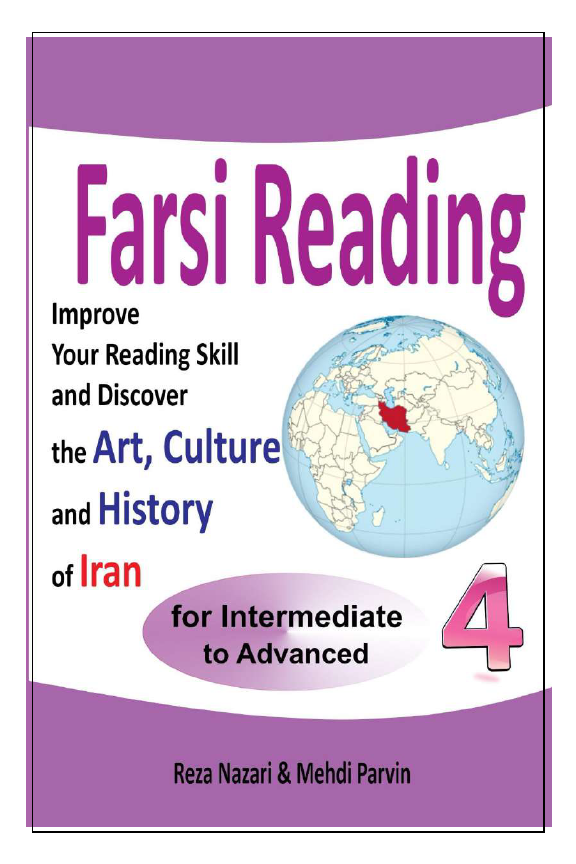
Farsi Reading 4 Improve your reading skill and discover the art, culture and history of Iran: For Intermediate and Advanced Farsi Learners
Farsi Reading 4 offers 50 Persian texts that lean toward literature and history: poets such as Parvin E’tesami, Sohrab Sepehri, Shahriar, Nima Yushij, Nezami and Attar, figures like Khajeh Nasir al-Din Tusi and Nezam-ol-Molk, and places from Lake Urmia to Chogha Zanbil. Each text has key words, four exercises and answers at the back. 234-page PDF by Reza Nazari and Mehdi Parvin.
Meet a dozen Persian poets in their own language, along with the places of Iran’s history
Volume 4 is the literature volume of the series. About a dozen of its 50 texts are short lives of poets, from the classical Naser Khosrow, Nezami, Attar and Jami to the modern Nima Yushij, Sohrab Sepehri, Parvin E’tesami and Shahriar. The rest cover scholars and statesmen, shrines, rivers and seas, and several chapters of modern Iranian history.
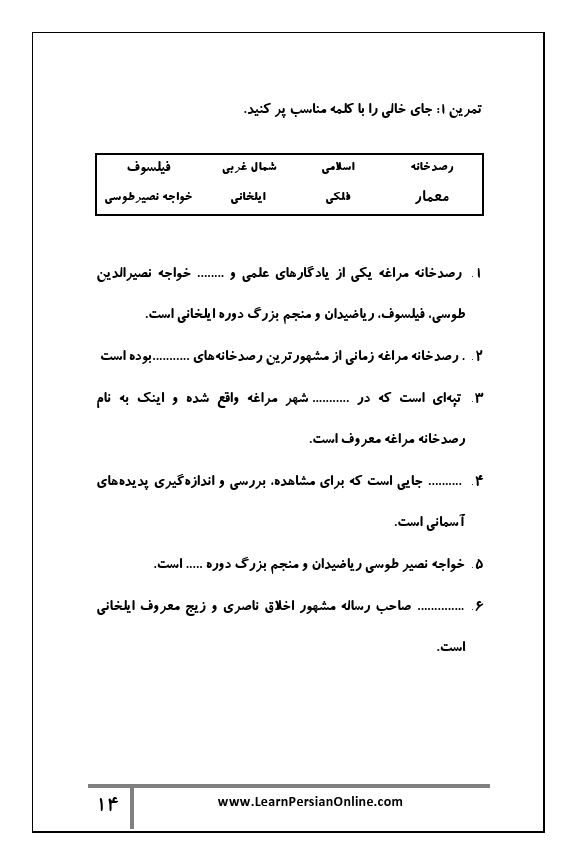
The title page of this volume reads For Advanced Farsi Learners, and the texts carry more dates and historical terms than the earlier books. The first text, on the Maragheh observatory, introduces Khajeh Nasir al-Din Tusi as a philosopher, mathematician and astronomer of the Ilkhanid period and gives 657 AH as the year construction began.
At a glance
What Volume 4 covers
Grouped by theme, the 50 texts fall into six strands.
Poets, classical and modern
Naser Khosrow, Nezami Ganjavi, Attar of Nishapur, Jami, Saeb Tabrizi, Iraj Mirza, Malek-osh-Sho’ara Bahar, Parvin E’tesami, Nima Yushij, Shahriar, Sohrab Sepehri and Mehrdad Avesta.
Scholars and statesmen
Khajeh Nasir al-Din Tusi and his Maragheh observatory, Khajeh Nezam-ol-Molk, Amir Kabir and Mirza Kuchak Khan.
Shrines and temples
Shah Cheragh, Jamkaran Mosque, the Atiq Mosque, the Blue Mosque, the Tomb of Daniel, the Qadamgah fire temple and the Chogha Zanbil temple.
Water and landscape
Lake Urmia, the Karun, Zayandeh Rud and Aras rivers, the Persian Gulf, the Caspian Sea, Ali Sadr Cave and the Heyran pass.
Modern history
Texts on the Islamic Revolution, the Sacred Defense (the Iran-Iraq war) and Dahe-ye Fajr, the ten days in February 1979 that Iran marks each year.
Monuments
Si-o-se Pol, Babak Castle, the Soltaniyeh Dome, Monar Jonban (the shaking minarets), the Qur’an Gate, the Ganjali Khan Bathhouse and Haft Tappeh.
Key words from text 1: the Maragheh observatory
Words from the first text’s key word table, each with the synonym the book pairs it with. Pronunciation is added for this page; the book itself has none.
| Key word | Pronunciation | Synonym in the book | English |
|---|---|---|---|
| منجم | monajjem | ستارهشناس | astronomer |
| دانشمندان | dâneshmandân | علما | scientists, scholars |
| آوازه | âvâze | شهرت | fame, renown |
| تحولات | tahavvolât | دگرگونی | changes, transformations |
| وسیع | vasi’ | بزرگ | vast, wide |
| مشاهده | moshâhede | دیدن | observation |
Exercise 2 asks you to join each of these words to its synonym. Exercise 3 then tests details, such as whether the observatory stands northwest or southwest of Maragheh.
Contents
The introduction and 50 texts, in order:
- Maragheh observatory, Sangtarashan cave, the ruined mill of Jolfa, Si-o-se Pol, Babak Castle (1 to 5)
- Ali Sadr Cave, Parvin E’tesami, Atiq Mosque, the port of Siraf, Jamkaran Mosque (6 to 10)
- Lake Urmia, the Karun river, Zayandeh Rud, the Islamic Revolution of Iran, Narenjestan Qavam museum (11 to 15)
- Zanjan laundry house, the Sacred Defense, Sohrab Sepehri, the Qur’an Gate, Khajeh Nasir al-Din (16 to 20)
- Shah Cheragh, Saeb Tabrizi, Shahriar, Naser Khosrow, Jami (21 to 25)
- Malek-osh-Sho’ara, Soltaniyeh Dome, Amir Kabir, El Goli park, Qadamgah fire temple (26 to 30)
- Monar Jonban, Mirza Kuchak Khan, Tomb of Baba Kuhi, the Blue Mosque, Iran (31 to 35)
- Khajeh Nezam-ol-Molk, the Persian Gulf, the Caspian Sea, Heyran pass, Nima Yushij (36 to 40)
- Haft Tappeh, Tomb of Daniel, Dahe-ye Fajr, the Aras river, Nezami Ganjavi (41 to 45)
- Attar of Nishapur, Chogha Zanbil temple, Ganjali Khan Bathhouse, Iraj Mirza, Mehrdad Avesta (46 to 50)
- Answer key
How to get the most from Volume 4
- Read the poets’ texts as a set (7, 18, 22 to 26, 40, 45, 46, 49 and 50) to learn the language of literary biography, such as سرود (sorud, composed) and به خاک سپرده شد (be khâk seporde shod, was buried).
- Keep a list of dates as you go; the texts give years in both the solar (شمسی, shamsi) and lunar (قمری, ghamari) Hijri calendars.
- Do the synonym exercise with the key word table covered, then check it and the true-or-false items in the answer key.
- Answer Exercise 4 in writing and read your answer aloud.
- Follow the poets further in the free Persian poetry section, then continue with Farsi Reading 5.
Who this book is for
A good fit if you
- read Persian comfortably and want texts on literature and history
- want to know who Nima, Sepehri, Shahriar and Parvin E’tesami were before you read their poems
- are moving toward advanced Persian and need dates, titles and historical terms
- have worked through earlier volumes and want a change from travel topics
Look elsewhere if you
- still find a page of Persian slow going; Volume 1 starts with more familiar subjects
- want the poems themselves with translations; Masnawi: In Farsi with English Translation is made for that
Use it with
- Farsi Reading Volume 3: the previous volume, on Iran’s western provinces and coasts.
- Farsi Reading Bundle: all six volumes at once.
- Persian poetry quiz: check how many of the poets you can now place.
- Farsi reading lessons: free online texts between chapters.
Questions about Farsi Reading 4
What makes Volume 4 different?
More than any earlier volume, it is about literature: about a dozen texts are lives of Persian poets, and several cover modern Iranian history. Volumes 1 to 3 focus more on festivals, cities and travel sites.
Is it only for advanced learners?
The title page says For Advanced Farsi Learners. Intermediate readers who read the script fluently can manage the texts with the key word tables and a dictionary.
Does it include the poets’ poems?
The texts are prose biographies: when and where each poet lived, what they wrote and where they are buried. They name famous works but are not poetry anthologies.
Is there an answer key?
Yes, at the back, with the answers to the fill-in, synonym and true-or-false exercises for each lesson.
What do I get after I buy?
You get a 234-page PDF to download right after checkout and read on a phone, tablet or computer, or print.
Is there a paperback?
Yes, Farsi Reading 4 is available in paperback on Amazon.
Related Persian books
More Persian learning books on similar topics.

 Farsi Reading Bundle: Improve your reading skill and discover the art, culture...
Original price was: $149.99.$59.99Current price is: $59.99.
 Farsi Reading: Improve your reading skill and discover the art, culture and...
Original price was: $24.99.$14.99Current price is: $14.99.


Product Reviews
There are no reviews yet.