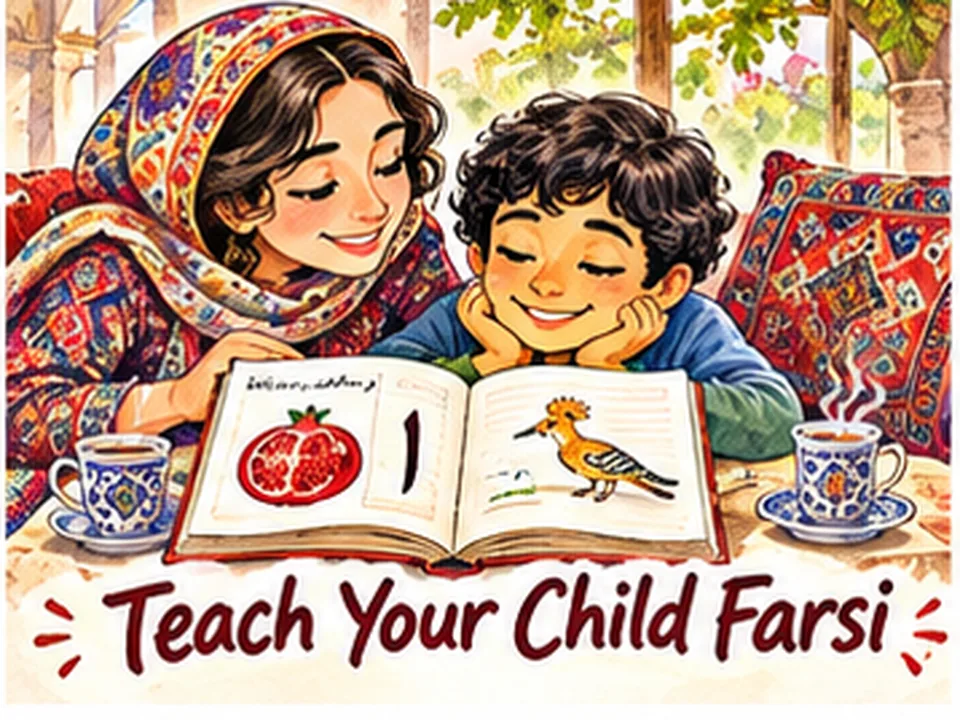
To teach your child Farsi at home, speak it with them every day, as much as you can, and make it the language of warm, routine moments: meals, play, bath time and bedtime stories. The amount of Persian your child hears and uses matters more than any single method. This guide gives you age-by-age strategies, a weekly routine and fixes for the most common problems.
What the research says (in brief)
- Amount of input matters. In a study of bilingual toddlers, each child’s vocabulary and grammar in a language was linked to how much of that language they heard (Hoff et al., 2012). The same study found bilingual toddlers’ total vocabulary was comparable to monolinguals’.
- Home use is the strongest predictor. A questionnaire study of 1,899 bilingual families found children were most likely to speak the minority language when both parents used it at home. “One parent, one language” was neither necessary nor sufficient on its own (De Houwer, 2007).
- Bilingualism is not a disorder. ASHA, the US association of speech-language pathologists, states that being multilingual is not a communication disorder and advises clinicians to encourage families to keep using their heritage languages.
- The switch to English is real. Lily Wong Fillmore’s well-known 1991 study, “When learning a second language means losing the first”, documented how young children of immigrant families in the US often shifted away from their home language once they entered English-language settings.
The practical message: Persian will not hold back your child’s English, but Persian needs deliberate support, because English will win by default.
Choose your family’s language plan
| Approach | How it works | Works well when |
|---|---|---|
| Persian at home | Everyone speaks Persian at home; English outside | Both parents speak Persian |
| One parent, one language | The Persian-speaking parent always speaks Persian; the other parent speaks English | Only one parent speaks Persian |
| Time and place | Persian at fixed times or places (meals, weekends, car rides, grandparents’ house) | Parents are not fluent or are short of time |
Whichever plan you choose, be consistent and give Persian plenty of hours. If only one parent speaks Persian, add extra Persian sources: grandparents, friends, Persian school, books and media.
Ages 0–3: talk, sing, repeat
- Narrate the day in Persian: what you are doing, what the baby sees, what comes next.
- Sing lullabies and simple songs. Repetition is how toddlers learn words.
- Read picture books every day, even if you just name the pictures.
- Use the same phrases in the same routines (see the phrase table below), so words become predictable.
- Do not worry about mixing. Toddlers mix languages; simply repeat their sentence back in Persian.
Ages 4–6: play, stories and first letters
- Play in Persian: shop, doctor, cooking, building. Pretend play needs lots of language.
- Read aloud and ask questions: “What happens next?” in Persian.
- Start letters gently. Begin with the letters in your child’s name. Our write your name in Persian tool helps, and free Persian printables give tracing practice.
- Find Persian-speaking friends of the same age. Peers make the language feel normal, not just a parent’s language.
Ages 7–10: reading, writing and real reasons to speak
- Short daily reading (10–15 minutes) in Persian, alternating between you reading and your child reading.
- Weekend Persian school or a small home group gives structure and friends who also learn Persian.
- Projects: a Nowruz card, a family recipe, a short diary, a letter to a grandparent. See our Persian calendar and Nowruz guide for ideas.
- Screen time in Persian: let favourite shows count as Persian time only when they are in Persian.
Ages 11+: identity, interests and independence
- Follow their interests: football, music, gaming, cooking. Find Persian content in that area.
- Give them a role: translating for a grandparent, helping a younger sibling, reading a short poem at a family gathering.
- Talk about why Persian matters to your family, without guilt. Teenagers respond better to choice than pressure.
- Grammar and reading for older learners: structured lessons such as our free online Persian lessons or a Persian tutor can fill gaps in reading and writing.
- Literature and poetry: a few lines of Hafez or Rumi can be a strong cultural link. Try Fal-e Hafez together.
Everyday phrases for family routines
These are everyday spoken Iranian Persian forms. If your family speaks Dari, use your own family’s words; see our Dari section.
| English | Persian | Pronunciation |
|---|---|---|
| Good morning! | صبح بخیر! | sobh bekheyr! |
| Come, let’s have breakfast. | بیا صبحونه بخوریم. | biyâ sobhune bokhorim. |
| Wash your hands. | دستاتو بشور. | dastâto beshur. |
| Put on your shoes. | کفشاتو بپوش. | kafshâto bepush. |
| Well done! | آفرین! | âfarin! |
| What happened? | چی شده؟ | chi shode? |
| Say it in Persian. | به فارسی بگو. | be fârsi begu. |
| Shall we read a story? | یه قصه بخونیم؟ | ye qesse bekhunim? |
| It’s bedtime. | وقت خوابه. | vaqt-e khâbe. |
| Good night, I love you. | شب بخیر، دوستت دارم. | shab bekheyr, dustet dâram. |
A sample weekly routine
Short, regular Persian time beats occasional long lessons. Adapt this to your family; the point is that Persian appears every day.
| Day | Activity | Time | Useful phrase |
|---|---|---|---|
| Monday | Bedtime story in Persian (read aloud, point at pictures) | 15 min | یه قصه بخونیم؟ ye qesse bekhunim? |
| Tuesday | Cook or set the table together, naming foods and objects | 20 min | اینو بذار رو میز. ino bezâr ru miz. (put this on the table) |
| Wednesday | Video call with grandparents or relatives | 15–20 min | سلام مامانبزرگ! salâm mâmânbozorg! |
| Thursday | Songs or rhymes; for older children, 10 minutes of letters or reading | 15 min | آفرین! âfarin! |
| Friday | Persian film or cartoon together, then talk about it | 30 min | چی شد؟ chi shod? (what happened?) |
| Saturday | Weekend Persian school, community event or playdate with Persian-speaking children | 1–3 h | |
| Sunday | Family meal in Persian; plan a small cultural activity (a recipe, a poem, a Nowruz craft) | 30+ min | نوش جان! nush-e jân! (enjoy your meal) |
Grandparents, relatives and community
- Grandparents are often the best Persian teachers. Regular video calls give your child a real reason to speak Persian.
- Ask relatives to stay in Persian with your child, even if the child answers in English.
- Persian schools and community centres run weekend classes and celebrations (Nowruz, Yalda). They help children see Persian as a shared, living language.
Common problems and fixes
| Problem | Try this |
|---|---|
| My child understands but answers in English. | Keep speaking Persian. Recast their answer in Persian and continue the conversation. Create situations where only Persian works (grandparents, Persian-only playdates). |
| My partner doesn’t speak Persian. | Agree on a plan together. Teach your partner a few phrases so they can support it, and add outside Persian input (school, relatives, media). |
| English took over when school started. | This is common. Protect fixed Persian times (dinner, bedtime story) and add a weekend Persian activity. |
| My child mixes the two languages. | Normal and temporary. Model the Persian word without criticism. |
| I am not fluent myself. | Use what you have: routines, songs and books. Learn alongside your child with our beginner lessons. |
| Reading Persian feels too hard. | Go slowly: a letter or two a week, with tracing sheets and picture books. Praise effort. |
| My teenager has lost interest. | Connect Persian to their interests and to people they care about. Offer choices, not lectures. |
Books, printables and more
- Browse our Farsi children’s books.
- Read more articles under Persian for kids.
- Download free Persian printables for letters and words.
- Find baby names and their meanings in our Persian names guide.
- Teachers and community schools: see Persian books for schools.
Books for young Persian learners
- Farsi Children’s Books Bundle – picture books for first words
- Let’s Learn Farsi: 11-book set – letters, words and activities
- Read and Write Persian Language in 7 Days – for older children and parents learning the script
Sources
- Erika Hoff et al. (2012), “Dual language exposure and early bilingual development”, Journal of Child Language 39(1): 1–27. https://www.cambridge.org/core/journals/journal-of-child-language/article/abs/dual-language-exposure-and-early-bilingual-development/57E4277E1737E70CC78775F0DB5D192D
- Annick De Houwer (2007), “Parental language input patterns and children’s bilingual use”, Applied Psycholinguistics 28(3): 411–424. https://www.cambridge.org/core/journals/applied-psycholinguistics/article/abs/parental-language-input-patterns-and-childrens-bilingual-use/821A5852222197491F4E7ABC8AA4B099
- American Speech-Language-Hearing Association (ASHA), Practice Portal: “Multilingual Service Delivery in Audiology and Speech-Language Pathology”. https://www.asha.org/practice-portal/professional-issues/multilingual-service-delivery/
- Lily Wong Fillmore (1991), “When learning a second language means losing the first”, Early Childhood Research Quarterly 6: 323–346 (citation via Wikipedia). https://en.wikipedia.org/wiki/Lily_Wong_Fillmore
FAQ
Will learning Farsi confuse my child or delay their English?
No. ASHA, the US professional body for speech-language pathologists, states that being multilingual is not a communication disorder and encourages families to keep using their heritage languages. Mixing words from two languages is a normal stage, not a sign of confusion.
Is it too late to start teaching Farsi to my 8-year-old (or teenager)?
It is never too late. Older children learn faster in some ways because they can read, ask questions and set goals. Focus on their interests and give them real reasons to use Persian, such as talking with relatives or a trip.
Do I have to use the one parent, one language method?
No. Research on nearly 1,900 bilingual families found that one parent, one language was neither necessary nor enough on its own. What mattered most was how much the home language was used; children were most likely to speak it when both parents used it at home.
My child understands Farsi but always answers in English. What should I do?
This is very common. Keep speaking Persian, show that you value Persian answers (respond warmly, repeat their sentence in Persian), and create situations where English does not work, such as calls with grandparents who speak only Persian.
When should my child learn to read Persian?
Many families start letters around ages 5–7, often alongside English reading. Short, regular sessions with tracing sheets and picture books work better than long lessons.
We are an Afghan family. Does this apply to Dari?
Yes. Everything on this page applies to Dari. Use the words and pronunciation your family uses; our Dari pages list common differences from Iranian Persian.
Free Persian Starter Pack: Alphabet + 100 Core Words
Get the 14-page printable Starter Pack (all 32 letters, a 7-day reading plan, 100 core words and 20 survival phrases) and a short 5-email course. Free.