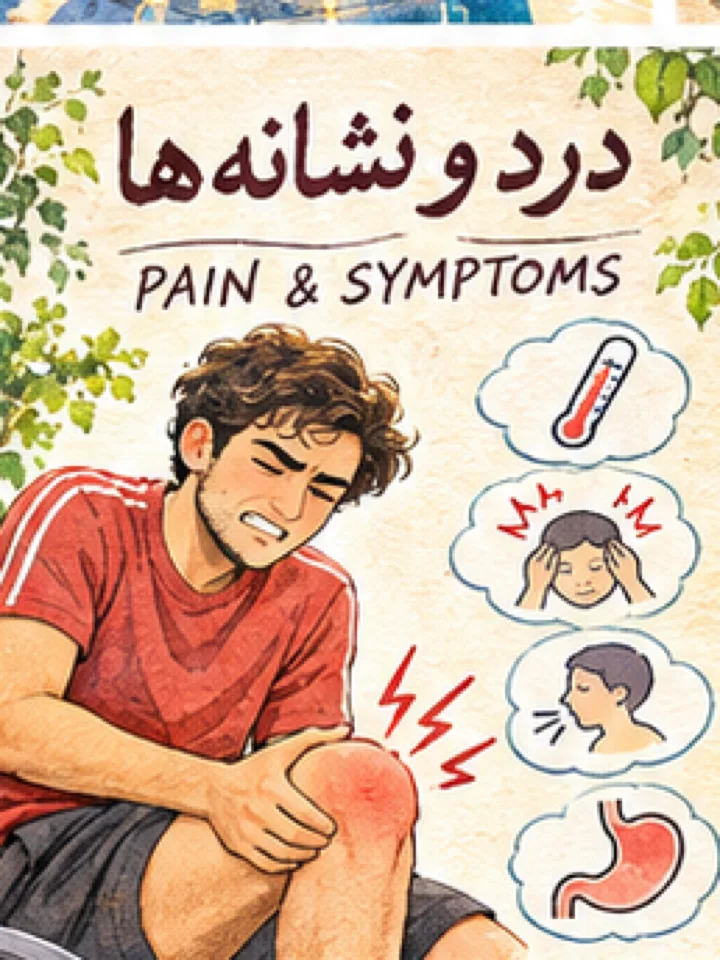
Pain and Symptoms in Persian (Farsi): headache is سردرد (sardard), fever is تب (tab) and cough is سرفه (sorfe). The full list below gives each word in English, Persian script and pronunciation.
pain ⇒ درد /dard/
| English | Pronunciation | Persian |
| Abdominal pains | shekam dard | شکم درد |
| Blister | tâval | تاول |
| Boil | damal | دمل |
| Bruise | kabudi | کبودی |
| Burn | sukhtegi | سوختگی |
| Chills | larz | لرز |
| Cold | sarmâkhordegi | سرماخوردگی |
| Cough | sorfe | سرفه |
| Cut | boridegi | بریدگی |
| Dizziness | sargije | سرگیجه |
| Flu | ânfolânzâ | آنفولانزا |
| Fracture | shekastegi | شکستگی |
| Graze | kharâshidegi | خراشیدگی |
| Headache | sardard | سردرد |
| Insect bite | nishe hashare | نیش حشره |
| Lump | barâmadegi | برآمدگی |
| Migraine headache | sardarde migreni | سردرد میگرنی |
| Period cramps | darde heyz | درد حیض |
| Rash | dâne | دانه |
| Sore throat | galudard | گلودرد |
| Stiff neck | gereftegiye gardan | گرفتگی گردن |
| Strain | keshidegiye azole | کشیدگی عضله |
| Swelling | varam | ورم |
| Wound | jerâhat | جراحت |
Talk about pain in Persian: more aches, symptoms and injuries, phrases to describe how it hurts, three ways to say it hurts, and a quiz.
More words for pain and symptoms
The list above gives the main injuries and illnesses. Persian builds many pain words the same way: a body part plus درد (dard, "pain"), as in سردرد (sardard, "headache") and گلودرد (galudard, "sore throat"). Once you know the body parts, you can make most of them yourself. Here are more symptoms, injuries and first-aid words.
| Persian | Pronunciation | English |
|---|---|---|
| دنداندرد | /dandândard/ | toothache |
| کمردرد | /kamardard/ | backache |
| دلدرد | /deldard/ | stomachache |
| گوشدرد | /gushdard/ | earache |
| زانودرد | /zânudard/ | knee pain |
| پادرد | /pâdard/ | leg or foot pain |
| تب | /tab/ | fever |
| خارش | /khâresh/ | itching |
| آبریزش بینی | /âbrizesh-e bini/ | runny nose |
| عطسه | /atse/ | sneeze |
| استفراغ | /estefrâgh/ | vomiting |
| اسهال | /eshâl/ | diarrhea |
| خستگی | /khastegi/ | tiredness, fatigue |
| ضعف | /za'f/ | weakness |
| بیخوابی | /bikhâbi/ | insomnia |
| پیچخوردگی | /pichkhordegi/ | sprain |
| خونریزی | /khunrizi/ | bleeding |
| زخم | /zakhm/ | wound, sore |
| درد شدید | /dard-e shadid/ | severe pain |
| درد خفیف | /dard-e khafif/ | mild pain |
| سوزش | /suzesh/ | burning sensation |
| تیر کشیدن | /tir keshidan/ | to have a shooting pain |
| مسکن | /mosakken/ | painkiller |
| کیسهی یخ | /kise-ye yakh/ | ice pack |
| باند | /bând/ | bandage |
| چسب زخم | /chasb-e zakhm/ | adhesive bandage |
Useful phrases
| Persian | Pronunciation | English |
|---|---|---|
| کجات درد میکنه؟ | /kojât dard mikone?/ | Where does it hurt? (informal) |
| اینجام درد میکنه. | /injâm dard mikone./ | It hurts here. |
| خیلی درد دارم. | /kheyli dard dâram./ | I'm in a lot of pain. |
| از کی درد داری؟ | /az key dard dâri?/ | How long have you had the pain? |
| دردش تیر میکشه. | /dardesh tir mikeshe./ | It's a shooting pain. |
| پام پیچ خورد. | /pâm pich khord./ | I twisted my ankle. |
| دستم رو بریدم. | /dastam ro boridam./ | I cut my hand. |
| یه مسکن داری؟ | /ye mosakken dâri?/ | Do you have a painkiller? |
| درد داره بدتر میشه. | /dard dâre badtar mishe./ | The pain is getting worse. |
| بهترم. | /behtaram./ | I'm better. |
Example sentences
| Persian | Pronunciation | English |
|---|---|---|
| از صبح دنداندرد دارم. | /az sobh dandândard dâram./ | I've had a toothache since this morning. |
| بچه تب دارد و سرفه میکند. | /bachche tab dârad va sorfe mikonad./ | The child has a fever and is coughing. |
| پایش هنگام بازی پیچ خورد. | /pâyash hengâm-e bâzi pich khord./ | He twisted his ankle during the game. |
| این قرص درد را کم میکند. | /in ghors dard râ kam mikonad./ | This pill reduces the pain. |
| روی زخم چسب زخم بزن. | /ru-ye zakhm chasb-e zakhm bezan./ | Put a bandage on the cut. |
| کمرم از دیروز درد میکند. | /kamaram az diruz dard mikonad./ | My back has been hurting since yesterday. |
Grammar note: three ways to say it hurts
- Pain word + داشتن: سردرد دارم (sardard dâram), "I have a headache".
- Body part + possessive ending + درد میکند: سرم درد میکند (saram dard mikonad), spoken سرم درد میکنه (saram dard mikone), "my head hurts". The ending (ـم, -am) shows whose head it is.
- درد داشتن on its own: درد دارم (dard dâram), "I'm in pain".
- Many symptoms have a verb with کردن: سرفه کردن (sorfe kardan, to cough), عطسه کردن (atse kardan, to sneeze), استفراغ کردن (estefrâgh kardan, to vomit).
Culture note
If someone says they are sick or hurt, Iranians often answer خدا بد نده (khodâ bad nade), roughly "God forbid" or "I hope it's nothing serious". When they recover, you can say خدا رو شکر (khodâ ro shokr), "thank God".
Practice
How do you say "toothache"?
Show answer
dandândard دنداندرد
Translate: "My head hurts."
Show answer
saram dard mikonad (spoken: saram dard mikone) سرم درد میکند.
What is a {{مسکن}}?
Show answer
A painkiller.
Which verb goes with {{عطسه}} (sneeze)?
Show answer
kardan: atse kardan عطسه کردن
What do you say when someone tells you they are ill?
Show answer
khodâ bad nade خدا بد نده
Related lists: Seeing a doctor and Drugstore. See also the Persian pronunciation guide.


Quiz: pain and symptoms in Persian
Check yourself on pain and symptoms: 10 questions, instant feedback, and your score as you go.
1. How do you say “abdominal pains” in Persian?
2. How do you say “chills” in Persian?
3. What does دمل (damal) mean?
4. How do you say “dizziness” in Persian?
5. How do you say “cough” in Persian?
6. What does تاول (tâval) mean?
7. How do you say “burn” in Persian?
8. How do you say “cut” in Persian?
9. What does سرماخوردگی (sarmâkhordegi) mean?
10. How do you say “bruise” in Persian?
Answer key with explanations
- D. شکم درد (shekam dard): “abdominal pains” is شکم درد (shekam dard).
- B. لرز (larz): “chills” is لرز (larz).
- B. boil: دمل (damal) means “boil”.
- D. سرگیجه (sargije): “dizziness” is سرگیجه (sargije).
- C. سرفه (sorfe): “cough” is سرفه (sorfe).
- B. blister: تاول (tâval) means “blister”.
- A. سوختگی (sukhtegi): “burn” is سوختگی (sukhtegi).
- B. بریدگی (boridegi): “cut” is بریدگی (boridegi).
- B. cold: سرماخوردگی (sarmâkhordegi) means “cold”.
- C. کبودی (kabudi): “bruise” is کبودی (kabudi).
Common questions
How do you say “blister” in Persian?
“blister” in Persian (Farsi) is تاول, pronounced tâval.
Take this lesson further

Serious about Persian? Get all 30 of our Persian learning books for $199.99 (55% less than buying them one by one).
Free Persian Starter Kit (PDF)
The Persian alphabet chart and the 101 most common Persian words with pronunciation, in one printable PDF. You also get a one-time 15% code for any of our books.
We will email you new lessons and book news from Learn Persian Online. Unsubscribe any time.Free: 100 Core Persian Words + 20 Survival Phrases
Get the 14-page printable Starter Pack (all 32 letters, a 7-day reading plan, 100 core words and 20 survival phrases) and a short 5-email course. Free.
Practise with free Persian games