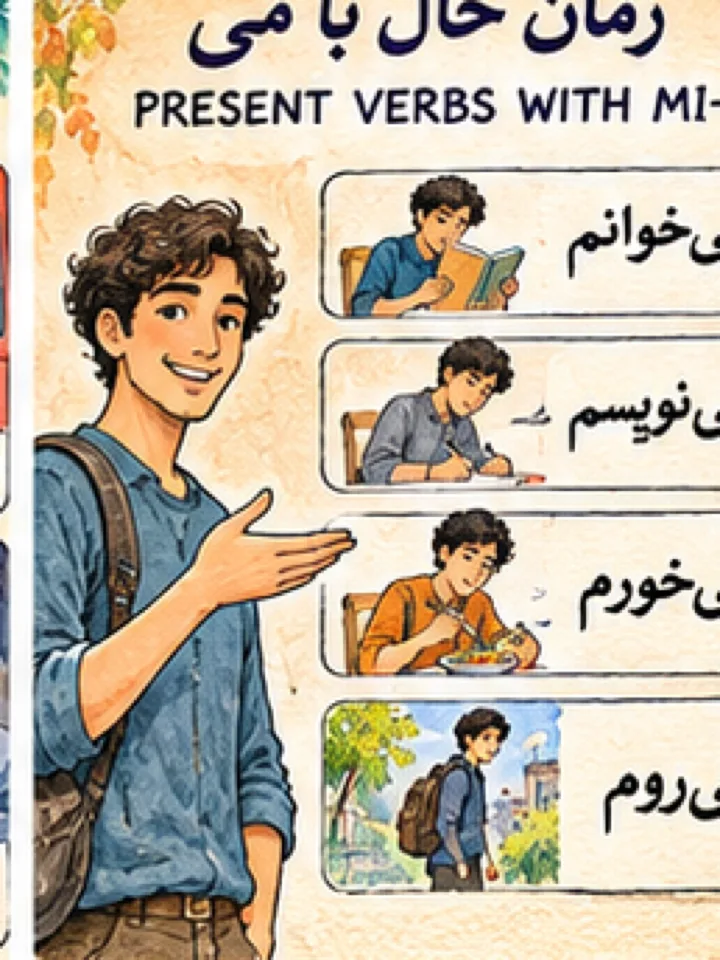


Study notes for lesson 6 grammar: the Persian simple present with mi-, present stems, negative nemi- and compound verbs, with student examples.
The simple present tense of Persian verbs
Study notes for this lesson. Lessons 3 and 4 dealt with "to be", which has its own forms. To say what a student does every day (I study, she goes, we live), you need the simple present of ordinary verbs. The pattern is regular and the same for almost every verb: می + present stem + personal ending.
The pattern
Take خواندن (khândan), "to read, to study". Its present stem is خوان (khân). Add می (mi-) in front, joined with a non-joiner, and a personal ending after it:
| Form | Pronunciation | Meaning |
|---|---|---|
| من میخوانم | /man mikhânam/ | I read, I study |
| تو میخوانی | /to mikhâni/ | you read (informal) |
| او میخواند | /u mikhânad/ | he, she reads |
| ما میخوانیم | /mâ mikhânim/ | we read |
| شما میخوانید | /shomâ mikhânid/ | you read (plural or polite) |
| آنها میخوانند | /ânhâ mikhânand/ | they read |
The endings are the same as the short forms of "to be" from lesson 3, except for the third person singular, which is -ad. In Tehran speech the forms sound like mikhunam, mikhuni, mikhune, mikhunim, mikhunid (or mikhunin), mikhunan.
Present stems
The present stem cannot always be guessed from the infinitive, so learn it with each new verb. Dictionaries list both.
| Infinitive and stem | Pronunciation | Meaning |
|---|---|---|
| خواندن ← خوان | /khândan, khân/ | to read: mikhânam |
| نوشتن ← نویس | /neveshtan, nevis/ | to write: minevisam |
| رفتن ← رو | /raftan, rav/ | to go: miravam (spoken: miram) |
| گرفتن ← گیر | /gereftan, gir/ | to take: migiram |
| کردن ← کن | /kardan, kon/ | to do: mikonam |
| گفتن ← گو | /goftan, gu/ | to say: miguyam (spoken: migam) |
Compound verbs
With verbs like درس خواندن or زندگی کردن, only the verb part changes. The noun stays in front, and می goes on the verb: زندگی میکنم (zendegi mikonam), "I live"; یاد میگیرم (yâd migiram), "I learn".
The negative
Replace می with نمی (nemi-): نمیخوانم (nemikhânam), "I don't read"; کار نمیکند (kâr nemikonad), "he doesn't work".
Examples
| Persian | Pronunciation | English |
|---|---|---|
| پریسا هر روز به دانشگاه میرود. | /parisâ har ruz be dâneshgâh miravad./ | Parisa goes to the university every day. |
| من در کتابخانه درس میخوانم. | /man dar ketâbkhâne dars mikhânam./ | I study in the library. |
| کاوه بعد از کلاس کار میکند. | /kâve ba'd az kelâs kâr mikonad./ | Kaveh works after class. |
| ما فارسی صحبت میکنیم. | /mâ fârsi sohbat mikonim./ | We speak Persian. |
| شما در خوابگاه زندگی میکنید؟ | /shomâ dar khâbgâh zendegi mikonid?/ | Do you live in the dormitory? |
| آنها انگلیسی یاد میگیرند. | /ânhâ engelisi yâd migirand./ | They are learning English. |
| او نامه نمینویسد. | /u nâme neminevisad./ | She doesn't write letters. |
One Persian form covers several English tenses: میخوانم can mean "I read", "I am reading" or, with a time word, "I will read": فردا میخوانم (fardâ mikhânam), "I'll read it tomorrow".
Word order
The verb stays at the end. Time words usually come early, and the place comes just before the verb phrase: من هر روز در کتابخانه درس میخوانم (man har ruz dar ketâbkhâne dars mikhânam), "I study in the library every day".
Common mistakes
- Using the infinitive in a sentence: say من میروم, not من رفتن.
- Building the present from the past stem: میرفتم means "I used to go". For the present use the present stem: میروم.
- Putting می on the noun of a compound verb: زندگی میکنم, not میزندگی کنم.
- Writing می joined directly to the stem. Use the non-joiner: میخوانم, not میخوانم, in careful writing.
Other pages in this lesson
- Lesson 6: Persian student, new words
- Lesson 6: Persian student, speaking
- Lesson 6: Persian student, reading
Practice
-
Complete: we study ما درس …
Show answer
mikhânim ما درس میخوانیم.
-
What is the present stem of raftan (to go)? رفتن
Show answer
rav رو
-
Make it negative. من کار میکنم.
Show answer
man kâr nemikonam. من کار نمیکنم.
-
Translate: She lives in the dormitory.
Show answer
u dar khâbgâh zendegi mikonad. او در خوابگاه زندگی میکند.
-
How does mikhânam sound in Tehran speech?
Show answer
mikhunam
This page is part of the free course Learn to Speak Persian Fast.
Take this lesson further

Study with the book
Learn to Speak Persian Fast: For Beginners
This free lesson is part of Learn to Speak Persian Fast. The book puts the whole series in one printable PDF you can study offline.
Serious about Persian? Get all 30 of our Persian learning books for $199.99 (55% less than buying them one by one).
Free Persian Starter Kit (PDF)
The Persian alphabet chart and the 101 most common Persian words with pronunciation, in one printable PDF. You also get a one-time 15% code for any of our books.
We will email you new lessons and book news from Learn Persian Online. Unsubscribe any time.Free: Persian Alphabet + 100 Core Words (PDF)
Get the 14-page printable Starter Pack (all 32 letters, a 7-day reading plan, 100 core words and 20 survival phrases) and a short 5-email course. Free.