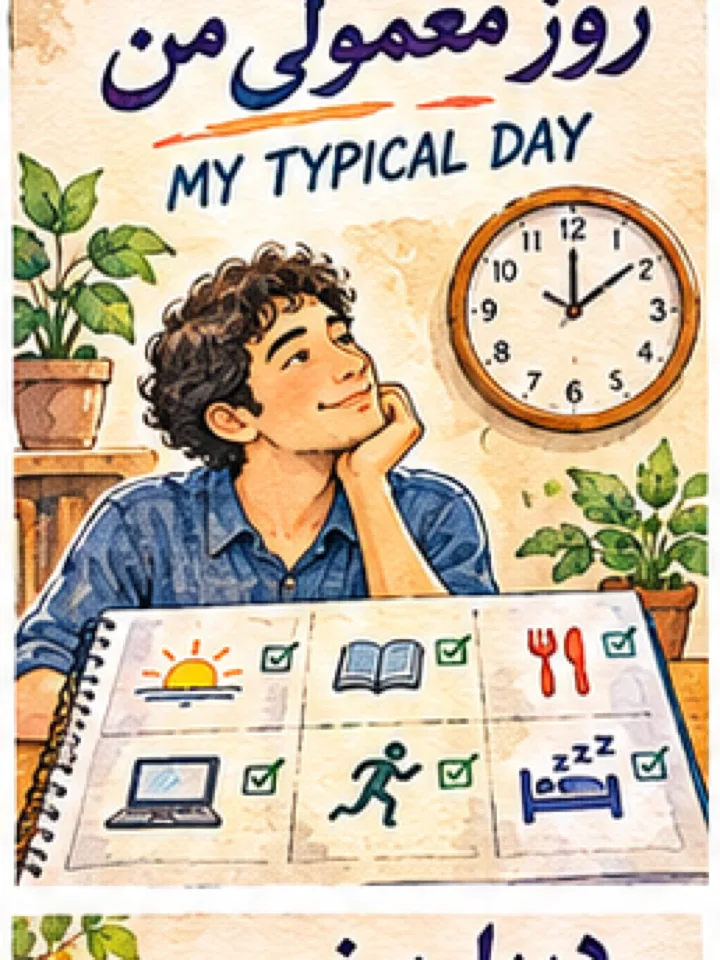

Exercise: Explain a typical day of your life.
Sample Writing:
من معمولا صبح ها زود از خواب بیدار می شوم. پس از دوش گرفتن، صبحانه می خورم. بعد از مسواک زدن لباس می پوشم و با اتوبوس به دانشگاه می روم. دانشگاه از خانه من زیاد دور نیست. بعضی وقتها تصمیم می گیرم تا دانشگاه پیاده بروم. من دانشجوی رشته مهندسی کامپیوتر هستم. در طول هفته معمولا صبح ها کلاس دارم و عصرها آزمایشگاه.
Write about your daily routine in Persian: a model answer line by line, time words and sequence connectors, a checklist and a short quiz.
Writing task: a typical day in your life
The task is to describe an ordinary day. This is one of the most useful writing topics for beginners because it practices the simple present (می + verb), time words, and words that put events in order. Follow the sample: start with the morning, move through the day, and end with the evening. The writer is a computer engineering student.
The model answer, sentence by sentence
| Persian | Pronunciation | English |
|---|---|---|
| من معمولا صبحها زود از خواب بیدار میشوم. | /man ma'mulan sobhhâ zud az khâb bidâr mishavam./ | I usually wake up early in the morning. |
| پس از دوش گرفتن، صبحانه میخورم. | /pas az dush gereftan, sobhâne mikhoram./ | After taking a shower, I have breakfast. |
| بعد از مسواک زدن لباس میپوشم و با اتوبوس به دانشگاه میروم. | /ba'd az mesvâk zadan lebâs mipusham va bâ otobus be dâneshgâh miravam./ | After brushing my teeth, I get dressed and take the bus to university. |
| دانشگاه از خانه من زیاد دور نیست. | /dâneshgâh az khâne-ye man ziyâd dur nist./ | The university is not very far from my home. |
| بعضی وقتها تصمیم میگیرم تا دانشگاه پیاده بروم. | /ba'zi vaghthâ tasmim migiram tâ dâneshgâh piyâde beravam./ | Sometimes I decide to walk to the university. |
| من دانشجوی رشته مهندسی کامپیوتر هستم. | /man dâneshju-ye reshte-ye mohandesi-ye kâmpiyuter hastam./ | I am a computer engineering student. |
| در طول هفته معمولا صبحها کلاس دارم و عصرها آزمایشگاه. | /dar tul-e hafte ma'mulan sobhhâ kelâs dâram va asrhâ âzmâyeshgâh./ | During the week I usually have classes in the morning and lab in the afternoon. |
| همیشه سعی میکنم شبها زودتر به خانه برگردم و به کارها و تکالیف درسی برسم. | /hamishe sa'y mikonam shabhâ zudtar be khâne bargardam va be kârhâ va takâlif-e darsi beresam./ | I always try to get home early in the evening and catch up on my chores and homework. |
| من اغلب قبل از ساعت 10 شب به رختخواب میروم تا صبح زودتر بیدار شوم. | /man aghlab ghabl az sâ'at-e dah-e shab be rakhtekhâb miravam tâ sobh zudtar bidâr shavam./ | I often go to bed before 10 p.m. so I can wake up earlier in the morning. |
Useful words and connectors
| Persian | Pronunciation | English |
|---|---|---|
| همیشه | /hamishe/ | always |
| معمولا | /ma'mulan/ | usually |
| اغلب | /aghlab/ | often |
| بعضی وقتها | /ba'zi vaghthâ/ | sometimes |
| هیچوقت | /hichvaght/ | never (with a negative verb) |
| اول / سپس / بعد | /avval / sepas / ba'd/ | first / then / after that |
| پس از / بعد از … | /pas az / ba'd az …/ | after … |
| قبل از … | /ghabl az …/ | before … |
| صبحها / عصرها / شبها | /sobhhâ / asrhâ / shabhâ/ | in the mornings / afternoons / evenings |
Notes on the model
Plural time words for routines. صبحها (sobhhâ), literally "mornings", means "in the mornings, every morning". This plural is the natural way to describe a habit. After پس از and بعد از, use the infinitive: بعد از مسواک زدن, "after brushing my teeth". تا + subjunctive gives the purpose: تا … بیدار شوم, "so that I wake up".
In the seventh sentence the verb is left out of the second half: عصرها آزمایشگاه means عصرها آزمایشگاه دارم. Persian often drops a repeated verb like this.
Checklist before you finish
- Did you cover morning, daytime and evening in order?
- Did you use at least three frequency words (همیشه, معمولا, بعضی وقتها)?
- Did you use بعد از or قبل از with an infinitive?
- Are all routine verbs in the present with می?
- Did you say what time you do at least one thing?
Your turn
Write eight to ten sentences about your own day. A good order is: wake up, morning routine, travel, work or classes, evening, bedtime. Add at least one time, such as ساعت هفت صبح (sâ'at-e haft-e sobh), "at 7 a.m.", and one sentence about what you do sometimes but not every day. Read your text aloud and check that every routine verb starts with می.
Keep reading
- Previous exercise: introduce yourself as a Persian student
- Next exercise: answer questions about yourself
Practice
-
How does the writer usually go to university?
Show answer
By bus. با اتوبوس
-
What does the writer have in the afternoons?
Show answer
Lab. آزمایشگاه
-
When does the writer often go to bed?
Show answer
Before 10 p.m. قبل از ساعت 10 شب
-
Translate: I always drink tea in the mornings.
Show answer
hamishe sobhhâ chây mikhoram. همیشه صبحها چای میخورم.
-
Translate: After eating lunch, I go to work.
Show answer
ba'd az nâhâr khordan, sar-e kâr miravam. بعد از ناهار خوردن، سر کار میروم.
Keep going with more Persian writing exercises.
همیشه سعی می کنم شبها زودتر به خانه برگردم و به کارها و تکالیف درسی برسم. من اغلب قبل از ساعت 10 شب به رختخواب می روم تا صبح زودتر بیدار شوم.


Take this lesson further

Serious about Persian? Get all 30 of our Persian learning books for $199.99 (55% less than buying them one by one).
Free Persian Starter Kit (PDF)
The Persian alphabet chart and the 101 most common Persian words with pronunciation, in one printable PDF. You also get a one-time 15% code for any of our books.
We will email you new lessons and book news from Learn Persian Online. Unsubscribe any time.Free Persian Starter Pack: Alphabet + 100 Core Words
Get the 14-page printable Starter Pack (all 32 letters, a 7-day reading plan, 100 core words and 20 survival phrases) and a short 5-email course. Free.