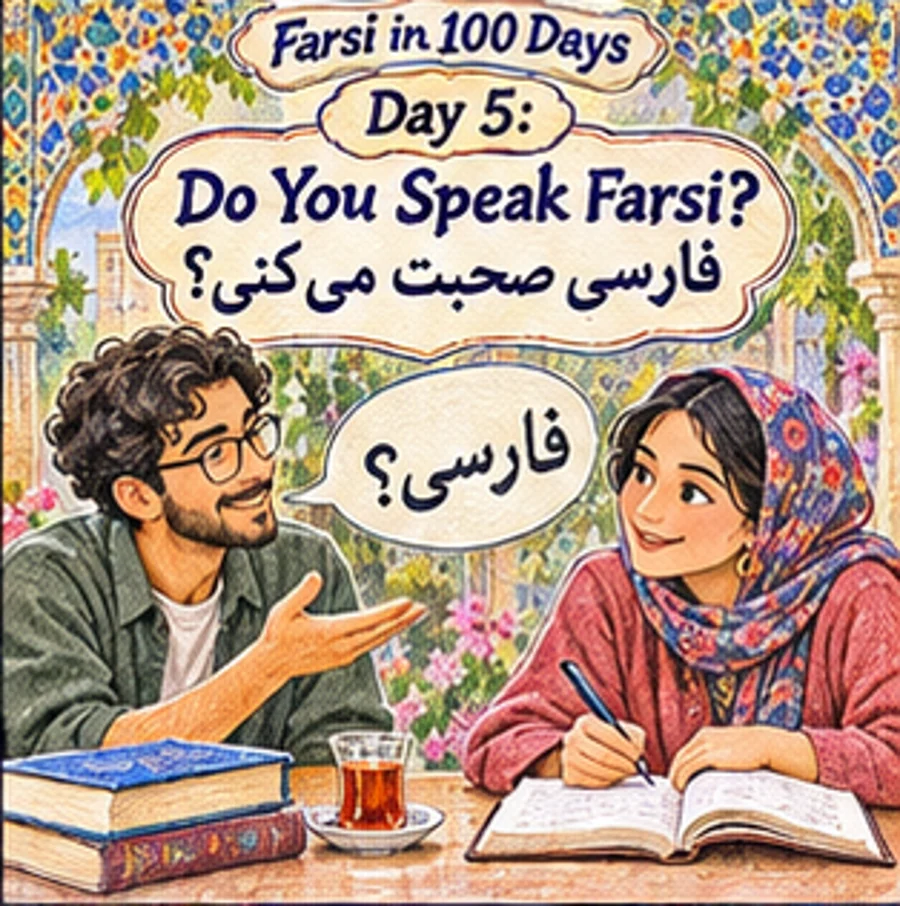
Day 5, Part 1 study notes: ask "Do you speak Farsi?", answer politely, and form the negative of "to be" with nistam and nist. Includes a quiz.
Listen to this lesson with Reza Nazari. All 399 lessons are in the free Learn Farsi in 100 Days video course.
Day 5: do you speak Farsi?
Day 5 of "Learn Farsi in 100 Days" is about a question every learner hears: "Do you speak Farsi?" Part 1 also covers the negative form of the verb "to be" and a short conversation. Use these notes alongside the video to review the phrases and the grammar.
Dialogue: meeting someone new
| Speaker | Persian | Pronunciation | English |
|---|---|---|---|
| Sara | سلام، شما فارسی صحبت میکنید؟ | /salâm, shomâ fârsi sohbat mikonid?/ | Hello, do you speak Farsi? |
| John | بله، کمی فارسی صحبت میکنم. | /bale, kami fârsi sohbat mikonam./ | Yes, I speak a little Farsi. |
| Sara | شما ایرانی هستید؟ | /shomâ irâni hastid?/ | Are you Iranian? |
| John | نه، ایرانی نیستم. آمریکایی هستم. | /na, irâni nistam. âmrikâyi hastam./ | No, I'm not Iranian. I'm American. |
| Sara | فارسی شما خیلی خوب است. | /fârsi-ye shomâ kheyli khub ast./ | Your Farsi is very good. |
| John | ممنون، ولی هنوز خیلی خوب نیست. | /mamnun, vali hanuz kheyli khub nist./ | Thanks, but it isn't very good yet. |
Notice how John answers the compliment. Iranians are usually delighted to hear a foreigner speak Persian and often say فارسیتون خیلی خوبه (fârsitun kheyli khube), "your Farsi is very good", even after a few words. A modest reply, like John's هنوز خیلی خوب نیست, "it isn't very good yet", sounds natural and polite. You can also simply say لطف دارید (lotf dârid), "you're kind".
Asking about languages
صحبت کردن (sohbat kardan), "to speak, to talk", is the neutral verb. In everyday speech you will also hear حرف زدن (harf zadan) and the very common بلد بودن (balad budan), "to know (how to)".
| Persian | Pronunciation | English |
|---|---|---|
| شما فارسی صحبت میکنید؟ | /shomâ fârsi sohbat mikonid?/ | Do you speak Farsi? (polite, written) |
| فارسی حرف میزنی؟ | /fârsi harf mizani?/ | Do you speak Farsi? (informal, spoken) |
| فارسی بلدی؟ | /fârsi baladi?/ | Do you know Farsi? (informal, spoken) |
| یه کم فارسی بلدم. | /ye kam fârsi baladam./ | I know a little Farsi. (spoken) |
| انگلیسی صحبت میکنید؟ | /engelisi sohbat mikonid?/ | Do you speak English? |
Grammar: the negative of "to be"
The negative of هستم (hastam), "I am", is نیستم (nistam), "I am not". The stem نیست (nist) takes the same personal endings as the positive form. Note that the third person singular is simply نیست, "is not": there is no separate word for "not".
| Persian | Pronunciation | English |
|---|---|---|
| من … نیستم | /man … nistam/ | I am not … |
| تو … نیستی | /to … nisti/ | you are not … (informal) |
| او … نیست | /u … nist/ | he / she is not … |
| ما … نیستیم | /mâ … nistim/ | we are not … |
| شما … نیستید | /shomâ … nistid/ | you are not … (plural or polite) |
| آنها … نیستند | /ânhâ … nistand/ | they are not … |
In speech, the last two forms are usually نیستین (nistin) and نیستن (nistan). As in English, the subject pronoun is often dropped because the ending already shows the person: ایرانی نیستم (irâni nistam), "I'm not Iranian".
Be careful not to confuse نیست (nist), "is not", with نه (na), "no". نه answers a question on its own; نیست is part of the sentence. A full answer often uses both: نه، ایرانی نیستم, "No, I'm not Iranian". The short spoken forms of "to be", like خوبم (khubam), "I'm fine", also become نیستم in the negative: خوب نیستم (khub nistam), "I'm not well".
Examples
| Persian | Pronunciation | English |
|---|---|---|
| من معلم نیستم، دانشجو هستم. | /man mo'allem nistam, dâneshju hastam./ | I'm not a teacher, I'm a student. |
| هوا سرد نیست. | /havâ sard nist./ | The weather isn't cold. |
| ما خسته نیستیم. | /mâ khaste nistim./ | We aren't tired. |
| آنها اینجا نیستند. | /ânhâ injâ nistand./ | They aren't here. |
- Day 5, Part 1: Do you speak Farsi? (main page)
- Day 5, Part 2: the verb "to have" and speech vs writing
Practice
-
Translate: "I'm not Iranian."
Show answer
irâni nistam. ایرانی نیستم.
-
What is the negative of this word? است
Show answer
nist, "is not" نیست
-
How do you ask a friend "Do you know Farsi?" informally?
Show answer
fârsi baladi? فارسی بلدی؟
-
Complete with the right form: "We aren't tired." ما خسته …
Show answer
nistim نیستیم
-
What does "kami" mean? کمی
Show answer
a little
Continue the course: Day 5, Part 2.
Take this lesson further

Study with the book
Learn Farsi in 100 Days: The Ultimate Crash Course to Learning Farsi Fast
This free lesson is part of Learn Farsi in 100 Days. The book puts the whole series in one printable PDF you can study offline.
Serious about Persian? Get all 30 of our Persian learning books for $199.99 (55% less than buying them one by one).
Free Persian Starter Kit (PDF)
The Persian alphabet chart and the 101 most common Persian words with pronunciation, in one printable PDF. You also get a one-time 15% code for any of our books.
We will email you new lessons and book news from Learn Persian Online. Unsubscribe any time.Free Persian Starter Pack: Alphabet + 100 Core Words
Get the 14-page printable Starter Pack (all 32 letters, a 7-day reading plan, 100 core words and 20 survival phrases) and a short 5-email course. Free.
Free. Every morning: that day’s four videos and the full lessons, with every Persian word, its pronunciation and its English meaning. Stop or pause with one click.