Learn the 200 most common Persian (Farsi) verbs from our book 200 Absolutely Essential Persian Verbs with free flashcards: 4 decks of 50, from the verbs you will use every day to less frequent ones. Each card gives the meaning, pronunciation, present and past stems and an example sentence, with a link to the full conjugation. Spaced repetition, quizzes, a typing drill and a free printable PDF are included. No sign-up.
Printable verb cards: all 200 verbs as cut-out cards, with the infinitive on the front and the meaning, both stems and an example sentence on the back. Free PDF, no sign-up. Every page has a QR code back to this page.
⬇ Download the PDFLoading flashcards…
What is on each verb card
The front shows the infinitive, the dictionary form ending in ـن (-an), as in نوشتن (neveshtan, to write). Flip it to see:
- the meaning and pronunciation;
- the present stem and the past stem. Every Persian tense is built from one of these two stems, so knowing both is knowing the verb. The past stem is the infinitive minus ن: نوشت (nevesht) gives نوشتم, I wrote. The present stem often has to be learned: نویس (nevis) gives مینویسم, I write;
- an example sentence with transliteration and English;
- a link to the full lesson for that verb, with every tense conjugated and more examples.
Why these 200 verbs, in this order
The verbs come from our book 200 Absolutely Essential Persian Verbs, plus رفتن (raftan, to go), the most common verb of all. The book lists them alphabetically. Here they are in order of how often they are used, measured with a frequency list of Persian film and TV subtitles, so Verbs 1–50 starts with کردن (to do), رفتن (to go), آمدن (to come) and بودن (to be).
About half of the list are compound verbs, a noun or adjective plus a light verb such as کردن (kardan), شدن (shodan) or دادن (dâdan): کمک کردن (komak kardan, to help) is literally “to make help”. Once you know the light verb’s stems, you can conjugate every compound built on it.
How to study Persian verbs with flashcards
- Learn the meaning first, with the Persian → English quiz and the flashcards.
- Then say the stems out loud each time you flip a card: present stem, past stem. This is the step most learners skip, and the one that makes conjugation easy later.
- Read the example sentence aloud and press 🔊 to compare, if your device has a Persian voice.
- Use the typing drill to practise spelling, then open the full lesson of any verb that keeps coming back as Again.
Common questions
What are the most common Persian verbs?
کردن (kardan, to do or make), رفتن (raftan, to go), آمدن (âmadan, to come), بودن (budan, to be), شدن (shodan, to become) and داشتن (dâshtan, to have) are the most frequent. They open the first deck.
How do I find the present stem of a Persian verb?
For regular verbs ending in یدن (-idan), drop یدن: خریدن (kharidan) → خر (khar). Most of the common verbs are irregular, so the stem has to be learned with the verb: دیدن (didan) → بین (bin). That is why every card shows it.
Can I print the verb cards?
Yes. The free PDF has cut-out cards. Print double-sided, flipping on the long edge, so each meaning lands behind its verb.
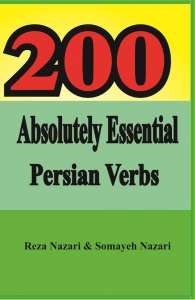
The book behind these cards: 200 Absolutely Essential Persian Verbs gives each verb its full conjugation, synonyms, opposites and example sentences on one page.
More Persian practice
- The 200 most common Persian verbs: the full list with a lesson for each verb
- 500 most common Persian words flashcards
- 1000 most common Persian phrases flashcards, in 61 everyday topics
- Persian flashcards by topic: 919 words in 32 themed decks
- Persian verbs quiz
Free: Persian Alphabet + 100 Core Words (PDF)
Get the 14-page printable Starter Pack (all 32 letters, a 7-day reading plan, 100 core words and 20 survival phrases) and a short 5-email course. Free.