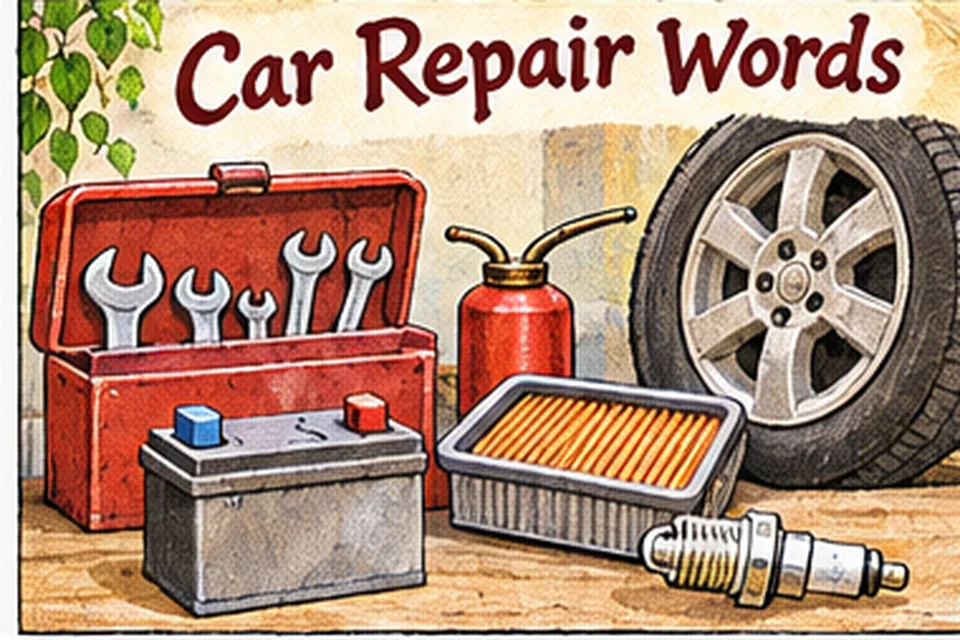
Lesson 17 of Learn to Speak Persian Fast, our free video course: At the Repair Shop. Watch the video for each part, then read the notes, with every Persian word in Persian script, pronunciation and English, and try the practice questions at the end of each part.
New words: Persian words for repairs and the repair shop
Learn 20 Persian words for car repair, with pronunciation, example sentences and a short quiz to go with the Lesson 17 video.
Study notes for this lesson. The video above introduces the new words for Lesson 17, which is about repairs. Below you will find a word list on the same theme, example sentences and a short quiz. The same words come back in the grammar, speaking and reading pages of this lesson, where Ali takes his car to Mr. Karimi's repair shop.
Read each word aloud twice while you look at the pronunciation column. Words borrowed from European languages, such as موتور (motor), باتری (bâtri) and لاستیک (lâstik), are easy to remember, so start with them and then move on to the native Persian words.
Word list
| Persian | Pronunciation | English |
|---|---|---|
| تعمیر | /ta'mir/ | repair |
| تعمیر کردن | /ta'mir kardan/ | to repair |
| تعمیرکار | /ta'mirkâr/ | repairman, mechanic |
| تعمیرگاه | /ta'mirgâh/ | repair shop, garage |
| ماشین | /mâshin/ | car |
| خراب | /kharâb/ | broken, not working |
| خراب شدن | /kharâb shodan/ | to break down |
| درست کردن | /dorost kardan/ | to fix |
| موتور | /motor/ | engine |
| ترمز | /tormoz/ | brake(s) |
| لاستیک | /lâstik/ | tire |
| باتری | /bâtri/ | battery |
| روغن | /roghan/ | oil |
| صدا | /sedâ/ | sound, noise |
| عوض کردن | /avaz kardan/ | to change, to replace |
| نگاه کردن | /negâh kardan/ | to look (at) |
| هزینه | /hazine/ | cost |
| آماده | /âmâde/ | ready |
| فردا | /fardâ/ | tomorrow |
| کلید | /kelid/ | key |
How the words work together
- Many verbs in Persian are made of a noun or adjective plus a light verb such as کردن (kardan, "to do") or شدن (shodan, "to become"). خراب (kharâb) means "broken"; خراب شدن (kharâb shodan) means "to break down."
- تعمیر (ta'mir) is "repair." Add -کار (-kâr, "worker") to get تعمیرکار (ta'mirkâr, "repairman"), and -گاه (-gâh, "place") to get تعمیرگاه (ta'mirgâh, "repair shop").
- In everyday speech, people say درست کردن (dorost kardan) more often than تعمیر کردن (ta'mir kardan) for "to fix."
- صدا دادن (sedâ dâdan), literally "to give a sound," means "to make a noise."
Example sentences
| Persian | Pronunciation | English |
|---|---|---|
| ماشین من خراب شده است. | /mâshin-e man kharâb shode ast. (spoken: mâshinam kharâb shode.)/ | My car has broken down. |
| تعمیرگاه کجاست؟ | /ta'mirgâh kojâst?/ | Where is the repair shop? |
| ترمز ماشین صدا میدهد. | /tormoz-e mâshin sedâ midahad. (spoken: sedâ mide.)/ | The car's brakes make a noise. |
| لطفاً روغن را عوض کنید. | /lotfan roghan râ avaz konid./ | Please change the oil. |
| تعمیرکار به موتور نگاه کرد. | /ta'mirkâr be motor negâh kard./ | The mechanic looked at the engine. |
| هزینهاش چقدر است؟ | /hazine-ash cheghadr ast? (spoken: hazinash cheghadr mishe?)/ | How much does it cost? |
| ماشین فردا آماده است. | /mâshin fardâ âmâde ast./ | The car will be ready tomorrow. |
Questions you will hear at a repair shop
| Persian | Pronunciation | English |
|---|---|---|
| چه مشکلی دارد؟ | /che moshkeli dârad? (spoken: che moshkeli dâre?)/ | What is wrong with it? |
| از کی خراب شده؟ | /az key kharâb shode?/ | Since when has it been broken? |
| کلید را دارید؟ | /kelid râ dârid? (spoken: kelid ro dârin?)/ | Do you have the key? |
| کی آماده میشود؟ | /key âmâde mishavad? (spoken: key âmâde mishe?)/ | When will it be ready? |
Tip for learning these words: group them. Put the car parts together (موتور, ترمز, لاستیک, باتری), the people and places together (تعمیرکار, تعمیرگاه), and the verbs together (خراب شدن, درست کردن, عوض کردن, نگاه کردن). Then say one sentence with a word from each group, for example "The mechanic changed the battery."
Practice
How do you say "repair shop" in Persian?
Show answer
ta'mirgâh تعمیرگاه
What does this mean? روغن را عوض کن.
Show answer
Change the oil.
Which word means "broken"?
Show answer
kharâb خراب
Translate: "The brakes make a noise."
Show answer
tormoz sedâ midahad. ترمز صدا میدهد.
What is the difference between {{تعمیر}} and {{تعمیرکار}}?
Show answer
ta'mir is "repair"; ta'mirkâr is the person who repairs, a mechanic.
Grammar: The imperative in Persian: giving commands and requests
How to give commands in Persian: the be- prefix, plural and polite forms, negative commands, spoken forms, examples and a quiz.
Study notes for this lesson. The Lesson 17 video teaches imperative verbs, the forms you use to tell someone to do something: "come," "look," "don't drive." At a repair shop you hear them all the time, so the examples here use the words from the New Words page.
Step 1: find the present stem
Every Persian verb has a present stem. For some verbs it is easy to see in the infinitive; for others you simply have to learn it. Here are the stems you need for this lesson.
| Infinitive: present stem | Pronunciation | English |
|---|---|---|
| رفتن: رو | /raftan: rav/ | to go |
| خوردن: خور | /khordan: khor/ | to eat |
| گفتن: گو | /goftan: gu/ | to say, to tell |
| دادن: ده | /dâdan: deh/ | to give |
| دیدن: بین | /didan: bin/ | to see |
| آمدن: آ | /âmadan: â/ | to come |
| آوردن: آور | /âvardan: âvar/ | to bring |
| گذاشتن: گذار | /gozâshtan: gozâr/ | to put, to leave, to let |
Step 2: add be- (and -id for the plural)
The singular imperative, used with one friend or family member, is ب (be-) plus the present stem. For more than one person, or to be polite with one person, add -ید (-id). The vowel of be- changes with the sound that follows it: it often becomes bo- when the next syllable has an o sound (boro, bokhor, bokon), and bi- before a stem that starts with â (بیا biyâ).
| Singular / plural or polite | Pronunciation | English |
|---|---|---|
| برو / بروید | /boro / beravid/ | go |
| بخور / بخورید | /bokhor / bokhorid/ | eat |
| بگو / بگویید | /begu / beguyid/ | say, tell |
| بده / بدهید | /bedeh / bedahid/ | give |
| ببین / ببینید | /bebin / bebinid/ | look, see |
| بیا / بیایید | /biyâ / biyâyid/ | come |
| بیاور / بیاورید | /biyâvar / biyâvarid/ | bring |
| بگذار / بگذارید | /begozâr / begozârid/ | put, leave, let |
Compound verbs
With compound verbs such as درست کردن (dorost kardan), only the verb part changes, and it normally takes no be-: درست کن (dorost kon), "fix." The imperative of شدن (shodan) is شو (sho): سوار شو (savâr sho), "get in."
| Persian | Pronunciation | English |
|---|---|---|
| درست کن / درست کنید | /dorost kon / dorost konid/ | fix |
| عوض کن / عوض کنید | /avaz kon / avaz konid/ | change |
| نگاه کن / نگاه کنید | /negâh kon / negâh konid/ | look |
| صبر کن / صبر کنید | /sabr kon / sabr konid/ | wait |
| سوار شو / سوار شوید | /savâr sho / savâr shavid/ | get in (the car) |
Negative commands
To say "don't," replace be- with ن (na-). With compound verbs, na- goes on the verb part.
| Persian | Pronunciation | English |
|---|---|---|
| نرو | /naro/ | don't go |
| نخور | /nakhor/ | don't eat |
| نگو | /nagu/ | don't say |
| نیا | /nayâ/ | don't come |
| درست نکن | /dorost nakon/ | don't fix (it) |
| رانندگی نکنید | /rânandegi nakonid/ | don't drive (polite) |
Spoken forms
In everyday Tehran speech the plural ending is often -in, and some stems are shortened: بروید becomes برید (berid), بیایید becomes بیاین (biyâin), بیاور becomes بیار (biyâr), بگذار becomes بذار (bezâr), بدهید becomes بدین (bedin). A very common polite word is بفرمایید (befarmâyid): "please, go ahead, here you are."
Examples
| Persian | Pronunciation | English |
|---|---|---|
| لطفاً ترمز را نگاه کنید. | /lotfan tormoz râ negâh konid./ | Please look at the brakes. |
| روغن را هم عوض کن. | /roghan râ ham avaz kon./ | Change the oil too. |
| کلید را به من بدهید. | /kelid râ be man bedahid./ | Give me the key. |
| فردا ساعت ده بیایید. | /fardâ sâ'at-e dah biyâyid./ | Come tomorrow at ten. |
| با این ماشین رانندگی نکن. | /bâ in mâshin rânandegi nakon./ | Don't drive this car. |
| بفرمایید بنشینید. | /befarmâyid beneshinid. (spoken: befarmâin beshinin.)/ | Please have a seat. |
| صبر کنید، الان میآیم. | /sabr konid, alân miâyam./ | Wait, I'm coming now. |
Common mistakes
- Keeping mi-: میرو is wrong; the imperative is برو (boro).
- Putting be- and na- together: نبرو is wrong; say نرو (naro).
- Adding be- to the first part of a compound verb: say درست کن (dorost kon), not "bedorost kon." You may hear درست بکن in speech, but درست کن is the standard form.
- Using the singular with a stranger, a shopkeeper or an older person. Use the plural form (بیایید, بدهید) to be polite.
Practice
Make the singular imperative of {{خوردن}} (khordan).
Show answer
bokhor بخور
Make it negative: {{برو}} (boro).
Show answer
naro نرو
Say politely to a mechanic: "Change the tire."
Show answer
lâstik râ avaz konid. لاستیک را عوض کنید.
What is the spoken form of {{بیاورید}}?
Show answer
biyârin (or biyârid) بیارین
Correct the mistake: {{میبیا}}
Show answer
biyâ بیا
Speaking practice: at the repair shop
A spoken Persian dialogue at a car repair shop, with useful phrases, a role-play idea and a quiz to practice Lesson 17.
Study notes for this lesson. After watching the speaking video, practice with this original dialogue. Ali's car is making a noise, so he takes it to Mr. Karimi's repair shop. The dialogue is in spoken Tehran Persian, the way people really talk; written forms are given in the phrase table.
Dialogue
| Speaker | Persian | Pronunciation | English |
|---|---|---|---|
| Ali | سلام آقای کریمی، خسته نباشید. | /salâm âghâ-ye karimi, khaste nabâshid./ | Hello, Mr. Karimi. (a greeting for someone at work) |
| Mr. Karimi | سلام، بفرمایید. چه کمکی از دستم برمیاد؟ | /salâm, befarmâyid. che komaki az dastam barmiyâd?/ | Hello, come in. How can I help? |
| Ali | ماشینم خراب شده. ترمزش صدا میده. | /mâshinam kharâb shode. tormozesh sedâ mide./ | My car has a problem. The brakes make a noise. |
| Mr. Karimi | کلید رو بدین، یه نگاه بکنم. | /kelid ro bedin, ye negâh bokonam./ | Give me the key; let me have a look. |
| Ali | بفرمایید. لطفاً روغنش رو هم عوض کنید. | /befarmâyid. lotfan roghanesh ro ham avaz konid./ | Here you are. Please change the oil too. |
| Mr. Karimi | باشه. ترمزش مشکل داره، باید درستش کنم. | /bâshe. tormozesh moshkel dâre, bâyad dorostesh konam./ | OK. The brakes have a problem; I need to fix them. |
| Ali | هزینهش چقدر میشه؟ | /hazinash cheghadr mishe?/ | How much will it cost? |
| Mr. Karimi | حدود دو میلیون تومن. | /hodud-e do milyun tomân./ | About two million tomans. |
| Ali | کی آماده میشه؟ | /key âmâde mishe?/ | When will it be ready? |
| Mr. Karimi | فردا ساعت ده بیاین. | /fardâ sâ'at-e dah biyâin./ | Come tomorrow at ten. |
| Ali | دستتون درد نکنه. | /dastetun dard nakone./ | Thank you very much. |
| Mr. Karimi | خواهش میکنم. خدانگهدار. | /khâhesh mikonam. khodâ negahdâr./ | You're welcome. Goodbye. |
Useful phrases
| Persian | Pronunciation | English |
|---|---|---|
| خسته نباشید | /khaste nabâshid/ | said to someone who is working; literally "may you not be tired" |
| چه کمکی از دستم برمیاد؟ | /che komaki az dastam barmiyâd?/ | How can I help? (formal: che komaki az dastam bar miâyad?) |
| ماشینم خراب شده. | /mâshinam kharâb shode./ | My car has broken down. (formal: mâshinam kharâb shode ast.) |
| یه نگاه بکنم. | /ye negâh bokonam./ | Let me take a look. |
| هزینهش چقدر میشه؟ | /hazinash cheghadr mishe?/ | How much will it cost? (formal: hazine-ash cheghadr mishavad?) |
| کی آماده میشه؟ | /key âmâde mishe?/ | When will it be ready? |
| دستتون درد نکنه. | /dastetun dard nakone./ | Thank you; literally "may your hand not hurt" |
Notes
- Notice the imperatives from the grammar page: بدین (bedin, "give"), عوض کنید (avaz konid, "change"), بیاین (biyâin, "come"). Ali and Mr. Karimi use plural forms because they speak politely to each other.
- کی here is key, "when." The same spelling read as ki means "who."
- Spoken Persian shortens many endings: میده (mide) for میدهد (midahad), میشه (mishe) for میشود (mishavad), رو (ro) for را (râ).
Role-play
Work with a partner. One of you is the car owner and the other is the mechanic. This time the car will not start because the battery (باتری, bâtri) is dead. The owner greets the mechanic, explains the problem, asks the mechanic to look at the battery, and asks how much it will cost and when it will be ready. The mechanic answers with at least two imperatives, for example "give me the key" and "come back this afternoon."
Practice
What does Ali say first when he arrives at the shop?
Show answer
khaste nabâshid (a greeting for someone at work). خسته نباشید.
What is wrong with Ali's car?
Show answer
The brakes make a noise. ترمزش صدا میده.
What else does Ali ask the mechanic to do?
Show answer
Change the oil. روغنش رو هم عوض کنید.
How do you ask "When will it be ready?" in spoken Persian?
Show answer
key âmâde mishe? کی آماده میشه؟
When should Ali come back?
Show answer
Tomorrow at ten. فردا ساعت ده.
Reading practice: Ali's car breaks down
A short beginner Persian reading about a car repair, sentence by sentence with pronunciation and English, key words and a quiz.
Study notes for this lesson. This original reading text uses the words and grammar of Lesson 17. It is written in standard written Persian. Read each sentence aloud, check the pronunciation, then cover the English column and try to understand the Persian alone.
Before you read, look at the title and guess: what might go wrong with a car, and who can fix it? If you have studied the New Words page, you already know almost every word in the text. New words are explained in the key word list below.
Reading text
| Persian | Pronunciation | English |
|---|---|---|
| علی یک ماشین کوچک دارد. | /ali yek mâshin-e kuchak dârad./ | Ali has a small car. |
| دیروز ماشین علی خراب شد. | /diruz mâshin-e ali kharâb shod./ | Yesterday Ali's car broke down. |
| ترمز ماشین صدای بدی میداد. | /tormoz-e mâshin sedâ-ye badi midâd./ | The car's brakes were making a bad noise. |
| علی ماشین را به تعمیرگاه آقای کریمی برد. | /ali mâshin râ be ta'mirgâh-e âghâ-ye karimi bord./ | Ali took the car to Mr. Karimi's repair shop. |
| آقای کریمی یک تعمیرکار خوب و باتجربه است. | /âghâ-ye karimi yek ta'mirkâr-e khub va bâtajrobe ast./ | Mr. Karimi is a good, experienced mechanic. |
| او به ترمز و موتور نگاه کرد. | /u be tormoz va motor negâh kard./ | He looked at the brakes and the engine. |
| آقای کریمی گفت: «ترمز مشکل دارد، اما موتور سالم است.» | /âghâ-ye karimi goft: "tormoz moshkel dârad, ammâ motor sâlem ast."/ | Mr. Karimi said, "The brakes have a problem, but the engine is fine." |
| علی گفت: «لطفاً روغن را هم عوض کنید.» | /ali goft: "lotfan roghan râ ham avaz konid."/ | Ali said, "Please change the oil too." |
| تعمیر ماشین دو میلیون تومان هزینه داشت. | /ta'mir-e mâshin do milyun tomân hazine dâsht./ | The repair cost two million tomans. |
| آقای کریمی گفت: «فردا ساعت ده بیایید.» | /âghâ-ye karimi goft: "fardâ sâ'at-e dah biyâyid."/ | Mr. Karimi said, "Come tomorrow at ten." |
| روز بعد، ماشین آماده بود و علی خوشحال به خانه رفت. | /ruz-e ba'd, mâshin âmâde bud va ali khoshhâl be khâne raft./ | The next day the car was ready, and Ali went home happy. |
Key words
- خراب شدن (kharâb shodan): to break down
- تعمیرگاه (ta'mirgâh): repair shop
- تعمیرکار (ta'mirkâr): mechanic
- ترمز (tormoz): brakes
- موتور (motor): engine
- باتجربه (bâtajrobe): experienced
- سالم (sâlem): healthy; here, in good condition
- هزینه داشتن (hazine dâshtan): to cost
- آماده (âmâde): ready
Grammar to notice
Sentences 8 and 10 contain imperatives from the grammar page: عوض کنید (avaz konid, "change") and بیایید (biyâyid, "come"). Both are plural forms, used to be polite. Sentence 3 uses میداد (midâd), the past progressive, "was making."
After you read
- Find the three people or places in the text: Ali, Mr. Karimi and the repair shop. Underline every word that belongs to the car: ماشین, ترمز, موتور, روغن.
- Retell the story in three Persian sentences of your own, for example: ماشین علی خراب شد. آقای کریمی ترمز را درست کرد. ماشین فردا آماده شد.
- Change sentence 1 to talk about yourself: "I have a small car" is من یک ماشین کوچک دارم. (man yek mâshin-e kuchak dâram.)
- Read the text again and time yourself. Try to read it aloud in under one minute without looking at the pronunciation column.
Practice
What was wrong with Ali's car? ترمز ماشین چه مشکلی داشت؟
Show answer
The brakes were making a bad noise. ترمز صدای بدی میداد.
Who is Mr. Karimi? آقای کریمی کیست؟
Show answer
A good, experienced mechanic. یک تعمیرکار خوب و باتجربه.
Was there a problem with the engine? موتور مشکل داشت؟
Show answer
No, the engine was fine. نه، موتور سالم بود.
How much did the repair cost? تعمیر چقدر هزینه داشت؟
Show answer
Two million tomans. دو میلیون تومان.
How did Ali feel at the end? علی در آخر چه حالی داشت؟
Show answer
Happy. خوشحال بود.
Take this lesson further

Study with the book
Learn to Speak Persian Fast: For Beginners
This free lesson is part of Learn to Speak Persian Fast. The book puts the whole series in one printable PDF you can study offline.
Serious about Persian? Get all 30 of our Persian learning books for $199.99 (55% less than buying them one by one).
Free Persian Starter Kit (PDF)
The Persian alphabet chart and the 101 most common Persian words with pronunciation, in one printable PDF. You also get a one-time 15% code for any of our books.
We will email you new lessons and book news from Learn Persian Online. Unsubscribe any time.Free Persian Starter Pack: Alphabet + 100 Core Words
Get the 14-page printable Starter Pack (all 32 letters, a 7-day reading plan, 100 core words and 20 survival phrases) and a short 5-email course. Free.