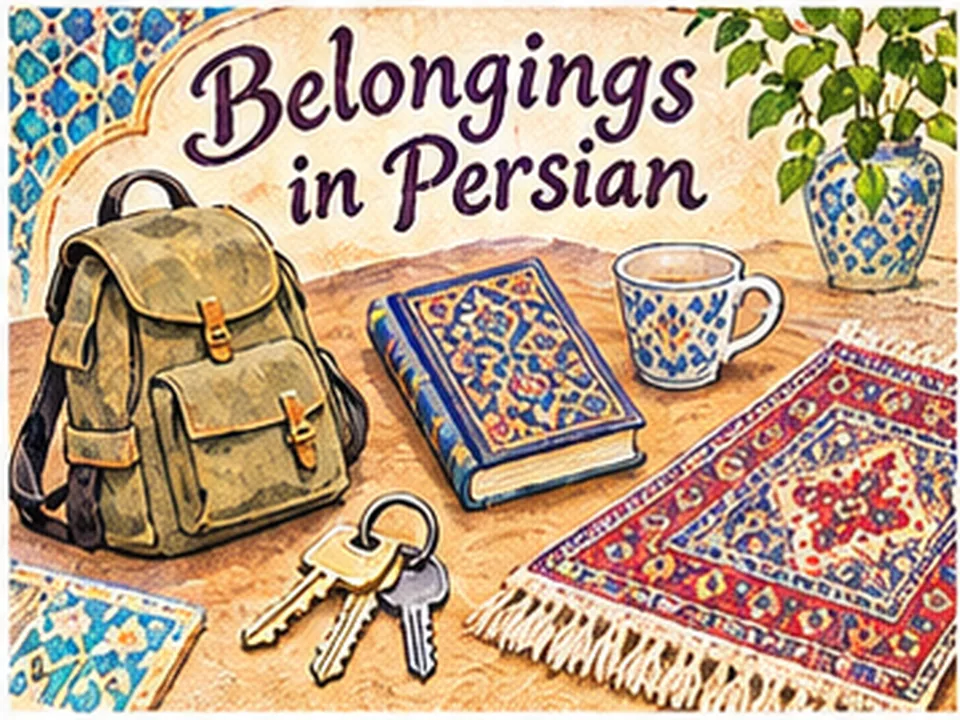
Lesson 13 of Learn to Speak Persian Fast, our free video course: Whose Is This?. Watch the video for each part, then read the notes, with every Persian word in Persian script, pronunciation and English, and try the practice questions at the end of each part.
New words: Belongings and family in Persian
Study notes for Lesson 13: twenty Persian words for everyday belongings and family members, with pronunciation, example sentences and a quiz.
These study notes go with the Lesson 13 video of Learn to Speak Persian Fast. Lesson 13 is about possession: saying my bag, your phone, Neda's room, or "this is mine". To practice that, you need things to own and people to own them. This page gives you both. In this lesson you will meet Neda and her brother Kaveh.
Word list
A good way to learn these words is to label real things around you. Walk through your home and say each object with "my": کلیدم (kelidam, my key), کیفم (kifam, my bag), کفشم (kafsham, my shoes). The more you connect a word to a real thing, the faster it sticks.
| Persian | Pronunciation | English |
|---|---|---|
| کتاب | /ketâb/ | book |
| دفتر | /daftar/ | notebook (also: office) |
| خودکار | /khodkâr/ | pen |
| کیف | /kif/ | bag; purse; wallet |
| کلید | /kelid/ | key |
| گوشی | /gushi/ | mobile phone |
| ساعت | /sâ'at/ | watch; clock |
| عینک | /eynak/ | glasses |
| ماشین | /mâshin/ | car |
| دوچرخه | /docharkhe/ | bicycle |
| خانه | /khâne/ | house, home |
| اتاق | /otâgh/ | room |
| لباس | /lebâs/ | clothes; dress |
| کفش | /kafsh/ | shoe, shoes |
| پدر | /pedar/ | father |
| مادر | /mâdar/ | mother |
| برادر | /barâdar/ | brother |
| خواهر | /khâhar/ | sister |
| دوست | /dust/ | friend |
| مال | /mâl/ | property; used for "belongs to" |
Notes on usage
- To link a thing and its owner, Persian adds the sound -e between them, called ezâfe: کتاب من (ketâb-e man), "my book". It is usually not written.
- After a word ending in a silent ه (-e), the ezâfe becomes -ye and is often written هی: خانهی من (khâne-ye man), "my house".
- After a word ending in ی (-i), you also hear -ye, but nothing extra is written: گوشی من (gushi-ye man), "my phone".
- مال (mâl) plus ezâfe means "belonging to": این مال من است (in mâl-e man ast), "this is mine".
- In spoken Persian, خانه is خونه (khune), and Mom and Dad are مامان (mâmân) and بابا (bâbâ).
Example sentences
| Persian | Pronunciation | English |
|---|---|---|
| این کتاب من است. | /in ketâb-e man ast./ | This is my book. |
| کلید ماشین کجاست؟ | /kelid-e mâshin kojâst?/ | Where is the car key? |
| این گوشی مال کیست؟ | /in gushi mâl-e kist?/ | Whose phone is this? |
| خواهرم یک دوچرخهی قرمز دارد. | /khâharam yek docharkhe-ye ghermez dârad./ | My sister has a red bicycle. |
| اتاق برادرم کوچک است. | /otâgh-e barâdaram kuchek ast./ | My brother's room is small. |
| دیروز عینکم را پیدا نکردم. | /diruz eynakam râ peydâ nakardam./ | Yesterday I couldn't find my glasses. |
More family words
| Persian | Pronunciation | English |
|---|---|---|
| خانواده | /khânevâde/ | family |
| پدربزرگ | /pedarbozorg/ | grandfather |
| مادربزرگ | /mâdarbozorg/ | grandmother |
| پسر | /pesar/ | son; boy |
| دختر | /dokhtar/ | daughter; girl |
| شوهر | /shohar/ | husband |
| زن | /zan/ | wife; woman |
These words work exactly like the others: پسرم (pesaram) is "my son" and خانوادهی من (khânevâde-ye man) is "my family".
Notice the two ways to say "my" in these sentences: کتاب من (ketâb-e man) and the short ending in خواهرم (khâharam). The grammar page explains both.
More from Lesson 13
Practice
What does this word mean? کلید
Show answer
key
How do you say "bicycle" in Persian?
Show answer
docharkhe دوچرخه
Translate: کتاب من
Show answer
my book
How do you pronounce "my house" (khâne + man)?
Show answer
khâne-ye man خانهی من
Ask "Whose phone is this?"
Show answer
in gushi mâl-e kist? این گوشی مال کیست؟
Grammar: How to show possession in Persian
Study notes for Lesson 13: three ways to show possession in Persian (ezâfe, possessive endings and mâl), with tables, examples and common mistakes.
The Lesson 13 grammar video covers possession. English uses words like my, your and 's. Persian has three tools for the same job: the ezâfe link with a pronoun or name, short possessive endings attached to the noun, and the word مال (mâl) for "mine, yours, his". You will hear all three every day.
1. Ezâfe + pronoun or name
Put the thing first, then the owner, and join them with the sound -e (the ezâfe). This is the most transparent way and is used both in writing and speech.
| Persian | Pronunciation | English |
|---|---|---|
| کتاب من | /ketâb-e man/ | my book |
| کتاب تو | /ketâb-e to/ | your book (singular, informal) |
| کتاب او | /ketâb-e u/ | his / her book |
| کتاب ما | /ketâb-e mâ/ | our book |
| کتاب شما | /ketâb-e shomâ/ | your book (plural or polite) |
| کتاب آنها | /ketâb-e ânhâ/ | their book |
| کتاب ندا | /ketâb-e nedâ/ | Neda's book |
| ماشین پدرم | /mâshin-e pedaram/ | my father's car |
2. Possessive endings
Instead of a separate pronoun, you can attach a short ending to the noun. This is very common, especially in speech. The table gives the written form and, after the slash, the everyday spoken pronunciation.
| Persian | Pronunciation | English |
|---|---|---|
| کتابم | /ketâbam/ | my book |
| کتابت | /ketâbat / ketâbet/ | your book (singular) |
| کتابش | /ketâbash / ketâbesh/ | his / her book |
| کتابمان | /ketâbemân / ketâbemun/ | our book |
| کتابتان | /ketâbetân / ketâbetun/ | your book (plural or polite) |
| کتابشان | /ketâbeshân / ketâbeshun/ | their book |
After a word ending in a silent ه, the endings are written separately with an alef: خانهام (khâne-am), خانهات (khâne-at), خانهاش (khâne-ash), خانهمان (khâne-mân), خانهتان (khâne-tân), خانهشان (khâne-shân). After a long â or u, a y is added in writing: صدایم (sedâyam), "my voice".
3. mâl: mine, yours, his
To say "mine" or "it belongs to", use مال with ezâfe: این کیف مال من است (in kif mâl-e man ast), "this bag is mine". In speech: این کیف مال منه (in kif mâl-e mane). To ask whose something is: مال کیست؟ (mâl-e kist?), spoken مال کیه؟ (mâl-e kiye?).
Adjectives and possession
When the noun has an adjective, the owner comes at the very end of the phrase: کیف سیاه من (kif-e siyâh-e man), "my black bag". A possessive ending also goes on the last word: کیف سیاهم (kif-e siyâham). Compare کیفم سیاه است (kifam siyâh ast), which is a full sentence: "my bag is black".
Examples
| Persian | Pronunciation | English |
|---|---|---|
| این دفتر من است. | /in daftar-e man ast./ | This is my notebook. |
| کلیدت کجاست؟ | /kelidet kojâst?/ | Where is your key? (spoken) |
| برادرش در تهران زندگی میکند. | /barâdarash dar tehrân zendegi mikonad./ | Her brother lives in Tehran. |
| خانهمان نزدیک پارک است. | /khâne-mân nazdik-e pârk ast./ | Our house is near the park. |
| ماشین سفید پدرم کجاست؟ | /mâshin-e sefid-e pedaram kojâst?/ | Where is my father's white car? |
| این دوچرخه مال کاوه است. | /in docharkhe mâl-e kâve ast./ | This bicycle is Kaveh's. |
| کفشهایتان را اینجا بگذارید. | /kafshhâyetân râ injâ begozârid./ | Leave your shoes here. |
| آن عینک مال من نیست. | /ân eynak mâl-e man nist./ | Those glasses are not mine. |
Common mistakes
- Using English order. "Neda's book" is کتاب ندا (ketâb-e nedâ): thing first, owner second.
- Dropping the ezâfe. Without the -e sound, کتاب من sounds like two separate words. Say ketâb-e man, not ketâb man.
- Putting the ending on the noun instead of the adjective. "My new phone" is گوشی جدیدم (gushi-ye jadidam). With the ending on the noun you get a sentence instead: گوشیام جدید است (gushi-am jadid ast), "my phone is new".
- Using both a pronoun and an ending: say کتاب من or کتابم, not کتابم من.
- Forgetting مال for "mine": "it's mine" is مال من است, not just من است, which means "it's me".
More from Lesson 13
Practice
Say "my sister" with a possessive ending.
Show answer
khâharam خواهرم
Say "our house" with a possessive ending.
Show answer
khâne-mân خانهمان
Translate: ماشین پدرم
Show answer
my father's car
How do you say "This bag is mine"?
Show answer
in kif mâl-e man ast. این کیف مال من است.
What is the difference between these two? کیف سیاهم / کیفم سیاه است
Show answer
The first is a phrase, "my black bag"; the second is a sentence, "my bag is black".
Speaking: whose is this?
Study notes for Lesson 13: an original Persian dialogue about lost keys and glasses, phrases for saying mine and yours, a role-play and a quiz.
These study notes accompany the Lesson 13 speaking video. The dialogue below is original practice material, not a transcript. Kaveh is looking for his father's car key, and his sister Neda helps him. It is in natural spoken Tehran Persian, so many words look a little different from the written forms on the grammar page. The notes after the dialogue show the written forms.
Dialogue
| Speaker | Persian | Pronunciation | English |
|---|---|---|---|
| Kaveh | ندا، کلید منو دیدی؟ | /nedâ, kelid-e mano didi?/ | Neda, have you seen my key? |
| Neda | کدوم کلید؟ کلید خونه؟ | /kodum kelid? kelid-e khune?/ | Which key? The house key? |
| Kaveh | نه، کلید ماشین بابا. | /na, kelid-e mâshin-e bâbâ./ | No, Dad's car key. |
| Neda | این کلید مال توئه؟ | /in kelid mâl-e toe?/ | Is this key yours? |
| Kaveh | نه، اون مال مامانه. | /na, un mâl-e mâmâne./ | No, that's Mom's. |
| Neda | تو کیفت رو نگاه کردی؟ | /tu kifet ro negâh kardi?/ | Did you look in your bag? |
| Kaveh | آره، اونجا نیست. عینکم هم نیست. | /âre, unjâ nist. eynakam ham nist./ | Yes, it's not there. And my glasses are missing too. |
| Neda | عینکت روی سرته. | /eynaket ru-ye sarete./ | Your glasses are on your head. |
| Kaveh | ای وای، راست میگی. | /ey vây, râst migi./ | Oh dear, you're right. |
| Neda | کلید هم توی جیبته. | /kelid ham tu-ye jibete./ | And the key is in your pocket. |
| Kaveh | آخ، آره. مرسی ندا. | /âkh, âre. mersi nedâ./ | Oh, yes. Thanks, Neda. |
Useful phrases
| Persian | Pronunciation | English |
|---|---|---|
| این مال توئه؟ | /in mâl-e toe?/ | Is this yours? |
| مال منه. | /mâl-e mane./ | It's mine. |
| مال من نیست. | /mâl-e man nist./ | It's not mine. |
| این مال کیه؟ | /in mâl-e kiye?/ | Whose is this? |
| کلیدمو ندیدی؟ | /kelidamo nadidi?/ | Haven't you seen my key? |
| راست میگی. | /râst migi./ | You're right. |
| مال مامانه. | /mâl-e mâmâne./ | It's Mom's. |
Spoken and written forms
- منو (mano) = من را (man râ); رو (ro) = را (râ), the object marker.
- توئه (toe) = تو است (to ast); مامانه (mâmâne) = مامان است. In speech, "is" shrinks to -e.
- اون (un) = آن (ân), "that"; اونجا (unjâ) = آنجا (ânjâ), "there".
- سرته (sarete) = سرت است (sarat ast), "is on your head": the possessive ending -et plus -e for "is".
- توی (tu-ye) means "in, inside". It is informal; the written word is در (dar).
Possession in the dialogue
Kaveh and Neda mostly use the short possessive endings, which is typical of conversation: کیفت (kifet, your bag), عینکم (eynakam, my glasses), عینکت (eynaket, your glasses), سرت (saret, your head) and جیبت (jibet, your pocket). In speech the "your" ending sounds like -et, while textbooks often write it as -at. The longer forms کلید من and مال تو appear when the speaker wants to stress whose thing it is.
Role-play
Put five or six real objects on a table: a pen, a phone, keys, glasses, a notebook. One partner picks up each object and asks این مال توئه؟. The other answers with آره، مال منه or نه، مال من نیست. مال باباست (na, mâl-e man nist. mâl-e bâbâst), "No, it's not mine. It's Dad's", naming a family member. Then switch, and try asking with a possessive ending instead: این گوشیته؟ (in gushite?), "is this your phone?"
More from Lesson 13
Practice
What is Kaveh looking for?
Show answer
His father's car key (and then his glasses). کلید ماشین بابا
Where are Kaveh's glasses?
Show answer
On his head. روی سرش
Say "Is this yours?" in spoken Persian.
Show answer
in mâl-e toe? این مال توئه؟
What is the written form of this sentence? مال مامانه.
Show answer
mâl-e mâmân ast. مال مامان است.
What does توی mean?
Show answer
in, inside (informal)
Reading: Neda's room
Study notes for Lesson 13: a short beginner Persian text in which Neda describes her room and family's things, with key words and a comprehension quiz.
This short text goes with the Lesson 13 reading video. It is an original beginner text that uses the words for belongings and the possessive forms of this lesson. Neda describes her room and some of her family's things. Read it once for meaning, then a second time and underline every way of saying "my", "his" or "our".
The text
| Persian | Pronunciation | English |
|---|---|---|
| اسم من ندا است. | /esm-e man nedâ ast./ | My name is Neda. |
| این اتاق من است. | /in otâgh-e man ast./ | This is my room. |
| اتاقم کوچک است، اما خیلی قشنگ است. | /otâgham kuchek ast, ammâ kheyli ghashang ast./ | My room is small, but it is very pretty. |
| کتابهایم روی میز است. | /ketâbhâyam ru-ye miz ast./ | My books are on the table. |
| کیف مدرسهام کنار در است. | /kif-e madrase-am kenâr-e dar ast./ | My school bag is next to the door. |
| این دوچرخه مال برادرم کاوه است. | /in docharkhe mâl-e barâdaram kâve ast./ | This bicycle belongs to my brother Kaveh. |
| کاوه یک گوشی جدید دارد. | /kâve yek gushi-ye jadid dârad./ | Kaveh has a new phone. |
| گوشی من قدیمی است، اما من آن را دوست دارم. | /gushi-ye man ghadimi ast, ammâ man ân râ dust dâram./ | My phone is old, but I like it. |
| پدرم یک ماشین سفید دارد. | /pedaram yek mâshin-e sefid dârad./ | My father has a white car. |
| کاوه همیشه کلید ماشین پدرمان را گم میکند. | /kâve hamishe kelid-e mâshin-e pedaremân râ gom mikonad./ | Kaveh always loses our father's car key. |
| خانهی ما بزرگ نیست، اما ما آن را خیلی دوست داریم. | /khâne-ye mâ bozorg nist, ammâ mâ ân râ kheyli dust dârim./ | Our house isn't big, but we love it. |
Two small grammar points to notice: Persian uses دوست داشتن (dust dâshtan) for both "like" and "love", so دوست دارم can be either, depending on context. And plural things such as کتابها often take a singular verb: کتابهایم روی میز است, literally "my books is on the table".
Possessive forms in the text
The text uses all three ways of showing possession. With ezâfe and a pronoun: اتاق من, گوشی من, خانهی ما. With endings: اتاقم, کتابهایم, مدرسهام, پدرم, پدرمان. With مال: مال برادرم. Notice کتابهایم (ketâbhâyam): after the plural ها, the ending is written with a ی.
After reading
- Read the text aloud twice. The second time, try not to look at the transliteration.
- Rewrite three sentences about your own room, for example اتاقم بزرگ است (otâgham bozorg ast), "my room is big".
- Change the text so Kaveh is speaking: اسم من کاوه است, این دوچرخهی من است, and so on.
Key words
- اسم (esm): name
- قشنگ (ghashang): pretty, nice
- روی میز (ru-ye miz): on the table
- کنار در (kenâr-e dar): next to the door
- جدید (jadid): new; قدیمی (ghadimi): old (for things)
- همیشه (hamishe): always
- گم کردن (gom kardan): to lose
More from Lesson 13
Practice
Is Neda's room big?
Show answer
No, it is small, but very pretty. اتاقش کوچک است.
Whose bicycle is in the room?
Show answer
Her brother Kaveh's. مال برادرش کاوه
Who has a new phone?
Show answer
Kaveh. کاوه
What does Kaveh always lose?
Show answer
Their father's car key. کلید ماشین پدرشان
Find the phrase in the text that means "my school bag".
Show answer
kif-e madrase-am کیف مدرسهام
Take this lesson further

Study with the book
Learn to Speak Persian Fast: For Beginners
This free lesson is part of Learn to Speak Persian Fast. The book puts the whole series in one printable PDF you can study offline.
Serious about Persian? Get all 30 of our Persian learning books for $199.99 (55% less than buying them one by one).
Free Persian Starter Kit (PDF)
The Persian alphabet chart and the 101 most common Persian words with pronunciation, in one printable PDF. You also get a one-time 15% code for any of our books.
We will email you new lessons and book news from Learn Persian Online. Unsubscribe any time.Free Persian Starter Pack: Alphabet + 100 Core Words
Get the 14-page printable Starter Pack (all 32 letters, a 7-day reading plan, 100 core words and 20 survival phrases) and a short 5-email course. Free.