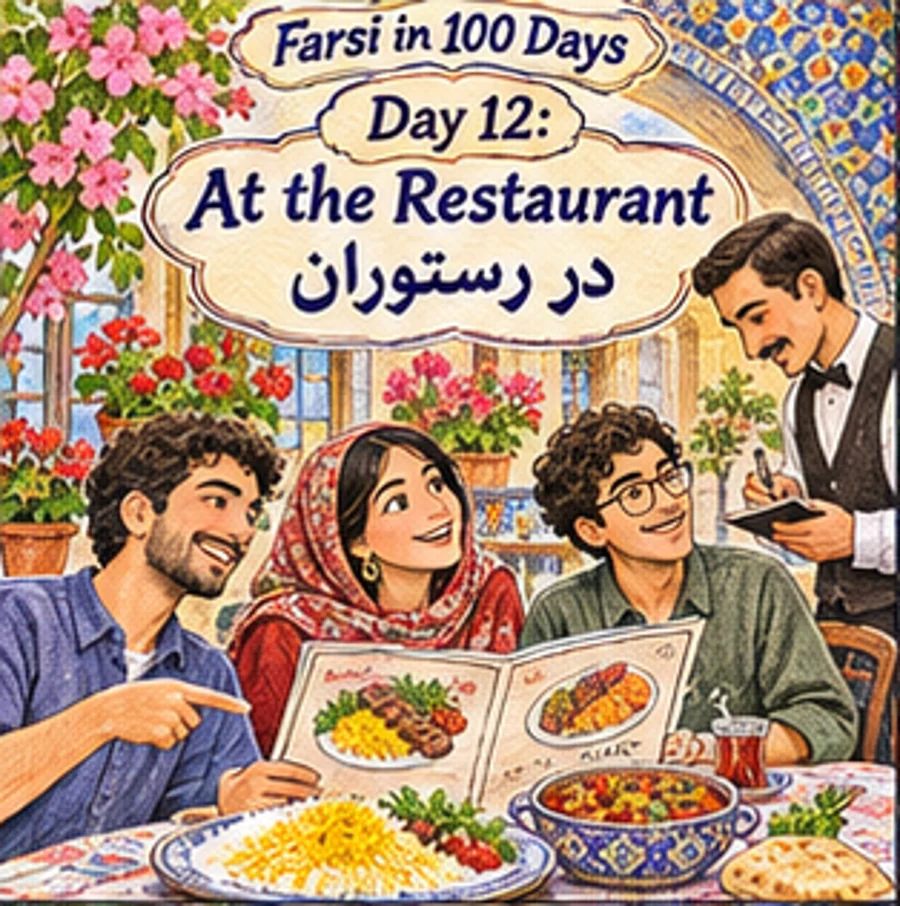
Day 12 of Learn Farsi in 100 Days, our free step-by-step Persian course: At the Restaurant. The lesson has four parts, with every Persian word in Persian script, pronunciation and English, and each part ends with a quick check.
Part 1Grammar and conversation
Day 12, Part 1 teaches the Persian present progressive made with داشتن plus the present tense, as in دارم میروم (dâram miravam, I am going), and a conversation where Shahla says گرسنه هستم (gorosne hastam, I’m hungry) and wants to go to an Iranian restaurant.
Grammar: the present progressive (حال استمراری)
To stress that an action is happening right now, Persian often puts the present forms of داشتن (dâshtan, to have) before the ordinary present tense (حال اخباری, hâl-e ekhbâri). Both verbs take the same person ending: دارم میروم (dâram miravam, I am going). This form is called حال استمراری (hâl-e estemrâri), and it is mostly used in affirmative sentences.
| Persian | Pronunciation | English |
|---|---|---|
| دارم میروم | dâram miravam | I am going |
| داری میروی | dâri miravi | you are going |
| دارد میرود | dârad miravad | he/she is going |
| داریم میرویم | dârim miravim | we are going |
| دارید میروید | dârid miravid | you (plural/polite) are going |
| دارند میروند | dârand miravand | they are going |
Examples
I’m going to buy a book.
They are talking.
Conversation: Where shall we eat?
| Speaker | Persian | English and pronunciation |
|---|---|---|
| Sepand سپند | سلام شهلا، چطوری؟ | Hi Shahla, how are you? salâm shahlâ, chetori? |
| Shahla شهلا | خوبم. تو چطوری؟ | I’m fine. And you? khubam. to chetori? |
| Sepand سپند | بد نیستم. چه کار میخواهی بکنی؟ | Not bad. What do you want to do? bad nistam. che kâr mikhâhi bokoni? |
| Shahla شهلا | خیلی گرسنه هستم. میخواهم چیزی بخورم. | I’m very hungry. I’d like to eat something. kheyli gorosne hastam. mikhâham chizi bokhoram. |
| Sepand سپند | کجا میخواهی بروی؟ | Where do you want to go? kojâ mikhâhi beravi? |
| Shahla شهلا | میخواهم بروم به یک رستوران ایرانی. | I’d like to go to an Iranian restaurant. mikhâham beravam be yek restorân-e irâni. |
Quick check
- How do you say “we are going” with the progressive form?
Show answer
داریم میرویم (dârim miravim) - Which verb is used as a helper in the present progressive?
Show answer
داشتن (dâshtan, to have): دارم، داری، دارد… - How does Shahla say “I’m very hungry”?
Show answer
خیلی گرسنه هستم (kheyli gorosne hastam)
Part 2Speech vs. writing, grammar and word of the day
Day 12, Part 2 shows spoken forms such as گرسنمه (gorosname, I’m hungry) and میخوام (mikhâm, I want), teaches the present subjunctive with بـ (be-), as in بگویم (beguyam, that I say), and gives the word of the day, غذا (ghazâ, food).
Speech vs. writing
Spoken Persian drops the v of the stem rav (بری for بروی), turns the ending -ad into -e (داره for دارد), shortens میخواهم to میخوام, and attaches “am” (I am) directly to an adjective (گرسنمه). The spoken form is first in each pair.
| Spoken | Written | English |
|---|---|---|
| بری. beri. | بروی. beravi. | (that) you go |
| گرسنمه gorosname | گرسنه هستم. gorosne hastam. | I’m hungry. |
| دارم میرم. dâram miram. | دارم میروم. dâram miravam. | I’m going. |
| داره میره. dâre mire. | دارد میرود. dârad miravad. | He/She is going. |
| میخوام. mikhâm. | میخواهم. mikhâham. | I want. |
| میخوره. mikhore. | میخورد. mikhorad. | He/She eats. |
Grammar: the present subjunctive (حال التزامی)
The present subjunctive (حال التزامی, hâl-e eltezâmi) expresses wishes, possibility, necessity or purpose, and is used after words like باید (bâyad, must), شاید (shâyad, maybe) and میخواهم (mikhâham, I want). Form it with the prefix بـ (be-) plus the present stem plus the personal endings. For گفتن (goftan, to say) the present stem is گو (gu), so “that I say” is بگویم (beguyam).
| Persian | Pronunciation | English |
|---|---|---|
| بگویم | beguyam | (that) I say |
| بگویی | beguyi | (that) you say |
| بگوید | beguyad | (that) he/she says |
| بگوییم | beguyim | (that) we say |
| بگویید | beguyid | (that) you (plural/polite) say |
| بگویند | beguyand | (that) they say |
Examples
Maybe I’ll go to school.
He/She must study.
Word of the day: غذا (ghazâ)
Meaning: food
We eat at the restaurant. Kabab is an Iranian dish.
Quick check
- What is the written form of the spoken میخوام (mikhâm)?
Show answer
میخواهم (mikhâham), “I want” - Which prefix forms the present subjunctive?
Show answer
بـ (be-), as in بروم (beravam) and بگویم (beguyam) - How do you say “He must study” in Persian?
Show answer
او باید درس بخواند (u bâyad dars bekhânad)
Part 3Foods, common phrases and idiom of the day
Day 12, Part 3 names foods such as کباب (kabâb, kebab) and برنج (berenj, rice), gives polite phrases for inviting someone out, like دوست دارید برای غذا برویم بیرون؟ (Would you like to go out for a meal?), and teaches the idiom در جریان گذاشتن (dar jaryân gozâshtan, to keep someone posted).
Foods
| Persian | Pronunciation | English |
|---|---|---|
| چیزبرگر | chizberger | cheeseburger |
| همبرگر | hamberger | hamburger |
| کباب | kabâb | kebab |
| قورمه | ghorme | ghormeh (slow-cooked meat stew) |
| پیتزا | pitzâ | pizza |
| برنج | berenj | rice |
| سالاد | sâlâd | salad |
| سوپ | sup | soup |
Common phrases
| Persian | Pronunciation | English |
|---|---|---|
| دوست دارید برای غذا برویم بیرون؟ | dust dârid barâ-ye ghazâ beravim birun? | Would you like to go out for a meal? |
| امروز به من خوش گذشت، مرسی. | emruz be man khosh gozasht, mersi. | I enjoyed myself today, thank you. |
| دوست دارید برویم نوشیدنی بخوریم؟ | dust dârid beravim nushidani bokhorim? | Would you like to go for a drink? |
| من شما را به یک نوشیدنی دعوت میکنم. | man shomâ râ be yek nushidani da’vat mikonam. | I’ll treat you to a drink. |
Idiom of the day
در جریان گذاشتن.
dar jaryân gozâshtan.
Word for word: to put (someone) in the flow
Meaning in Persian: اطلاع دادن، خبر دادن، آگاه کردن.
Meaning: To inform, to give news, to make (someone) aware.
English equivalent: Keep someone posted.
Quick check
- What is the Persian word for “rice”?
Show answer
برنج (berenj) - How do you say “I enjoyed myself today, thank you”?
Show answer
امروز به من خوش گذشت، مرسی (emruz be man khosh gozasht, mersi) - What does در جریان گذاشتن (dar jaryân gozâshtan) mean?
Show answer
to keep someone informed (keep someone posted)
Part 4Reading and vocabulary
Day 12, Part 4 is a short reading about Mrs. Ahmadi, an accountant who takes her children to a kebab restaurant on Thursdays, plus food and restaurant words such as سفارش دادن (sefâresh dâdan, to order), رزرو کردن (rezerv kardan, to reserve) and تند (tond, spicy).
Reading: Mrs. Ahmadi and the kebab restaurant
خانم احمدی حسابدار است. او باید صبح زود بیدار شود. باید به بچهها غذا بدهد.
Mrs. Ahmadi is an accountant. She has to wake up early in the morning. She has to feed the children.
خانم احمدی پنجشنبه بچهها را به رستوران میبرد. بچهها کباب خیلی دوست دارند. همیشه در رستوران کباب میخورند.
On Thursday Mrs. Ahmadi takes the children to a restaurant. The children love kebab. They always eat kebab at the restaurant.
Vocabulary
| Persian | Pronunciation | English |
|---|---|---|
| انتخاب کردن | entekhâb kardan | to select, to choose |
| حسابدار | hesâbdâr | accountant |
| بیدار شدن | bidâr shodan | to wake up |
| باید | bâyad | must |
| غذا دادن | ghazâ dâdan | to feed |
| پنجشنبه | panjshanbe | Thursday |
| همیشه | hamishe | always |
| اطلاع دادن | ettelâ’ dâdan | to inform |
| گذاشتن | gozâshtan | to put |
| جریان | jaryân | current, flow |
| جدید | jadid | new |
| دسر | deser | dessert |
| قدیم | ghadim | old (times), the past |
| آگاه کردن | âgâh kardan | to inform |
| دوغ | dugh | doogh (yogurt drink) |
| دانش | dânesh | knowledge |
| خبر دادن | khabar dâdan | to inform |
| حساب کردن | hesâb kardan | to calculate |
| رزرو کردن | rezerv kardan | to reserve |
| سفارش دادن | sefâresh dâdan | to order |
| تلخ | talkh | bitter |
| کیک | keyk | cake |
| پختن | pokhtan | to cook |
| تازه | tâze | fresh |
| میوه | mive | fruit |
| مربا | morabbâ | jam |
| ماکارانی | mâkârâni | macaroni, pasta |
| آب پز شده | âb-paz shode | boiled |
| چیپس | chips | potato chips |
| خام | khâm | raw |
| شور | shur | salty |
| تند | tond | spicy, hot |
| نرم | narm | soft, tender |
| نان تست | nân-e tost | toast |
| چاشنی غذا | châshni-ye ghazâ | seasoning, condiment |
Quick check
- What is Mrs. Ahmadi’s job?
Show answer
She is an accountant: حسابدار (hesâbdâr). - On which day does she take the children to the restaurant?
Show answer
On Thursday, پنجشنبه (panjshanbe). - How do you say “to order” (food) in Persian?
Show answer
سفارش دادن (sefâresh dâdan)
Take this lesson further

Study with the book
Learn Farsi in 100 Days: The Ultimate Crash Course to Learning Farsi Fast
This free lesson is part of Learn Farsi in 100 Days. The book puts the whole series in one printable PDF you can study offline.
Serious about Persian? Get all 30 of our Persian learning books for $199.99 (0% less than buying them one by one).
Free Persian Starter Pack: Alphabet + 100 Core Words
Get the 14-page printable Starter Pack (all 32 letters, a 7-day reading plan, 100 core words and 20 survival phrases) and a short 5-email course. Free.
Free. Every morning: that day’s four videos and the full lessons, with every Persian word, its pronunciation and its English meaning. Stop or pause with one click.