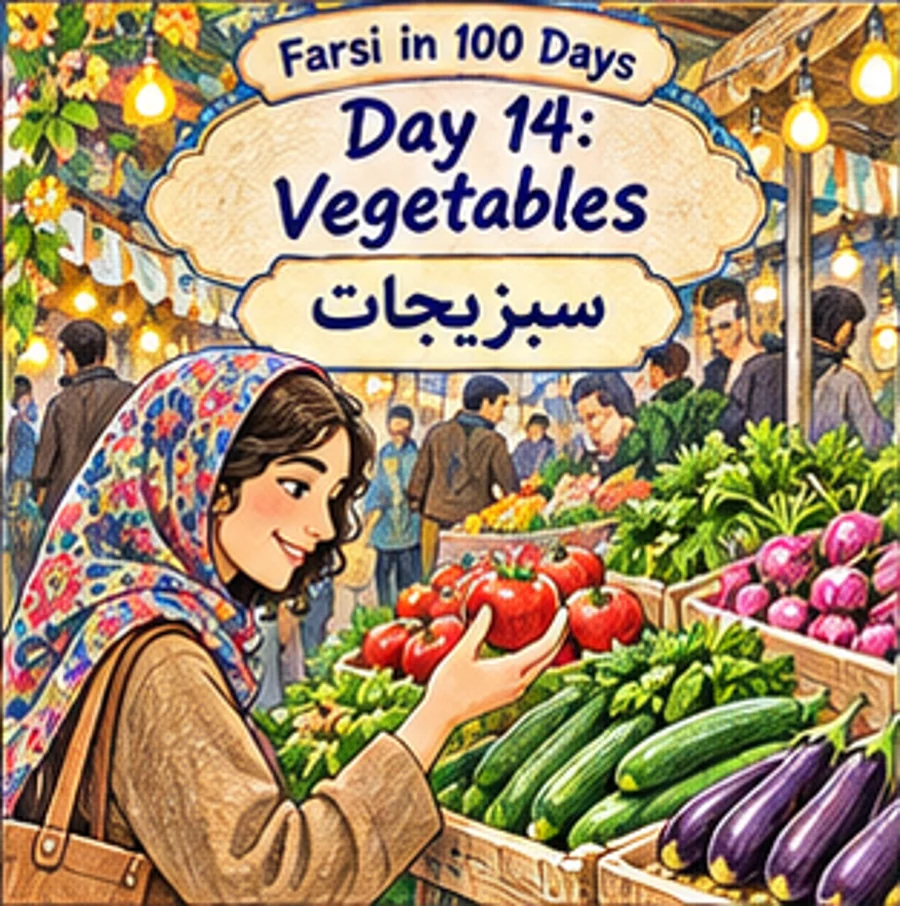
Day 14 of Learn Farsi in 100 Days, our free step-by-step Persian course: Vegetables. The lesson has four parts, with every Persian word in Persian script, pronunciation and English, and each part ends with a quick check.
Part 1Grammar and conversation
Day 14, Part 1 explains the Persian past stem (ستاک گذشته, setâk-e gozashte), made by dropping ن from the infinitive, as in دیدن (didan, to see) becoming دید (did), and a kitchen conversation with words like ریحان (reyhân, basil) and جعفری (ja’fari, parsley).
Grammar: the past stem (ستاک گذشته)
The past stem (ستاک گذشته, setâk-e gozashte) is the base used to build the simple past and other past forms of a verb. It is easy to find: take the infinitive (مصدر, masdar) and drop the final ن (-an). So دیدن (didan, to see) gives دید (did), and گفتن (goftan, to say) gives گفت (goft).
| Persian | Pronunciation | English |
|---|---|---|
| دیدن ← دید | didan → did | to see → past stem “saw” |
| گفتن ← گفت | goftan → goft | to say → past stem “said” |
Conversation: A tasty dish
| Speaker | Persian | English and pronunciation |
|---|---|---|
| Anisa آنیسا | بوی این غذا، اشتها را باز میکند. | The smell of this food is appetizing. bu-ye in ghazâ, eshtehâ râ bâz mikonad. |
| Golnar گلنار | بله، بوی خوبی دارد. | Yes, it smells good! bale, bu-ye khubi dârad. |
| Anisa آنیسا | این غذا ریحان دارد؟ | Does this food have any basil? in ghazâ reyhân dârad? |
| Golnar گلنار | بله، ریحان و جعفری. | Yes, basil and parsley. bale, reyhân va ja’fari. |
| Anisa آنیسا | این غذا واقعا خوشمزه است. | This food tastes really delicious. in ghazâ vâghe’an khoshmaze ast. |
| Golnar گلنار | من به ندرت غذاهای چرب میخورم. نمیخواهم بیشتر از این وزنم زیاد شود. | I seldom eat greasy food. I don’t want to put on any more weight. man be nodrat ghazâ-hâ-ye charb mikhoram. nemikhâham bishtar az in vaznam ziyâd shavad. |
Quick check
- How do you find the past stem of a Persian verb?
Show answer
Drop the final ن from the infinitive: دیدن (didan) → دید (did). - What is the past stem of گفتن (goftan, to say)?
Show answer
گفت (goft) - What does جعفری (ja’fari) mean?
Show answer
parsley
Part 2Speech vs. writing, grammar and word of the day
Day 14, Part 2 shows spoken forms like صبر کنین (sabr konin, please wait) and تقصیر منه (taghsir-e mane, it’s my fault), teaches the simple past built on the past stem, as in گفتم (goftam, I said), and gives the word of the day, آسمان (âsemân, sky).
Speech vs. writing
In speech the ending -id becomes -in (صبر کنین for صبر کنید), -etân becomes -etun, است after a word becomes -e (تقصیر منه), the ending -ad becomes -e (میکنه), and a possessive ending often replaces a separate pronoun (وزنم for وزن من). The spoken form is first in each pair.
| Spoken | Written | English |
|---|---|---|
| صبر کنین. sabr konin. | صبر کنید. sabr konid. | Wait, please. |
| کمکتون. komaketun. | کمکتان. komaketân. | your help |
| هستین. hastin. | هستید. hastid. | You are. |
| تقصیر منه. taghsir-e mane. | تقصیر من است. taghsir-e man ast. | It’s my fault. |
| وزنم. vaznam. | وزن من. vazn-e man. | my weight |
| زیاد بشه. ziyâd beshe. | زیاد شود. ziyâd shavad. | (that it) increases |
| پرواز میکنه. parvâz mikone. | پرواز میکند. parvâz mikonad. | It flies. |
| نگه نمیداره. negah nemidâre. | نگه نمیدارد. negah nemidârad. | He/She doesn’t keep (it). |
Grammar: the simple past (گذشتهی ساده)
The simple past (گذشتهی ساده, gozashte-ye sâde) describes a finished action. Take the past stem (the infinitive without ن) and add the personal endings -am, -i, -im, -id, -and; the third person singular has no ending. So گفتن (goftan, to say) gives گفتم (goftam, I said) and گفت (goft, he/she said).
| Persian | Pronunciation | English |
|---|---|---|
| گفتم | goftam | I said |
| گفتی | gofti | you said |
| گفت | goft | he/she said |
| گفتیم | goftim | we said |
| گفتید | goftid | you (plural/polite) said |
| گفتند | goftand | they said |
Examples
I was at school yesterday.
You wrote the letter.
Word of the day: آسمان (âsemân)
Meaning: sky
The bird flies in the sky. The sky is blue.
Quick check
- How do you say “we said” in Persian?
Show answer
گفتیم (goftim) - What is the written form of the spoken صبر کنین (sabr konin)?
Show answer
صبر کنید (sabr konid), “please wait” - What does آسمان (âsemân) mean?
Show answer
sky
Part 3Vegetables, common phrases and idiom of the day
Day 14, Part 3 names vegetables such as هویج (havij, carrots) and بادمجان (bâdenjân, eggplant), gives greetings and wishes like نوش جان (nush-e jân, bon appetit) and عیدتان مبارک (eydetân mobârak, happy holiday), and teaches the idiom دهن لق است (dahan-lagh ast, he has a big mouth).
Vegetables
| Persian | Pronunciation | English |
|---|---|---|
| کلم | kalam | cabbage |
| هویج | havij | carrots |
| گوجه | gowje | tomatoes |
| خیار | khiyâr | cucumber |
| سیب زمینی | sib zamini | potato |
| پیاز | piyâz | onion |
| اسفناج | esfenâj | spinach |
| بادمجان | bâdenjân | eggplant |
| آووکادو | âvokâdo | avocado |
| گل کلم | gol kalam | cauliflower |
| زغالاخته | zoghâl-akhte | blueberries |
| لیمو ترش | limu torsh | lime |
Common phrases
| Persian | Pronunciation | English |
|---|---|---|
| عیدتان مبارک! | eydetân mobârak! | Happy holiday! (said at Nowruz, Eid, Easter and other festivals) |
| بهترین آرزوها برای تولد شما! | behtarin ârezu-hâ barâ-ye tavallod-e shomâ! | Best wishes for your birthday! |
| اوقات خوبی داشته باشید! | owghât-e khubi dâshte bâshid! | Have a good time! |
| نوش جان! | nush-e jân! | Bon appetit! / Enjoy! |
Idiom of the day
دهن لق است!
dahan-lagh ast!
Word for word: (he/she) is loose-mouthed
Meaning in Persian: راز دیگران را نگه نمیدارد. مثال: او خیلی دهن لق است.
Meaning: He/She doesn’t keep other people’s secrets. Example: He/She has a really big mouth.
English equivalent: He has a big mouth!
Quick check
- What is the Persian word for “eggplant”?
Show answer
بادمجان (bâdenjân) - What do Iranians say to someone who is about to eat or has just eaten?
Show answer
نوش جان! (nush-e jân!), “Bon appetit! / Enjoy!” - What does دهن لق (dahan-lagh) describe?
Show answer
someone who can’t keep a secret, a big mouth
Part 4Reading and vocabulary
Day 14, Part 4 is a reading about where Persian is spoken and its status as the official language (زبان رسمی, zabân-e rasmi) of Iran and Tajikistan, plus vocabulary such as کشاورز (keshâvarz, farmer), مزرعه (mazra’e, farm) and کاشتن (kâshtan, to plant).
Reading: The Persian language
زبان فارسی در کشورهای ایران، افغانستان، تاجیکستان و ازبکستان رایج است. زبان فارسی، زبان رسمی کشور ایران و کشور تاجیکستان است.
The Persian language is spoken in Iran, Afghanistan, Tajikistan and Uzbekistan. Persian is the official language of Iran and Tajikistan.
در حال حاضر بیش از ۱۱۰ میلیون نفر در سراسر جهان به زبان شیرین فارسی صحبت میکنند.
Today more than 110 million people around the world speak the sweet Persian language.
Vocabulary
| Persian | Pronunciation | English |
|---|---|---|
| صبر کردن | sabr kardan | to wait |
| اصلی | asli | main, original |
| پیشغذا | pish-ghazâ | appetizer |
| راز | râz | secret |
| نگه داشتن | negah dâshtan | to keep |
| دهان | dahân | mouth |
| لق | lagh | loose |
| تقصیر | taghsir | fault |
| دقیقه | daghighe | minute |
| پرنده | parande | bird |
| کبوتر | kabutar | pigeon |
| لانه | lâne | nest |
| رزرو کردن | rezerv kardan | to reserve |
| دیگران | digarân | others |
| پرواز کردن | parvâz kardan | to fly |
| گیلاس | gilâs | cherry |
| ذرت | zorrat | corn |
| سالم | sâlem | healthy |
| تمیز | tamiz | clean |
| ضدعفونی | zedd-e ofuni | disinfection |
| میکروب | mikrob | microbe, germ |
| رشد کردن | roshd kardan | to grow |
| آب دادن | âb dâdan | to water, to irrigate |
| گل | gol | flower |
| نگهداری کردن | negahdâri kardan | to maintain, to take care of |
| انگور | angur | grapes |
| لیمو | limu | lemon |
| کاهو | kâhu | lettuce |
| قارچ | ghârch | mushroom |
| گلدان | goldân | flowerpot, vase |
| مزرعه | mazra’e | farm |
| کشاورز | keshâvarz | farmer |
| گیاه | giyâh | plant |
| کشمش | keshmesh | raisins |
| کدو | kadu | zucchini, squash |
| کاشتن | kâshtan | to plant |
| مراقب بودن | morâgheb budan | to look after, to be careful |
Quick check
- In which two countries is Persian the official language?
Show answer
Iran and Tajikistan (ایران و تاجیکستان, irân va tâjikestân). - How many people speak Persian worldwide, according to the reading?
Show answer
More than 110 million: بیش از ۱۱۰ میلیون نفر (bish az sad-o-dah milyun nafar). - What does کشاورز (keshâvarz) mean?
Show answer
farmer
Take this lesson further

Study with the book
Learn Farsi in 100 Days: The Ultimate Crash Course to Learning Farsi Fast
This free lesson is part of Learn Farsi in 100 Days. The book puts the whole series in one printable PDF you can study offline.
Serious about Persian? Get all 30 of our Persian learning books for $199.99 (0% less than buying them one by one).
Free Persian Starter Pack: Alphabet + 100 Core Words
Get the 14-page printable Starter Pack (all 32 letters, a 7-day reading plan, 100 core words and 20 survival phrases) and a short 5-email course. Free.
Free. Every morning: that day’s four videos and the full lessons, with every Persian word, its pronunciation and its English meaning. Stop or pause with one click.