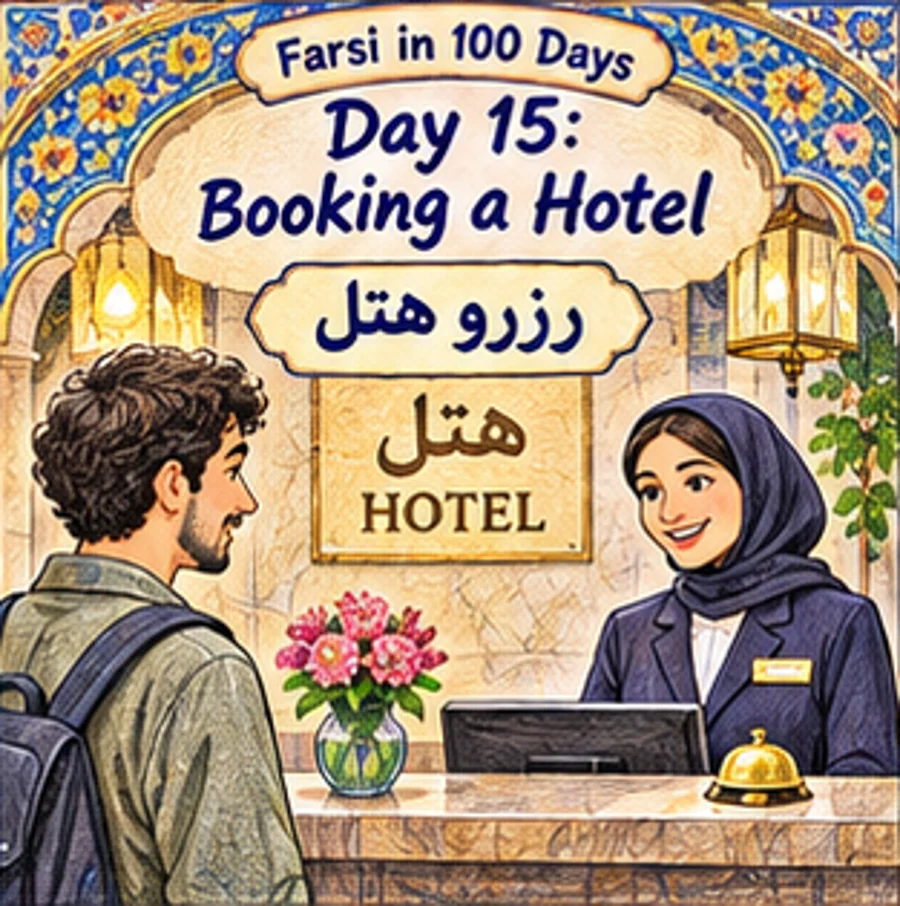
Day 15 of Learn Farsi in 100 Days, our free step-by-step Persian course: Booking a Hotel. The lesson has four parts, with every Persian word in Persian script, pronunciation and English, and each part ends with a quick check.
Part 1Grammar and conversation
Day 15, Part 1 teaches singular and plural imperatives, such as ببین (bebin, see) and بگویید (beguyid, say), and a phone conversation for booking a hotel room with phrases like آیا اتاق خالی دارید؟ (âyâ otâgh-e khâli dârid?, do you have any vacancies?).
Grammar: imperative verbs, singular and plural (فعل امر)
The imperative (فعل امر, fe’l-e amr) gives a command or request. For one person (مفرد, mofrad) use بـ (be-) plus the present stem: ببین (bebin, see!). For more than one person, or to be polite (جمع, jam’), add -id: ببرید (bebarid, take!). Before a stem with the vowel o the prefix often sounds bo-, as in برو (borow, go!).
| Persian | Pronunciation | English |
|---|---|---|
| ببین | bebin | see (singular) |
| ببرید | bebarid | take (plural) |
| برو | borow | go (singular) |
| بگویید | beguyid | say (plural) |
Conversation: Calling a hotel
| Speaker | Persian | English and pronunciation |
|---|---|---|
| Bahram بهرام | سلام، هتل پارس؟ | Hi, is this the Pars Hotel? salâm, hotel-e pârs? |
| Clerk منشی | بله! بفرمایید. | Yes, go ahead. bale! befarmâyid. |
| Bahram بهرام | آیا اتاق خالی دارید؟ | Do you have any vacancies? âyâ otâgh-e khâli dârid? |
| Clerk منشی | برای چه تاریخی؟ | For what date? barâ-ye che târikhi? |
| Bahram بهرام | میخواهم برای هفتهی آینده یک اتاق رزرو کنم. | I’d like to reserve a room for next week. mikhâham barâ-ye hafte-ye âyande yek otâgh rezerv konam. |
| Clerk منشی | بله، اسم شما چیست؟ | Yes, what’s your name? bale, esm-e shomâ chist? |
| Bahram بهرام | بهرام حریری. | Bahram Hariri. bahrâm hariri. |
Quick check
- How do you form the plural imperative in Persian?
Show answer
بـ (be-) + present stem + ید (-id), e.g. ببرید (bebarid, take!) - How do you say “go!” to one person?
Show answer
برو (borow) - How do you ask “Do you have any vacancies?”
Show answer
آیا اتاق خالی دارید؟ (âyâ otâgh-e khâli dârid?)
Part 2Speech vs. writing, grammar and word of the day
Day 15, Part 2 shows spoken forms such as اسمتون (esmetun, your name) and خوش آمدین (khosh âmadin, welcome), teaches the past continuous with می (mi) plus the past stem, as in میگفتم (migoftam, I was saying), and gives the word of the day, مسافرت (mosâferat, travel).
Speech vs. writing
In speech the verb ending -id becomes -in (رزرو کردین for رزرو کردید), â before n becomes u (برسونین for برسانید), and pronouns become endings with -etun/-tun (اسمتون for اسم شما, براتون for برای شما). The spoken form is first in each pair.
| Spoken | Written | English |
|---|---|---|
| رزرو کردین. rezerv kardin. | رزرو کردید. rezerv kardid. | You reserved. |
| برسونین. beresunin. | برسانید. beresânid. | Deliver / Give (my regards). |
| اسمتون. esmetun. | اسم شما. esm-e shomâ. | your name |
| براتون. barâtun. | برای شما. barâ-ye shomâ. | for you |
| خوش آمدین. khosh âmadin. | خوش آمدید. khosh âmadid. | Welcome. |
| سالا. sâlâ. | سالها. sâl-hâ. | years |
Grammar: the past continuous (گذشتهی استمراری)
The past continuous (گذشتهی استمراری, gozashte-ye estemrâri) describes an action that was going on or that happened regularly in the past: “I was saying” or “I used to say”. Put می (mi) before the past stem and add the past personal endings, as in میگفتم (migoftam). To stress that something was in progress at a moment, Persian often adds the past of داشتن (dâshtan): داشتم میرفتم (dâshtam miraftam, I was going).
| Persian | Pronunciation | English |
|---|---|---|
| میگفتم | migoftam | I was saying / I used to say |
| میگفتی | migofti | you were saying |
| میگفت | migoft | he/she was saying |
| میگفتیم | migoftim | we were saying |
| میگفتید | migoftid | you (plural/polite) were saying |
| میگفتند | migoftand | they were saying |
Examples
The verb داشت (dâsht) often comes with the past continuous:
I was going to school when I saw Ali.
Word of the day: مسافرت (mosâferat)
Meaning: travel, trip
I’m going on a trip this weekend. He/She went on a trip during the holidays.
Quick check
- How do you say “they were saying” in Persian?
Show answer
میگفتند (migoftand) - What is the written form of the spoken اسمتون (esmetun)?
Show answer
اسم شما (esm-e shomâ), “your name” - What does مسافرت (mosâferat) mean?
Show answer
travel, a trip
Part 3At the hotel, common phrases and idiom of the day
Day 15, Part 3 gives hotel words such as اتاق یکتخته (otâgh-e yek-takhte, single room) and تسویه کردن (tasviye kardan, to pay off the bill), polite requests like لطفا من را به این هتل ببرید (take me to this hotel, please), and the birthday wish صد سال به این سالها (sad sâl be in sâl-hâ).
At the hotel
| Persian | Pronunciation | English |
|---|---|---|
| اتاق یکتخته | otâgh-e yek-takhte | single room |
| تسویه کردن | tasviye kardan | to pay off, to settle the bill |
| پذیرش | paziresh | reception desk |
| مدیر | modir | manager |
| اتاق دو تخته | otâgh-e do takhte | double room |
| کرایه کردن | kerâye kardan | to rent |
| رزرو کردن | rezerv kardan | to reserve |
| خدمتکار | khedmatkâr | chambermaid, housekeeper |
Common phrases
| Persian | Pronunciation | English |
|---|---|---|
| ممکن است راه هتل را به من نشان بدهید؟ | momken ast râh-e hotel râ be man neshân bedahid? | Could you please show me the way to the hotel? |
| ممکن است به من بگویید چطور به این هتل بروم؟ | momken ast be man beguyid chetor be in hotel beravam? | Would you tell me how to get to this hotel? |
| لطفا من را به این هتل ببرید. | lotfan man râ be in hotel bebarid. | Take me to this hotel, please. |
| لطفا چمدانهای من را به هتلم بفرستید؟ | lotfan chamedân-hâ-ye man râ be hotelam befrestid? | Please send my baggage to my hotel. |
Idiom of the day
صد سال به این سالها!
sad sâl be in sâl-hâ!
Word for word: a hundred years like these years!
Meaning in Persian: سال خوبی را برای شما آرزو میکنم.
Meaning: I wish you a good year (and many more like it). Said on birthdays and at the New Year.
English equivalent: Many happy returns of the day!
Quick check
- What is a “double room” in Persian?
Show answer
اتاق دو تخته (otâgh-e do takhte) - How do you ask someone to take you to this hotel?
Show answer
لطفا من را به این هتل ببرید (lotfan man râ be in hotel bebarid) - When do you say صد سال به این سالها (sad sâl be in sâl-hâ)?
Show answer
On a birthday or at the New Year, to wish someone many more good years.
Part 4Reading and vocabulary
Day 15, Part 4 is a short past-tense reading about a week-long hotel stay in Isfahan and its Khaju bridge (پل, pol), plus travel and hotel vocabulary such as اقامت داشتن (eghâmat dâshtan, to stay), کارت اعتباری (kârt-e e’tebâri, credit card) and هزینه (hazine, cost).
Reading: A trip to Isfahan
من سال گذشته به اصفهان سفر کردم. من در یک هتل، اقامت داشتم. یک هفته آنجا بودم. اتاق من یکتخته بود.
Last year I traveled to Isfahan. I stayed in a hotel. I was there for a week. My room was a single room.
اصفهان شهر زیبایی است. من مکانهای زیادی را دیدم. اصفهان یک پل بزرگ دارد. اسم آن پل، خواجو است.
Isfahan is a beautiful city. I saw many places. Isfahan has a big bridge. The name of that bridge is Khaju.
Vocabulary
| Persian | Pronunciation | English |
|---|---|---|
| پل | pol | bridge |
| زیبا | zibâ | beautiful |
| مکان | makân | place |
| گذشته | gozashte | past |
| آرزو کردن | ârezu kardan | to wish |
| ممکن | momken | possible |
| دوباره | dobâre | again |
| تکرار کردن | tekrâr kardan | to repeat |
| هزینه | hazine | cost |
| پول | pul | money |
| دستشویی | dastshuyi | restroom, WC |
| حمام | hammâm | bathroom |
| سفر کردن | safar kardan | to travel |
| اقامت داشتن | eghâmat dâshtan | to reside, to stay |
| آنجا | ânjâ | there |
| کمک کردن | komak kardan | to help |
| تسویه کردن | tasviye kardan | to check out, to settle the bill |
| یخچال | yakhchâl | refrigerator |
| تاکسی | tâksi | taxi |
| خدمتکار | khedmatkâr | servant, housekeeper |
| کارت اعتباری | kârt-e e’tebâri | credit card |
| آشپزخانه | âshpazkhâne | kitchen |
| قهوه | ghahve | coffee |
| کیف | kif | bag |
| مرکز | markaz | center |
| رساندن | resândan | to deliver, to convey |
| آخر | âkhar | end |
| اتاق | otâgh | room |
| اجاق گاز | ojâgh-e gâz | stove |
| پارک | pârk | park |
| مسجد | masjed | mosque |
| تاریخی | târikhi | historical |
| فرهنگی | farhangi | cultural |
| بردن | bordan | to carry, to take; to win |
| راننده | rânande | driver |
Quick check
- How long did the writer stay in Isfahan?
Show answer
One week: یک هفته آنجا بودم (yek hafte ânjâ budam). - What is the name of the big bridge in the reading?
Show answer
خواجو (khâju), the Khaju Bridge - How do you say “credit card” in Persian?
Show answer
کارت اعتباری (kârt-e e’tebâri)
Take this lesson further

Study with the book
Learn Farsi in 100 Days: The Ultimate Crash Course to Learning Farsi Fast
This free lesson is part of Learn Farsi in 100 Days. The book puts the whole series in one printable PDF you can study offline.
Serious about Persian? Get all 30 of our Persian learning books for $199.99 (0% less than buying them one by one).
Free Persian Starter Pack: Alphabet + 100 Core Words
Get the 14-page printable Starter Pack (all 32 letters, a 7-day reading plan, 100 core words and 20 survival phrases) and a short 5-email course. Free.
Free. Every morning: that day’s four videos and the full lessons, with every Persian word, its pronunciation and its English meaning. Stop or pause with one click.