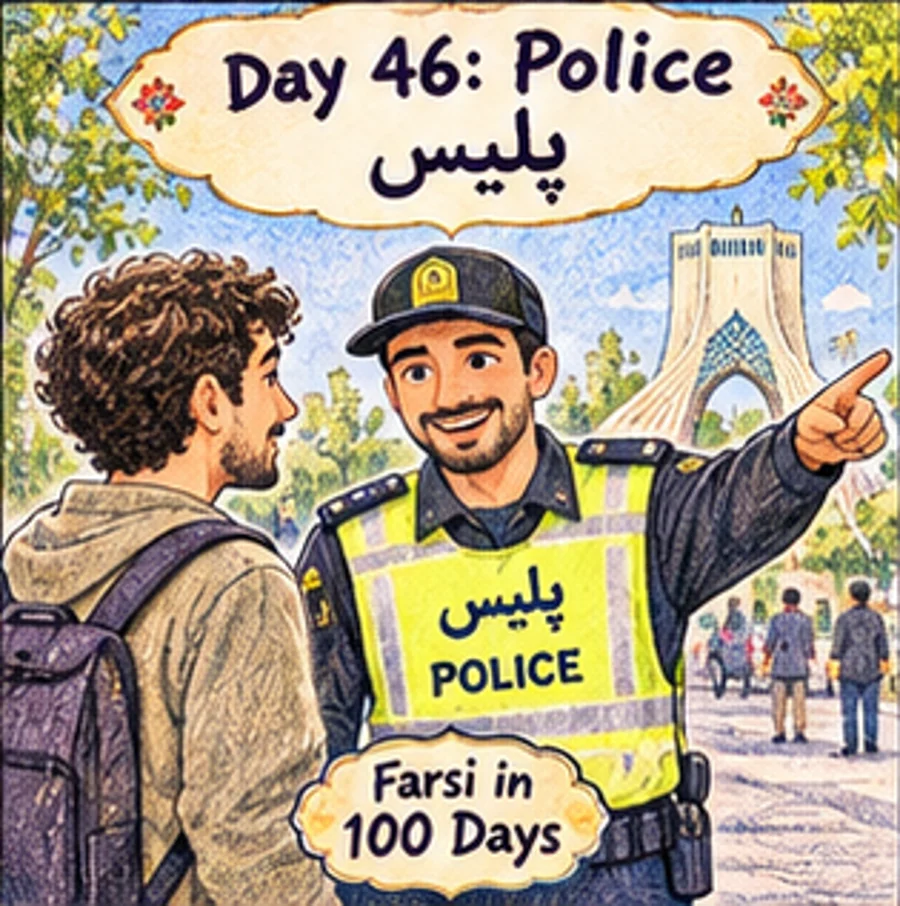
Day 46 of Learn Farsi in 100 Days, our free step-by-step Persian course: The Police. The lesson has four parts, with every Persian word in Persian script, pronunciation and English, and each part ends with a quick check.
Part 1Grammar and conversation
Day 46, Part 1 introduces the appositive (بدل, badal), a noun phrase set between commas that describes the noun before it, as in حافظ، شاعر بزرگ (Hâfez, the great poet), and a conversation at the police about a stolen wallet (کیف پول, kif-e pul).
Grammar: the appositive (بدل)
An appositive, بدل (badal), is a noun or noun phrase that describes or renames the noun right before it. It usually sits between two commas, and because it only adds extra information, it can be removed from the sentence without breaking it. In حافظ، شاعر بزرگ، در ایران زندگی میکرد the phrase شاعر بزرگ (shâ’er-e bozorg, the great poet) is the appositive.
Examples
Hafez, the great poet, lived in Iran.
Conversation: reporting a theft to the police
| Speaker | Persian | English and pronunciation |
|---|---|---|
| A الف | لطفا به من کمک کنید پولهای من را دزدیدهاند. | Please help me, my money has been stolen. lotfan be man komak konid pul-hâ-ye man râ dozdide-and. |
| B ب | کجا این اتفاق برای شما افتاد؟ | Where did this happen to you? kojâ in ettefâgh barâye shomâ oftâd? |
| A الف | در همین خیابان. از بانک که بیرون آمدم یک موتورسوار کیف پولم را زد و فرار کرد. | On this very street. When I came out of the bank, a man on a motorcycle snatched my wallet and ran off. dar hamin khiyâbân. az bânk ke birun âmadam yek motorsavâr kif-e pulam râ zad va farâr kard. |
| B ب | چهرهی شخص را دیدهاید؟ | Did you see the person’s face? chehre-ye shakhs râ dide-id? |
| A الف | نه صورتش را پوشانده بود. | No, he had covered his face. na, suratash râ pushânde bud. |
| B ب | مشخصات موتورسیکلت یادتان است؟ | Do you remember what the motorcycle looked like? moshakhasât-e motorsiklet yâdetân ast? |
| A الف | تا حدودی. تازه از بانک وام گرفته بودم. لطفا کمک کنید آن را پیدا کنم. | To some extent. I had just taken out a loan from the bank. Please help me find it. tâ hodudi. tâze az bânk vâm gerefte budam. lotfan komak konid ân râ peydâ konam. |
| B ب | نگران نباشید ما پیگیری میکنیم. لطفا این برگه را پر کنید و آنچه را که دیدهاید بنویسید. | Don’t worry, we will follow it up. Please fill out this form and write down what you saw. negarân nabâshid, mâ peygiri mikonim. lotfan in barge râ por konid va ânche râ ke dide-id benevisid. |
| A الف | بسیار خوب. | All right. besyâr khub. |
Quick check
- In حافظ، شاعر بزرگ، در ایران زندگی میکرد, which words are the appositive (بدل)?
Show answer
شاعر بزرگ (shâ’er-e bozorg), “the great poet” - How do you say “Please help me” in Persian?
Show answer
لطفا به من کمک کنید (lotfan be man komak konid) - What does موتورسوار (motorsavâr) mean?
Show answer
a motorcyclist, someone riding a motorcycle
Part 2Grammar, common phrases, poetry and word of the day
Day 46, Part 2 shows how که (ke, who/that) links a dependent clause to a noun, gives phrases for losing things such as من گذرنامهام را گم کردم (I lost my passport), a short poem by Hafez, and the word of the day دستگیر کردن (dastgir kardan, to arrest).
Grammar: the conjunction که in dependent clauses
The conjunction که (ke, “who, which, that”) joins a dependent clause to the noun it describes, much like a relative pronoun in English. The noun before که usually takes the unstressed ending ـی (-i), as in دانشآموزانی که (dânesh-âmuzâni ke, “the students who”) and کشوری که (keshvari ke, “a country that”). When the noun has another role inside the clause, Persian repeats it with a pronoun, as in در آن (dar ân, “in it”).
Examples
The students who study at this school are Iranian.
Iran is the country (that) I grew up in.
Common phrases
| Persian | Pronunciation | English |
|---|---|---|
| من گذرنامهام را گم کردم. | man gozarnâme-am râ gom kardam. | I lost my passport. |
| کیف من دزدیده شدهاست. | kif-e man dozdide shode ast. | My purse was stolen. |
| من وسایلم را گم کردهام. | man vasâyelam râ gom karde-am. | I lost my baggage. |
| من باید با وکیلم تماس بگیرم. | man bâyad bâ vakilam tamâs begiram. | I need to call my lawyer. |
Poetry: a ghazal by Hafez
Two couplets by Hafez, written as a dialogue between the poet and the beloved. The last three rows are the book’s own explanations of the old verb forms in the poem.
| Persian | Pronunciation | English |
|---|---|---|
| گفتم غم تو دارم گفتا غمت سرآید | goftam gham-e to dâram, goftâ ghamat sar âyad | I said, “I grieve for you.” She said, “Your grief will come to an end.” |
| گفتم که ماه من شو گفتا اگر برآید | goftam ke mâh-e man sho, goftâ agar bar âyad | I said, “Be my moon.” She said, “If it rises.” |
| گفتم ز مهرورزان رسم وفا بیاموز | goftam ze mehr-varzân rasm-e vafâ biyâmuz | I said, “Learn the way of faithfulness from those who love.” |
| گفتا ز خوبرویان این کار کمتر آید | goftâ ze khub-ruyân in kâr kamtar âyad | She said, “The fair-faced seldom do such a thing.” |
| سرآید: تمام شود | sar âyad: tamâm shavad | sar âyad = comes to an end |
| برآید: بالا بیاید | bar âyad: bâlâ biyâyad | bar âyad = rises, comes up |
| کمتر آید: کمتر انجام شود | kamtar âyad: kamtar anjâm shavad | kamtar âyad = is seldom done |
Word of the day: دستگیر کردن (dastgir kardan)
Meaning: to arrest
The police arrested the thief.
Quick check
- Join the clause with که: “Iran is the country that I grew up in.”
Show answer
ایران کشوری است که من در آن بزرگ شدهام. (irân keshvari ast ke man dar ân bozorg shode-am.) - How do you say “I lost my passport” in Persian?
Show answer
من گذرنامهام را گم کردم. (man gozarnâme-am râ gom kardam.) - What does دستگیر کردن (dastgir kardan) mean?
Show answer
to arrest
Part 3Police station, conversation and idiom of the day
Day 46, Part 3 teaches police-station verbs such as دزدیدن (dozdidan, to steal) and بازداشت کردن (bâzdâsht kardan, to arrest), a conversation about a lost passport and the lost-and-found office, and the idiom تا سه نشود، بازی نشود (third time lucky).
Police station (ادارهی پلیس)
| Persian | Pronunciation | English |
|---|---|---|
| دزدیدن | dozdidan | to steal |
| گم کردن | gom kardan | to lose |
| فرار کردن | farâr kardan | to escape, to run away |
| تصادف کردن | tasâdof kardan | to have an accident |
| تعقیب کردن | ta’ghib kardan | to pursue, to chase |
| بازداشت کردن | bâzdâsht kardan | to arrest, to detain |
| جریمه کردن | jarime kardan | to fine, to penalize |
| زندانی کردن | zendâni kardan | to put in prison |
Conversation: a lost passport
| Speaker | Persian | English and pronunciation |
|---|---|---|
| A الف | ببخشید من گذرنامهام را گم کردهام، نمیدانم چه کار باید بکنم. | Excuse me, I’ve lost my passport and I don’t know what to do. bebakhshid, man gozarnâme-am râ gom karde-am, nemidânam che kâr bâyad bekonam. |
| B ب | ممکن است آن را جایی جا گذاشته باشید. | You may have left it somewhere. momken ast ân râ jâyi jâ gozâshte bâshid. |
| A الف | احتمالا، ولی به خاطر نمیآورم. | Probably, but I can’t remember. ehtemâlan, vali be khâter nemi-âvaram. |
| B ب | بروید به دفتر اشیاء گم شده، اگر کسی آن را پیدا کند به آنجا تحویل میدهد. | Go to the lost-and-found office. If someone finds it, they will hand it in there. beravid be daftar-e ashyâ’-e gom shode, agar kasi ân râ peydâ konad be ânjâ tahvil midahad. |
| A الف | دفتر اشیاء گم شده کجاست؟ | Where is the lost-and-found office? daftar-e ashyâ’-e gom shode kojâst? |
| B ب | طبقهی همکف، سمت راست. | On the ground floor, on the right. tabaghe-ye hamkaf, samt-e râst. |
| A الف | ممنون. | Thanks. mamnun. |
Idiom of the day
تا سه نشود، بازی نشود.
tâ se nashavad, bâzi nashavad.
Word for word: Until it becomes three, it does not become a game.
Meaning in Persian: باز هم فرصت هست!
Meaning: There is still another chance! (said to encourage someone to try once more after failing)
English equivalent: Third time lucky.
Quick check
- What does فرار کردن (farâr kardan) mean?
Show answer
to escape, to run away - How do you say “lost-and-found office” in Persian?
Show answer
دفتر اشیاء گم شده (daftar-e ashyâ’-e gom shode) - Which Persian idiom matches “Third time lucky”?
Show answer
تا سه نشود، بازی نشود (tâ se nashavad, bâzi nashavad)
Part 4Reading and new words
Day 46, Part 4 is a short reading on the history of Iran’s police, founded after ناصرالدین شاه (Naser al-Din Shah) saw modern police in Europe, plus a vocabulary list with words like امنیت (amniyat, security) and پیگیری کردن (peygiri kardan, to follow up).
Reading: the police in Iran
ایران در حدود ۲۰۰۰ سال قبل بنیانگذار سیستم حکومتی امپراطوری بودهاست. کشور ایران برای ایجاد نظم و امنیت، انواع سیستمهای امنیتی را مورد بررسی قرار داده است.
About 2,000 years ago, Iran founded the imperial system of government. To create order and security, Iran has studied many kinds of security systems.
پلیس نوین ایران صد سال پیش تأسیس شد. ناصرالدین شاه قاجار در سفر خود به اروپا این سیستم نوین پلیس را آموخت و آن را در ایران پیریزی کرد.
Iran’s modern police force was founded a hundred years ago. On his trip to Europe, Naser al-Din Shah Qajar learned about this modern police system and laid its foundations in Iran.
New words
| Persian | Pronunciation | English |
|---|---|---|
| توصیف کردن | tosif kardan | to describe |
| قابل | ghâbel | able, capable (of) |
| حذف | hazf | deletion, removal |
| موتورسوار | motorsavâr | motorcyclist |
| چهره | chehre | face |
| پوشانده | pushânde | covered |
| مشخصات | moshakhasât | details, specifications |
| پیگیری کردن | peygiri kardan | to follow up |
| بهخاطر آوردن | be khâter âvardan | to remember |
| گشتن | gashtan | to search |
| تحویل دادن | tahvil dâdan | to deliver, to hand over |
| اشیاء | ashyâ’ | objects, things |
| کشف کردن | kashf kardan | to discover |
| گیر افتادن | gir oftâdan | to be caught, to be arrested |
| نتیجه | natije | result |
| بنیانگذار | bonyân-gozâr | founder |
| سیستم | sistem | system |
| حکومتی | hokumati | governmental |
| وقایع | vaghâye’ | events |
| امپراطوری | emperâturi | empire; imperial |
| رعایت کردن | re’âyat kardan | to observe, to follow (a rule) |
| نظم | nazm | order, discipline |
| امنیت | amniyat | security |
| خلاف کردن | khalâf kardan | to break the law, to commit an offense |
| انواع | anvâ’ | types, kinds |
| اسلحه | aslahe | weapon, gun |
| امنیتی | amniyati | security (adjective) |
| تأسیس کردن | ta’sis kardan | to establish, to found |
| آموختن | âmukhtan | to learn |
| پیریزی کردن | pey-rizi kardan | to lay the foundation of, to establish |
Quick check
- According to the reading, who brought the modern police system to Iran?
Show answer
ناصرالدین شاه قاجار (Naser al-Din Shah Qajar), after his trip to Europe - What does امنیت (amniyat) mean?
Show answer
security - How do you say “to follow up” in Persian?
Show answer
پیگیری کردن (peygiri kardan)
Take this lesson further

Study with the book
Learn Farsi in 100 Days: The Ultimate Crash Course to Learning Farsi Fast
This free lesson is part of Learn Farsi in 100 Days. The book puts the whole series in one printable PDF you can study offline.
Serious about Persian? Get all 30 of our Persian learning books for $199.99 (0% less than buying them one by one).
Free Persian Starter Pack: Alphabet + 100 Core Words
Get the 14-page printable Starter Pack (all 32 letters, a 7-day reading plan, 100 core words and 20 survival phrases) and a short 5-email course. Free.
Free. Every morning: that day’s four videos and the full lessons, with every Persian word, its pronunciation and its English meaning. Stop or pause with one click.