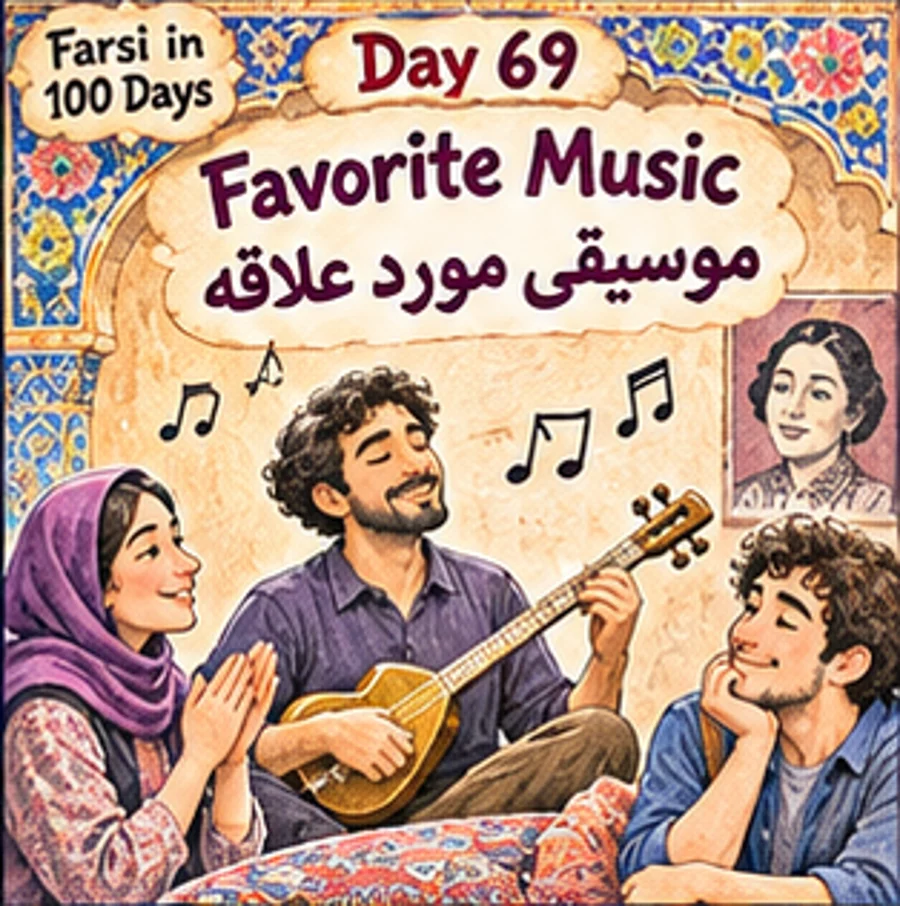
Day 69 of Learn Farsi in 100 Days, our free step-by-step Persian course: What Is Your Favorite Music?. The lesson has four parts, with every Persian word in Persian script, pronunciation and English, and each part ends with a quick check.
Part 1Conversation and grammar
Day 69, Part 1 has a conversation in which Farangis says she likes pop music (به موسیقی پاپ علاقه دارم, be musighi-ye pâp alâghe dâram) and names her favorite singer, and teaches two uses of the suffix ی (-i): relation, as in ایرانی (irâni, Iranian), and place, as in شهرداری (shahrdâri, city hall).
Conversation: favorite singers
| Speaker | Persian | English and pronunciation |
|---|---|---|
| Artin آرتین | چی گوش میکنی؟ | What are you listening to? chi gush mikoni? |
| Farangis فرنگیس | رادیو گوش میکنم. | I’m listening to the radio. râdyo gush mikonam. |
| Artin آرتین | میدانم. کی میخواند؟ | I know. Who’s singing? midânam. ki mikhânad? |
| Farangis فرنگیس | فکر کنم عارف است، درست است؟ | I think it’s Aref, right? fekr konam âref ast, dorost ast? |
| Artin آرتین | درست است. چطور او را میشناسی؟ | That’s right. How do you know him? dorost ast. chetor u râ mishenâsi? |
| Farangis فرنگیس | در کشور من همه او را میشناسند. او معروف است. | Everyone in my country knows him. He’s famous. dar keshvar-e man hame u râ mishenâsand. u ma’ruf ast. |
| Artin آرتین | چه نوع موزیکی معمولا گوش میکنی؟ | What kind of music do you usually listen to? che no’ muziki ma’mulan gush mikoni? |
| Farangis فرنگیس | من معمولا همه چی گوش میکنم، اما به موسیقی پاپ علاقه دارم. | I usually listen to everything, but I like pop music. man ma’mulan hame chi gush mikonam, ammâ be musighi-ye pâp alâghe dâram. |
| Artin آرتین | خوانندهی محبوب تو چه کسی است؟ | Who is your favorite singer? khânande-ye mahbub-e to che kasi ast? |
| Farangis فرنگیس | هایده. | Hayedeh. hâyede. |
| Artin آرتین | من هم او را دوست دارم. او صدای خوبی دارد. | I like her too. She has a good voice. man ham u râ dust dâram. u sedâ-ye khubi dârad. |
Grammar: two meanings of the suffix -i (ی)
The suffix ی (-i) has several jobs in Persian. As a marker of relation (نشانهی نسبت, neshâne-ye nesbat) it turns a noun or number into an adjective meaning “of, related to”: ایران → ایرانی (irâni, Iranian), آب → آبی (âbi, blue, water-colored). As a marker of place (نشانهی مکان, neshâne-ye makân) it names the place where an activity or office is: شهردار (mayor) → شهرداری (shahrdâri, city hall).
| Persian | Pronunciation | English |
|---|---|---|
| ایرانی | irâni | Iranian (relation) |
| سومی | sevvomi | the third one (relation) |
| آبی | âbi | blue; watery (relation) |
| شهرداری | shahrdâri | city hall, municipality (place) |
| دادگستری | dâdgostari | courthouse, department of justice (place) |
Quick check
- What kind of music does Farangis like?
Show answer
pop music: موسیقی پاپ (musighi-ye pâp) - How do you ask “Who is your favorite singer?” in Persian?
Show answer
خوانندهی محبوب تو چه کسی است؟ (khânande-ye mahbub-e to che kasi ast?) - What does the ی in شهرداری (shahrdâri) show?
Show answer
place: شهرداری is the place of the mayor’s office, city hall
Part 2Idiom of the day, common phrases, poetry and word of the day
Day 69, Part 2 gives the proverb جور مرا بکش (jur-e marâ bekesh, bear my burden for me), phrases about hobbies such as سرگرمی من نجاری است (sargarmi-ye man najjâri ast, my hobby is carpentry), a couplet on friendship, and the word of the day دیرینه (dirine, age-old).
Idiom of the day
جور مرا بکش
jur-e marâ bekesh
Word for word: Bear my hardship.
Meaning in Persian: این اصطلاح به معنای سختی را به جای شخص دیگری تحمل کردن یا کار او را انجام دادن است.
Meaning: This expression means to bear a hardship in someone else’s place or to do their work for them.
English equivalent: to carry someone’s burden; to pick up the slack for someone
Common phrases
| Persian | Pronunciation | English |
|---|---|---|
| سرگرمی من نجاری است. | sargarmi-ye man najjâri ast. | My hobby is carpentry. |
| من عاشق شطرنج هستم. | man âshegh-e shatranj hastam. | I’m crazy about chess. |
| به خوشنویسی علاقه دارم. | be khoshnevisi alâghe dâram. | I’m interested in calligraphy. |
| سرگرمی مورد علاقهی من نقاشی است. | sargarmi-ye mored-e alâghe-ye man naghghâshi ast. | My favorite hobby is painting. |
Poetry: plant the tree of friendship
The book attributes this couplet to Saadi (سعدی); it is in fact the opening line of a ghazal by Hafez (حافظ). The book’s English: “Plant the tree of friendship, that, to fruit, the heart’s desire bringeth: Up-pluck the bush of enmity, that countless troubles bringeth.”
| Persian | Pronunciation | English |
|---|---|---|
| درخت دوستی بنشان که کام دل به بار آرد | derakht-e dusti benshân ke kâm-e del be bâr ârad | Plant the tree of friendship, for it bears the fruit of the heart’s desire; |
| نهال دشمنی برکن که رنج بیشمار آرد | nahâl-e doshmani barkan ke ranj-e bishomâr ârad | uproot the sapling of enmity, for it brings countless troubles. |
Word of the day: دیرینه (dirine)
Meaning: age-old, long-standing, ancient
Chaharshanbe Suri (the fire festival before Nowruz) is an age-old ceremony in Iran.
Quick check
- How do you say “My hobby is carpentry” in Persian?
Show answer
سرگرمی من نجاری است. (sargarmi-ye man najjâri ast.) - What does جور مرا بکش mean?
Show answer
to bear a hardship in someone else’s place or do their work for them - What does دیرینه (dirine) mean?
Show answer
age-old, long-standing
Part 3Musical instruments, conversation and idiom of the day
Day 69, Part 3 names musical instruments such as ویولن (viyolon, violin) and ساز دهنی (sâz-e dahani, harmonica), has a conversation about Persian traditional music (موسیقی سنتی, musighi-ye sonnati) and the singers Nazeri and Shajarian, and gives the idiom آن روی سگ منو بالا نیار (don’t make me lose my temper).
Musical instruments (ابزارهای موسیقی)
| Persian | Pronunciation | English |
|---|---|---|
| سازهای بادی | sâz-hâ-ye bâdi | wind instruments |
| گیتار برقی | gitâr-e barghi | electric guitar |
| ویولن سل | viyolon sel | cello |
| ویولن | viyolon | violin, fiddle |
| سنج | senj | cymbals |
| فلوت | flut | flute |
| طبل | tabl | drum |
| ساز دهنی | sâz-e dahani | harmonica |
Conversation: traditional music and the violin
| Speaker | Persian | English and pronunciation |
|---|---|---|
| Shahriar شهریار | تو چه موسیقی را دوست داری؟ | What music do you like? to che musighi râ dust dâri? |
| Farah فرح | من عاشق موسیقی سنتی هستم. | I love traditional music. man âshegh-e musighi-ye sonnati hastam. |
| Shahriar شهریار | کدام خواننده سنتی را بیشتر دوست داری؟ | Which traditional singer do you like most? kodâm khânande-ye sonnati râ bishtar dust dâri? |
| Farah فرح | من صدای ناظری را خیلی دوست دارم. | I really love Nazeri’s voice. man sedâ-ye nâzeri râ kheyli dust dâram. |
| Shahriar شهریار | من هم صدای او را دوست دارم اما بیشتر صدای شجریان را دوست دارم. | I like his voice too, but I like Shajarian’s voice more. man ham sedâ-ye u râ dust dâram ammâ bishtar sedâ-ye shajariyân râ dust dâram. |
| Farah فرح | تو هیچ موسیقی بلدی بنوازی؟ | Can you play any music? to hich musighi baladi benavâzi? |
| Shahriar شهریار | بله، من ویولن میزنم. | Yes, I play the violin. bale, man viyolon mizanam. |
| Farah فرح | واقعا، عالی است! ممکن است یک بار برای من هم بنوازی؟ | Really? That’s great! Could you play for me sometime? vâghe’an, âli ast! momken ast yek bâr barâ-ye man ham benavâzi? |
| Shahriar شهریار | حتما. | Sure. hatman. |
Idiom of the day
آن روی سگ منو بالا نیار
ân ru-ye sag-e mano bâlâ nayâr
Word for word: Don’t bring up the dog side of me.
Meaning in Persian: من را عصبانی نکن. این اصطلاح هنگام دعوا به کار میرود.
Meaning: Don’t make me angry. This expression is used in a quarrel.
English equivalent: Don’t get my monkey up. (Don’t make me lose my temper.)
Quick check
- How do you say “I play the violin” in Persian?
Show answer
من ویولن میزنم. (man viyolon mizanam.) - What kind of music does Farah love?
Show answer
traditional music: موسیقی سنتی (musighi-ye sonnati) - When do people say آن روی سگ منو بالا نیار?
Show answer
in a quarrel, to mean “Don’t make me angry”
Part 4Reading and new words
Day 69, Part 4 is a reading about Khorramabad (خرمآباد, khorramâbâd), capital of Lorestan, and its Falak-ol-Aflak castle, followed by a vocabulary list with words like سرگذشت (sargozasht, life story), سوء تفاهم (su’-e tafâhom, misunderstanding) and سرزمین (sarzamin, land).
Reading: the city of Khorramabad
خرمآباد بزرگترین شهر لرنشین و مرکز استان لرستان است. خرمآباد یک شهر کوهستانی است که در میان یک دره قرار گرفته است. آثار تاریخی باقی مانده نشان میدهد خرمآباد یکی از شهرهای مهم غرب ایران در دورهی ساسانیان بوده است. قلعهی فلکالافلاک نماد این شهر است.
Khorramabad is the largest Lur-populated city and the capital of Lorestan Province. Khorramabad is a mountain city set in the middle of a valley. The historical remains show that Khorramabad was one of the important cities of western Iran in the Sasanian period. Falak-ol-Aflak Castle is the symbol of the city.
شهر خرمآباد در درهای خوش آب و هوا و پر آب واقع شده است. وجود چشمههای فراوان و آثار تاریخی متعدد موجب شده است که مجموعهای از دیدنیهای طبیعی و تاریخی در شهر به وجود آید.
The city of Khorramabad lies in a valley with a pleasant climate and plenty of water. Its many springs and numerous historical monuments have given the city a whole collection of natural and historical sights.
New words
| Persian | Pronunciation | English |
|---|---|---|
| موسیقی پاپ | musighi-ye pâp | pop music |
| شجاعت | shojâ’at | bravery, courage |
| شکایتکننده | shekâyat-konande | complainant, plaintiff |
| ستودنی | sotudani | admirable, praiseworthy |
| مسئول | mas’ul | responsible; person in charge |
| زیستن | zistan | to live |
| سیاحت کردن | siyâhat kardan | to travel, to tour |
| شدید شدن | shadid shodan | to become intense, to intensify |
| زراعت کردن | zerâ’at kardan | to farm, to cultivate |
| ماه | mâh | moon; month |
| شربت | sharbat | sherbet, sweet fruit drink |
| خورشید | khorshid | sun |
| سود | sud | profit |
| سوء تفاهم | su’-e tafâhom | misunderstanding |
| موسم | mosem | season |
| سور دادن | sur dâdan | to treat (people) to a party or meal |
| زایمان | zâymân | childbirth |
| نامفهوم | nâmafhum | incomprehensible, unclear |
| بیمعنی | bima’ni | meaningless |
| روح | ruh | spirit, soul |
| موضوع | mozu’ | subject, topic, issue |
| راهزن | râhzan | robber, bandit |
| سفارشی | sefâreshi | custom-made, made to order |
| سرگذشت | sargozasht | life story, account (of what happened) |
| شادی کردن | shâdi kardan | to rejoice, to celebrate |
| ردهبندی کردن | radebandi kardan | to rank, to categorize |
| سرشار | sarshâr | full (of), brimming |
| سماجت | semâjat | persistence, insistence |
| شرافتمندانه | sherâfatmandâne | honorably, honorable |
| رمز | ramz | code, password; secret |
| سرزمین | sarzamin | land, country |
| محفوظ | mahfuz | protected, preserved |
| سیم | sim | wire |
Quick check
- What is the symbol of Khorramabad?
Show answer
Falak-ol-Aflak Castle: قلعهی فلکالافلاک (ghal’e-ye falak-ol-aflâk) - What does سوء تفاهم (su’-e tafâhom) mean?
Show answer
misunderstanding - How do you say “wire” in Persian?
Show answer
سیم (sim)
Take this lesson further

Study with the book
Learn Farsi in 100 Days: The Ultimate Crash Course to Learning Farsi Fast
This free lesson is part of Learn Farsi in 100 Days. The book puts the whole series in one printable PDF you can study offline.
Serious about Persian? Get all 30 of our Persian learning books for $199.99 (55% less than buying them one by one).
Free Persian Starter Pack: Alphabet + 100 Core Words
Get the 14-page printable Starter Pack (all 32 letters, a 7-day reading plan, 100 core words and 20 survival phrases) and a short 5-email course. Free.
Free. Every morning: that day’s four videos and the full lessons, with every Persian word, its pronunciation and its English meaning. Stop or pause with one click.