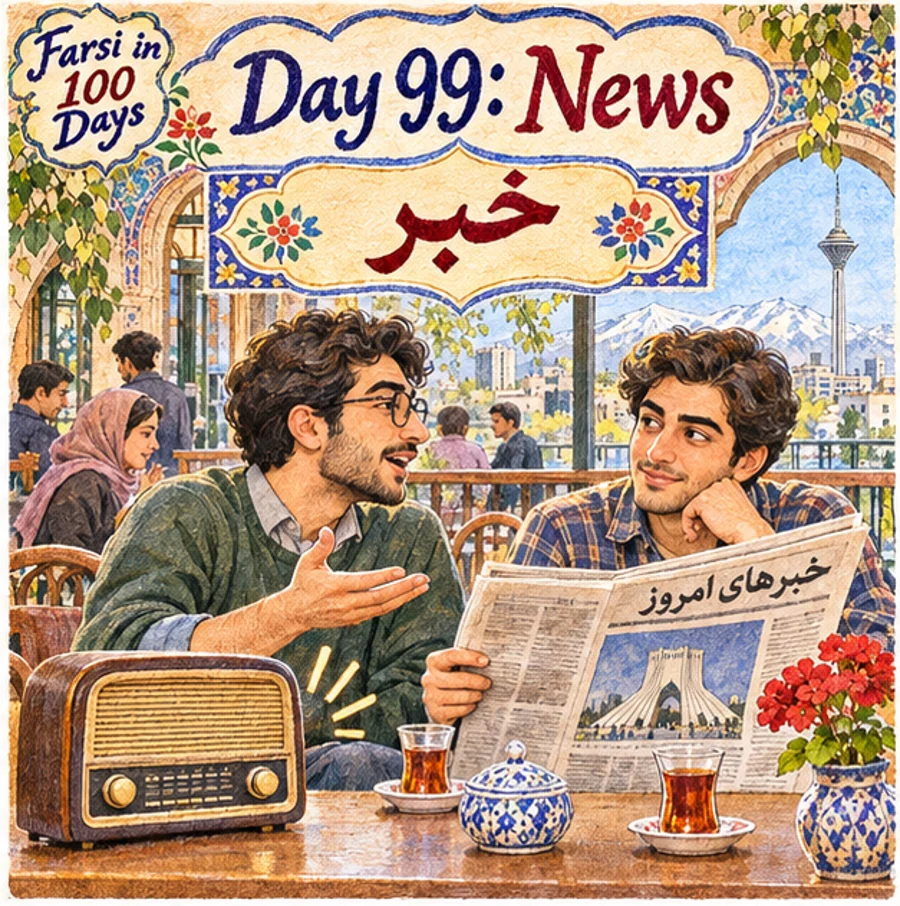
Day 99 of Learn Farsi in 100 Days, our free step-by-step Persian course: The News. The lesson has four parts, with every Persian word in Persian script, pronunciation and English, and each part ends with a quick check.
Part 1Conversation and joke
Day 99, Part 1 has Rastin tell Tirdad the news of a big earthquake (زلزلهی بزرگ, zelzele-ye bozorg) in Bam, with words like اخبار (akhbâr, news) and فاجعه (fâje’e, disaster), plus a Mulla joke about a drunk man who sees double.
Conversation: today’s news
| Speaker | Persian | English and pronunciation |
|---|---|---|
| Rastin راستین | اخبار امروز را دیدهای؟ | Have you seen today’s news? akhbâr-e emruz râ dide’i? |
| Tirdad تیرداد | نه، اتفاقی افتاده است؟ | No, has something happened? na, ettefâghi oftâde ast? |
| Rastin راستین | یک زلزلهی بزرگ در بم اتفاق افتاده است. | A big earthquake has happened in Bam. yek zelzele-ye bozorg dar bam ettefâgh oftâde ast. |
| Tirdad تیرداد | آه! خدای من. | Oh! My God. âh! khodâ-ye man. |
| Rastin راستین | رئیس جمهور در اخبار در مورد آن صحبت میکرد. | The president was talking about it on the news. ra’is jomhur dar akhbâr dar mored-e ân sohbat mikard. |
| Tirdad تیرداد | کسی هم صدمه دیده است؟ | Was anyone hurt? kasi ham sadame dide ast? |
| Rastin راستین | فکر میکنم که گفتند در حدود ۴۰ هزار نفر کشته شدهاند. | I think they said about 40,000 people have been killed. fekr mikonam ke goftand dar hodud-e chehel hezâr nafar koshte shode’and. |
| Tirdad تیرداد | فاجعه است! | That’s a disaster! fâje’e ast! |
| Rastin راستین | بله، من فکر نمیکردم که نشنیده باشی. تمام روز دربارهی آن صحبت میکردند. | Yes. I didn’t think you could have missed it. They were talking about it all day. bale, man fekr nemikardam ke nashnide bâshi. tamâm-e ruz darbâre-ye ân sohbat mikardand. |
| Tirdad تیرداد | من معمولا تلویزیون تماشا نمیکنم. | I don’t usually watch TV. man ma’mulan televiziyon tamâshâ nemikonam. |
| Rastin راستین | اخبار تماشا نمیکنی؟ | You don’t watch the news? akhbâr tamâshâ nemikoni? |
| Tirdad تیرداد | نه من معمولا خبرها را به صورت آنلاین میخوانم، اما امروز فرصت نکردم کامپیوترم را روشن کنم. | No, I usually read the news online, but today I didn’t get a chance to turn on my computer. na, man ma’mulan khabar-hâ râ be surat-e ânlâyn mikhânam, ammâ emruz forsat nakardam kâmpyuteram râ roshan konam. |
Joke: seeing double
یک شب ملا به سمت خانه میرفت. در راه مرد مستی با او تصادف کرد. ملا به او گفت: احمق مگر کور هستی که آدم به این بزرگی را نمیبینی؟
One night Mulla was walking home. On the way a drunk man bumped into him. Mulla said to him, “You fool, are you blind that you can’t see a person this big?”
مرد مست گفت: به جای یکی دو تا میبینم. ملا گفت: خوب پس چرا با من تصادف میکنی؟ مرد مست گفت: چون من میخواستم از وسط شما دو نفر عبور کنم!
The drunk man said, “I see two instead of one.” Mulla said, “Well then, why did you bump into me?” The drunk man said, “Because I wanted to pass between the two of you!”
Quick check
- How do you ask “Have you seen today’s news?” in Persian?
Show answer
اخبار امروز را دیدهای؟ (akhbâr-e emruz râ dide’i?) - What does فاجعه (fâje’e) mean?
Show answer
disaster, tragedy - How does Tirdad usually get the news?
Show answer
He reads it online: به صورت آنلاین میخوانم (be surat-e ânlâyn mikhânam).
Part 2Common phrases, poetry, words in the poem and word of the day
Day 99, Part 2 gives everyday phrases such as آسانسور خراب است (âsânsor kharâb ast, the elevator is out of order) and آسمان دارد صاف میشود (the clouds are lifting), a Khayyam quatrain about the potter of time, and the word of the day, آشفته (âshofte, distraught, messy).
Common phrases
| Persian | Pronunciation | English |
|---|---|---|
| آسانسور خراب است. | âsânsor kharâb ast. | The elevator is out of order. |
| باید از پلهها برویم. | bâyad az pelle-hâ beravim. | We have to take the stairs. |
| آسمان دارد صاف میشود. | âsemân dârad sâf mishavad. | The clouds are lifting. / The sky is clearing up. |
| تلفن آنها روی پیغامگیر است. | telefon-e ân-hâ ru-ye peyghâmgir ast. | Their answering machine is on. |
Poetry: a quatrain by Khayyam
A quatrain (robâ’i) by Omar Khayyam (خیام): the human being is a fine cup that the potter of time makes and then breaks. The book gives this English verse translation: “That ev’n my buried Ashes such a Snare / Of Perfume shall fling up into the Air, As not a True / Believer passing by / But shall be overtaken unaware.”
| Persian | Pronunciation | English |
|---|---|---|
| جامی است که عقل آفرین میزندش | jâmi ast ke ‘aghl âfarin mizanadash | It is a cup that reason praises, |
| صد بوسه ز مهر بر جبین میزندش | sad buse ze mehr bar jabin mizanadash | and kisses a hundred times on the brow with love. |
| این کوزهگر دهر چنین جام لطیف | in kuzegar-e dahr chonin jâm-e latif | This potter of time makes such a delicate cup |
| میسازد و باز بر زمین میزندش | misâzad o bâz bar zamin mizanadash | and then dashes it to the ground again. |
Words in the poem
| Persian | Pronunciation | English |
|---|---|---|
| جبین: پیشانی | jabin: pishâni | forehead, brow |
| دهر: روزگار | dahr: ruzegâr | time, the world, fate |
| آفرین میزندش: به او آفرین میگوید. | âfarin mizanadash: be u âfarin miguyad. | praises it, says “well done” to it |
Word of the day: آشفته (âshofte)
Meaning: distraught, agitated; messy
The employee came out of the boss’s office upset and distraught.
Quick check
- How do you say “The elevator is out of order” in Persian?
Show answer
آسانسور خراب است. (âsânsor kharâb ast.) - In the Khayyam poem, what does جبین (jabin) mean?
Show answer
forehead, brow (= پیشانی, pishâni) - What does آشفته (âshofte) mean?
Show answer
distraught, agitated; messy
Part 3Idiom of the day and conversation
Day 99, Part 3 tells the story behind ماستمالی کردن (mâstmâli kardan, to whitewash or cover up a problem), has Samyar and Radmehr talk about the newspaper and a pay raise (افزایش حقوق, afzâyesh-e hoghugh), and gives the idiom آنقدر سمن است که یاسمن پیدا نیست.
Idiom of the day
ماستمالی کردن
mâstmâli kardan
Word for word: to smear with yogurt
Meaning in Persian: این ضربالمثل یعنی، کاری که ممکن است موجب دعوا شود را به نحوی توجیه کردن، ظاهر یک قضیه را درست کردن. داستان ضربالمثل: هنگام عروسی محمدرضاشاه پهلوی، قرار بود مهمانان مصری و همراهان عروس به وسیلهی راهآهن از جنوب به تهران وارد شوند. شهربانی دستور داده بود که دیوارهای تمام روستاها در طول مسیر ورود مهمانان را سفید کنند. در یکی از روستاها گچ برای سفید کردن دیوار وجود نداشت. کدخدای آن روستا دستور میدهد که با ماست تمام دیوارها را سفید کنند.
Meaning: This proverb means to explain away something that could cause a quarrel, to fix only the surface of a matter. The story behind it: at the wedding of Mohammad Reza Shah Pahlavi, the Egyptian guests and the bride’s companions were to arrive in Tehran by train from the south. The police had ordered that the walls of all the villages along the guests’ route be whitened. In one of the villages there was no plaster to whiten the walls, so the village headman ordered all the walls to be whitened with yogurt.
English equivalent: to whitewash, to paper over the cracks, to cover up
Conversation: reading the newspaper
| Speaker | Persian | English and pronunciation |
|---|---|---|
| Samyar سامیار | چه کاری انجام میدهی رادمهر؟ | What are you doing, Radmehr? che kâri anjâm midahi râdmehr? |
| Radmehr رادمهر | دارم روزنامه میخوانم. | I’m reading the newspaper. dâram ruznâme mikhânam. |
| Samyar سامیار | من از اخبار متنفرم. چیز خاصی هم نوشته است؟ | I hate the news. Does it say anything special? man az akhbâr motenafferam. chiz-e khâssi ham neveshte ast? |
| Radmehr رادمهر | بله چیزهای زیادی نوشته است. من دوست دارم بدانم اطرافم چه خبر است. | Yes, it says a lot. I like to know what’s going on around me. bale chiz-hâ-ye ziyâdi neveshte ast. man dust dâram bedânam atrâfam che khabar ast. |
| Samyar سامیار | در مورد افزایش حقوق کارمندان دولت چیزی ننوشته است؟ | Doesn’t it say anything about a pay raise for government employees? dar mored-e afzâyesh-e hoghugh-e kârmandân-e dowlat chizi naneveshte ast? |
| Radmehr رادمهر | نه چیزی ننوشته است. به تنها چیزی که فکر میکنی پول است! | No, it doesn’t. The only thing you think about is money! na chizi naneveshte ast. be tanhâ chizi ke fekr mikoni pul ast! |
| Samyar سامیار | اگر پول باشد تمام مشکلات حل میشود! | If there’s money, all problems get solved! agar pul bâshad tamâm-e moshkelât hal mishavad! |
Idiom of the day
آنقدر سمن است که یاسمن پیدا نیست.
ânghadr saman ast ke yâsaman peydâ nist.
Word for word: There is so much saman that the jasmine can’t be seen.
Meaning in Persian: تعداد افراد یا چیزهای خاص و مورد توجه آنقدر زیاد است که دیگران به حساب نمیآیند.
Meaning: There are so many special or noteworthy people or things that the others don’t count.
English equivalent: You can’t see the wood for the trees.
Quick check
- What does ماستمالی کردن (mâstmâli kardan) mean?
Show answer
to cover up or explain away a problem, fixing only its surface - How do you say “I’m reading the newspaper” in Persian?
Show answer
دارم روزنامه میخوانم. (dâram ruznâme mikhânam.) - What English idiom does the book give for آنقدر سمن است که یاسمن پیدا نیست?
Show answer
You can’t see the wood for the trees.
Part 4Reading and vocabulary
Day 99, Part 4 is a reading about Qeshm (قشم, gheshm), the largest island in the Persian Gulf, and the small “Naz” islands that join it at low tide, followed by the day’s vocabulary, including پیغامگیر (peyghâmgir, answering machine) and شهربانی (shahrbâni, police).
Reading: Qeshm Island
قشم بزرگترین جزیره خلیج فارس است که در استان هرمزگان قرار دارد. بهخاطر بازار پر رونق و ورود کالاهای بسیار مهم از کشورهای حاشیهی خلیج فارس به این جزیره، جزیرهای بسیار مهم و مورد توجه است.
Qeshm is the largest island in the Persian Gulf, in Hormozgan Province. Because of its thriving market and the very important goods that come to it from the countries around the Persian Gulf, it is a very important island that attracts a lot of attention.
جزیرههای بزرگ اطراف قشم عبارتاند از: جزیرهی هنگام، هرمز و لارک. جزیرههای کوچکی اطراف قشم وجود دارند که فاصله کمی با ساحل جزیره دارند. این جزیرههای کوچک هنگام جزر و مد به ساحل جزیره میپیوندند و جدا میشوند. به این جزیرهها «ناز» میگویند.
The large islands around Qeshm are Hengam, Hormuz and Larak. There are also small islands around Qeshm, a short distance from its shore. With the ebb and flow of the tide, these small islands join the island’s shore and then separate from it again. They are called “Naz”.
Vocabulary
| Persian | Pronunciation | English |
|---|---|---|
| پیغامگیر | peyghâmgir | answering machine |
| عبور کردن | ‘obur kardan | to cross, to pass |
| افزایش | afzâyesh | increase |
| بهنحوی | be nahvi | somehow |
| توجیه کردن | towjih kardan | to justify |
| قضیه | ghaziye | matter, case |
| سراسر | sarâsar | throughout |
| همراهان | hamrâhân | companions, entourage |
| مشاغل | mashâghel | jobs, occupations |
| به این خاطر | be in khâter | because of this |
| شهربانی | shahrbâni | police (the former name of the police force) |
| گچ | gach | plaster |
| اطراف | atrâf | around, surroundings |
| مورد توجه | mored-e tavajjoh | noteworthy, receiving attention |
| به حساب آمدن | be hesâb âmadan | to be considered, to count |
| دستکم | dast-e kam | at least |
| قفس | ghafas | cage |
| سیلی زدن | sili zadan | to slap |
| شایستگی داشتن | shâyestegi dâshtan | to be qualified, to deserve |
| کمیابی | kamyâbi | scarcity |
| پخش کردن | pakhsh kardan | to spread, to distribute; to broadcast |
| پریشان | parishân | distressed, upset |
| پیشانی | pishâni | forehead |
| لطیف | latif | tender, delicate |
| قهر | ghahr | wrath; sulking, not being on speaking terms |
| کارمزد | kârmozd | commission, service fee |
Quick check
- Which is the largest island in the Persian Gulf?
Show answer
Qeshm, قشم (gheshm), in Hormozgan Province - What are the small islands near Qeshm that join it at low tide called?
Show answer
ناز (nâz) - What does پیغامگیر (peyghâmgir) mean?
Show answer
answering machine
Take this lesson further

Study with the book
Learn Farsi in 100 Days: The Ultimate Crash Course to Learning Farsi Fast
This free lesson is part of Learn Farsi in 100 Days. The book puts the whole series in one printable PDF you can study offline.
Serious about Persian? Get all 30 of our Persian learning books for $199.99 (55% less than buying them one by one).
Free Persian Starter Pack: Alphabet + 100 Core Words
Get the 14-page printable Starter Pack (all 32 letters, a 7-day reading plan, 100 core words and 20 survival phrases) and a short 5-email course. Free.
Free. Every morning: that day’s four videos and the full lessons, with every Persian word, its pronunciation and its English meaning. Stop or pause with one click.