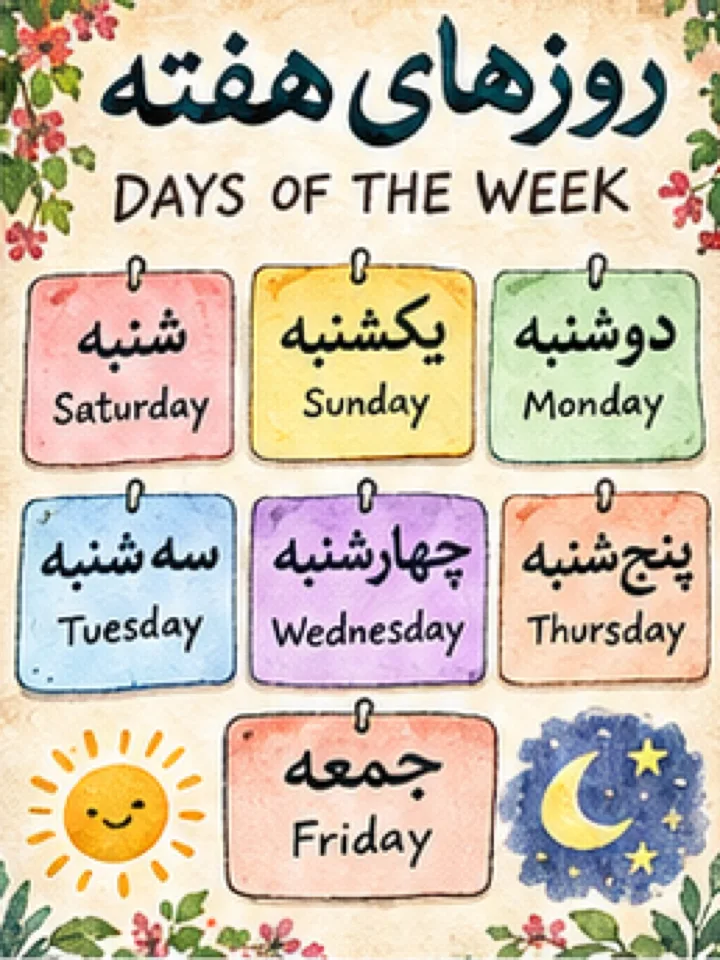
Learn the seven days of the week in Persian, how the names are built from شنبه, how to ask
Days of the week:
| Saturday | shanbe | شنبه |
| Sunday | yekshanbe | یکشنبه |
| Monday | doshanbe | دوشنبه |
| Tuesday | seshanbe | سه شنبه |
| Wednesday | chârshanbe | چهارشنبه |
| Thursday | panjshanbe | پنج شنبه |
| Friday | Jom’e | جمعه |
.Saturday is the first day in Iran and Friday is the last day
Exercises: Answer the following questions in complete sentences.
1- روز اول هفته چه روزی است؟
2- کدام روز تعطیل است؟
3- امروز چندشنبه است؟
4- فردا چند شنبه است؟
5- چند روز در هفته کار می کنید؟
Learn the seven days of the week in Persian, how the names are built from شنبه, how to ask what day it is, spoken forms and a short quiz.
The days of the week in Persian
The Iranian week starts on Saturday and ends on Friday. Friday, جمعه (jom'e), is the weekly holiday, so Thursday and Friday together are the weekend for many people. The day names are easy to learn because most of them are built on one word: شنبه (shanbe), "Saturday."
| Persian | Pronunciation | English |
|---|---|---|
| شنبه | /shanbe/ | Saturday |
| یکشنبه | /yekshanbe/ | Sunday |
| دوشنبه | /doshanbe/ | Monday |
| سهشنبه | /seshanbe/ | Tuesday |
| چهارشنبه | /chahârshanbe/ | Wednesday |
| پنجشنبه | /panjshanbe/ | Thursday |
| جمعه | /jom'e/ | Friday |
How the names work
Sunday to Thursday are a number + شنبه: یک (one), دو (two), سه (three), چهار (four), پنج (five). The number counts the days after Saturday, so دوشنبه, "two-shanbe," is Monday, the second day after Saturday, not the second day of the week. Friday has its own name, جمعه, which comes from the Arabic word for gathering, the day of the Friday prayer.
The sentences from the lesson
| Persian | Pronunciation | English |
|---|---|---|
| شنبه روزِ اولِ هفته است. | /shanbe ruz-e avval-e hafte ast./ | Saturday is the first day of the week. |
| جمعه روزِ آخرِ هفته و تعطیل است. | /jom'e ruz-e âkhar-e hafte va ta'til ast./ | Friday is the last day of the week and a holiday. |
Talking about days
- To ask the day: امروز چندشنبه است؟ (emruz chandshanbe ast?), "What day is it today?" literally "today is how-many-shanbe?"
- No preposition is needed for "on": شنبه میآیم (shanbe miâyam), "I'm coming on Saturday." You can also say روزِ شنبه (ruz-e shanbe).
- Add ها for "on Saturdays": شنبهها کلاس دارم (shanbehâ kelâs dâram), "I have class on Saturdays."
- Next and last: شنبهی آینده (shanbe-ye âyande), "next Saturday"; شنبهی گذشته (shanbe-ye gozashte), "last Saturday."
More examples
| Persian | Pronunciation | English |
|---|---|---|
| امروز دوشنبه است. | /emruz doshanbe ast./ | Today is Monday. |
| فردا سهشنبه است. | /fardâ seshanbe ast./ | Tomorrow is Tuesday. |
| دیروز یکشنبه بود. | /diruz yekshanbe bud./ | Yesterday was Sunday. |
| چهارشنبهها به باشگاه میروم. | /chahârshanbehâ be bâshgâh miravam./ | I go to the gym on Wednesdays. |
| جمعه خانهی مادربزرگ هستیم. | /jom'e khâne-ye mâdarbozorg hastim./ | On Friday we're at grandma's house. |
| پنجشنبهی آینده مهمانی داریم. | /panjshanbe-ye âyande mehmâni dârim./ | We're having a party next Thursday. |
| از شنبه تا چهارشنبه کار میکنم. | /az shanbe tâ chahârshanbe kâr mikonam./ | I work from Saturday to Wednesday. |
| کلاس فارسی روزهای یکشنبه است. | /kelâs-e fârsi ruzhâ-ye yekshanbe ast./ | The Persian class is on Sundays. |
| هفته هفت روز دارد. | /hafte haft ruz dârad./ | A week has seven days. |
| آخرِ هفته کجا میروی؟ | /âkhar-e hafte kojâ miravi?/ | Where are you going at the weekend? |
In spoken Persian
In everyday speech the n before b in شنبه is usually pronounced m: shambe, yekshambe, doshambe, seshambe, panjshambe. چهارشنبه is said chârshambe, and است becomes -e: امروز چندشنبهست؟ (emruz chandshambast?), "What day is it today?" You will also hear چهارشنبهسوری (chahârshanbe suri), the fire festival held on the evening of the last Tuesday before the Persian New Year.
Common mistakes
- Assuming دوشنبه means "second day": it is Monday, the third day of the Iranian week.
- Adding در or به for "on": "on Monday" is just دوشنبه or روزِ دوشنبه.
- Writing سه شنبه with a full space: use a zero-width non-joiner (سهشنبه) or join it, so the two parts stay one word.
Now answer the questions in the exercise above in full sentences.
Practice
-
Which day is پنجشنبه?
Show answer
Thursday
-
How do you say "on Tuesdays"?
Show answer
seshanbehâ سهشنبهها
-
Translate: "Yesterday was Friday."
Show answer
diruz jom'e bud. دیروز جمعه بود.
-
How is یکشنبه usually pronounced in speech?
Show answer
yekshambe
See all lessons in the Persian grammar series.

Take this lesson further
Study with the book
Farsi Grammar in Use: For Beginners
This free lesson is part of Persian grammar lessons. The book puts the whole series in one printable PDF you can study offline.
Serious about Persian? Get all 30 of our Persian learning books for $199.99 (55% less than buying them one by one).
Free Persian Starter Kit (PDF)
The Persian alphabet chart and the 101 most common Persian words with pronunciation, in one printable PDF. You also get a one-time 15% code for any of our books.
We will email you new lessons and book news from Learn Persian Online. Unsubscribe any time.Free: Persian Alphabet + 100 Core Words (PDF)
Get the 14-page printable Starter Pack (all 32 letters, a 7-day reading plan, 100 core words and 20 survival phrases) and a short 5-email course. Free.