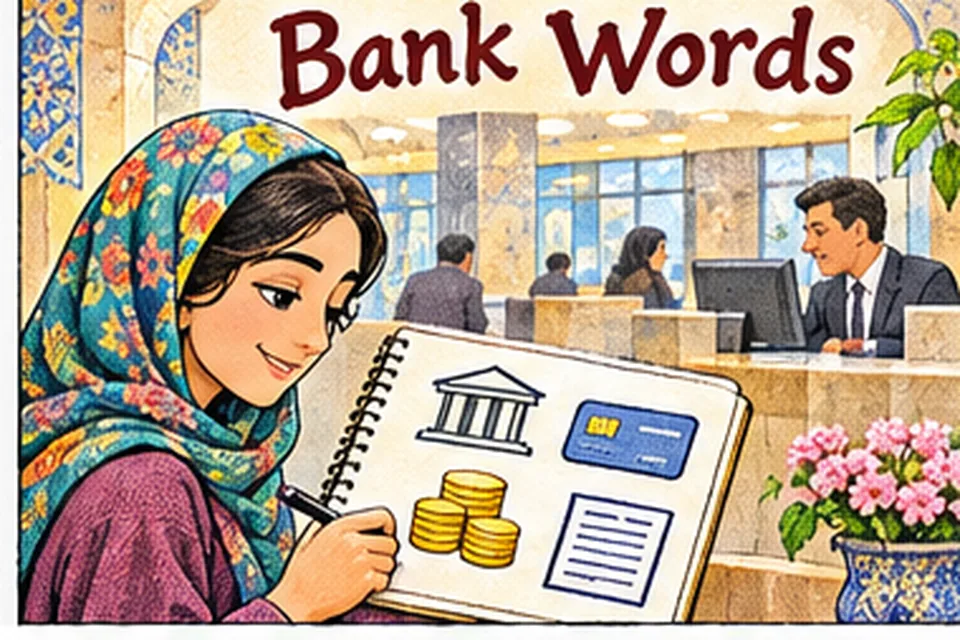
Lesson 18 of Learn to Speak Persian Fast, our free video course: At the Bank. Watch the video for each part, then read the notes, with every Persian word in Persian script, pronunciation and English, and try the practice questions at the end of each part.
New words: Persian words for the bank
Learn 20 Persian words for the bank, from account and cash to signature and deposit, with examples and a quiz for Lesson 18.
Study notes for this lesson. The Lesson 18 video introduces new words for a visit to the bank. Below is a word list on the same theme, example sentences and a short quiz. In the other pages of this lesson, Maryam goes to the bank to open a savings account, and a clerk, Mr. Ahmadi, helps her.
Several of these words are international (بانک bânk, فرم form, کارت kârt), so you can learn them quickly. Spend more time on the native and Arabic-origin words such as حساب, نوبت and واریز کردن.
Word list
| Persian | Pronunciation | English |
|---|---|---|
| بانک | /bânk/ | bank |
| حساب | /hesâb/ | account |
| حساب باز کردن | /hesâb bâz kardan/ | to open an account |
| شمارهی حساب | /shomâre-ye hesâb/ | account number |
| کارمند | /kârmand/ | employee, clerk |
| مشتری | /moshtari/ | customer |
| باجه | /bâje/ | counter, teller window |
| نوبت | /nobat/ | turn (in a line) |
| فرم | /form/ | form |
| پر کردن | /por kardan/ | to fill in |
| امضا | /emzâ/ | signature |
| امضا کردن | /emzâ kardan/ | to sign |
| کارت ملی | /kârt-e melli/ | national ID card |
| کارت بانکی | /kârt-e bânki/ | bank card |
| پول | /pul/ | money |
| پول نقد | /pul-e naghd/ | cash |
| اسکناس | /eskenâs/ | banknote, bill |
| سکه | /sekke/ | coin |
| پسانداز | /pas-andâz/ | savings |
| واریز کردن | /vâriz kardan/ | to deposit, to pay in |
Notes on the words
- حساب (hesâb) means "account" at a bank, but also "bill" at a restaurant and "arithmetic" at school.
- پسانداز (pas-andâz) comes from پس انداختن, "to put aside." A savings account is حساب پسانداز (hesâb-e pas-andâz).
- نوبت (nobat) is your turn in a line. At a bank you usually take a ticket and wait until your number is called: نوبت شماست (nobat-e shomâst), "it's your turn."
- In many Iranian banks the clerk sits behind a window or counter, the باجه (bâje).
Example sentences
| Persian | Pronunciation | English |
|---|---|---|
| میخواهم یک حساب باز کنم. | /mikhâham yek hesâb bâz konam. (spoken: mikhâm ye hesâb bâz konam.)/ | I want to open an account. |
| کارت ملیتان را بدهید، لطفاً. | /kârt-e melli-tân râ bedahid, lotfan./ | Please give me your national ID card. |
| این فرم را پر کنید و امضا کنید. | /in form râ por konid va emzâ konid./ | Fill in this form and sign it. |
| پول نقد دارید؟ | /pul-e naghd dârid?/ | Do you have cash? |
| مریم یک میلیون تومان واریز کرد. | /maryam yek milyun tomân vâriz kard./ | Maryam deposited one million tomans. |
| نوبت شماست. | /nobat-e shomâst./ | It's your turn. |
| شمارهی حسابم را نمیدانم. | /shomâre-ye hesâbam râ nemidânam./ | I don't know my account number. |
Questions you will hear at the bank
| Persian | Pronunciation | English |
|---|---|---|
| چه کاری دارید؟ | /che kâri dârid? (spoken: che kâri dârin?)/ | What can I do for you? |
| حساب دارید؟ | /hesâb dârid?/ | Do you have an account? |
| شمارهی حسابتان چند است؟ | /shomâre-ye hesâbetân chand ast? (spoken: shomâre hesâbetun chande?)/ | What is your account number? |
| چقدر میخواهید واریز کنید؟ | /cheghadr mikhâhid vâriz konid?/ | How much do you want to deposit? |
Practice tip
Make a small set of cards: Persian on one side, English on the other. Sort them into three groups: things you can hold (cash, coin, banknote, card), people and places (clerk, customer, window, bank), and actions (open an account, fill in, sign, deposit). Then build one sentence from each group.
Practice
How do you say "cash" in Persian?
Show answer
pul-e naghd پول نقد
What does this mean? نوبت شماست.
Show answer
It's your turn.
Which verb means "to sign"?
Show answer
emzâ kardan امضا کردن
Translate: "I want to open a savings account."
Show answer
mikhâham yek hesâb-e pas-andâz bâz konam. میخواهم یک حساب پسانداز باز کنم.
Give two meanings of {{حساب}}.
Show answer
account; bill (also arithmetic)
Grammar: Plural nouns in Persian
How to make Persian nouns plural with -hâ and -ân, spelling and spoken forms, Arabic plurals, numbers with singular nouns, and a quiz.
Study notes for this lesson. The Lesson 18 video teaches the plural of nouns. Persian plurals are simple: one ending works for almost every noun, and a second ending is used mainly for people in more formal Persian. The examples below use the bank words from the New Words page.
The ending -hâ: for every noun
Add ها (-hâ) to make any noun plural: things, people, animals and ideas. It is the most common plural in both speech and writing. In careful writing it is separated from the noun with a zero-width non-joiner, so the letters do not join: کارتها, سکهها.
| Persian | Pronunciation | English |
|---|---|---|
| حسابها | /hesâbhâ/ | accounts |
| بانکها | /bânkhâ/ | banks |
| فرمها | /formhâ/ | forms |
| اسکناسها | /eskenâshâ/ | banknotes |
| سکهها | /sekkehâ/ | coins |
| مشتریها | /moshtarihâ/ | customers |
| کارمندها | /kârmandhâ/ | clerks |
The ending -ân: mostly for people, more formal
Nouns for people (and some animals and plants) can also take ان (-ân). This sounds more formal and is common in writing, news and official language. After a vowel the ending changes its shape.
| Singular: plural | Pronunciation | English |
|---|---|---|
| کارمند: کارمندان | /kârmand: kârmandân/ | clerk: clerks |
| مشتری: مشتریان | /moshtari: moshtariyân/ | customer: customers |
| مرد: مردان | /mard: mardân/ | man: men |
| زن: زنان | /zan: zanân/ | woman: women |
| آقا: آقایان | /âghâ: âghâyân/ | gentleman: gentlemen (-yân after â) |
| دانشجو: دانشجویان | /dâneshju: dâneshjuyân/ | student: students (-yân after u) |
| نماینده: نمایندگان | /namâyande: namâyandegân/ | representative: representatives (-gân after silent e) |
Spoken plurals: -â
In everyday Tehran speech, -hâ after a consonant is usually pronounced -â: حسابا (hesâbâ), بانکا (bânkâ), کارتا (kârtâ). After a vowel, the h usually stays: سکهها (sekkehâ). In writing, always use ها.
Plurals borrowed from Arabic
Some words from Arabic keep an Arabic plural in standard Persian. You will meet them often in banks and offices, so learn them as vocabulary: مدرک (madrak), "document," plural مدارک (madârek); اطلاعات (ettelâ'ât), "information"; شرایط (sharâyet), "conditions."
Numbers take the singular
After a number, or words like چند (chand, "a few, how many"), the noun stays singular: دو حساب (do hesâb), "two accounts," سه کارمند (se kârmand), "three clerks." In speech people often add تا (tâ) after the number: دو تا فرم (do tâ form), "two forms."
Plurals with ezâfe and râ
The plural ending comes first, then the ezâfe or را: حسابهای من (hesâbhâ-ye man), "my accounts"; اسکناسها را بشمارید (eskenâshâ râ beshomârid), "count the banknotes."
Examples
| Persian | Pronunciation | English |
|---|---|---|
| مشتریها منتظر نوبت هستند. | /moshtarihâ montazer-e nobat hastand./ | The customers are waiting for their turn. |
| کارمندان بانک مهربان هستند. | /kârmandân-e bânk mehrabân hastand./ | The bank clerks are kind. |
| این فرمها را پر کنید. | /in formhâ râ por konid./ | Fill in these forms. |
| سه سکه در کیفم دارم. | /se sekke dar kifam dâram./ | I have three coins in my bag. |
| اسکناسها نو هستند. | /eskenâshâ no hastand./ | The banknotes are new. |
| مدارکتان را بیاورید. | /madârek-etân râ biyâvarid./ | Bring your documents. |
| بانکا امروز شلوغن. | /bânkâ emruz sholughan. (spoken)/ | The banks are busy today. |
Common mistakes
- Using a plural after a number: دو حسابها is wrong; say دو حساب (do hesâb).
- Making the adjective plural: "new banknotes" is اسکناسهای نو (eskenâshâ-ye no), with the plural only on the noun.
- Using -ân for objects: "forms" is فرمها, not "formân." Use -ân only for people and some living things.
- Forgetting the ezâfe after the plural: "the bank's customers" is مشتریهای بانک (moshtarihâ-ye bânk).
Practice
Make plural with -hâ: {{کارت}}
Show answer
kârthâ کارتها
Make plural with -ân: {{مشتری}}
Show answer
moshtariyân مشتریان
Correct the mistake: {{پنج اسکناسها}}
Show answer
panj eskenâs پنج اسکناس
How do people usually say {{حسابها}} in spoken Tehran Persian?
Show answer
hesâbâ حسابا
What is the singular of {{مدارک}}?
Show answer
madrak, "document" مدرک
Speaking practice: opening an account at the bank
A spoken Persian dialogue for opening a bank account and depositing cash, with useful phrases, a role-play and a quiz for Lesson 18.
Study notes for this lesson. After the speaking video, practice with this original dialogue. Maryam wants to open a savings account. Her number is called, and Mr. Ahmadi, a bank clerk, helps her. The dialogue is in polite spoken Persian; the phrase table shows written forms where they differ.
Dialogue
| Speaker | Persian | Pronunciation | English |
|---|---|---|---|
| Mr. Ahmadi | نوبت شماست. بفرمایید. | /nobat-e shomâst. befarmâyid./ | It's your turn. Go ahead. |
| Maryam | سلام. میخوام یه حساب پسانداز باز کنم. | /salâm. mikhâm ye hesâb-e pas-andâz bâz konam./ | Hello. I'd like to open a savings account. |
| Mr. Ahmadi | کارت ملیتون همراهتونه؟ | /kârt-e melli-tun hamrâhetune?/ | Do you have your national ID card with you? |
| Maryam | بله، بفرمایید. | /bale, befarmâyid./ | Yes, here you are. |
| Mr. Ahmadi | این دو تا فرم رو پر کنید و پایینشون رو امضا کنید. | /in do tâ form ro por konid va pâyineshun ro emzâ konid./ | Fill in these two forms and sign at the bottom. |
| Maryam | امروز یه میلیون تومن هم واریز میکنم. | /emruz ye milyun tomân ham vâriz mikonam./ | I'll also deposit one million tomans today. |
| Mr. Ahmadi | نقده یا با کارت؟ | /naghde yâ bâ kârt?/ | Is it cash or by card? |
| Maryam | نقده. اسکناسا اینجاست. | /naghde. eskenâsâ injâst./ | Cash. Here are the banknotes. |
| Mr. Ahmadi | ممنون. این شماره حسابتونه. کارت بانکیتون هم یه هفته دیگه آماده میشه. | /mamnun. in shomâre hesâbetune. kârt-e bânki-tun ham ye hafte-ye dige âmâde mishe./ | Thank you. This is your account number. Your bank card will be ready in a week. |
| Maryam | خیلی ممنون، خسته نباشید. | /kheyli mamnun, khaste nabâshid./ | Thank you very much. (said to someone at work) |
| Mr. Ahmadi | خواهش میکنم. روز خوبی داشته باشید. | /khâhesh mikonam. ruz-e khubi dâshte bâshid./ | You're welcome. Have a nice day. |
Useful phrases
| Persian | Pronunciation | English |
|---|---|---|
| نوبت شماست. | /nobat-e shomâst./ | It's your turn. |
| میخوام یه حساب باز کنم. | /mikhâm ye hesâb bâz konam./ | I'd like to open an account. (written: mikhâham yek hesâb bâz konam.) |
| کارت ملیتون همراهتونه؟ | /kârt-e melli-tun hamrâhetune?/ | Do you have your ID card with you? (written: kârt-e melli-tân hamrâhetân ast?) |
| اینجا رو امضا کنید. | /injâ ro emzâ konid./ | Sign here. |
| نقده یا با کارت؟ | /naghde yâ bâ kârt?/ | Cash or card? |
| میخوام پول واریز کنم. | /mikhâm pul vâriz konam./ | I want to deposit money. |
| شماره حسابم چنده؟ | /shomâre hesâbam chande?/ | What is my account number? |
Notes
- Find the plurals from the grammar page: اسکناسا (eskenâsâ) is the spoken form of اسکناسها.
- Notice دو تا فرم (do tâ form): after a number, the noun stays singular.
- بفرمایید (befarmâyid) appears twice with two meanings: "go ahead" and "here you are."
Role-play
Work with a partner. One of you is a customer and the other is a bank clerk. The customer wants to deposit cash into an existing account. The clerk asks for the account number and the national ID card, asks the customer to sign a form, and counts the banknotes. Use at least two plural nouns, such as اسکناسها or فرمها, and one number with a singular noun.
Practice
What kind of account does Maryam want to open?
Show answer
A savings account. حساب پسانداز
What does the clerk ask for first?
Show answer
Her national ID card. کارت ملی
How many forms does Maryam fill in?
Show answer
Two. دو تا فرم
How much money does she deposit, and how?
Show answer
One million tomans, in cash. یه میلیون تومن، نقد
When will her bank card be ready?
Show answer
In a week. یه هفته دیگه
Reading practice: Maryam goes to the bank
A short beginner Persian reading about opening a bank account, with pronunciation, English, key words and a comprehension quiz.
Study notes for this lesson. This original reading text uses the bank words and the plural forms of Lesson 18. It is in standard written Persian. Read each sentence aloud, check the pronunciation, then cover the English column and read again.
Before you read, look for plural nouns. There are three in the text. Can you find them before you look at the English?
Reading text
| Persian | Pronunciation | English |
|---|---|---|
| مریم امروز به بانک رفت. | /maryam emruz be bânk raft./ | Maryam went to the bank today. |
| بانک خیلی شلوغ بود و مشتریها منتظر نوبت بودند. | /bânk kheyli sholugh bud va moshtarihâ montazer-e nobat budand./ | The bank was very busy, and the customers were waiting for their turn. |
| پشت باجهها سه کارمند کار میکردند. | /posht-e bâjehâ se kârmand kâr mikardand./ | Three clerks were working behind the windows. |
| بعد از بیست دقیقه نوبت مریم شد. | /ba'd az bist daghighe nobat-e maryam shod./ | After twenty minutes, it was Maryam's turn. |
| او میخواست یک حساب پسانداز باز کند. | /u mikhâst yek hesâb-e pas-andâz bâz konad./ | She wanted to open a savings account. |
| آقای احمدی کارت ملی او را گرفت. | /âghâ-ye ahmadi kârt-e melli-ye u râ gereft./ | Mr. Ahmadi took her national ID card. |
| مریم دو فرم را پر کرد و امضا کرد. | /maryam do form râ por kard va emzâ kard./ | Maryam filled in and signed two forms. |
| بعد یک میلیون تومان پول نقد واریز کرد. | /ba'd yek milyun tomân pul-e naghd vâriz kard./ | Then she deposited one million tomans in cash. |
| آقای احمدی اسکناسها را شمرد. | /âghâ-ye ahmadi eskenâshâ râ shemord./ | Mr. Ahmadi counted the banknotes. |
| او شمارهی حساب را روی یک کاغذ نوشت و به مریم داد. | /u shomâre-ye hesâb râ ru-ye yek kâghaz nevesht va be maryam dâd./ | He wrote the account number on a piece of paper and gave it to Maryam. |
| کارت بانکی مریم یک هفته بعد آماده میشود. | /kârt-e bânki-ye maryam yek hafte ba'd âmâde mishavad./ | Maryam's bank card will be ready a week later. |
Key words
- شلوغ (sholugh): busy, crowded
- منتظر (montazer): waiting; منتظر نوبت (montazer-e nobat), waiting for one's turn
- باجه (bâje): counter, teller window
- حساب پسانداز (hesâb-e pas-andâz): savings account
- پر کردن (por kardan): to fill in
- واریز کردن (vâriz kardan): to deposit
- شمردن (shemordan): to count
- کاغذ (kâghaz): paper
Grammar to notice
The plurals in the text are مشتریها, باجهها, and اسکناسها. In sentences 3 and 7 a number comes before the noun, so the noun stays singular: سه کارمند, دو فرم.
Questions to think about
- How long did Maryam wait, and why?
- What two things did Maryam do with the forms?
- What will Maryam receive a week later?
- Have you ever opened a bank account? Which of these steps were the same for you?
After you read
Retell the story in the first person, as if you were Maryam: امروز به بانک رفتم. (emruz be bânk raftam), "Today I went to the bank." Change each verb to the "I" form and read your version aloud.
Practice
Why did Maryam wait? چرا مریم منتظر ماند؟
Show answer
The bank was busy, and the customers were waiting for their turn. بانک شلوغ بود.
How many clerks were working? چند کارمند کار میکردند؟
Show answer
Three. سه کارمند.
What did Mr. Ahmadi take from Maryam? آقای احمدی چه چیزی از مریم گرفت؟
Show answer
Her national ID card. کارت ملی او را.
What did Mr. Ahmadi write on the paper? آقای احمدی روی کاغذ چه نوشت؟
Show answer
The account number. شمارهی حساب را.
Find the plural of {{اسکناس}} in the text.
Show answer
eskenâshâ اسکناسها
Take this lesson further

Study with the book
Learn to Speak Persian Fast: For Beginners
This free lesson is part of Learn to Speak Persian Fast. The book puts the whole series in one printable PDF you can study offline.
Serious about Persian? Get all 30 of our Persian learning books for $199.99 (55% less than buying them one by one).
Free Persian Starter Kit (PDF)
The Persian alphabet chart and the 101 most common Persian words with pronunciation, in one printable PDF. You also get a one-time 15% code for any of our books.
We will email you new lessons and book news from Learn Persian Online. Unsubscribe any time.Free Persian Starter Pack: Alphabet + 100 Core Words
Get the 14-page printable Starter Pack (all 32 letters, a 7-day reading plan, 100 core words and 20 survival phrases) and a short 5-email course. Free.