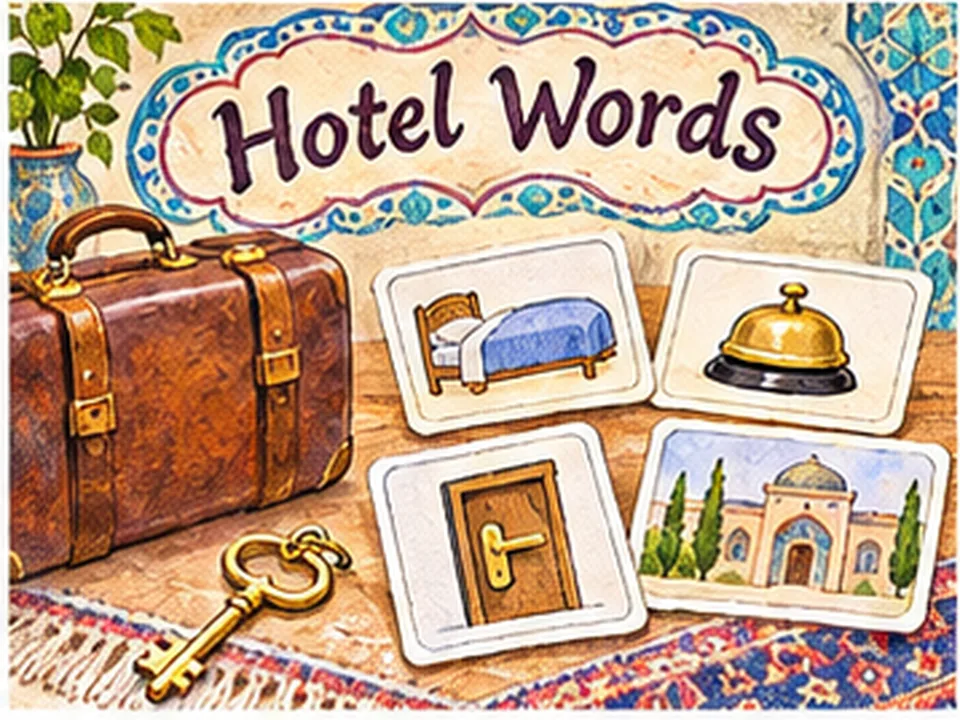
Lesson 15 of Learn to Speak Persian Fast, our free video course: Checking Out of a Hotel. Watch the video for each part, then read the notes, with every Persian word in Persian script, pronunciation and English, and try the practice questions at the end of each part.
New words: Checking out of a hotel: Persian words
Study notes for Lesson 15: Persian words for checking out of a hotel, from bill and receipt to suitcase and taxi, with examples and a quiz.
These study notes go with the Lesson 15 video of Learn to Speak Persian Fast, whose theme is checking out. On this version of the lesson we focus on the end of a hotel stay: returning the key, paying the bill, getting a receipt and a taxi to the airport. You will follow Mr. Karimi on the last day of a trip to Shiraz.
Word list
| Persian | Pronunciation | English |
|---|---|---|
| هتل | /hotel/ | hotel |
| پذیرش | /paziresh/ | reception, front desk |
| اتاق | /otâgh/ | room |
| کلید | /kelid/ | key |
| اقامت | /eghâmat/ | stay |
| تسویه حساب کردن | /tasviye-hesâb kardan/ | to settle the bill, to check out |
| تحویل دادن | /tahvil dâdan/ | to hand in, to return |
| تخلیه کردن | /takhliye kardan/ | to vacate (a room) |
| صورتحساب | /surat-hesâb/ | bill, invoice |
| پرداخت کردن | /pardâkht kardan/ | to pay |
| نقد | /naghd/ | cash |
| کارت بانکی | /kârt-e bânki/ | bank card |
| رسید | /resid/ | receipt |
| چمدان | /chamedân/ | suitcase |
| گذاشتن | /gozâshtan/ | to put, to leave (something somewhere) |
| مینیبار | /minibâr/ | minibar |
| پرواز | /parvâz/ | flight |
| تاکسی | /tâksi/ | taxi |
| فرودگاه | /forudgâh/ | airport |
Notes on usage
- The usual way to say "check out" is تسویه حساب کردن (tasviye-hesâb kardan), literally "to settle the account". In speech it is often just تسویه کردن (tasviye kardan). Many hotel staff also understand the English loanword چکاوت (chek-out).
- Check-out time is ساعت تخلیه (sâ'at-e takhliye) or ساعت تحویل اتاق (sâ'at-e tahvil-e otâgh), the time to vacate or hand back the room.
- چمدان is چمدون (chamedun) in everyday speech.
- In Iran, payment by bank card at a card reader is very common; foreign cards usually do not work there, so visitors often pay نقد (naghd), in cash.
Example sentences
| Persian | Pronunciation | English |
|---|---|---|
| میخواهم تسویه حساب کنم. | /mikhâham tasviye-hesâb konam./ | I'd like to check out. |
| کلید اتاق را تحویل دادم. | /kelid-e otâgh râ tahvil dâdam./ | I handed in the room key. |
| صورتحساب را با کارت پرداخت کردم. | /surat-hesâb râ bâ kârt pardâkht kardam./ | I paid the bill by card. |
| ساعت تخلیهی اتاق ساعت دوازده است. | /sâ'at-e takhliye-ye otâgh sâ'at-e davâzdah ast./ | Check-out time is twelve o'clock. |
| میتوانم چمدانم را اینجا بگذارم؟ | /mitavânam chamedânam râ injâ begozâram?/ | Can I leave my suitcase here? |
| لطفاً یک تاکسی برای فرودگاه بگیرید. | /lotfan yek tâksi barâye forudgâh begirid./ | Please get a taxi to the airport. |
| یک رسید میخواهم. | /yek resid mikhâham./ | I'd like a receipt. |
Words on a hotel bill
| Persian | Pronunciation | English |
|---|---|---|
| تاریخ ورود | /târikh-e vorud/ | arrival date |
| تاریخ خروج | /târikh-e khoruj/ | departure date |
| تعداد شب | /te'dâd-e shab/ | number of nights |
| جمع کل | /jam'-e kol/ | total |
| مالیات | /mâliyât/ | tax |
Two patterns appear again and again here: میخواهم (I want) and میتوانم (I can), each followed by a second verb. The grammar page explains how they work.
More from Lesson 15 (hotel version)
Practice
What does this word mean? رسید
Show answer
receipt
How do you say "suitcase" in Persian?
Show answer
chamedân (spoken chamedun) چمدان
Which phrase means "to check out" (settle the bill)?
Show answer
tasviye-hesâb kardan تسویه حساب کردن
Translate: میتوانم چمدانم را اینجا بگذارم؟
Show answer
Can I leave my suitcase here?
How do you say "reception" (the front desk) in Persian?
Show answer
paziresh پذیرش
Study notes for Lesson 15: Persian words for paying and leaving a shop, from cashier and receipt to discount and change, with examples and a quiz.
More practice: At the checkout: Persian shopping words
These study notes go with the Lesson 15 video of Learn to Speak Persian Fast, whose theme is checking out. On this version of the lesson we focus on the checkout of a shop: the cashier, the price, paying by card or cash, the receipt and exchanging something later. You will follow Laleh, who buys a birthday present for her mother.
Word list
| Persian | Pronunciation | English |
|---|---|---|
| فروشگاه | /forushgâh/ | store |
| مغازه | /maghâze/ | shop |
| صندوق | /sandugh/ | checkout, till |
| صندوقدار | /sandughdâr/ | cashier |
| خریدن | /kharidan/ | to buy |
| خرید | /kharid/ | shopping; a purchase |
| قیمت | /gheymat/ | price |
| تومان | /tomân/ | toman (unit of money) |
| پول | /pul/ | money |
| نقد | /naghd/ | cash |
| کارت | /kârt/ | card |
| کارتخوان | /kârtkhân/ | card reader |
| رمز | /ramz/ | PIN, password |
| رسید | /resid/ | receipt |
| تخفیف | /takhfif/ | discount |
| کیسه | /kise/ | bag (plastic or paper) |
| حساب کردن | /hesâb kardan/ | to add up, to ring up |
| عوض کردن | /avaz kardan/ | to exchange |
| پس دادن | /pas dâdan/ | to return (an item) |
Notes on usage
- The official currency of Iran is the rial, but in everyday life prices are given in tomân. One tomân is ten rials. Price tags may show either, so it is worth checking.
- حساب کنید (hesâb konid), literally "calculate", is what you say at the till to ask for the total.
- چقدر شد؟ (cheghadr shod?), literally "how much did it become?", asks for the total. چند است؟ (chand ast?, spoken chande?) asks the price of one item.
- مغازه is a small shop; فروشگاه is a store, often a bigger one. سوپرمارکت (supermârket) is also common.
- In speech, تومان is often shortened to تومن (toman), and people often leave out هزار (hezâr, thousand) when the context is clear, so صد تومن may mean 100,000 tomans.
Example sentences
| Persian | Pronunciation | English |
|---|---|---|
| لطفاً حساب کنید. | /lotfan hesâb konid./ | Could you ring this up, please? |
| چقدر شد؟ | /cheghadr shod?/ | How much is it altogether? |
| با کارت پرداخت میکنم. | /bâ kârt pardâkht mikonam./ | I'll pay by card. |
| رمزتان را بزنید. | /ramzetân râ bezanid./ | Enter your PIN. |
| یک کیسه هم بدهید، لطفاً. | /yek kise ham bedahid, lotfan./ | A bag too, please. |
| این کفش تخفیف دارد؟ | /in kafsh takhfif dârad?/ | Are these shoes on sale? |
| میتوانم این را عوض کنم؟ | /mitavânam in râ avaz konam?/ | Can I exchange this? |
What the cashier may say
| Persian | Pronunciation | English |
|---|---|---|
| بفرمایید. | /befarmâyid./ | Go ahead. / Here you are. |
| کارت یا نقد؟ | /kârt yâ naghd?/ | Card or cash? |
| رمز را بزنید. | /ramz râ bezanid./ | Enter the PIN. |
| کیسه میخواهید؟ | /kise mikhâhid?/ | Do you want a bag? |
| پول خرد ندارید؟ | /pul-e khord nadârid?/ | Don't you have small change? |
Many of these sentences are requests or commands: حساب کنید, بزنید, بدهید. That form, the imperative, is the topic of the grammar page.
More from Lesson 15 (shop version)
Practice
What does this word mean? صندوقدار
Show answer
cashier
How do you say "receipt" in Persian?
Show answer
resid رسید
What do you say to ask for the total?
Show answer
cheghadr shod? چقدر شد؟
How many rials are in one tomân?
Show answer
Ten.
Translate: میتوانم این را عوض کنم؟
Show answer
Can I exchange this?


Grammar: "I want to" and "I can" in Persian
Study notes for Lesson 15: how to say I want to and I can in Persian with the present subjunctive, with tables, hotel examples and common mistakes.
These grammar notes go with the Lesson 15 video. At a hotel desk you constantly say "I want to check out", "I'd like a receipt" or "Can I pay by card?". In Persian, خواستن (khâstan, to want) and توانستن (tavânestan, to be able to) are followed by a second verb in the present subjunctive, never by an infinitive.
Step 1: the present of khâstan and tavânestan
Both verbs are regular in the present: می + present stem + ending. Written forms first, spoken Tehran forms after the slash.
| Persian | Pronunciation | English |
|---|---|---|
| میخواهم | /mikhâham / mikhâm/ | I want |
| میخواهی | /mikhâhi / mikhây/ | you want |
| میخواهد | /mikhâhad / mikhâd/ | he / she wants |
| میخواهیم | /mikhâhim / mikhâym/ | we want |
| میخواهید | /mikhâhid / mikhâyn/ | you (pl./polite) want |
| میخواهند | /mikhâhand / mikhân/ | they want |
| Persian | Pronunciation | English |
|---|---|---|
| میتوانم | /mitavânam / mitunam/ | I can |
| میتوانی | /mitavâni / mituni/ | you can |
| میتواند | /mitavânad / mitune/ | he / she can |
| میتوانیم | /mitavânim / mitunim/ | we can |
| میتوانید | /mitavânid / mitunin/ | you (pl./polite) can |
| میتوانند | /mitavânand / mitunan/ | they can |
Step 2: the present subjunctive
The subjunctive is ب (be-) + present stem + personal ending. For رفتن (raftan, to go) the present stem is رو (rav):
| Persian | Pronunciation | English |
|---|---|---|
| بروم | /beravam / beram/ | (that) I go |
| بروی | /beravi / beri/ | (that) you go |
| برود | /beravad / bere/ | (that) he / she go |
| برویم | /beravim / berim/ | (that) we go |
| بروید | /beravid / berin/ | (that) you go |
| بروند | /beravand / beran/ | (that) they go |
Compound verbs such as تسویه کردن and پرداخت کردن normally drop the be-: تسویه کنم (tasviye konam), پرداخت کنم (pardâkht konam). With دادن the be- usually stays: تحویل بدهم (tahvil bedaham, spoken tahvil bedam).
Step 3: put them together
Both verbs agree with their subject: میخواهم بروم (mikhâham beravam), "I want to go"; میخواهیم برویم (mikhâhim beravim), "we want to go". If the subjects are different, the second verb shows who: میخواهم بروی (mikhâham beravi), "I want you to go".
Examples
| Persian | Pronunciation | English |
|---|---|---|
| میخواهم تسویه حساب کنم. | /mikhâham tasviye-hesâb konam./ | I'd like to check out. |
| میتوانم با کارت پرداخت کنم؟ | /mitavânam bâ kârt pardâkht konam?/ | Can I pay by card? |
| میخواهم کلید را تحویل بدهم. | /mikhâham kelid râ tahvil bedaham./ | I want to hand in the key. |
| میتوانید یک تاکسی بگیرید؟ | /mitavânid yek tâksi begirid?/ | Could you get a taxi? |
| آقای کریمی میخواهد به فرودگاه برود. | /âghâ-ye karimi mikhâhad be forudgâh beravad./ | Mr. Karimi wants to go to the airport. |
| نمیتوانم چمدانم را ببرم. | /nemitavânam chamedânam râ bebaram./ | I can't take my suitcase. |
| میخواهیم یک شب دیگر بمانیم. | /mikhâhim yek shab-e digar bemânim./ | We want to stay one more night. |
| میخواهید رسید بگیرید؟ | /mikhâhid resid begirid?/ | Would you like to get a receipt? |
Making it negative
Make the first verb negative, not the subjunctive: نمیخواهم بروم (nemikhâham beravam), "I don't want to go"; نمیتوانم بمانم (nemitavânam bemânam), "I can't stay".
Common mistakes
- Using the infinitive after want or can. Say میخواهم بروم, not میخواهم رفتن.
- Forgetting to match the person: "we want to go" is میخواهیم برویم, not میخواهیم بروم, which means "we want me to go".
- Adding be- to every verb. Compound verbs with کردن usually drop it: پرداخت کنم is the normal form, while پرداخت بکنم is possible but much less common.
- Confusing میخواهم with the noun خواهر (khâhar, sister). Both have a silent و after خ.
More from Lesson 15 (hotel version)
Practice
Say "I want to go".
Show answer
mikhâham beravam (spoken mikhâm beram) میخواهم بروم
Say "Can I pay by card?"
Show answer
mitavânam bâ kârt pardâkht konam? میتوانم با کارت پرداخت کنم؟
Correct the mistake: میخواهم تسویه حساب کردن
Show answer
mikhâham tasviye-hesâb konam میخواهم تسویه حساب کنم
Make negative: "I can stay." میتوانم بمانم
Show answer
nemitavânam bemânam نمیتوانم بمانم
What is the spoken form of this word? میتوانم
Show answer
mitunam
Study notes for Lesson 15: how to form the Persian imperative, singular and polite, negative commands and polite requests for shops, with examples.
More practice: The imperative and polite requests
These grammar notes go with the Lesson 15 video. At a shop checkout you hear short requests all the time: "enter your PIN", "keep the receipt", "give me a bag, please". In Persian these are imperatives, and they are easy to form once you know a verb's present stem.
How to form the imperative
Take ب (be-) + the present stem. That is the singular form, used with friends and family. For the plural, and for polite speech to strangers, shop staff or anyone older, add ید (-id). A few common verbs sound a little irregular: برو (boro, go), بیا (biâ, come) and بکن (bokon, do).
| Infinitive → singular / polite | Pronunciation | English |
|---|---|---|
| دادن ← بده / بدهید | /dâdan → bedeh / bedahid/ | to give → give! |
| گرفتن ← بگیر / بگیرید | /gereftan → begir / begirid/ | to take, to get → take! |
| زدن ← بزن / بزنید | /zadan → bezan / bezanid/ | to hit, to press → press! |
| گذاشتن ← بگذار / بگذارید | /gozâshtan → begozâr / begozârid/ | to put → put! |
| آمدن ← بیا / بیایید | /âmadan → biâ / biâyid/ | to come → come! |
| رفتن ← برو / بروید | /raftan → boro / beravid/ | to go → go! |
| خریدن ← بخر / بخرید | /kharidan → bekhar / bekharid/ | to buy → buy! |
In spoken Persian the polite -id usually sounds like -in: بدین (bedin), بزنین (bezanin), برین (berin). And بده is pronounced bede.
Compound verbs
Compound verbs with کردن or داشتن usually drop the be- and simply use the imperative of the verb part: حساب کنید (hesâb konid), "ring it up"; صبر کنید (sabr konid), "wait"; نگه دارید (negah dârid), "keep it". With دادن the be- is kept: پس بدهید (pas bedahid), "give it back".
Negative commands
Replace be- with ن (na-): نده (nade), "don't give"; نروید (naravid), "don't go"; نگذارید (nagozârid), "don't put". In compound verbs the na- goes on the verb part: فراموش نکنید (farâmush nakonid), "don't forget".
Making it polite
- Add لطفاً (lotfan, please) at the start or end: لطفاً حساب کنید.
- بفرمایید (befarmâyid) is the polite imperative of فرمودن. Shop staff use it for "here you are", "go ahead" or "next, please".
- For a softer request, use میشه (mishe, "is it possible") + subjunctive: میشه یه کیسه بدین؟ (mishe ye kise bedin?), "could you give me a bag?"
Examples
| Persian | Pronunciation | English |
|---|---|---|
| لطفاً حساب کنید. | /lotfan hesâb konid./ | Ring this up, please. |
| رمزتان را بزنید. | /ramzetân râ bezanid./ | Enter your PIN. |
| رسید را نگه دارید. | /resid râ negah dârid./ | Keep the receipt. |
| یک کیسه هم بدهید. | /yek kise ham bedahid./ | Give me a bag too. |
| کارت را اینجا بگذارید. | /kârt râ injâ begozârid./ | Put the card here. |
| بفرمایید، این رسیدتان. | /befarmâyid, in residetân./ | Here you are, this is your receipt. |
| رسید را فراموش نکنید. | /resid râ farâmush nakonid./ | Don't forget the receipt. |
| بیا اینجا، این شال را ببین. | /biâ injâ, in shâl râ bebin./ | Come here, look at this scarf. (to a friend) |
Common mistakes
- Using the singular imperative with a stranger. بده to a cashier sounds rude; use بدهید or بدین.
- Forgetting the be-: say بگیرید, not گیرید.
- Building the imperative on the past stem: say بدهید (present stem ده), not بدادید.
- Putting na- on the wrong part of a compound verb: حساب نکنید (hesâb nakonid), not نحساب کنید.
More from Lesson 15 (shop version)
Practice
Make the polite imperative of this verb. زدن
Show answer
bezanid بزنید
Say "Keep the receipt" politely.
Show answer
resid râ negah dârid. رسید را نگه دارید.
Make this command negative: بروید
Show answer
naravid, "don't go" نروید
What does a cashier mean by this word? بفرمایید
Show answer
Here you are / go ahead / next, please.
Correct the mistake: بدادید
Show answer
bedahid بدهید
Speaking: checking out at the reception desk
Study notes for Lesson 15: an original Persian dialogue at a hotel reception desk, phrases for checking out and paying, a role-play and a quiz.
These study notes accompany the Lesson 15 speaking video. The dialogue below is original practice material, not a transcript. Mr. Karimi stayed three nights in a hotel in Shiraz and now checks out. He speaks politely with the receptionist, in everyday spoken Persian. The written forms of the spoken words are listed after the dialogue.
Dialogue
| Speaker | Persian | Pronunciation | English |
|---|---|---|---|
| Mr. Karimi | سلام، صبح بخیر. میخوام تسویه کنم. | /salâm, sobh bekheyr. mikhâm tasviye konam./ | Hello, good morning. I'd like to check out. |
| Receptionist | صبح بخیر. شمارهی اتاقتون؟ | /sobh bekheyr. shomâre-ye otâghetun?/ | Good morning. Your room number? |
| Mr. Karimi | دویست و پنج. این هم کلید. | /devist-o panj. in ham kelid./ | Two hundred and five. Here's the key. |
| Receptionist | ممنون. از مینیبار چیزی استفاده کردین؟ | /mamnun. az minibâr chizi estefâde kardin?/ | Thank you. Did you use anything from the minibar? |
| Mr. Karimi | فقط دو تا آب. | /faghat do tâ âb./ | Just two bottles of water. |
| Receptionist | بسیار خب. این صورتحسابتونه: سه شب، با صبحانه. | /besyâr khob. in surat-hesâbetune: se shab, bâ sobhâne./ | Very well. Here's your bill: three nights, with breakfast. |
| Mr. Karimi | میتونم با کارت پرداخت کنم؟ | /mitunam bâ kârt pardâkht konam?/ | Can I pay by card? |
| Receptionist | بله، حتماً. رسید میخواین؟ | /bale, hatman. resid mikhâyn?/ | Yes, of course. Would you like a receipt? |
| Mr. Karimi | بله، لطفاً. پروازم ساعت پنجه. میتونم چمدونم رو اینجا بذارم؟ | /bale, lotfan. parvâzam sâ'at-e panje. mitunam chamedunam ro injâ bezâram?/ | Yes, please. My flight is at five. Can I leave my suitcase here? |
| Receptionist | بله، تا ساعت سه مشکلی نیست. | /bale, tâ sâ'at-e se moshkeli nist./ | Yes, until three that's no problem. |
| Mr. Karimi | ممنون. ساعت سه یه تاکسی برای فرودگاه میخوام. | /mamnun. sâ'at-e se ye tâksi barâye forudgâh mikhâm./ | Thanks. At three I'd like a taxi to the airport. |
| Receptionist | حتماً. سفر خوبی داشته باشید. | /hatman. safar-e khubi dâshte bâshid./ | Certainly. Have a good trip. |
Useful phrases
| Persian | Pronunciation | English |
|---|---|---|
| میخوام تسویه کنم. | /mikhâm tasviye konam./ | I'd like to check out. |
| شمارهی اتاقتون؟ | /shomâre-ye otâghetun?/ | Your room number? |
| این هم کلید. | /in ham kelid./ | Here's the key. |
| میتونم با کارت پرداخت کنم؟ | /mitunam bâ kârt pardâkht konam?/ | Can I pay by card? |
| رسید میخوام. | /resid mikhâm./ | I'd like a receipt. |
| میتونم چمدونم رو اینجا بذارم؟ | /mitunam chamedunam ro injâ bezâram?/ | Can I leave my suitcase here? |
| سفر خوبی داشته باشید. | /safar-e khubi dâshte bâshid./ | Have a good trip. |
Spoken and written forms
- میخوام (mikhâm) = میخواهم (mikhâham); میتونم (mitunam) = میتوانم (mitavânam).
- بذارم (bezâram) = بگذارم (begozâram), "(that) I leave/put".
- کردین (kardin) and میخواین (mikhâyn) are the spoken polite forms of کردید and میخواهید.
- صورتحسابتونه (surat-hesâbetune) = صورتحساب شما است, "is your bill": the ending تون (-etun) is spoken "your" (plural/polite), plus -e for "is".
- دو تا آب (do tâ âb): Persian counts things with تا (tâ) in speech, "two (items of) water".
Role-play
One partner is the receptionist, the other a guest. The guest checks out with میخوام تسویه کنم, gives a room number, pays and asks for one extra service: leaving luggage, a taxi or a late check-out (میتونم تا ساعت دو بمونم؟ mitunam tâ sâ'at-e do bemunam?, "can I stay until two?"). The receptionist asks about the minibar and offers a receipt. Swap roles and change the number of nights.
More from Lesson 15 (hotel version)
Practice
What is Mr. Karimi's room number?
Show answer
205 (devist-o panj) دویست و پنج
What did he take from the minibar?
Show answer
Two bottles of water. دو تا آب
How long can he leave his suitcase at the hotel?
Show answer
Until three o'clock. تا ساعت سه
What does he ask for at three?
Show answer
A taxi to the airport. یه تاکسی برای فرودگاه
Say politely in spoken Persian: "Can I pay by card?"
Show answer
mitunam bâ kârt pardâkht konam? میتونم با کارت پرداخت کنم؟
Study notes for Lesson 15: an original Persian dialogue at a shop checkout, with a discount, card payment and an exchange question, plus a role-play.
More practice: Speaking: at the checkout
These study notes accompany the Lesson 15 speaking video. The dialogue below is original practice material, not a transcript. Laleh is buying a birthday present for her mother: a scarf and a bag. At the checkout she asks about a discount, pays by card and checks whether she can exchange the scarf later. The dialogue is in everyday spoken Persian.
Dialogue
| Speaker | Persian | Pronunciation | English |
|---|---|---|---|
| Cashier | سلام، بفرمایید. | /salâm, befarmâyid./ | Hello, go ahead. |
| Laleh | سلام. این دو تا رو لطفاً حساب کنید. | /salâm. in do tâ ro lotfan hesâb konid./ | Hello. Could you ring up these two, please? |
| Cashier | یه شال و یه کیف. میشه چهارصد و پنجاه هزار تومان. | /ye shâl-o ye kif. mishe chahârsad-o panjâh hezâr tomân./ | A scarf and a bag. That's 450,000 tomans. |
| Laleh | تخفیف ندارید؟ | /takhfif nadârid?/ | Is there no discount? |
| Cashier | کیف ده درصد تخفیف داره. میشه چهارصد و بیست هزار. | /kif dah darsad takhfif dâre. mishe chahârsad-o bist hezâr./ | The bag has a ten percent discount. That makes 420,000. |
| Laleh | با کارت حساب میکنم. | /bâ kârt hesâb mikonam./ | I'll pay by card. |
| Cashier | بفرمایید، رمزتون رو بزنید. | /befarmâyid, ramzetun ro bezanid./ | Here you go, enter your PIN. |
| Laleh | اگه مادرم این رنگ رو دوست نداشت، میتونم عوضش کنم؟ | /age mâdaram in rang ro dust nadâsht, mitunam avazesh konam?/ | If my mother doesn't like this color, can I exchange it? |
| Cashier | بله، تا یه هفته. رسید رو نگه دارید. | /bale, tâ ye hafte. resid ro negah dârid./ | Yes, within a week. Keep the receipt. |
| Laleh | باشه. یه کیسه هم بدین، لطفاً. | /bâshe. ye kise ham bedin, lotfan./ | OK. A bag too, please. |
| Cashier | بفرمایید. روز خوبی داشته باشید. | /befarmâyid. ruz-e khubi dâshte bâshid./ | Here you are. Have a nice day. |
| Laleh | مرسی، خداحافظ. | /mersi, khodâhâfez./ | Thanks, goodbye. |
Useful phrases
| Persian | Pronunciation | English |
|---|---|---|
| لطفاً حساب کنید. | /lotfan hesâb konid./ | Could you ring this up, please? |
| چقدر میشه؟ | /cheghadr mishe?/ | How much does it come to? |
| تخفیف ندارید؟ | /takhfif nadârid?/ | Is there a discount? |
| با کارت حساب میکنم. | /bâ kârt hesâb mikonam./ | I'll pay by card. |
| نقد میدم. | /naghd midam./ | I'll pay cash. |
| میتونم عوضش کنم؟ | /mitunam avazesh konam?/ | Can I exchange it? |
| یه کیسه هم بدین. | /ye kise ham bedin./ | A bag too, please. |
Spoken and written forms
- میشه (mishe) = میشود (mishavad), "it becomes"; at a till it means "that comes to".
- داره (dâre) = دارد (dârad); بدین (bedin) = بدهید (bedahid).
- اگه (age) = اگر (agar), "if".
- عوضش کنم (avazesh konam) = آن را عوض کنم (ân râ avaz konam): in speech the object "it" is often the ending -esh.
- حساب کردن at a till can mean both "to ring up" (cashier) and "to pay" (customer).
Role-play
Set up a small shop with three items and invented prices. The cashier says the total with میشه … تومان. The customer asks for a discount, chooses cash or card, and asks to exchange one item later. The cashier uses at least two polite imperatives, such as رمزتون رو بزنید and رسید رو نگه دارید. Then swap roles and add one negative command: رسید رو گم نکنید (resid ro gom nakonid), "don't lose the receipt".
More from Lesson 15 (shop version)
Practice
What two things does Laleh buy?
Show answer
A scarf and a bag. یه شال و یه کیف
Which item has a discount, and how much?
Show answer
The bag, ten percent. کیف، ده درصد
What is the final total?
Show answer
420,000 tomans. چهارصد و بیست هزار تومان
How long does she have to exchange the scarf?
Show answer
One week, with the receipt. تا یه هفته
Say politely in spoken Persian: "A bag too, please."
Show answer
ye kise ham bedin, lotfan. یه کیسه هم بدین، لطفاً.
Reading: Mr. Karimi's last day in Shiraz
Study notes for Lesson 15: a short beginner Persian text about Mr. Karimi's last morning at a hotel in Shiraz, with key words and comprehension questions.
This text goes with the Lesson 15 reading video. It is an original beginner text that retells, in the simple past, the same morning as the speaking dialogue. Mr. Karimi checks out of his hotel in Shiraz, leaves his suitcase and does some last shopping before his flight.
The text
| Persian | Pronunciation | English |
|---|---|---|
| آقای کریمی سه شب در یک هتل در شیراز ماند. | /âghâ-ye karimi se shab dar yek hotel dar shirâz mând./ | Mr. Karimi stayed in a hotel in Shiraz for three nights. |
| امروز روز آخر سفرش بود. | /emruz ruz-e âkhar-e safarash bud./ | Today was the last day of his trip. |
| او صبح زود بیدار شد و صبحانه خورد. | /u sobh zud bidâr shod va sobhâne khord./ | He woke up early and had breakfast. |
| بعد چمدانش را بست. | /ba'd chamedânash râ bast./ | Then he packed his suitcase. |
| ساعت ده به پذیرش رفت و کلید را تحویل داد. | /sâ'at-e dah be paziresh raft va kelid râ tahvil dâd./ | At ten he went to reception and handed in the key. |
| او میخواست تسویه حساب کند. | /u mikhâst tasviye-hesâb konad./ | He wanted to settle his bill. |
| صورتحساب برای سه شب با صبحانه بود. | /surat-hesâb barâye se shab bâ sobhâne bud./ | The bill was for three nights with breakfast. |
| او با کارت بانکی پرداخت کرد و رسید گرفت. | /u bâ kârt-e bânki pardâkht kard va resid gereft./ | He paid by bank card and got a receipt. |
| پروازش ساعت پنج بود، پس چمدانش را در هتل گذاشت. | /parvâzash sâ'at-e panj bud, pas chamedânash râ dar hotel gozâsht./ | His flight was at five, so he left his suitcase at the hotel. |
| بعد به بازار وکیل رفت و برای خانوادهاش هدیه خرید. | /ba'd be bâzâr-e vakil raft va barâye khânevâde-ash hedye kharid./ | Then he went to the Vakil Bazaar and bought presents for his family. |
| ساعت سه به هتل برگشت و با تاکسی به فرودگاه رفت. | /sâ'at-e se be hotel bargasht va bâ tâksi be forudgâh raft./ | At three he went back to the hotel and took a taxi to the airport. |
Grammar in the text
Sentence 6 uses the past of "want": میخواست (mikhâst), "he wanted", still followed by the subjunctive تسویه حساب کند. The rest of the text is in the simple past: ماند (stayed), بست (closed, packed), داد (gave), گرفت (got), گذاشت (left, put), خرید (bought), برگشت (came back).
Key words
- آقای (âghâ-ye): Mr.
- ماندن (mândan): to stay
- روز آخر (ruz-e âkhar): the last day
- چمدان بستن (chamedân bastan): to pack a suitcase
- پس (pas): so, therefore
- هدیه (hedye): present, gift
- برگشتن (bargashtan): to come back, to return
More from Lesson 15 (hotel version)
Practice
How many nights did Mr. Karimi stay at the hotel?
Show answer
Three nights. سه شب
What did he do at ten o'clock?
Show answer
He went to reception and handed in the key. به پذیرش رفت و کلید را تحویل داد.
How did he pay?
Show answer
By bank card. با کارت بانکی
Why did he leave his suitcase at the hotel?
Show answer
Because his flight was at five. چون پروازش ساعت پنج بود.
What did he buy at the bazaar?
Show answer
Presents for his family. هدیه برای خانوادهاش
Study notes for Lesson 15: a short beginner Persian text about Laleh buying a present and paying at a store, with key words and a comprehension quiz.
More practice: Reading: Laleh buys a present
This text goes with the Lesson 15 reading video. It is an original beginner text that tells the story of the speaking dialogue in the simple past. Laleh goes shopping for her mother's birthday, pays at the checkout and leaves with her receipt.
The text
| Persian | Pronunciation | English |
|---|---|---|
| فردا تولد مادر لاله است. | /fardâ tavallod-e mâdar-e lâle ast./ | Tomorrow is Laleh's mother's birthday. |
| لاله امروز به یک فروشگاه در مرکز شهر رفت. | /lâle emruz be yek forushgâh dar markaz-e shahr raft./ | Today Laleh went to a store in the city center. |
| او یک شال آبی و یک کیف مشکی برداشت. | /u yek shâl-e âbi va yek kif-e meshki bardâsht./ | She picked out a blue scarf and a black bag. |
| شال صد و پنجاه هزار تومان بود و کیف سیصد هزار تومان. | /shâl sad-o panjâh hezâr tomân bud va kif sisad hezâr tomân./ | The scarf was 150,000 tomans and the bag 300,000 tomans. |
| کیف ده درصد تخفیف داشت. | /kif dah darsad takhfif dâsht./ | The bag had a ten percent discount. |
| لاله به صندوق رفت و به صندوقدار گفت: «لطفاً حساب کنید.» | /lâle be sandugh raft va be sandughdâr goft: "lotfan hesâb konid."/ | Laleh went to the checkout and said to the cashier, "Please ring this up." |
| جمع خرید چهارصد و بیست هزار تومان شد. | /jam'-e kharid chahârsad-o bist hezâr tomân shod./ | The total came to 420,000 tomans. |
| او با کارت بانکی پرداخت کرد و رمزش را زد. | /u bâ kârt-e bânki pardâkht kard va ramzash râ zad./ | She paid by bank card and entered her PIN. |
| صندوقدار گفت: «رسید را نگه دارید. تا یک هفته میتوانید عوض کنید.» | /sandughdâr goft: "resid râ negah dârid. tâ yek hafte mitavânid avaz konid."/ | The cashier said, "Keep the receipt. You can exchange it within a week." |
| لاله رسید را در کیف پولش گذاشت. | /lâle resid râ dar kif-e pulash gozâsht./ | Laleh put the receipt in her wallet. |
| بعد هدیه را در یک کیسه گذاشت و از فروشگاه بیرون رفت. | /ba'd hedye râ dar yek kise gozâsht va az forushgâh birun raft./ | Then she put the present in a bag and left the store. |
Grammar in the text
Most verbs are in the simple past (رفت, برداشت, گفت, زد, گذاشت). The words in quotation marks show the grammar point of this lesson, the polite imperative: حساب کنید and نگه دارید. Persian uses the guillemets « » as quotation marks.
Check the numbers: 10 percent of 300,000 is 30,000, so the bag cost 270,000 tomans, and 150,000 + 270,000 = 420,000. Reading prices aloud is good practice for big Persian numbers.
Key words
- تولد (tavallod): birthday
- مرکز شهر (markaz-e shahr): city center
- برداشتن (bardâshtan): to pick up, to take
- مشکی (meshki): black (for clothes and things); آبی (âbi): blue
- درصد (darsad): percent
- جمع (jam'): total, sum
- کیف پول (kif-e pul): wallet
- بیرون رفتن (birun raftan): to go out, to leave
More from Lesson 15 (shop version)
Practice
Why is Laleh shopping?
Show answer
For her mother's birthday tomorrow. برای تولد مادرش
What color is the scarf?
Show answer
Blue. آبی
How much was the bag before the discount?
Show answer
300,000 tomans. سیصد هزار تومان
What did the cashier tell her to do with the receipt?
Show answer
Keep it, because she can exchange the item within a week. رسید را نگه دارید.
Where did Laleh put the receipt?
Show answer
In her wallet. در کیف پولش
Take this lesson further

Study with the book
Learn to Speak Persian Fast: For Beginners
This free lesson is part of Learn to Speak Persian Fast. The book puts the whole series in one printable PDF you can study offline.
Serious about Persian? Get all 30 of our Persian learning books for $199.99 (55% less than buying them one by one).
Free Persian Starter Kit (PDF)
The Persian alphabet chart and the 101 most common Persian words with pronunciation, in one printable PDF. You also get a one-time 15% code for any of our books.
We will email you new lessons and book news from Learn Persian Online. Unsubscribe any time.Free Persian Starter Pack: Alphabet + 100 Core Words
Get the 14-page printable Starter Pack (all 32 letters, a 7-day reading plan, 100 core words and 20 survival phrases) and a short 5-email course. Free.