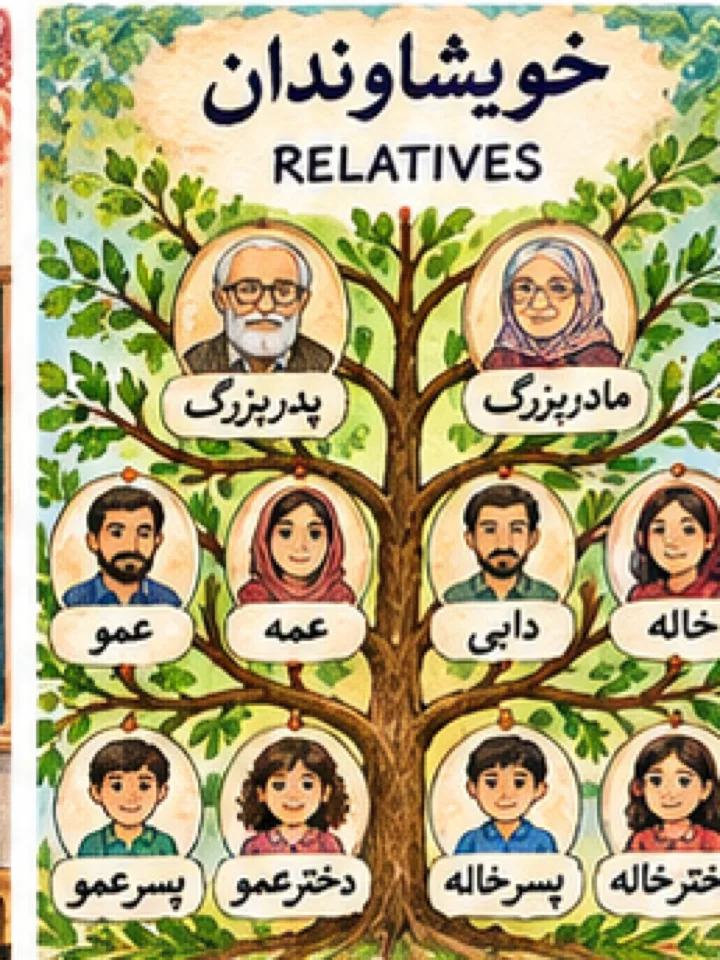
Lesson 5 of Learn to Speak Persian Fast, our free video course: Family. Watch the video for each part, then read the notes, with every Persian word in Persian script, pronunciation and English, and try the practice questions at the end of each part.
New words: Family words in Persian: grandparents, aunts, uncles and cousins
Study notes for lesson 5: 18 Persian words for grandparents, aunts, uncles, cousins and spouses, such as amu, khâle and dâyi, with examples.
Study notes for this lesson. Lesson 5 is about the family. Lesson 3 already gave you the close family (پدر, مادر, برادر, خواهر), so this list moves on to the wider family. Persian is more precise than English here: it has different words for an uncle on your father's side and on your mother's side. All four pages of the lesson follow Mina, an only child with a big family, and her friend Arash.
Word list
| Persian | Pronunciation | English |
|---|---|---|
| پدربزرگ | /pedarbozorg/ | grandfather |
| مادربزرگ | /mâdarbozorg/ | grandmother |
| عمو | /amu/ | uncle (father's brother) |
| عمه | /ame/ | aunt (father's sister) |
| دایی | /dâyi/ | uncle (mother's brother) |
| خاله | /khâle/ | aunt (mother's sister) |
| پسرعمو | /pesar-amu/ | cousin (son of father's brother) |
| دخترخاله | /dokhtar-khâle/ | cousin (daughter of mother's sister) |
| شوهر | /shohar/ | husband |
| زن | /zan/ | wife; woman |
| همسر | /hamsar/ | spouse (husband or wife) |
| نوه | /nave/ | grandchild |
| پدر و مادر | /pedar o mâdar/ | parents |
| فامیل | /fâmil/ | relatives, the extended family |
| بزرگتر | /bozorgtar/ | older (sibling) |
| کوچکتر | /kuchektar/ | younger (sibling) |
| تکفرزند | /tak-farzand/ | only child |
| ازدواج کرده | /ezdevâj karde/ | married |
Notes on the words
- Cousins are named by combining پسر or دختر with the parent's sibling: پسرعمو, دخترعمو, پسرخاله, دخترخاله, پسردایی, دختردایی, پسرعمه, دخترعمه. There is no single word for "cousin".
- فامیل in Persian means relatives, not "family name". A surname is نام خانوادگی (nâm-e khânevâdegi).
- زن means both "woman" and "wife"; همسر is the polite, neutral word for a spouse.
- Relatives are often addressed by the title alone, or the title plus the first name: خاله نرگس (khâle narges), "Aunt Narges".
Example sentences
| Persian | Pronunciation | English |
|---|---|---|
| پدربزرگ من در شیراز زندگی میکند. | /pedarbozorg-e man dar shirâz zendegi mikonad./ | My grandfather lives in Shiraz. |
| عموی من دو پسر دارد. | /amu-ye man do pesar dârad./ | My uncle has two sons. |
| خاله نرگس ازدواج کرده است. | /khâle narges ezdevâj karde ast./ | Aunt Narges is married. |
| دخترخالهی من بهترین دوست من است. | /dokhtar-khâle-ye man behtarin dust-e man ast./ | My cousin is my best friend. |
| من تکفرزند هستم. | /man tak-farzand hastam./ | I am an only child. |
| برادر بزرگتر آرش دانشجوست. | /barâdar-e bozorgtar-e ârash dâneshjust./ | Arash's older brother is a student. |
After a word ending in a vowel, ezâfe is pronounced -ye and written with ی: عموی من (amu-ye man), دایی من (dâyi-ye man, no extra letter after ی). The grammar page shows a shorter way to say "my uncle": عمویم (amuyam), with a possessive ending.
How to learn these words
Draw your own family tree and label everyone in Persian. Start with your parents and grandparents, then add عمو and عمه on your father's side and دایی and خاله on your mother's side. Finally, add the cousins with their compound names. Seeing the two sides of the tree makes the difference between عمو and دایی easy to remember.
Other pages in this lesson
Practice
What do you call your mother's sister?
Show answer
khâle خاله
What do you call your father's brother?
Show answer
amu عمو
What does this word mean? نوه
Show answer
grandchild (nave)
What does fâmil mean in Persian? فامیل
Show answer
relatives, the extended family
How do you say "I am an only child"?
Show answer
man tak-farzand hastam. من تکفرزند هستم.
Grammar: Possessive endings in Persian: my, your, his, her
Study notes for lesson 5 grammar: Persian possessive endings like pedaram, 'my father', in written and spoken forms, with family examples.
Study notes for this lesson. Talking about the family means saying "my father", "her aunt", "our grandparents" all the time. The lesson 5 grammar video deals with the family theme, and the key grammar for it is possession. Persian has two ways to show it. You already know the first from lessons 2 and 3: ezâfe plus a pronoun, پدر من (pedar-e man). The second, shorter way is a possessive ending attached to the noun: پدرم (pedaram). Both mean "my father".
The possessive endings
| Form | Pronunciation | Meaning |
|---|---|---|
| پدرم | /pedaram/ | my father |
| پدرت | /pedarat/ | your father (informal) |
| پدرش | /pedarash/ | his, her father |
| پدرمان | /pedaremân/ | our father |
| پدرتان | /pedaretân/ | your father (plural or polite) |
| پدرشان | /pedareshân/ | their father |
In everyday Tehran speech the endings change slightly: pedaram, pedaret, pedaresh, pedaremun, pedaretun, pedareshun. The written ـمان، ـتان، ـشان become -mun, -tun, -shun, following the same ân to un change you saw in lesson 4.
After a vowel
When the noun ends in a vowel, the spelling changes so the ending can attach. After silent ه, as in خاله (khâle), an alef is added and the ending is separated with a non-joiner. After ی, as in دایی, the same written forms are used. After ا or و, as in عمو, a ی is added before the ending.
| Persian | Pronunciation | English |
|---|---|---|
| خالهام / خالهات / خالهاش | /khâle-am / khâle-at / khâle-ash/ | my / your / his or her aunt |
| خالهمان / خالهتان / خالهشان | /khâle-mân / khâle-tân / khâle-shân/ | our / your / their aunt |
| داییام / داییاش | /dâyi-am / dâyi-ash/ | my / his or her uncle |
| عمویم / عمویت / عمویش | /amuyam / amuyat / amuyash/ | my / your / his or her uncle |
| عمویمان | /amuyemân/ | our uncle |
If the spelling after vowels feels hard, remember that خالهی من (khâle-ye man) and عموی من (amu-ye man) are always correct and mean the same thing.
Examples
| Persian | Pronunciation | English |
|---|---|---|
| مادرم معلم است. | /mâdaram mo'allem ast./ | My mother is a teacher. |
| برادرت کجاست؟ | /barâdarat kojâst?/ | Where is your brother? |
| خالهام دو دختر دارد. | /khâle-am do dokhtar dârad./ | My aunt has two daughters. |
| اسمش نرگس است. | /esmash narges ast./ | Her name is Narges. |
| پدربزرگمان پیر است، اما خیلی شاد است. | /pedarbozorgemân pir ast, ammâ kheyli shâd ast./ | Our grandfather is old, but he is very cheerful. |
| خانوادهتان بزرگ است؟ | /khânevâde-tân bozorg ast?/ | Is your family big? (polite) |
| پسرعمویشان دانشجوست. | /pesar-amuyeshân dâneshjust./ | Their cousin is a student. |
Ending or ezâfe?
The ending is the normal choice in speech and in most writing. Use ezâfe with a pronoun when you want to stress whose it is, as in پدر من، نه پدر تو (pedar-e man, na pedar-e to), "my father, not your father". In the polite style, پدر شما and پدرتان are both common.
Common mistakes
- Using both forms together, as in پدرم من. Choose one: پدرم or پدر من.
- Confusing ـش (his, her) and ـشان (their). خانهاش is his or her house; خانهشان is their house.
- Attaching ـم straight to a silent ه: write خالهام, not خالهم.
- Mixing up the possessive ـم in پدرم (my father) with the verb ending in خوشحالم (I am happy). The context makes it clear: one follows a noun, the other an adjective.
Other pages in this lesson
Practice
Say "my mother" with an ending.
Show answer
mâdaram مادرم
What does this mean? خالهاش
Show answer
his or her aunt (khâle-ash)
Say "their grandfather".
Show answer
pedarbozorgeshân پدربزرگشان
How does pedaretân sound in everyday speech? پدرتان
Show answer
pedaretun
Correct the mistake. برادرم من دانشجوست.
Show answer
barâdaram dâneshjust (or barâdar-e man dâneshjust). برادرم دانشجوست.
Speaking practice: looking at a family photo
Study notes for lesson 5 speaking: a spoken Persian dialogue about a family photo with amu, khâle and cousins, useful phrases and a role-play.
Study notes for this lesson. In this original dialogue, Arash visits his friend Mina and notices a family photo on the wall. They talk the way friends do in Tehran, using تو and the spoken forms of the possessive endings from the grammar page. Read it aloud and pay attention to how the endings and است combine in speech, as in عمومه (amume), "he's my uncle".
Dialogue
| Speaker | Persian | Pronunciation | English |
|---|---|---|---|
| Arash | این عکس کیه؟ | /in aks-e kiye?/ | Whose photo is this? |
| Mina | عکس خانوادهمه. | /aks-e khânevâdame./ | It's a photo of my family. |
| Arash | این آقا پدرته؟ | /in âghâ pedarete?/ | Is this man your father? |
| Mina | نه، عمومه. پدرم اینجاست، کنار مادرم. | /na, amume. pedaram injâst, kenâr-e mâdaram./ | No, he's my uncle. My father is here, next to my mother. |
| Arash | این خانم کیه؟ | /in khânom kiye?/ | Who is this lady? |
| Mina | خالهمه، خاله نرگس. | /khâleme, khâle narges./ | She's my aunt, Aunt Narges. |
| Arash | اون دختر کوچولو دخترشه؟ | /un dokhtar kuchulu dokhtareshe?/ | Is that little girl her daughter? |
| Mina | آره، نیلوفره. دخترخالهمه. | /âre, nilufare. dokhtar-khâleme./ | Yes, that's Nilufar. She's my cousin. |
| Arash | تو خواهر یا برادر داری؟ | /to khâhar yâ barâdar dâri?/ | Do you have any sisters or brothers? |
| Mina | نه، تکفرزندم. تو چی؟ | /na, tak-farzandam. to chi?/ | No, I'm an only child. What about you? |
| Arash | من یه برادر بزرگتر دارم. | /man ye barâdar-e bozorgtar dâram./ | I have an older brother. |
Useful phrases
| Persian | Pronunciation | English |
|---|---|---|
| این کیه؟ | /in kiye?/ | Who is this? Written: in kist? |
| عکس کیه؟ | /aks-e kiye?/ | Whose photo is it? |
| عمومه. | /amume./ | He's my uncle. Written: amuyam ast. |
| خالهمه. | /khâleme./ | She's my aunt. Written: khâle-am ast. |
| پدرته؟ | /pedarete?/ | Is he your father? Written: pedarat ast? |
| تکفرزندم. | /tak-farzandam./ | I'm an only child. |
| تو چی؟ | /to chi?/ | What about you? |
| یه برادر دارم. | /ye barâdar dâram./ | I have a brother. Written: yek barâdar dâram. |
Two spoken habits stand out. یک (yek), "one", becomes یه (ye) before a noun. And when a possessive ending meets the spoken "is", you hear both: پدرته is pedar + -et (your) + -e (is).
Role-play
Take a real or imagined family photo. Your partner points to people and asks این کیه؟; you answer with a family word and a possessive ending, such as عمومه, دخترخالهمه or پدربزرگمه, and add one more sentence about the person. Then ask your partner تو خواهر یا برادر داری؟ and swap roles. Try to use at least four different relatives.
Pronunciation tip
Spoken endings stack up quickly, so say them smoothly as one word: dokh-tar-khâ-le-me. Stress falls on the last syllable of the family word, before the endings: dokhtar-khâLE-me.
Other pages in this lesson
Practice
Who is the man in the photo?
Show answer
Mina's uncle (her father's brother) عمومه.
Who is Nilufar?
Show answer
Mina's cousin, the daughter of Aunt Narges دخترخالهمه.
Does Mina have brothers or sisters?
Show answer
No, she is an only child. تکفرزندم.
Say "I have an older brother" in spoken Persian.
Show answer
man ye barâdar-e bozorgtar dâram. من یه برادر بزرگتر دارم.
Reading: Mina's big family
Study notes for lesson 5 reading: a short Persian text about Mina's uncles, aunts, cousins and grandparents, with translation and a quiz.
Study notes for this lesson. In this original text, Mina describes her extended family in standard written Persian. It brings together the family words, the possessive endings and the verb داشتن (dâshtan), "to have", which appears in forms like دارد (dârad), "he or she has". The same people appear in the speaking dialogue of this lesson.
Reading text
| Persian | Pronunciation | English |
|---|---|---|
| اسم من میناست. | /esm-e man minâst./ | My name is Mina. |
| من تکفرزند هستم، اما خانوادهی بزرگی دارم. | /man tak-farzand hastam, ammâ khânevâde-ye bozorgi dâram./ | I am an only child, but I have a big family. |
| پدرم دو برادر دارد. | /pedaram do barâdar dârad./ | My father has two brothers. |
| آنها عموهای من هستند. | /ânhâ amuhâ-ye man hastand./ | They are my uncles. |
| مادرم یک خواهر دارد. | /mâdaram yek khâhar dârad./ | My mother has one sister. |
| او خالهی من است و اسمش نرگس است. | /u khâle-ye man ast va esmash narges ast./ | She is my aunt and her name is Narges. |
| خاله نرگس ازدواج کرده است و یک دختر دارد. | /khâle narges ezdevâj karde ast va yek dokhtar dârad./ | Aunt Narges is married and has a daughter. |
| دخترخالهام، نیلوفر، بهترین دوست من است. | /dokhtar-khâle-am, nilufar, behtarin dust-e man ast./ | My cousin Nilufar is my best friend. |
| پدربزرگ و مادربزرگم در شیراز زندگی میکنند. | /pedarbozorg va mâdarbozorgam dar shirâz zendegi mikonand./ | My grandfather and grandmother live in Shiraz. |
| تابستانها ما به شیراز میرویم. | /tâbestân-hâ mâ be shirâz miravim./ | In the summers we go to Shiraz. |
| آنجا همهی فامیل دور هم جمع میشوند. | /ânjâ hame-ye fâmil dor-e ham jam' mishavand./ | There, all the relatives get together. |
Key words
- دارم / دارد (dâram / dârad): I have / he, she has
- عموها (amuhâ): uncles; ـها makes a plural
- بهترین (behtarin): best
- زندگی میکنند (zendegi mikonand): they live
- تابستان (tâbestân): summer; تابستانها, in the summers
- دور هم جمع میشوند (dor-e ham jam' mishavand): they get together
Notes on the text
- خانوادهی بزرگی (khânevâde-ye bozorgi) has an extra -i at the end, meaning "a": "a big family".
- Mina says پدرم and مادرم with endings, but دوست من and عموهای من with ezâfe. Both styles are normal and often mixed in one text.
- In پدربزرگ و مادربزرگم one ending at the end covers both words: "my grandfather and grandmother".
- Shiraz is a large city in the south of Iran.
After reading, draw Mina's family tree from the text: her parents, two uncles, Aunt Narges, Nilufar and the grandparents. Label each person in Persian with the word Mina would use. Notice which relatives belong to her father's side and which to her mother's side.
Then write five sentences about your own relatives in the same style, for example مادرم دو خواهر دارد or پسرعمویم دانشجوست.
Other pages in this lesson
Practice
How many brothers does Mina's father have?
Show answer
two دو برادر
Who is Narges?
Show answer
Mina's aunt, her mother's sister خالهی مینا
Who is Mina's best friend?
Show answer
her cousin Nilufar نیلوفر
Where do Mina's grandparents live?
Show answer
in Shiraz در شیراز
When does the family go to Shiraz?
Show answer
in the summers تابستانها
Take this lesson further

Study with the book
Learn to Speak Persian Fast: For Beginners
This free lesson is part of Learn to Speak Persian Fast. The book puts the whole series in one printable PDF you can study offline.
Serious about Persian? Get all 30 of our Persian learning books for $199.99 (55% less than buying them one by one).
Free Persian Starter Kit (PDF)
The Persian alphabet chart and the 101 most common Persian words with pronunciation, in one printable PDF. You also get a one-time 15% code for any of our books.
We will email you new lessons and book news from Learn Persian Online. Unsubscribe any time.Free Persian Starter Pack: Alphabet + 100 Core Words
Get the 14-page printable Starter Pack (all 32 letters, a 7-day reading plan, 100 core words and 20 survival phrases) and a short 5-email course. Free.