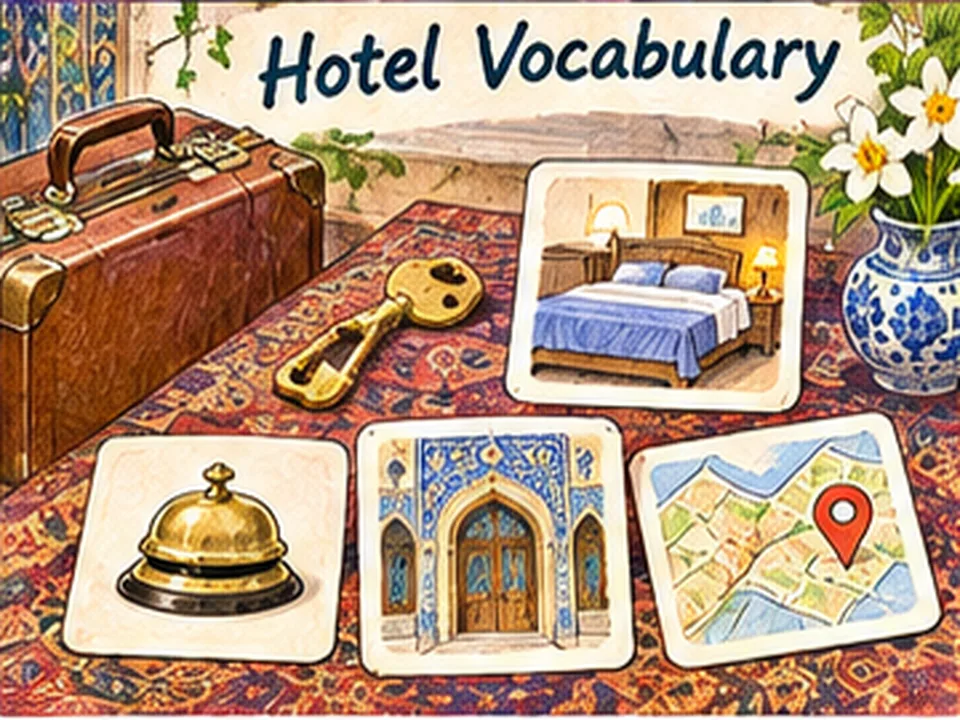
Lesson 10 of Learn to Speak Persian Fast, our free video course: At the Hotel. Watch the video for each part, then read the notes, with every Persian word in Persian script, pronunciation and English, and try the practice questions at the end of each part.
New words: Persian words for staying at a hotel
Learn 19 Persian words for hotels, from room, key and reception to breakfast and passport, with example sentences and a quiz.
Study notes for this lesson. This page collects the words you need to book a room, check in and ask about breakfast or the elevator in Persian. The example sentences follow Daniel, a tourist who stays at a small hotel in Shiraz in the reading and speaking parts of this lesson.
Vocabulary: at the hotel
| Persian | Pronunciation | English |
|---|---|---|
| هتل | /hotel/ | hotel |
| اتاق | /otâgh/ | room |
| اتاق یکنفره | /otâgh-e yek-nafare/ | single room |
| اتاق دونفره | /otâgh-e do-nafare/ | double room |
| تخت | /takht/ | bed |
| کلید | /kelid/ | key |
| پذیرش | /paziresh/ | reception, front desk |
| رزرو کردن | /rezerv kardan/ | to book, reserve |
| ماندن | /mândan/ | to stay |
| شب | /shab/ | night |
| طبقه | /tabaghe/ | floor, story |
| آسانسور | /âsânsor/ | elevator |
| حمام | /hammâm/ | bathroom (with shower) |
| صبحانه | /sobhâne/ | breakfast |
| گذرنامه | /gozarnâme/ | passport |
| قیمت | /gheymat/ | price |
| خالی | /khâli/ | free, vacant, empty |
| چمدان | /chamedân/ | suitcase |
| تمیز | /tamiz/ | clean |
Example sentences
| Persian | Pronunciation | English |
|---|---|---|
| اتاق خالی دارید؟ | /otâgh-e khâli dârid?/ | Do you have a free room? |
| یک اتاق یکنفره برای سه شب میخواهم. | /yek otâgh-e yek-nafare barâye se shab mikhâham./ | I'd like a single room for three nights. |
| قیمت اتاق چند است؟ | /gheymat-e otâgh chand ast?/ | How much is the room? |
| صبحانه در قیمت اتاق است. | /sobhâne dar gheymat-e otâgh ast./ | Breakfast is included in the room price. |
| اتاق شما در طبقهی سوم است. | /otâgh-e shomâ dar tabaghe-ye sevvom ast./ | Your room is on the third floor. |
| این کلید اتاق شماست. | /in kelid-e otâgh-e shomâst./ | This is your room key. |
| دنیل با آسانسور بالا میرود. | /daniel bâ âsânsor bâlâ miravad./ | Daniel goes up in the elevator. |
| اتاق تمیز است و یک تخت بزرگ دارد. | /otâgh tamiz ast va yek takht-e bozorg dârad./ | The room is clean and has a big bed. |
Notes on the words
- یکنفره (yek-nafare) and دونفره (do-nafare) are built from a number plus نفر (nafar, "person") plus ـه (-e). The same pattern gives سهنفره (se-nafare), "for three people".
- رزرو (rezerv) is borrowed from French and works like a noun in the compound verb رزرو کردن: اتاق رزرو کردم (otâgh rezerv kardam), "I booked a room".
- حمام (hammâm) is the room with the shower or bath. A toilet is دستشویی (dastshuyi) or, more formally, توالت (tuâlet).
- پذیرش (paziresh) is both the front desk and the act of checking in. The person who works there is مسئول پذیرش (mas'ul-e paziresh), "receptionist".
- Floors use ordinal numbers: طبقهی اول (tabaghe-ye avval), "first floor"; طبقهی دوم (tabaghe-ye dovvom), "second floor"; طبقهی سوم (tabaghe-ye sevvom), "third floor". The ground floor is همکف (hamkaf).
- خالی (khâli) means "empty" in general. At a hotel it means a room is free: اتاق خالی نداریم (otâgh-e khâli nadârim), "we have no rooms available".
Tip: imagine you are checking in and say what you see, step by step, in Persian: the reception, the key, the elevator, the floor, the room, the bed and the bathroom. Saying the words in the order you would meet them makes them easier to recall.
Other parts of Lesson 10
Practice
How do you ask "Do you have a free room?"
Show answer
otâgh-e khâli dârid? اتاق خالی دارید؟
What is the difference between yek-nafare and do-nafare? یکنفره / دونفره
Show answer
yek-nafare is for one person (single); do-nafare is for two (double).
Translate: "Your room is on the second floor."
Show answer
otâgh-e shomâ dar tabaghe-ye dovvom ast. اتاق شما در طبقهی دوم است.
What is the Persian word for "passport"?
Show answer
gozarnâme گذرنامه
Who is the mas'ul-e paziresh? مسئول پذیرش
Show answer
The receptionist.
Grammar: The Persian subjunctive: I want to stay, I can go
Learn the Persian present subjunctive to say I want to, I can and I must, with formation tables, hotel examples and a quiz.
Study notes for this lesson. At a hotel you constantly say what you want to do or can do: "I want to book a room", "Can I see the room?", "I have to leave early". In Persian, the second verb in these sentences goes into the present subjunctive. It is one of the most useful forms for beginners, and it is easy to build once you know present stems.
How to form it
Take the present stem, add the same personal endings as the present indicative, and put بـ (be-) in front in place of می. So میمانم (mimânam), "I stay", becomes بمانم (bemânam), "(that) I stay". Before a stem with an o sound, be- is usually pronounced bo-: بخورم (bokhoram), بکنم (bokonam). Before آ it is written بیـ (bi-): بیایم (biâyam), "(that) I come".
Full example: ماندن (mândan), to stay
| Persian | Pronunciation | English |
|---|---|---|
| بمانم | /bemânam (spoken: bemunam)/ | (that) I stay |
| بمانی | /bemâni (spoken: bemuni)/ | (that) you stay |
| بماند | /bemânad (spoken: bemune)/ | (that) he / she stays |
| بمانیم | /bemânim (spoken: bemunim)/ | (that) we stay |
| بمانید | /bemânid (spoken: bemunin)/ | (that) you stay (plural or polite) |
| بمانند | /bemânand (spoken: bemunan)/ | (that) they stay |
More verbs in the subjunctive
| Infinitive and subjunctive | Pronunciation | Meaning |
|---|---|---|
| رفتن ← بروم | /raftan → beravam (spoken: beram)/ | to go |
| دیدن ← ببینم | /didan → bebinam/ | to see |
| گرفتن ← بگیرم | /gereftan → begiram/ | to take, get |
| دادن ← بدهم | /dâdan → bedaham (spoken: bedam)/ | to give |
| خوردن ← بخورم | /khordan → bokhoram/ | to eat |
| آمدن ← بیایم | /âmadan → biâyam (spoken: biyâm)/ | to come |
| رزرو کردن ← رزرو کنم | /rezerv kardan → rezerv konam/ | to book (compound verbs usually drop be-) |
Words that call for the subjunctive
| Persian | Pronunciation | English |
|---|---|---|
| میخواهم … | /mikhâham … (spoken: mikhâm)/ | I want to … |
| میتوانم … | /mitavânam … (spoken: mitunam)/ | I can … |
| باید … | /bâyad …/ | must, have to (never changes) |
| دوست دارم … | /dust dâram …/ | I'd like to … |
Both verbs agree with their own subject: میخواهیم بمانیم (mikhâhim bemânim), "we want to stay". If the subjects are different, the second verb takes the second subject, often after که (ke, "that"): میخواهم (که) او بماند (mikhâham (ke) u bemânad), "I want him to stay". باید itself does not change: باید بروم (bâyad beravam), "I must go"; باید بروند (bâyad beravand), "they must go".
Examples
| Persian | Pronunciation | English |
|---|---|---|
| میخواهم یک اتاق رزرو کنم. | /mikhâham yek otâgh rezerv konam./ | I want to book a room. |
| میتوانم اتاق را ببینم؟ | /mitavânam otâgh râ bebinam?/ | Can I see the room? |
| دنیل میخواهد سه شب بماند. | /daniel mikhâhad se shab bemânad./ | Daniel wants to stay three nights. |
| باید ساعت ده اتاق را تحویل بدهید. | /bâyad sâ'at-e dah otâgh râ tahvil bedahid./ | You have to check out at ten. |
| میتونم صبحانه رو توی اتاق بخورم؟ | /mitunam sobhâne ro tu otâgh bokhoram?/ | Can I have breakfast in the room? (spoken) |
| فردا میخواهیم شهر را ببینیم. | /fardâ mikhâhim shahr râ bebinim./ | Tomorrow we want to see the city. |
| نمیتوانم امشب بیایم. | /nemitavânam emshab biâyam./ | I can't come tonight. |
Negative
To say "I can't" or "I don't want", make the first verb negative: نمیخواهم بروم (nemikhâham beravam), "I don't want to go". To say "I want not to …", make the subjunctive negative with نـ (na-) in place of be-: میخواهم امشب بیرون نروم (mikhâham emshab birun naravam), "I want to not go out tonight".
Common mistakes
- Using the present indicative after want or can: say میخواهم بمانم, not میخواهم میمانم.
- Leaving the second verb unconjugated or in the infinitive: میخواهم ماندن is wrong for "I want to stay".
- Conjugating باید: there is no بایدم for "I must" in standard Persian. Only the second verb changes.
- Adding be- to a compound verb where people normally leave it out: رزرو کنم sounds more natural than رزرو بکنم, though both are heard.
Other parts of Lesson 10
Practice
Put dâdan into the subjunctive for "I". دادن
Show answer
bedaham (spoken: bedam) بدهم
Translate: "I want to see the room."
Show answer
mikhâham otâgh râ bebinam. میخواهم اتاق را ببینم.
Correct the mistake: mikhâham mimânam. میخواهم میمانم.
Show answer
mikhâham bemânam. میخواهم بمانم.
Say "They must go" in Persian.
Show answer
bâyad beravand. باید بروند.
Say "Can I stay one more night?" in spoken Persian.
Show answer
mitunam ye shab-e dige bemunam? میتونم یه شب دیگه بمونم؟
Speaking: Checking in at a hotel in Persian
Practice checking in at a hotel in spoken Persian with a reception dialogue, useful phrases, a role-play idea and a short quiz.
Study notes for this lesson. Daniel arrives at a small hotel in Shiraz and checks in. The receptionist speaks polite spoken Persian, using the شما (shomâ) forms. Listen for the subjunctive after میتونم (mitunam), "can I", which you studied on the Grammar page.
Dialogue: Daniel and the receptionist
| Speaker | Persian | Pronunciation | English |
|---|---|---|---|
| Receptionist | سلام، خوش اومدین. بفرمایید. | /salâm, khosh umadin. befarmâyid./ | Hello, welcome. How can I help you? |
| Daniel | سلام. من یه اتاق رزرو کردم. اسمم دنیله. | /salâm. man ye otâgh rezerv kardam. esmam danile./ | Hello. I booked a room. My name is Daniel. |
| Receptionist | بله، یه اتاق یکنفره برای سه شب. گذرنامهتون لطفاً. | /bale, ye otâgh-e yek-nafare barâye se shab. gozarnâmatun lotfan./ | Yes, a single room for three nights. Your passport, please. |
| Daniel | بفرمایید. صبحانه هم داره؟ | /befarmâyid. sobhâne ham dâre?/ | Here you are. Is breakfast included? |
| Receptionist | بله، صبحانه از ساعت هفت تا ده توی رستوران هتله. | /bale, sobhâne az sâ'at-e haft tâ dah tu resturân-e hotele./ | Yes, breakfast is from seven to ten in the hotel restaurant. |
| Daniel | میتونم از اینترنت استفاده کنم؟ | /mitunam az internet estefâde konam?/ | Can I use the internet? |
| Receptionist | بله، رمز وایفای روی این کارته. | /bale, ramz-e vây-fây ru-ye in kârte./ | Yes, the Wi-Fi password is on this card. |
| Receptionist | اتاقتون طبقهی سومه. اینم کلید. | /otâghetun tabaghe-ye sevvome. inam kelid./ | Your room is on the third floor. And here's the key. |
| Daniel | آسانسور کجاست؟ | /âsânsor kojâst?/ | Where is the elevator? |
| Receptionist | سمت راست. اگه چیزی خواستین، با پذیرش تماس بگیرین. | /samt-e râst. age chizi khâstin, bâ paziresh tamâs begirin./ | On the right. If you need anything, call reception. |
| Daniel | خیلی ممنون. | /kheyli mamnun./ | Thank you very much. |
| Receptionist | خواهش میکنم. خوش بگذره. | /khâhesh mikonam. khosh begzare./ | You're welcome. Enjoy your stay. |
Notes on the dialogue
- بفرمایید (befarmâyid) changes meaning with the situation: "how can I help?", "here you are", or "please come in".
- گذرنامهتون (gozarnâmatun) is the spoken form of گذرنامهتان, "your passport". You will also hear پاسپورت (pâsport).
- من یه اتاق رزرو کردم uses the simple past, "I booked", which you will study in Lesson 11.
- تماس بگیرین (tamâs begirin), "call", is the polite imperative of تماس گرفتن (tamâs gereftan), "to contact".
- خوش بگذره (khosh begzare), "have a good time", is a friendly wish for someone starting a trip, a stay or a party.
Useful phrases
| Persian | Pronunciation | English |
|---|---|---|
| اتاق خالی دارین؟ | /otâgh-e khâli dârin?/ | Do you have a free room? |
| یه اتاق رزرو کردم. | /ye otâgh rezerv kardam./ | I have a reservation. |
| برای … شب. | /barâye … shab./ | For … nights. |
| صبحانه هم داره؟ | /sobhâne ham dâre?/ | Is breakfast included? |
| میتونم اتاق رو ببینم؟ | /mitunam otâgh ro bebinam?/ | Can I see the room? |
| رمز وایفای چیه؟ | /ramz-e vây-fây chiye?/ | What's the Wi-Fi password? |
| آسانسور کجاست؟ | /âsânsor kojâst?/ | Where is the elevator? |
| کی باید اتاق رو تحویل بدم؟ | /key bâyad otâgh ro tahvil bedam?/ | When do I have to check out? |
Role-play
- One person is the receptionist and one is a guest.
- The guest asks اتاق خالی دارین؟ and says how many nights and how many people.
- The receptionist gives the floor and the key and asks for a passport.
- The guest asks two questions with میتونم …؟, for example about breakfast or the internet.
- End with خیلی ممنون and خوش بگذره. Then swap roles.
Other parts of Lesson 10
Practice
How many nights is Daniel staying?
Show answer
Three. سه شب
When is breakfast served?
Show answer
From seven to ten, in the hotel restaurant. از ساعت هفت تا ده
Where is the Wi-Fi password?
Show answer
On a card the receptionist gives him. روی این کارت
Ask "Can I see the room?" in spoken Persian.
Show answer
mitunam otâgh ro bebinam? میتونم اتاق رو ببینم؟
What does khosh begzare mean? خوش بگذره
Show answer
Have a good time / enjoy your stay.
Reading: Daniel's hotel in Shiraz
Read a short beginner Persian text about checking into a hotel in Shiraz, with translation, key words, grammar notes and a quiz.
Study notes for this lesson. Daniel, a tourist, arrives at his hotel in Shiraz. The text is in standard written Persian and uses the hotel vocabulary and the subjunctive after میخواهد and میتواند. Read it once for the general idea, then a second time sentence by sentence.
Reading text
| Persian | Pronunciation | English |
|---|---|---|
| دنیل یک توریست است و برای اولین بار به شیراز میآید. | /daniel yek turist ast va barâye avvalin bâr be shirâz miâyad./ | Daniel is a tourist and is coming to Shiraz for the first time. |
| او میخواهد سه شب در یک هتل کوچک بماند. | /u mikhâhad se shab dar yek hotel-e kuchak bemânad./ | He wants to stay three nights in a small hotel. |
| هتل نزدیک مرکز شهر است. | /hotel nazdik-e markaz-e shahr ast./ | The hotel is near the city center. |
| در پذیرش، دنیل به فارسی سلام میکند. | /dar paziresh, daniel be fârsi salâm mikonad./ | At the reception, Daniel says hello in Persian. |
| مسئول پذیرش گذرنامهی او را میخواهد. | /mas'ul-e paziresh gozarnâme-ye u râ mikhâhad./ | The receptionist asks for his passport. |
| اتاق دنیل یکنفره است و در طبقهی سوم است. | /otâgh-e daniel yek-nafare ast va dar tabaghe-ye sevvom ast./ | Daniel's room is a single and is on the third floor. |
| صبحانه در قیمت اتاق است. | /sobhâne dar gheymat-e otâgh ast./ | Breakfast is included in the room price. |
| دنیل با آسانسور به طبقهی سوم میرود. | /daniel bâ âsânsor be tabaghe-ye sevvom miravad./ | Daniel takes the elevator to the third floor. |
| اتاق تمیز است و یک تخت بزرگ و یک حمام کوچک دارد. | /otâgh tamiz ast va yek takht-e bozorg va yek hammâm-e kuchak dârad./ | The room is clean and has a big bed and a small bathroom. |
| اینترنت هتل خوب است، پس دنیل میتواند به خانوادهاش ایمیل بزند. | /internet-e hotel khub ast, pas daniel mitavânad be khânevâde-ash imeyl bezanad./ | The hotel internet is good, so Daniel can email his family. |
| فردا صبح او میخواهد شهر را ببیند. | /fardâ sobh u mikhâhad shahr râ bebinad./ | Tomorrow morning he wants to see the city. |
Key words
- توریست (turist): tourist; also گردشگر (gardeshgar)
- برای اولین بار (barâye avvalin bâr): for the first time
- مرکز شهر (markaz-e shahr): city center
- مسئول پذیرش (mas'ul-e paziresh): receptionist
- یکنفره (yek-nafare): single (room)
- تمیز (tamiz): clean
- ایمیل زدن (imeyl zadan): to send an email
- فردا صبح (fardâ sobh): tomorrow morning
Grammar in the text
- Three sentences use the subjunctive from the Grammar page: بماند (bemânad) after میخواهد, ایمیل بزند (imeyl bezanad) after میتواند, and ببیند (bebinad) after میخواهد.
- بزند comes from زدن (zadan), present stem زن (zan). Many compound verbs use زدن, such as ایمیل زدن and زنگ زدن (zang zadan), "to phone".
- Ordinal numbers come after the noun with the ezâfe: طبقهی سوم (tabaghe-ye sevvom), "the third floor".
- خانوادهاش (khânevâde-ash), "his family", uses the possessive suffix after silent ه from Lesson 7.
Writing task: imagine your own arrival at a hotel. Write five sentences: where the hotel is, what kind of room you have, which floor it is on, what the room has, and one thing you want to do tomorrow, using میخواهم plus the subjunctive.
Other parts of Lesson 10
Practice
Is this Daniel's first visit to Shiraz?
Show answer
Yes, he is coming for the first time. برای اولین بار
How long does Daniel want to stay?
Show answer
Three nights. سه شب
What does the receptionist ask for?
Show answer
His passport. گذرنامه
What is in Daniel's room?
Show answer
A big bed and a small bathroom. یک تخت بزرگ و یک حمام کوچک
What does Daniel want to do tomorrow morning?
Show answer
See the city. شهر را ببیند.
Take this lesson further

Study with the book
Learn to Speak Persian Fast: For Beginners
This free lesson is part of Learn to Speak Persian Fast. The book puts the whole series in one printable PDF you can study offline.
Serious about Persian? Get all 30 of our Persian learning books for $199.99 (55% less than buying them one by one).
Free Persian Starter Kit (PDF)
The Persian alphabet chart and the 101 most common Persian words with pronunciation, in one printable PDF. You also get a one-time 15% code for any of our books.
We will email you new lessons and book news from Learn Persian Online. Unsubscribe any time.Free Persian Starter Pack: Alphabet + 100 Core Words
Get the 14-page printable Starter Pack (all 32 letters, a 7-day reading plan, 100 core words and 20 survival phrases) and a short 5-email course. Free.