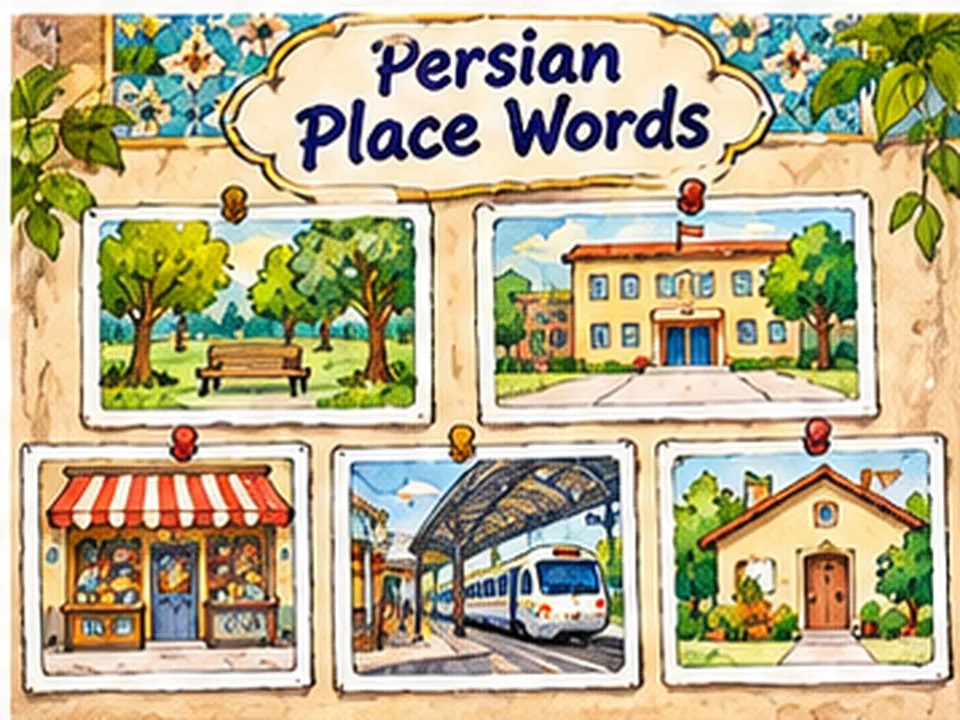
Lesson 22 of Learn to Speak Persian Fast, our free video course: Where Are You Going?. Watch the video for each part, then read the notes, with every Persian word in Persian script, pronunciation and English, and try the practice questions at the end of each part.
New words: Persian words for places and getting around town
Learn 20 Persian words for places in town and getting around, with pronunciation, example sentences and a quiz for Lesson 22.
Study notes for this lesson. The Lesson 22 video introduces the new words for this lesson, whose theme is "Where are you going?" Below is a word list of places in town and ways to get there, example sentences and a short quiz. On the other pages of this lesson, Omid meets his friend Saeed in the street on the way to the bazaar.
The most useful question of the lesson is کجا میروی؟ (kojâ miravi?), in speech کجا میری؟ (kojâ miri?), "Where are you going?"
Word list
| Persian | Pronunciation | English |
|---|---|---|
| کجا | /kojâ/ | where |
| رفتن | /raftan/ | to go |
| برگشتن | /bargashtan/ | to go back, to return |
| خیابان | /khiyâbân/ | street (spoken: khiyâbun) |
| میدان | /meydân/ | square (spoken: meydun) |
| ایستگاه | /istgâh/ | station, stop |
| مترو | /metro/ | metro, subway |
| اتوبوس | /otobus/ | bus |
| تاکسی | /tâksi/ | taxi |
| پیاده | /piyâde/ | on foot |
| بازار | /bâzâr/ | bazaar, market |
| کتابخانه | /ketâbkhâne/ | library (spoken: ketâbkhune) |
| سینما | /sinamâ/ | cinema |
| پارک | /pârk/ | park |
| بیمارستان | /bimârestân/ | hospital |
| خرید کردن | /kharid kardan/ | to shop, to do the shopping |
| دیر | /dir/ | late |
| زود | /zud/ | early; soon |
| با هم | /bâ ham/ | together |
| شاید | /shâyad/ | maybe, perhaps |
Notes on the words
- In spoken Tehran Persian, â before n or m often becomes u: خیابون (khiyâbun), میدون (meydun), کتابخونه (ketâbkhune).
- To say how you travel, use با (bâ, "with"): با مترو (bâ metro), "by metro"; با تاکسی (bâ tâksi), "by taxi." On foot is simply پیاده (piyâde).
- کتابخانه is کتاب (ketâb, "book") plus خانه (khâne, "house"): a house of books.
- دیرم شد (diram shod), literally "it became late for me," means "I'm late."
Example sentences
| Persian | Pronunciation | English |
|---|---|---|
| کجا میروی؟ | /kojâ miravi? (spoken: kojâ miri?)/ | Where are you going? |
| به بازار میروم. | /be bâzâr miravam. (spoken: miram bâzâr.)/ | I'm going to the bazaar. |
| با مترو میروم. | /bâ metro miravam./ | I'm going by metro. |
| ایستگاه اتوبوس کجاست؟ | /istgâh-e otobus kojâst?/ | Where is the bus stop? |
| کتابخانه نزدیک میدان است. | /ketâbkhâne nazdik-e meydân ast./ | The library is near the square. |
| بیا با هم برویم. | /biyâ bâ ham beravim. (spoken: biyâ bâ ham berim.)/ | Let's go together. |
| شاید به سینما برویم. | /shâyad be sinamâ beravim./ | Maybe we'll go to the cinema. |
Answers to "Where are you going?"
| Persian | Pronunciation | English |
|---|---|---|
| میرم خونه. | /miram khune./ | I'm going home. |
| میرم سر کار. | /miram sar-e kâr./ | I'm going to work. |
| میرم خرید. | /miram kharid./ | I'm going shopping. |
| جای خاصی نمیرم. | /jâ-ye khâssi nemiram./ | I'm not going anywhere special. |
Practice tip
Draw a simple map of your own neighborhood and label the places in Persian: the street, the square, the station, the park. Then choose a place and say how you would get there, for example با اتوبوس به پارک میروم (bâ otobus be pârk miravam), "I go to the park by bus." Finally, ask yourself the lesson's question, کجا میروی؟, and answer it out loud for three different places. You will use these same sentences on the grammar and speaking pages.
Practice
How do you ask a friend "Where are you going?" in spoken Persian?
Show answer
kojâ miri? کجا میری؟
How do you say "by bus"?
Show answer
bâ otobus با اتوبوس
What does {{کتابخانه}} mean?
Show answer
library
Translate: "Let's go together."
Show answer
biyâ bâ ham beravim. (spoken: biyâ bâ ham berim.) بیا با هم برویم.
What is the opposite of {{دیر}}?
Show answer
zud, "early" زود
Grammar: The present subjunctive in Persian
How to form and use the Persian present subjunctive: be- + stem, spoken forms, after want, must, can and maybe, with examples and a quiz.
Study notes for this lesson. The Lesson 22 video teaches the present subjunctive. You need it all the time: "I want to go," "I have to go," "maybe we'll go," "let's go." In each of these, the second verb is in the subjunctive. The examples use the places from the New Words page.
How to form it
Take the present stem, put ب (be-) in front, and add the personal endings. It looks like the present tense with be- instead of mi-. As with the imperative (Lesson 17), be- often becomes bo- before an o sound and bi- before â.
| Persian | Pronunciation | English |
|---|---|---|
| (من) بروم | /(man) beravam (spoken: beram)/ | (that) I go |
| (تو) بروی | /(to) beravi (spoken: beri)/ | (that) you go |
| (او) برود | /(u) beravad (spoken: bere)/ | (that) he/she goes |
| (ما) برویم | /(mâ) beravim (spoken: berim)/ | (that) we go |
| (شما) بروید | /(shomâ) beravid (spoken: berid / berin)/ | (that) you (pl./polite) go |
| (آنها) بروند | /(ânhâ) beravand (spoken: beran)/ | (that) they go |
More verbs
| Infinitive: subjunctive | Pronunciation | English |
|---|---|---|
| خریدن: بخرم | /kharidan: bekharam/ | to buy: (that) I buy |
| دیدن: ببینم | /didan: bebinam/ | to see: (that) I see |
| آمدن: بیایم | /âmadan: biyâyam (spoken: biyâm)/ | to come: (that) I come |
| برگشتن: برگردم | /bargashtan: bargardam/ | to return: (that) I return |
| خرید کردن: خرید کنم | /kharid kardan: kharid konam/ | to shop: (that) I shop |
| بودن: باشم | /budan: bâsham/ | to be: (that) I am |
| داشتن: داشته باشم | /dâshtan: dâshte bâsham/ | to have: (that) I have |
Compound verbs such as خرید کردن normally take no be-, and verbs that start with a prefix such as بر (برگشتن) do not take it either: برگردم (bargardam). بودن and داشتن have the special forms shown above.
When to use it
- After خواستن, "to want": میخواهم بروم (mikhâham beravam), "I want to go." Both verbs change for the person: میخواهد برود, "he wants to go."
- After باید, "must, have to." باید itself never changes: باید بروم, باید بروی.
- After توانستن, "can": میتوانی بیایی؟ (mitavâni biyâyi?), "Can you come?"
- After شاید, "maybe": شاید به پارک برویم, "maybe we'll go to the park."
- For "let's": برویم or بیا برویم (spoken: بیا بریم), "let's go."
- After تا or که meaning "so that, in order to": به بازار میروم تا خرید کنم, "I'm going to the bazaar to shop."
Examples
| Persian | Pronunciation | English |
|---|---|---|
| میخواهم به کتابخانه بروم. | /mikhâham be ketâbkhâne beravam./ | I want to go to the library. |
| باید زود به خانه برگردم. | /bâyad zud be khâne bargardam./ | I have to get back home early. |
| میتوانی با ما بیایی؟ | /mitavâni bâ mâ biyâyi?/ | Can you come with us? |
| شاید با تاکسی برویم. | /shâyad bâ tâksi beravim./ | Maybe we'll go by taxi. |
| بیا با هم به سینما برویم. | /biyâ bâ ham be sinamâ beravim./ | Let's go to the cinema together. |
| امید میخواهد خرید کند. | /omid mikhâhad kharid konad./ | Omid wants to do some shopping. |
| میخواهم تو هم بیایی. | /mikhâham to ham biyâyi./ | I want you to come too. |
Common mistakes
- Using the infinitive after "want": میخواهم رفتن is wrong; say میخواهم بروم.
- Using mi- for the second verb: میخواهم میروم is wrong; the second verb needs be-.
- Adding a personal ending to باید: say باید بروم, not "bâyadam beravam."
- Forgetting that the subject can change: "I want you to come" is میخواهم بیایی, with the second verb in the "you" form.
Practice
Give the subjunctive "(that) we go."
Show answer
beravim (spoken: berim) برویم
Translate: "I want to buy."
Show answer
mikhâham bekharam. میخواهم بخرم.
Correct the mistake: {{باید میروم}}
Show answer
bâyad beravam باید بروم
Translate: "Maybe they will come."
Show answer
shâyad biyâyand. شاید بیایند.
What is the subjunctive of {{بودن}} for "I"?
Show answer
bâsham باشم
Speaking practice: "Where are you going?"
A spoken Persian street conversation about where you are going and how, with useful phrases, a role-play idea and a quiz for Lesson 22.
Study notes for this lesson. After the speaking video, practice with this original dialogue. Saeed meets his friend Omid in the street and asks where he is going. They are friends, so they speak informally in spoken Tehran Persian.
Dialogue
| Speaker | Persian | Pronunciation | English |
|---|---|---|---|
| Saeed | سلام امید. کجا میری؟ | /salâm omid. kojâ miri?/ | Hi, Omid. Where are you going? |
| Omid | سلام سعید. میرم بازار، میخوام یه کم خرید کنم. | /salâm sa'id. miram bâzâr, mikhâm ye kam kharid konam./ | Hi, Saeed. I'm going to the bazaar; I want to do a bit of shopping. |
| Saeed | با چی میری؟ | /bâ chi miri?/ | How are you getting there? |
| Omid | با مترو. ایستگاه همین نزدیکیه. | /bâ metro. istgâh hamin nazdikiye./ | By metro. The station is right nearby. |
| Saeed | منم باید برم کتابخونه. | /manam bâyad beram ketâbkhune./ | I have to go to the library too. |
| Omid | کتابخونه کجاست؟ | /ketâbkhune kojâst?/ | Where is the library? |
| Saeed | نزدیک میدون، کنار سینما. | /nazdik-e meydun, kenâr-e sinamâ./ | Near the square, next to the cinema. |
| Omid | پس بیا با هم بریم. | /pas biyâ bâ ham berim./ | Then let's go together. |
| Saeed | باشه. بعدش شاید بریم پارک؟ | /bâshe. ba'desh shâyad berim pârk?/ | OK. Maybe we could go to the park afterward? |
| Omid | نه، دیرم میشه. باید زود برگردم خونه. | /na, diram mishe. bâyad zud bargardam khune./ | No, I'll be late. I have to get back home early. |
| Saeed | باشه، پس عجله کنیم. | /bâshe, pas ajale konim./ | OK, then let's hurry. |
Useful phrases
| Persian | Pronunciation | English |
|---|---|---|
| کجا میری؟ | /kojâ miri?/ | Where are you going? (polite: kojâ mirin? written: kojâ miravid?) |
| میرم بازار. | /miram bâzâr./ | I'm going to the bazaar. (written: be bâzâr miravam.) |
| با چی میری؟ | /bâ chi miri?/ | How are you getting there? (literally "with what") |
| همین نزدیکیه. | /hamin nazdikiye./ | It's right nearby. |
| بیا با هم بریم. | /biyâ bâ ham berim./ | Let's go together. |
| دیرم میشه. | /diram mishe./ | I'll be late. |
| عجله کنیم. | /ajale konim./ | Let's hurry. |
Notes
- Find the subjunctives from the grammar page: خرید کنم (after میخوام), برم and برگردم (after باید), بریم (after بیا and شاید) and عجله کنیم ("let's hurry").
- In speech, به is dropped after verbs of motion: میرم بازار, برگردم خونه.
- منم (manam) is short for من هم (man ham), "me too, I also."
Role-play
Work with a partner. You meet in the street. Ask each other where you are going and how you are getting there. Each of you must use at least three subjunctives: one after میخوام (I want), one after باید (I have to) and one after شاید (maybe). End by suggesting that you go somewhere together.
Tip: practice the dialogue twice, once as Saeed and once as Omid. The second time, change the places and the means of transport, for example the hospital by taxi or the cinema on foot, and see how many sentences you can keep the same.
Practice
Where is Omid going, and why?
Show answer
To the bazaar, to do some shopping. بازار، میخواد خرید کنه.
How is Omid getting there?
Show answer
By metro. با مترو
Where is the library?
Show answer
Near the square, next to the cinema. نزدیک میدون، کنار سینما.
Why can't Omid go to the park?
Show answer
He has to get back home early. باید زود برگرده خونه.
Say "I have to go to the library" in spoken Persian.
Show answer
bâyad beram ketâbkhune. باید برم کتابخونه.
Reading practice: Omid and Saeed in town
A short beginner Persian reading about two friends going around town, with pronunciation, English, key words and a comprehension quiz.
Study notes for this lesson. This original reading text uses the places and the present subjunctive of Lesson 22. It is in standard written Persian, so the spoken forms of the dialogue appear here in their written forms. Read each sentence aloud, check the pronunciation, then cover the English column and read again.
Before you read, look for verbs that start with ب (be-) after words like میخواهد, باید and شاید. These are subjunctives.
Reading text
| Persian | Pronunciation | English |
|---|---|---|
| امروز شنبه است و امید کار زیادی دارد. | /emruz shanbe ast va omid kâr-e ziyâdi dârad./ | Today is Saturday, and Omid has a lot to do. |
| او میخواهد به بازار برود و خرید کند. | /u mikhâhad be bâzâr beravad va kharid konad./ | He wants to go to the bazaar and do some shopping. |
| در خیابان، دوستش سعید را میبیند. | /dar khiyâbân, dustash sa'id râ mibinad./ | In the street, he sees his friend Saeed. |
| سعید میپرسد: «کجا میروی؟» | /sa'id miporsad: "kojâ miravi?"/ | Saeed asks, "Where are you going?" |
| سعید هم باید به کتابخانه برود. | /sa'id ham bâyad be ketâbkhâne beravad./ | Saeed has to go to the library too. |
| کتابخانه نزدیک میدان است، کنار سینما. | /ketâbkhâne nazdik-e meydân ast, kenâr-e sinamâ./ | The library is near the square, next to the cinema. |
| آنها تصمیم میگیرند با هم با مترو بروند. | /ânhâ tasmim migirand bâ ham bâ metro beravand./ | They decide to go together by metro. |
| ایستگاه مترو فقط پنج دقیقه پیادهروی فاصله دارد. | /istgâh-e metro faghat panj daghighe piyâderavi fâsele dârad./ | The metro station is only a five-minute walk away. |
| سعید میخواهد بعد از کتابخانه به پارک بروند. | /sa'id mikhâhad ba'd az ketâbkhâne be pârk beravand./ | Saeed wants them to go to the park after the library. |
| اما امید نمیتواند بیاید، چون باید زود به خانه برگردد. | /ammâ omid nemitavânad biyâyad, chon bâyad zud be khâne bargardad./ | But Omid can't come, because he has to get back home early. |
| شاید فردا با هم به پارک بروند. | /shâyad fardâ bâ ham be pârk beravand./ | Maybe they will go to the park together tomorrow. |
Key words
- شنبه (shanbe): Saturday
- کار زیادی (kâr-e ziyâdi): a lot of work, a lot to do
- تصمیم گرفتن (tasmim gereftan): to decide
- پیادهروی (piyâderavi): walking
- فاصله داشتن (fâsele dâshtan): to be (a distance) away
- نمیتواند (nemitavânad): he/she can't
- برگشتن (bargashtan): to go back, to return
Grammar to notice
Every sentence with a subjunctive has a trigger word before it: میخواهد in sentences 2 and 9, باید in 5 and 10, تصمیم میگیرند in 7, نمیتواند in 10, and شاید in 11. Sentence 9 shows that the subject of the second verb can change: Saeed wants, but "they" go (بروند).
After you read
- Make a list of every place in the text and say how you would get there from your home: با مترو, با اتوبوس or پیاده.
- Write three sentences about your own plans for tomorrow with میخواهم, باید and شاید.
Finally, read the whole text aloud once more without stopping, then try to tell the story in three sentences without looking.
Practice
What does Omid want to do today? امید امروز میخواهد چه کار کند؟
Show answer
Go to the bazaar and do some shopping. به بازار برود و خرید کند.
Where does Saeed have to go? سعید باید کجا برود؟
Show answer
To the library. به کتابخانه.
How do they decide to travel? آنها چطور میروند؟
Show answer
Together, by metro. با هم، با مترو.
How far is the metro station? ایستگاه مترو چقدر فاصله دارد؟
Show answer
A five-minute walk. پنج دقیقه پیادهروی.
Why can't Omid go to the park? چرا امید نمیتواند به پارک برود؟
Show answer
He has to get back home early. چون باید زود به خانه برگردد.
Take this lesson further

Study with the book
Learn to Speak Persian Fast: For Beginners
This free lesson is part of Learn to Speak Persian Fast. The book puts the whole series in one printable PDF you can study offline.
Serious about Persian? Get all 30 of our Persian learning books for $199.99 (55% less than buying them one by one).
Free Persian Starter Kit (PDF)
The Persian alphabet chart and the 101 most common Persian words with pronunciation, in one printable PDF. You also get a one-time 15% code for any of our books.
We will email you new lessons and book news from Learn Persian Online. Unsubscribe any time.Free Persian Starter Pack: Alphabet + 100 Core Words
Get the 14-page printable Starter Pack (all 32 letters, a 7-day reading plan, 100 core words and 20 survival phrases) and a short 5-email course. Free.