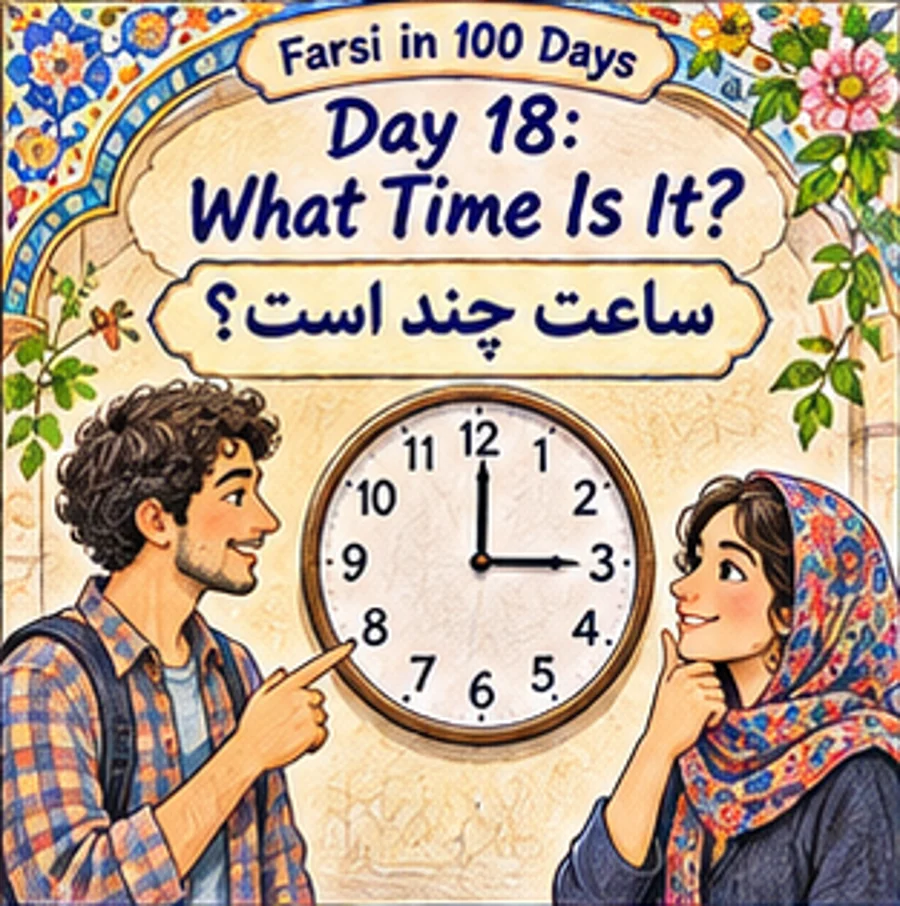
Day 18 of Learn Farsi in 100 Days, our free step-by-step Persian course: What Time Is It?. The lesson has four parts, with every Persian word in Persian script, pronunciation and English, and each part ends with a quick check.
Part 1Grammar and conversation
Day 18, Part 1 explains the preposition تا (tâ, until, to), as in از صبح تا شب (az sobh tâ shab, from morning to night), and a conversation about the time with ساعت چند است؟ (sâ’at chand ast?, what time is it?) and شش و ربع (shesh-o rob’, a quarter past six).
Grammar: the preposition تا (tâ)
The preposition تا (tâ) means “until”, “to” or “up to” and marks the end point of a time, a place or a count. It is often paired with از (az, from): از … تا … (az … tâ …, from … to …). For example, از صبح تا شب (az sobh tâ shab) is “from morning to night”, and از یک تا ده (az yek tâ dah) is “from one to ten”.
Examples
Yesterday I worked from morning to night.
I walked from home to the university.
Conversation: what time is it?
| Speaker | Persian | English and pronunciation |
|---|---|---|
| Mahshid مهشید | ساعت چند است؟ دیر شده است! | What time is it? It’s getting late! sâ’at chand ast? dir shode ast! |
| Nazanin نازنین | شش و ربع است. نگران نباش به موقع میرسیم. | It’s a quarter after six. Don’t worry, we’ll get there on time. shesh-o rob’ ast. negarân nabâsh be mowghe’ mirasim. |
| Mahshid مهشید | مهمانی ساعت هفت شروع میشود. | The party starts at 7:00. mehmâni sâ’at-e haft shoru’ mishavad. |
| Nazanin نازنین | نه ساعت هفت و نیم شروع میشود. | No, it starts at 7:30. na, sâ’at-e haft-o nim shoru’ mishavad. |
Quick check
- How do you say “from morning to night” in Persian?
Show answer
از صبح تا شب (az sobh tâ shab) - How do you ask “What time is it?” in written Persian?
Show answer
ساعت چند است؟ (sâ’at chand ast?) - How do you say “half past seven”?
Show answer
هفت و نیم (haft-o nim)
Part 2Speech vs. writing, grammar and word of the day
Day 18, Part 2 shows spoken forms such as چنده؟ (chande?) for چند است؟ (chand ast?, how much / what time is it?), teaches participle adjectives like شنیده (shenide, heard) and خواننده (khânande, reader, singer), and gives the word of the day, ثانیه (sâniye, second).
Speech vs. writing
In speech, است (ast, is) after a word shrinks to -e (خوب است becomes خوبه), the verb ending -ad becomes -e (باشد becomes باشه), and -avim becomes -im (برویم becomes بریم). The spoken form is on the left of each pair, the written form on the right.
| Spoken | Written | English |
|---|---|---|
| چنده؟ chande? | چند است؟ chand ast? | How much is it? / What time is it? |
| خوبه khube | خوب است khub ast | it is good |
| بریم berim | برویم beravim | let’s go |
| چطوره؟ chetore? | چطور است؟ chetor ast? | How is it? |
| دیره dire | دیر است dir ast | it is late |
| باشه bâshe | باشد bâshad | OK, all right (lit. let it be) |
Grammar: past participle and agent adjectives
The past participle (صفت مفعولی, sefat-e maf’uli) is made by adding ـه (-e) to the past stem: شنید (shenid) gives شنیده (shenide, heard). The agent or active adjective (صفت فاعلی, sefat-e fâ’eli) is made by adding ـنده (-ande), ـان (-ân) or ـا (-â) to the present stem: خوان (khân, read) gives خواننده (khânande, reader, singer), خند (khand, laugh) gives خندان (khandân, smiling), and دان (dân, know) gives دانا (dânâ, wise).
| Persian | Pronunciation | English |
|---|---|---|
| شنیده | shenide | heard (past participle of شنیدن, shenidan, to hear) |
| برده | borde | taken, carried (from بردن, bordan, to take) |
| گرفته | gerefte | taken, gotten; gloomy (from گرفتن, gereftan, to take) |
| خوانده | khânde | read (from خواندن, khândan, to read) |
| گریان | geryân | crying, in tears (from گری, gery, cry) |
| خواننده | khânande | reader; singer (from خوان, khân, read/sing) |
| دانا | dânâ | wise, knowledgeable (from دان, dân, know) |
| خندان | khandân | smiling, laughing (from خند, khand, laugh) |
Word of the day: ثانیه (sâniye)
Meaning: second (of time)
Every sixty seconds is one minute.
Quick check
- What is the written form of the spoken دیره (dire)?
Show answer
دیر است (dir ast), “it is late” - How is the past participle شنیده (shenide) formed?
Show answer
past stem شنید (shenid) + ـه (-e) - What does ثانیه (sâniye) mean?
Show answer
second (of time)
Part 3What time is it?, common phrases and idiom of the day
Day 18, Part 3 shows how to tell the time, from یک و ربع (yek-o rob’, a quarter past one) to ده دقیقه به دو (dah daghighe be do, ten to two), gives phrases like تا چه ساعتی؟ (tâ che sâ’ati?, till what time?), and the idiom حرفهای صد من یک غاز (idle talk).
What time is it?
Persian says the hour first, then و (-o, and) plus the minutes past it, or the minutes, then به (be, to) plus the next hour. ربع (rob’) is a quarter of an hour.
| Persian | Pronunciation | English |
|---|---|---|
| بیست دقیقه به دوازده | bist daghighe be davâzdah | twenty to twelve (11:40) |
| ده دقیقه به دو | dah daghighe be do | ten to two (1:50) |
| پنج دقیقه به یک | panj daghighe be yek | five to one (12:55) |
| یک و ربع | yek-o rob’ | a quarter past one (1:15) |
| چهار و پنج دقیقه | chahâr-o panj daghighe | five past four (4:05) |
| یک ربع به ده | yek rob’ be dah | a quarter to ten (9:45) |
| ده | dah | ten o’clock (10:00) |
| پنج | panj | five o’clock (5:00) |
Common phrases
| Persian | Pronunciation | English |
|---|---|---|
| از چه ساعتی؟ | az che sâ’ati? | From what time? |
| تا چه ساعتی؟ | tâ che sâ’ati? | Till what time? |
| یک ساعت دیگر. | yek sâ’at-e digar. | In an hour. |
| ساعت چنده؟ | sâ’at chande? | What time is it? |
| ظهر است. | zohr ast. | It is noon. |
| دیر است؟ | dir ast? | Is it late? |
Idiom of the day
حرفهای صد من یک غاز.
harf-hâ-ye sad man yek ghâz.
Word for word: Words at a hundred man (an old unit of weight) for one ghaz (a tiny old coin).
Meaning in Persian: حرفهای بیهوده، حرفهای بیاساس.
Meaning: Pointless talk; baseless words.
English equivalent: Hot air; idle talk.
Quick check
- How do you say “a quarter to ten” in Persian?
Show answer
یک ربع به ده (yek rob’ be dah) - How do you ask “Till what time?”
Show answer
تا چه ساعتی؟ (tâ che sâ’ati?) - What does حرفهای صد من یک غاز (harf-hâ-ye sad man yek ghâz) mean?
Show answer
Pointless, baseless talk; hot air.
Part 4Reading and new words
Day 18, Part 4 is a reading about چهارشنبهسوری (chahârshanbe-suri), the fire festival held on the last Tuesday night of the year, with its chant زردی من از تو، سرخی تو از من, followed by new words such as آتش (âtash, fire) and پریدن (paridan, to jump).
Reading: Chaharshanbe Suri
چهارشنبهسوری یکی از جشنهای ایرانی است. این جشن قدمت زیادی دارد. این مراسم در شب آخرین چهارشنبهی سال (سهشنبه شب) برگزار میشود.
Chaharshanbe Suri is one of the Iranian festivals. This festival is very old. The ceremony is held on the eve of the last Wednesday of the year (Tuesday night).
مردم در این مراسم آتش روشن میکنند و از روی آن میپرند. مردم ایران در زمان پریدن از روی آتش میخوانند: «زردی من از تو، سرخی تو از من».
During this ceremony people light fires and jump over them. While jumping over the fire, Iranians chant: “My yellowness (paleness) to you, your redness (vitality) to me.”
New words
| Persian | Pronunciation | English |
|---|---|---|
| بیهوده | bihude | vain, pointless |
| دیگران | digarân | others |
| دقیقه | daghighe | minute |
| گریان | geryân | crying |
| دانا | dânâ | wise |
| ربع | rob’ | quarter |
| زود | zud | early |
| ماه | mâh | month, moon |
| سه شنبه | seshanbe | Tuesday |
| قدمت | ghedmat | antiquity, age |
| زرد | zard | yellow |
| موقعیت | mowghe’iyyat | position, situation |
| غاز | ghâz | goose |
| نیم | nim | half |
| پاییز | pâyiz | fall, autumn |
| هدایت کردن | hedâyat kardan | to guide |
| نگاه کردن | negâh kardan | to look |
| پایان | pâyân | end |
| بعدی | ba’di | next |
| آتش | âtash | fire |
| پرسیدن | porsidan | to ask |
| نوبت | nowbat | shift, turn |
| سرخ | sorkh | red |
| رابطه | râbete | relation, relationship |
| روشن کردن | roshan kardan | to light, to turn on |
| زمستان | zemestân | winter |
| مقصد | maghsad | destination |
| شروع | shoru’ | start, beginning |
| چهارشنبه | chahârshanbe | Wednesday |
| مطالعه کردن | motâle’e kardan | to study, to read |
| نمایش | namâyesh | show, play |
| پریدن | paridan | to jump |
| قرار گذاشتن | gharâr gozâshtan | to arrange to meet, to make a date |
| دعوت کردن | da’vat kardan | to invite |
| توجه | tavajjoh | attention |
| هرگز | hargez | never |
Quick check
- When is چهارشنبهسوری (chahârshanbe-suri) held?
Show answer
On the eve of the last Wednesday of the year, i.e. Tuesday night (سهشنبه شب, seshanbe shab). - What do people do with fire at Chaharshanbe Suri?
Show answer
They light fires and jump over them: آتش روشن میکنند و از روی آن میپرند (âtash roshan mikonand va az ru-ye ân miparand). - What does سرخ (sorkh) mean?
Show answer
red
Take this lesson further

Study with the book
Learn Farsi in 100 Days: The Ultimate Crash Course to Learning Farsi Fast
This free lesson is part of Learn Farsi in 100 Days. The book puts the whole series in one printable PDF you can study offline.
Serious about Persian? Get all 30 of our Persian learning books for $199.99 (0% less than buying them one by one).
Free Persian Starter Pack: Alphabet + 100 Core Words
Get the 14-page printable Starter Pack (all 32 letters, a 7-day reading plan, 100 core words and 20 survival phrases) and a short 5-email course. Free.
Free. Every morning: that day’s four videos and the full lessons, with every Persian word, its pronunciation and its English meaning. Stop or pause with one click.