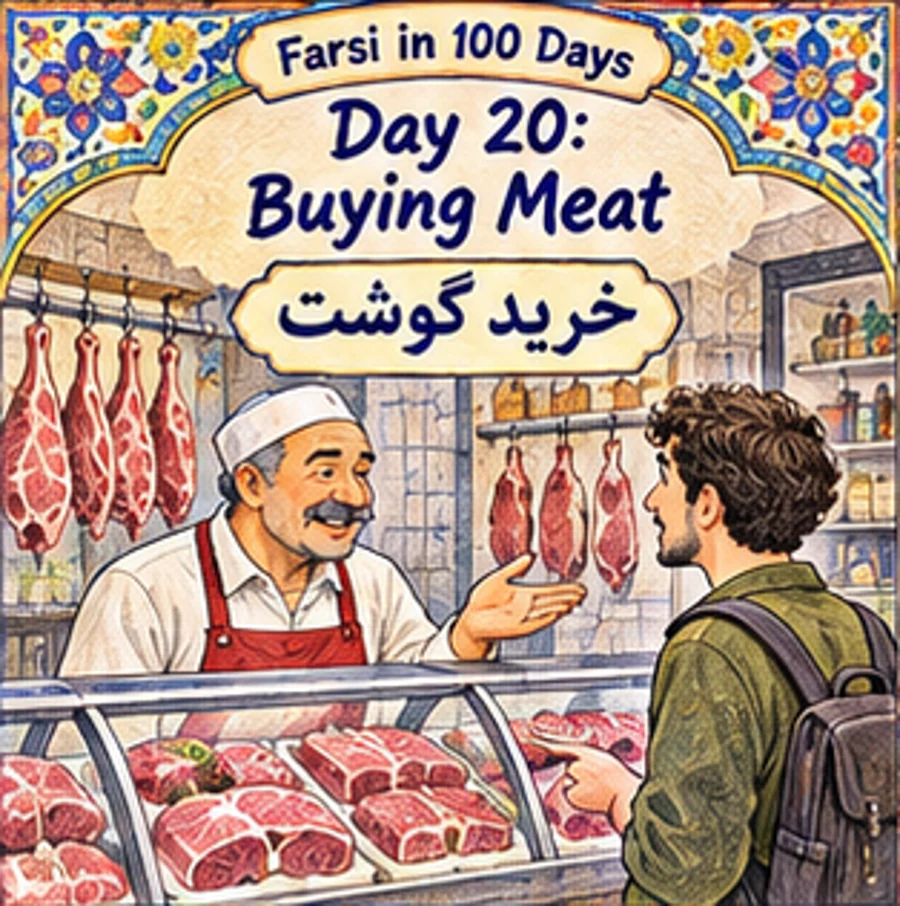
Day 20 of Learn Farsi in 100 Days, our free step-by-step Persian course: Buying Meat. The lesson has four parts, with every Persian word in Persian script, pronunciation and English, and each part ends with a quick check.
Part 1Grammar and conversation
Day 20, Part 1 teaches the negative present perfect, as in نگفتهام (nagofte-am, I have not said) and نخواندهام (nakhânde-am, I have not read), and a conversation at a butcher’s where a customer orders یک کیلو گوشت چرخکرده (yek kilo gusht-e charkh-karde, a kilo of ground meat).
Grammar: the negative present perfect
To make the present perfect (گذشتهی نقلی, gozashte-ye naghli) negative, add نـ (na-) to the front of the past participle and keep the same endings ام، ای، است، ایم، اید، اند: نگفتهام (nagofte-am, I have not said). In compound verbs the na- goes on the verb part: تماشا نکردهای (tamâshâ nakarde-i, you have not watched).
| Persian | Pronunciation | English |
|---|---|---|
| نگفتهام | nagofte-am | I have not said |
| نگفتهای | nagofte-i | you have not said |
| نگفتهاست | nagofte ast | he/she has not said |
| نگفتهایم | nagofte-im | we have not said |
| نگفتهاید | nagofte-id | you (plural/polite) have not said |
| نگفتهاند | nagofte-and | they have not said |
Examples
I haven’t read this book.
He/She hasn’t told me his/her secret.
You haven’t watched this movie.
They haven’t eaten the food.
Conversation: at the butcher’s
| Speaker | Persian | English and pronunciation |
|---|---|---|
| Customer مشتری | من مقداری گوشت میخواهم. | I’d like some meat. man meghdâri gusht mikhâham. |
| Seller فروشنده | چه نوع گوشتی میخواهید؟ | What kind of meat do you want? che no’ gushti mikhâhid? |
| Customer مشتری | مقداری گوشت چرخکرده میخواهم. | I’d like some ground (minced) meat. meghdâri gusht-e charkh-karde mikhâham. |
| Seller فروشنده | چقدر لازم دارید؟ | How much do you need? cheghadr lâzem dârid? |
| Customer مشتری | یک کیلو گوشت چرخکرده میخواهم. | I would like 1 kilogram of ground meat. yek kilo gusht-e charkh-karde mikhâham. |
| Seller فروشنده | اجازه بدهید برای شما آن را بستهبندی کنم. | Let me wrap it up for you. ejâze bedahid barâ-ye shomâ ân râ baste-bandi konam. |
| Customer مشتری | ممنون. | Thanks! mamnun. |
Quick check
- How do you say “I haven’t read this book” in Persian?
Show answer
من این کتاب را نخواندهام. (man in ketâb râ nakhânde-am.) - Which prefix makes the present perfect negative?
Show answer
نـ (na-), added to the past participle, e.g. نخوردهاند (nakhorde-and, they haven’t eaten) - What is “ground meat” in Persian?
Show answer
گوشت چرخکرده (gusht-e charkh-karde)
Part 2Speech vs. writing, grammar and word of the day
Day 20, Part 2 shows spoken forms like اجازه بدین (ejâze bedin) for اجازه بدهید (ejâze bedahid, allow me), lists common prepositions such as از (az, from), تا (tâ, until) and درباره (darbâre, about), and gives the word of the day, سرمایهگذاری (sarmâye-gozâri, investment).
Speech vs. writing
In speech the polite plural verb ending -id becomes -in, and بدهید (bedahid) is shortened further to بدین (bedin). The spoken form is on the left of each pair, the written form on the right.
| Spoken | Written | English |
|---|---|---|
| اجازه بدین ejâze bedin | اجازه بدهید ejâze bedahid | allow (me), let (me) |
| لازم دارین lâzem dârin | لازم دارید lâzem dârid | you need |
Grammar: prepositions
Prepositions (حرف اضافه, harf-e ezâfe) come before a noun and show place, time, direction or relation. Some are single words, like از (az, from) and به (be, to), and some are phrases, like قبل از (ghabl az, before) and بعد از (ba’d az, after). از and تا (tâ, until, as far as) are often used together: از خانه تا دانشگاه (az khâne tâ dâneshgâh, from home to the university).
| Persian | Pronunciation | English |
|---|---|---|
| از | az | from, of |
| تا | tâ | until, up to, as far as |
| زیر | zir | under |
| با | bâ | with |
| در | dar | in, at |
| قبل از | ghabl az | before |
| به | be | to |
| بعد از | ba’d az | after |
| درباره | darbâre | about |
Examples
He/She walks from home to the university.
Word of the day: سرمایهگذاری (sarmâye-gozâri)
Meaning: investment
I invested in the stock market.
Quick check
- What is the written form of the spoken لازم دارین (lâzem dârin)?
Show answer
لازم دارید (lâzem dârid), “you need” - How do you say “before” and “after” in Persian?
Show answer
قبل از (ghabl az) and بعد از (ba’d az) - What does سرمایهگذاری (sarmâye-gozâri) mean?
Show answer
investment
Part 3Meat, common phrases and idiom of the day
Day 20, Part 3 names kinds of meat, from گوشت گاو (gusht-e gâv, beef) and گوشت بره (gusht-e barre, lamb) to بوقلمون (bughalamun, turkey), gives phrases like کجا را باید امضاء کنم؟ (where do I sign?), and the idiom آدم قحطی نیست (âdam ghahti nist, there’s no shortage of people).
Meat
| Persian | Pronunciation | English |
|---|---|---|
| گوشت گاو | gusht-e gâv | beef |
| جوجه | juje | chicken (young chicken, often grilled pieces) |
| اردک | ordak | duck |
| گوشت بره | gusht-e barre | lamb |
| گوشت چرخ کرده | gusht-e charkh-karde | ground meat, minced meat |
| مرغ | morgh | chicken |
| گوشت خوک | gusht-e khuk | pork |
| شنیسل | shenitsel | schnitzel |
| گوشت گوساله | gusht-e gusâle | veal |
| خرگوش | khargush | rabbit |
| بوقلمون | bughalamun | turkey |
| استیک | estik | steak |
Common phrases
| Persian | Pronunciation | English |
|---|---|---|
| کجا را باید امضاء کنم؟ | kojâ râ bâyad emzâ konam? | Where do I sign? |
| حق کمیسیون چند است؟ | hagh-e komisiyon chand ast? | What is the commission? |
Idiom of the day
آدم قحطی نیست.
âdam ghahti nist.
Word for word: There is no famine of people.
Meaning in Persian: او شخص مناسبی برای این کار نیست.
Meaning: He/She is not the right person for this job (we can find someone else).
English equivalent: There are plenty of other fish in the sea.
Quick check
- What is the Persian for “lamb”?
Show answer
گوشت بره (gusht-e barre) - How do you ask “What is the commission?”
Show answer
حق کمیسیون چند است؟ (hagh-e komisiyon chand ast?) - When would you say آدم قحطی نیست (âdam ghahti nist)?
Show answer
When someone is not right for a job and others can be found: “There are plenty of other fish in the sea.”
Part 4Reading and new words
Day 20, Part 4 is a reading about خط فارسی (khatt-e fârsi, the Persian script), where it is the official script and why Tajiks call it خط نیاکان (khatt-e niyâkân, the script of the ancestors), followed by new money words such as سود (sud, profit) and قسط (ghest, installment).
Reading: the Persian script
خط فارسی یا الفبای فارسی، خطی است که از آن برای نوشتن زبان فارسی استفاده میشود.
The Persian script, or Persian alphabet, is the script used to write the Persian language.
خط فارسی در کشورهای ایران و افغانستان و پاکستان خط رسمی است.
The Persian script is the official script in Iran, Afghanistan and Pakistan.
در تاجیکستان خط فارسی را خط نیاکان مینامند.
In Tajikistan, the Persian script is called “the script of the ancestors”.
New words
| Persian | Pronunciation | English |
|---|---|---|
| بازار بورس | bâzâr-e burs | stock market |
| رسمی | rasmi | official, formal |
| تماشا کردن | tamâshâ kardan | to watch |
| قسط | ghest | installment |
| قحطی | ghahti | famine, shortage |
| دادن | dâdan | to give |
| شرکت کردن | sherkat kardan | to participate, to take part |
| از دست دادن | az dast dâdan | to lose |
| استفاده کردن | estefâde kardan | to use |
| پس دادن | pas dâdan | to give back, to return |
| بالا رفتن | bâlâ raftan | to climb, to go up, to rise |
| قبل از | ghabl az | before |
| آدم | âdam | human, person |
| شریک | sharik | partner |
| سود | sud | profit |
| تا | tâ | until |
| خسارت | khesârat | damage |
| قرض کردن | gharz kardan | to borrow |
| نیاز | niyâz | need |
| کالا | kâlâ | commodity, goods |
| کاهش دادن | kâhesh dâdan | to reduce |
| مرتب کردن | morattab kardan | to organize, to tidy |
| سهام | sahâm | stocks, shares |
| سرمایه | sarmâye | capital |
| بعد از | ba’d az | after |
| ضرر | zarar | loss, damage |
| روی | ru-ye | on |
| افزایش دادن | afzâyesh dâdan | to increase |
| پرداخت کردن | pardâkht kardan | to pay |
| حقوق | hoghugh | salary |
| تبدیل کردن | tabdil kardan | to convert |
| خریدن | kharidan | to buy |
| خلافکار | khalâfkâr | criminal, offender |
Quick check
- What do people in Tajikistan call the Persian script?
Show answer
خط نیاکان (khatt-e niyâkân), “the script of the ancestors” - What is the Persian for “stock market”?
Show answer
بازار بورس (bâzâr-e burs) - What does سود (sud) mean?
Show answer
profit
Take this lesson further

Study with the book
Learn Farsi in 100 Days: The Ultimate Crash Course to Learning Farsi Fast
This free lesson is part of Learn Farsi in 100 Days. The book puts the whole series in one printable PDF you can study offline.
Serious about Persian? Get all 30 of our Persian learning books for $199.99 (0% less than buying them one by one).
Free Persian Starter Pack: Alphabet + 100 Core Words
Get the 14-page printable Starter Pack (all 32 letters, a 7-day reading plan, 100 core words and 20 survival phrases) and a short 5-email course. Free.
Free. Every morning: that day’s four videos and the full lessons, with every Persian word, its pronunciation and its English meaning. Stop or pause with one click.