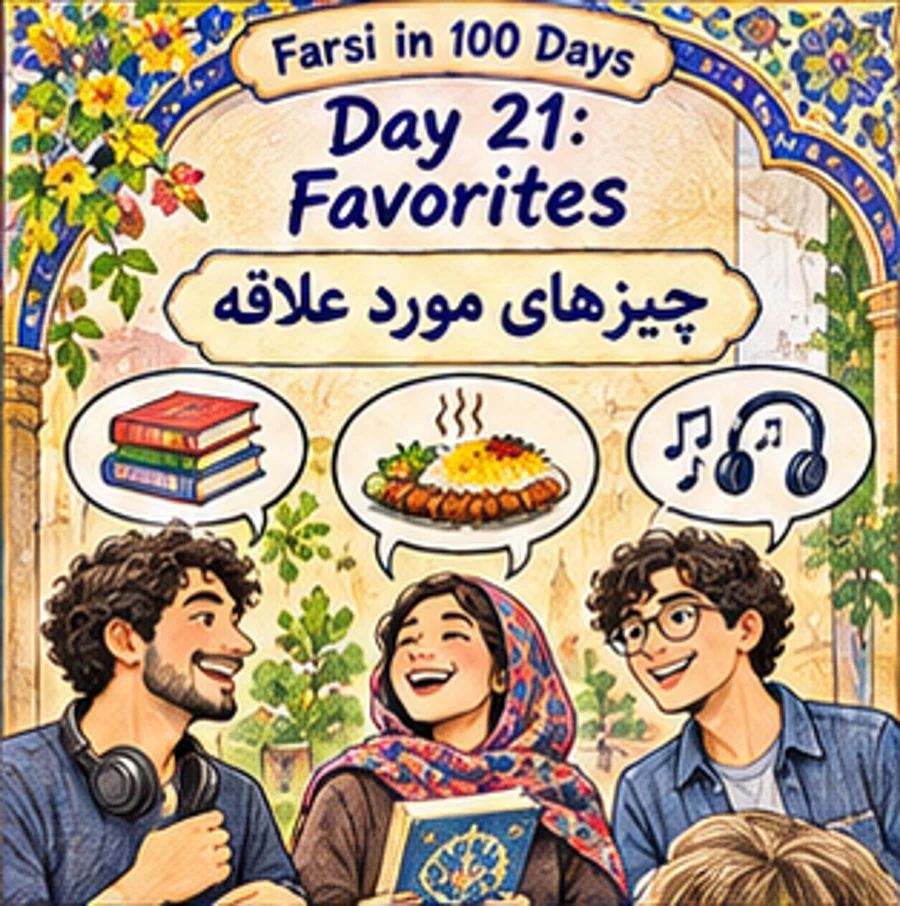
Day 21 of Learn Farsi in 100 Days, our free step-by-step Persian course: Favorites. The lesson has four parts, with every Persian word in Persian script, pronunciation and English, and each part ends with a quick check.
Part 1Grammar and conversation
Day 21, Part 1 teaches the negative present perfect (نگفتهام, nagofte’am, “I have not said”) and a conversation about favorite music, with phrases like موسیقی کلاسیک (musiqi-ye kelâsik, classical music) and پیانو بنوازم (piyâno benavâzam, play the piano).
Grammar: the negative present perfect
The present perfect (گذشتهی نقلی, gozashte-ye naghli) describes something that has or has not happened up to now. To make it negative, put نـ (na-) in front of the past participle (صفت مفعولی, sefat-e maf’uli), such as گفته (gofte, said), and then add the endings ام، ای، است، ایم، اید، اند. So گفتهام (gofte’am, I have said) becomes نگفتهام (nagofte’am, I have not said).
| Persian | Pronunciation | English |
|---|---|---|
| نگفتهام | nagofte’am | I have not said |
| نگفتهای | nagofte’i | you have not said |
| نگفتهاست | nagofte ast | he/she has not said |
| نگفتهایم | nagofte’im | we have not said |
| نگفتهاید | nagofte’id | you (plural/polite) have not said |
| نگفتهاند | nagofte’and | they have not said |
Examples
I have not read this book.
Conversation: favorite music
| Speaker | Persian | English and pronunciation |
|---|---|---|
| Elnaz الناز | موسیقی مورد علاقهی من موسیقی کلاسیک است. | My favorite kind of music is classical music. musiqi-ye mored-e alâghe-ye man musiqi-ye kelâsik ast. |
| Roham روهام | سازی میتوانی بنوازی؟ | Can you play any (musical) instrument? sâzi mitavâni benavâzi? |
| Elnaz الناز | آره، من میتوانم پیانو بنوازم. | Yes, I can play the piano. âre, man mitavânam piyâno benavâzam. |
| Roham روهام | من یک مجموعه از صفحههای موسیقی دارم. | I have a collection of records. man yek majmu’e az safhe-hâ-ye musiqi dâram. |
| Elnaz الناز | واقعا؟ جالب است. | Really? That’s interesting! vâghe’an? jâleb ast. |
| Roham روهام | من عاشق کارهای بتهوون هستم و تمام سمفونیهای بتهوون را دارم. | I love the works of Beethoven and I have all of Beethoven’s symphonies. man âshegh-e kâr-hâ-ye betahovan hastam va tamâm-e samfoni-hâ-ye betahovan râ dâram. |
Quick check
- How do you say “we have not said” in Persian?
Show answer
نگفتهایم (nagofte’im) - What does من این کتاب را نخواندهام mean?
Show answer
“I have not read this book.” (man in ketâb râ nakhânde’am) - What instrument can Elnaz play?
Show answer
the piano: پیانو (piyâno)
Part 2Speech vs. writing, grammar and word of the day
Day 21, Part 2 compares spoken and written forms such as اون کیه؟ (un kiye?, who is he?) and میگه (mige, he says), teaches the past perfect (رفته بودم, rafte budam, “I had gone”), and gives the word of the day, بیهوده (bihude, vain).
Speech vs. writing
In speech, -ad and -id verb endings become -e and -in (میگه for میگوید, میخواین for میخواهید), â before n often becomes u (پیمونه for پیمانه), and است/هستیم shrink to an ending (-e, -im). The spoken form comes first in each pair, the written form second.
| Spoken | Written | English |
|---|---|---|
| برایت barâyat | برای تو barâ-ye to | for you |
| اون کیه؟ un kiye? | او کیست؟ u kist? | Who is he/she? |
| کنارش kenâresh | کنار او kenâr-e u | beside him/her |
| پیمونه peymune | پیمانه peymâne | measuring cup, measure |
| دوستیم dustim | دوست هستیم dust hastim | we are friends |
| میخواین mikhâyn | میخواهید mikhâhid | you (plural/polite) want |
| وقتت vaghtet | وقت شما vaght-e shomâ | your time |
| آزاده âzâde | آزاد است âzâd ast | he/she/it is free |
| میگه mige | میگوید miguyad | he/she says |
Grammar: the past perfect
The past perfect (گذشتهی بعید, gozashte-ye ba’id) describes an action that had already happened before another moment in the past. It is made with the past participle (صفت مفعولی, sefat-e maf’uli), such as رفته (rafte, gone), followed by the simple past of بودن (budan, to be): بودم، بودی، بود، بودیم، بودید، بودند.
| Persian | Pronunciation | English |
|---|---|---|
| رفته بودم | rafte budam | I had gone |
| رفته بودی | rafte budi | you had gone |
| رفته بود | rafte bud | he/she had gone |
| رفته بودیم | rafte budim | we had gone |
| رفته بودید | rafte budid | you (plural/polite) had gone |
| رفته بودند | rafte budand | they had gone |
Examples
You had given me a book.
He had gone to school.
They had started the game.
Word of the day: بیهوده (bihude)
Meaning: vain, useless
He had tried in vain for the exam.
Quick check
- How do you say “they had gone” in Persian?
Show answer
رفته بودند (rafte budand) - What is the written form of the spoken میگه (mige)?
Show answer
میگوید (miguyad), “he/she says” - What does بیهوده (bihude) mean?
Show answer
vain, useless
Part 3Colors, common phrases and idiom of the day
Day 21, Part 3 teaches ten colors such as قرمز (ghermez, red) and خاکستری (khâkestari, gray), phrases for making plans like امشب وقت شما آزاد است؟ (emshab vaght-e shomâ âzâd ast?, are you free tonight?), and the idiom باید بسوزی و بسازی (grin and bear it).
Colors
| Persian | Pronunciation | English |
|---|---|---|
| قرمز | ghermez | red |
| آبی | âbi | blue |
| سبز | sabz | green |
| زرد | zard | yellow |
| سفید | sefid | white |
| قهوهای | ghahve’i | brown |
| نارنجی | nârenji | orange |
| بنفش | banafsh | violet, purple |
| خاکستری | khâkestari | gray |
| سیاه | siyâh | black |
Common phrases
| Persian | Pronunciation | English |
|---|---|---|
| میتوانیم امروز همدیگر را ببینیم؟ | mitavânim emruz hamdigar râ bebinim? | Could we see each other today? |
| امشب وقت شما آزاد است؟ | emshab vaght-e shomâ âzâd ast? | Do you have free time tonight? |
| دوست دارید برای غذا برویم بیرون؟ | dust dârid barâ-ye ghazâ beravim birun? | Would you like to go out for a meal? |
| دوست دارید با من بیاید؟ | dust dârid bâ man biyâyid? | Would you like to come with me? |
| شما فردا وقت دارید؟ | shomâ fardâ vaght dârid? | Do you have free time tomorrow? |
Idiom of the day
باید بسوزی و بسازی.
bâyad besuzi va besâzi.
Word for word: You must burn and put up with it.
Meaning in Persian: باید شرایط سخت را تحمل کرد.
Meaning: One has to endure hard conditions.
English equivalent: You must grin and bear it.
Quick check
- What is the Persian word for “gray”?
Show answer
خاکستری (khâkestari) - How do you ask “Do you have free time tomorrow?” in Persian?
Show answer
شما فردا وقت دارید؟ (shomâ fardâ vaght dârid?) - What does the idiom باید بسوزی و بسازی mean?
Show answer
You have to put up with a hard situation: “grin and bear it” (bâyad besuzi va besâzi)
Part 4Reading and new words
Day 21, Part 4 is a short reading about تخت جمشید (takht-e jamshid, Persepolis), its founder Darius the Great and its burning by Alexander, followed by 35 new words such as باستانی (bâstâni, ancient), کتیبه (katibe, inscription) and آتش زدن (âtash zadan, to set on fire).
Reading: Persepolis
تخت جمشید در شمال استان فارس قرار دارد و نام یکی از شهرهای باستانی در ایران است. بنیانگذار تخت جمشید، داریوش بزرگ بود. در این شهر تاریخی کتیبههای زیادی پیدا شده است.
Persepolis (Takht-e Jamshid) is in the north of Fars province, and it is the name of one of the ancient cities of Iran. The founder of Persepolis was Darius the Great. Many inscriptions have been found in this historical city.
اسکندر مقدونی در ۳۳۰ سال قبل از میلاد به تخت جمشید حمله کرد و آن را آتش زد. بسیاری از کتابها و هنرهای ایرانی در آن آتش سوخت.
Alexander of Macedon attacked Persepolis in 330 BC and set it on fire. Many Iranian books and works of art burned in that fire.
New words
| Persian | Pronunciation | English |
|---|---|---|
| باستانی | bâstâni | ancient |
| بنیانگذار | bonyân-gozâr | founder |
| تاریخی | târikhi | historical |
| کتیبه | katibe | inscription |
| پیدا شدن | peydâ shodan | to be found |
| قبل از | ghabl az | before |
| تحمل کردن | tahammol kardan | to tolerate, to endure |
| بنا کردن | banâ kardan | to build |
| امشب | emshab | tonight |
| بیرون | birun | outside |
| پیمانه | peymâne | measure |
| دوست | dust | friend |
| حمله کردن | hamle kardan | to attack |
| آتش زدن | âtash zadan | to set on fire |
| شرایط | sharâyet | conditions |
| سخت | sakht | hard |
| آزاد | âzâd | free |
| وقت | vaght | time |
| شروع کردن | shoru’ kardan | to start |
| پس | pas | so, then |
| شناختن | shenâkhtan | to recognize, to know |
| پیراهن | pirâhan | shirt |
| تلاش | talâsh | effort |
| خواستن | khâstan | to want |
| بسیاری | besyâri | many |
| هنر | honar | art |
| سوختن | sukhtan | to burn |
| بنابراین | banâbar-in | so, therefore |
| تماشا کردن | tamâshâ kardan | to watch |
| خواندن | khândan | to read |
| توانستن | tavânestan | to be able |
| پوشیدن | pushidan | to wear |
| آماده شدن | âmâde shodan | to get ready, to prepare |
| آرزو کردن | ârezu kardan | to wish |
| دشمن | doshman | enemy |
Quick check
- Who founded Persepolis, according to the reading?
Show answer
داریوش بزرگ (dâryush-e bozorg), Darius the Great - What does کتیبه (katibe) mean?
Show answer
inscription - How do you say “to attack” in Persian?
Show answer
حمله کردن (hamle kardan)
Take this lesson further

Study with the book
Learn Farsi in 100 Days: The Ultimate Crash Course to Learning Farsi Fast
This free lesson is part of Learn Farsi in 100 Days. The book puts the whole series in one printable PDF you can study offline.
Serious about Persian? Get all 30 of our Persian learning books for $199.99 (0% less than buying them one by one).
Free Persian Starter Pack: Alphabet + 100 Core Words
Get the 14-page printable Starter Pack (all 32 letters, a 7-day reading plan, 100 core words and 20 survival phrases) and a short 5-email course. Free.
Free. Every morning: that day’s four videos and the full lessons, with every Persian word, its pronunciation and its English meaning. Stop or pause with one click.