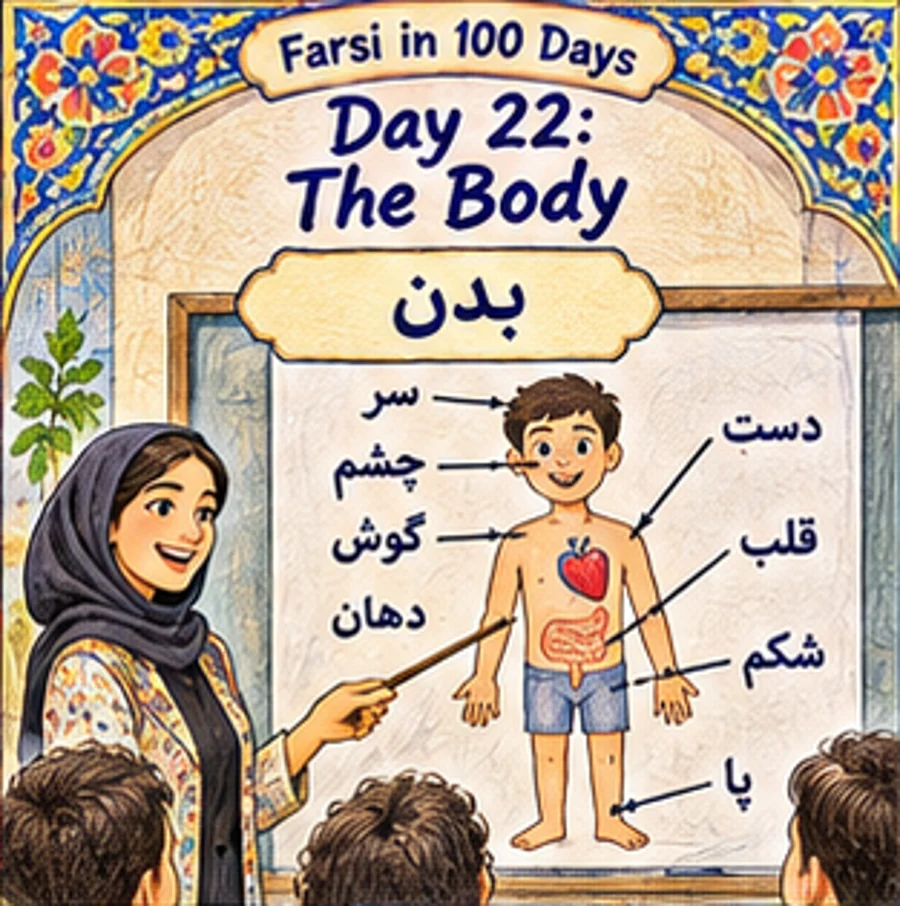
Day 22 of Learn Farsi in 100 Days, our free step-by-step Persian course: The Body. The lesson has four parts, with every Persian word in Persian script, pronunciation and English, and each part ends with a quick check.
Part 1Grammar and conversation
Day 22, Part 1 teaches the negative past perfect (نرفته بودم, narafte budam, “I had not gone”) and a conversation about sore fingers from typing, with phrases like استراحت کنی (esterâhat koni, take a break) and باید بروم دکتر (bâyad beravam doktor, I should see a doctor).
Grammar: the negative past perfect
The past perfect (گذشتهی بعید, gozashte-ye ba’id) says what had happened before a past moment. To make it negative, put نـ (na-) in front of the past participle (صفت مفعولی, sefat-e maf’uli) and keep the forms of بودن (budan) unchanged: رفته بودم (rafte budam, I had gone) becomes نرفته بودم (narafte budam, I had not gone).
| Persian | Pronunciation | English |
|---|---|---|
| نرفته بودم | narafte budam | I had not gone |
| نرفته بودی | narafte budi | you had not gone |
| نرفته بود | narafte bud | he/she had not gone |
| نرفته بودیم | narafte budim | we had not gone |
| نرفته بودید | narafte budid | you (plural/polite) had not gone |
| نرفته بودند | narafte budand | they had not gone |
Examples
I had not gone to school.
They had not made plans.
Conversation: sore fingers
| Speaker | Persian | English and pronunciation |
|---|---|---|
| Afsun افسون | انگشتهایم صدمه دیدهاند. | My fingers hurt. angosht-hâyam sadame dide’and. |
| Parviz پرویز | چرا صدمه دیدهاست؟ | Why do they hurt? cherâ sadame dide ast? |
| Afsun افسون | خیلی تایپ کردم. | I typed too much. kheyli tâyp kardam. |
| Parviz پرویز | تو باید استراحت کنی. | You should take a break. to bâyad esterâhat koni. |
| Afsun افسون | من باید تایپ کنم تا پول بهدست آورم. | I have to type to make money. man bâyad tâyp konam tâ pul be-dast âvaram. |
| Parviz پرویز | اما تایپ باعث میشود درد بکشی. | But typing is causing you pain. ammâ tâyp bâ’es mishavad dard bekeshi. |
| Afsun افسون | باید بروم دکتر. | I should see a doctor. bâyad beravam doktor. |
Quick check
- How do you say “they had not gone” in Persian?
Show answer
نرفته بودند (narafte budand) - What does تو باید استراحت کنی mean?
Show answer
“You should take a break.” (to bâyad esterâhat koni) - How do you say “I had not gone to school”?
Show answer
من به مدرسه نرفته بودم (man be madrese narafte budam)
Part 2Speech vs. writing, grammar and word of the day
Day 22, Part 2 compares spoken and written verbs such as میده (mide, he gives) and آفتابیه (âftâbiye, it’s sunny), teaches words for wishing and sorrow like ای کاش (ey kâsh, if only) and دریغ (darigh, alas), and gives the word of the day, پاداش (pâdâsh, reward).
Speech vs. writing
In speech the verb ending -ad becomes -e (میده for میدهد), -avi becomes -i (میری for میروی), and است shrinks to -e after a vowel, written ـه (آفتابیه for آفتابی است). The spoken form comes first in each pair, the written form second.
| Spoken | Written | English |
|---|---|---|
| داری میری dâri miri | داری میروی dâri miravi | you are going |
| میخوای بری mikhây beri | میخواهی بروی mikhâhi beravi | you want to go |
| میده mide | میدهد midahad | he/she gives |
| میشناسه mishnâse | میشناسد mishenâsad | he/she knows (someone) |
| بباره bebâre | ببارد bebârad | (that) it rains |
| آفتابیه âftâbiye | آفتابی است âftâbi ast | it is sunny |
Grammar: sentences of hope and of sorrow
Persian uses short words to express feelings. For hope and wishes (امید و آرزو, omid va ârezu) it uses کاش or ای کاش (kâsh, ey kâsh, I wish / if only), followed by a verb in the subjunctive, such as ببارد (bebârad) or باشد (bâshad). For grief and sorrow (غم و ناراحتی, gham va nârâhati) it uses interjections such as آه (âh, oh), وای (vây, oh no), دریغ (darigh, alas) and فریاد (faryâd, woe).
| Persian | Pronunciation | English |
|---|---|---|
| کاش، ای کاش | kâsh, ey kâsh | I wish, if only (hope and wishes) |
| آه، وای، دریغ، فریاد | âh, vây, darigh, faryâd | oh, oh no, alas, woe (grief and sorrow) |
Examples
I wish it would rain tomorrow.
If only the weather were sunny tomorrow.
Oh, what bad luck!
Not even a speck of kindness, alas.
Word of the day: پاداش (pâdâsh)
Meaning: reward, bonus
The boss gave the employees a bonus. A big reward was set for finding the thief.
Quick check
- What is the written form of the spoken میده (mide)?
Show answer
میدهد (midahad), “he/she gives” - Which word is used to express a wish in Persian?
Show answer
کاش or ای کاش (kâsh, ey kâsh), “I wish, if only” - What does پاداش (pâdâsh) mean?
Show answer
reward, bonus
Part 3Parts of the body, common phrases and idiom of the day
Day 22, Part 3 teaches ten body words such as پیشانی (pishâni, forehead) and انگشت (angosht, finger), compliments like خیلی خوشتیپ شدی! (kheyli khosh-tip shodi!, you look good!), and the idiom بکوب کار کردن (bekub kâr kardan, to work flat out).
Parts of the body
| Persian | Pronunciation | English |
|---|---|---|
| مو | mu | hair |
| پیشانی | pishâni | forehead |
| زانو | zânu | knee |
| ناخن | nâkhon | nail |
| شانه | shâne | shoulder |
| دندان | dandân | tooth, teeth |
| دماغ | damâgh | nose |
| انگشت | angosht | finger |
| دست | dast | hand |
| قلب | ghalb | heart |
Common phrases
| Persian | Pronunciation | English |
|---|---|---|
| موهایت خیلی خوب شدهاست. | muhâyat kheyli khub shode ast. | Your haircut is good. |
| شما سلیقهی خوبی برای لباس دارید. | shomâ salighe-ye khubi barâ-ye lebâs dârid. | You have wonderful taste in clothes. |
| ممنون از زحمتی که کشیدید. | mamnun az zahmati ke keshidid. | Thanks for your trouble. |
| خیلی خوشتیپ شدی! | kheyli khosh-tip shodi! | You look good! |
Idiom of the day
بکوب کار کردن.
bekub kâr kardan.
Word for word: to work pounding (nonstop)
Meaning in Persian: زیاد کار کردن. سخت تلاش کردن.
Meaning: To work a lot; to try hard. Example: او بکوب کار میکند و درآمد خوبی دارد. (u bekub kâr mikonad va darâmad-e khubi dârad), “He works nonstop and has a good income.”
English equivalent: Work all the hours God sends.
Quick check
- What is the Persian word for “knee”?
Show answer
زانو (zânu) - How do you say “Thanks for your trouble” in Persian?
Show answer
ممنون از زحمتی که کشیدید (mamnun az zahmati ke keshidid) - What does بکوب کار کردن (bekub kâr kardan) mean?
Show answer
to work very hard, nonstop
Part 4Reading and new words
Day 22, Part 4 is a reading about پاسارگاد (pâsârgâd, Pasargadae), the ancient capital that holds the tomb of Cyrus the Great, followed by 36 new words such as پایتخت (pâytakht, capital), آرامگاه (ârâmgâh, tomb) and خوشرفتار (khosh-raftâr, affable).
Reading: Pasargadae
پاسارگاد یک شهر باستانی در ایران است. این شهر در استان فارس قرار دارد. پاسارگاد در گذشته پایتخت خاندان پارس بود.
Pasargadae is an ancient city in Iran. This city is in Fars province. In the past, Pasargadae was the capital of the Pars dynasty.
این شهر تاریخی مکانهای دیدنی زیادی دارد. آرامگاه کوروش بزرگ در این شهر قرار دارد. این شهر یک برج سنگی زیبا دارد. شهر تاریخی پاسارگاد در فهرست جهانی یونسکو قرار دارد.
This historical city has many sights. The tomb of Cyrus the Great is in this city. The city has a beautiful stone tower. The historical city of Pasargadae is on UNESCO’s World Heritage List.
New words
| Persian | Pronunciation | English |
|---|---|---|
| پایتخت | pâytakht | capital |
| مکان | makân | place |
| آرامگاه | ârâmgâh | tomb |
| سنگ | sang | stone |
| فهرست | fehrest | list |
| جهانی | jahâni | global, world |
| ناراحتی | nârâhati | sorrow, upset |
| بدشانسی | bad-shânsi | bad luck, misfortune |
| تولد | tavallod | birth |
| فکر | fekr | thought |
| ثبت کردن | sabt kardan | to register |
| پاساژ | pâsâzh | shopping arcade |
| آهنگ | âhang | song, tune |
| قرار داشتن | gharâr dâshtan | to be located |
| استان | ostân | province |
| رئیس | ra’is | boss, head |
| غم | gham | sorrow |
| عکس گرفتن | aks gereftan | to take a photo |
| پادشاه | pâdeshâh | king |
| خوشرفتار | khosh-raftâr | affable, well-behaved |
| خون | khun | blood |
| خیال کردن | khiyâl kardan | to imagine |
| خیلی خوب | kheyli khub | very good, very well |
| دایره | dâyere | circle |
| دبستان | dabestân | primary school |
| خاندان | khândân | family, dynasty |
| دخالت کردن | dekhâlat kardan | to interfere |
| دروغ | dorugh | lie |
| دست دادن | dast dâdan | to shake hands |
| رقص | raghs | dance |
| روزگار | ruzegâr | times, days |
| حیرتانگیز | heyrat-angiz | amazing |
| سرباز | sarbâz | soldier |
| وجود داشتن | vojud dâshtan | to exist |
| افسانه | afsâne | myth, legend |
| خواننده | khânande | singer |
Quick check
- Whose tomb is in Pasargadae, according to the reading?
Show answer
کوروش بزرگ (kurosh-e bozorg), Cyrus the Great - What does آرامگاه (ârâmgâh) mean?
Show answer
tomb - How do you say “to shake hands” in Persian?
Show answer
دست دادن (dast dâdan)
Take this lesson further

Study with the book
Learn Farsi in 100 Days: The Ultimate Crash Course to Learning Farsi Fast
This free lesson is part of Learn Farsi in 100 Days. The book puts the whole series in one printable PDF you can study offline.
Serious about Persian? Get all 30 of our Persian learning books for $199.99 (0% less than buying them one by one).
Free Persian Starter Pack: Alphabet + 100 Core Words
Get the 14-page printable Starter Pack (all 32 letters, a 7-day reading plan, 100 core words and 20 survival phrases) and a short 5-email course. Free.
Free. Every morning: that day’s four videos and the full lessons, with every Persian word, its pronunciation and its English meaning. Stop or pause with one click.