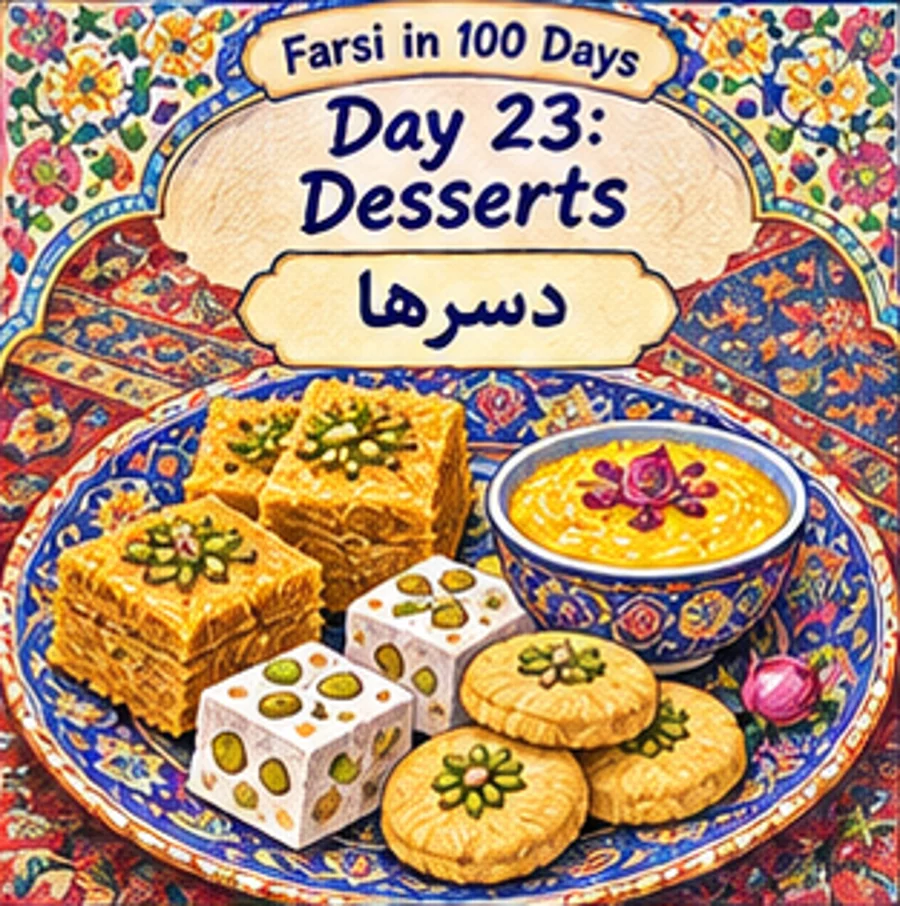
Day 23 of Learn Farsi in 100 Days, our free step-by-step Persian course: Desserts. The lesson has four parts, with every Persian word in Persian script, pronunciation and English, and each part ends with a quick check.
Part 1Grammar and conversation
Day 23, Part 1 teaches the direct object and its marker را (râ), as in من کتاب را بردم (man ketâb râ bordam, I took the book), and a conversation about dessert with phrases like یک چیز شیرین (yek chiz-e shirin, something sweet) and پای سیب (pây-e sib, apple pie).
Grammar: the direct object and را
The direct object (مفعول, maf’ul) is the person or thing that receives the action of the verb. When the object is definite (a specific, known thing or person), Persian marks it with را (râ), placed right after the object. In the examples below, کتاب (ketâb, the book) and آنها (ân-hâ, them) are the objects.
| Persian | Pronunciation | English |
|---|---|---|
| کتاب | ketâb | object in the first example: the book |
| آنها | ân-hâ | object in the second example: them |
Examples
I took the book and gave it to Sina.
We saw them and got to know them.
Conversation: something sweet
| Speaker | Persian | English and pronunciation |
|---|---|---|
| Behrad بهراد | من بعد از شام یک چیز شیرین میخواهم. | I want something sweet after dinner. man ba’d az shâm yek chiz-e shirin mikhâham. |
| Mahsa مهسا | دقیقا چه چیزی میخواهی؟ | What exactly do you want? daghighan che chizi mikhâhi? |
| Behrad بهراد | یک دسر خوب. | A good dessert. yek deser-e khub. |
| Mahsa مهسا | چه نوع دسری میخواهی؟ | What kind of dessert do you want? che no’ deseri mikhâhi? |
| Behrad بهراد | من پای سیب خیلی دوست دارم. | I like apple pie a lot. man pây-e sib kheyli dust dâram. |
| Mahsa مهسا | من هم آن را خیلی دوست دارم. | I love it too. man ham ân râ kheyli dust dâram. |
Quick check
- Which word marks a definite direct object in Persian?
Show answer
را (râ) - What is the object in ما آنها را دیدیم?
Show answer
آنها (ân-hâ), “them” - How do you say “apple pie” in Persian?
Show answer
پای سیب (pây-e sib)
Part 2Speech vs. writing, grammar and word of the day
Day 23, Part 2 compares spoken and written forms such as هوا چطوره؟ (havâ chetore?, how’s the weather?), teaches the prepositional complement متمم (motammam), as in با سارا (bâ sârâ, with Sara), and gives the word of the day, روحیه (ruhiye, morale).
Speech vs. writing
In speech است becomes -e (سرده for سرد است), میشود becomes میشه, and آمده becomes اومده, with â turning into u. The spoken form comes first in each pair, the written form second.
| Spoken | Written | English |
|---|---|---|
| هوا چطوره؟ havâ chetore? | هوا چطور است؟ havâ chetor ast? | How is the weather? |
| هوا سرده. havâ sarde. | هوا سرد است. havâ sard ast. | The weather is cold. |
| تعطیل میشه. ta’til mishe. | تعطیل میشود. ta’til mishavad. | It closes. / It will be a holiday. |
| اومده. umade. | آمده است. âmade ast. | He/she has come. |
Grammar: the prepositional complement
A complement (متمم, motammam) is a noun or pronoun that comes after a preposition (حرف اضافه, harf-e ezâfe) such as با (bâ, with) or به (be, to). The preposition is what marks it, just as را (râ) marks the direct object (مفعول, maf’ul). In the examples, سارا and خانه are complements, while او and کیف are objects.
| Persian | Pronunciation | English |
|---|---|---|
| سارا | sârâ | complement in the first example (after با, with) |
| او | u | object in the first example (marked by را) |
| خانه | khâne | complement in the second example (after به, to) |
| کیف | kif | object in the second example (marked by را) |
Examples
I talked with Sara and persuaded her.
We went home and picked up the bag.
Word of the day: روحیه (ruhiye)
Meaning: morale, spirit
The members of the soccer team have good morale.
Quick check
- What marks a complement (متمم) in Persian?
Show answer
a preposition (حرف اضافه, harf-e ezâfe), such as با (bâ) or به (be) - What is the written form of the spoken هوا سرده (havâ sarde)?
Show answer
هوا سرد است (havâ sard ast), “The weather is cold.” - What does روحیه (ruhiye) mean?
Show answer
morale
Part 3Desserts, common phrases and idiom of the day
Day 23, Part 3 names eight desserts such as بستنی (bastani, ice cream) and کیک گردویی (keyk-e gerduyi, walnut cake), phrases like آن کیک بزرگ خیلی وسوسهانگیز است (that big cake looks very tempting), and the idiom بیشیلهپیله بودن (bi-shile-pile budan, to be open and straightforward).
Desserts
| Persian | Pronunciation | English |
|---|---|---|
| بیسکوییت | biskuit | biscuits, cookies |
| پای سیب | pây-e sib | apple pie |
| کیک شکلاتی | keyk-e shokolâti | chocolate cake |
| بستنی | bastani | ice cream |
| پنکیک | pankeyk | pancake |
| نان خامهای | nân-e khâme’i | cream puff, profiterole |
| شیرینی دانمارکی | shirini-ye dânmârki | Danish pastry |
| کیک گردویی | keyk-e gerduyi | walnut cake |
Common phrases
| Persian | Pronunciation | English |
|---|---|---|
| میخواهم روی کیکم، خامه باشد. | mikhâham ru-ye keykam, khâme bâshad. | I’d like my cake to have cream on top. |
| آن کیک بزرگ خیلی وسوسهانگیز است. | ân keyk-e bozorg kheyli vasvase-angiz ast. | That big cake looks very tempting. |
| انواع زیادی از شیرینیها را داریم. | anvâ’-e ziyâdi az shirini-hâ râ dârim. | We have a large selection of pastries. |
Idiom of the day
بیشیلهپیله بودن.
bi-shile-pile budan.
Word for word: to be without tricks and frills
Meaning in Persian: ساده بودن.
Meaning: To be simple and straightforward, with nothing hidden. Example: او یک مرد بیشیلهپیله است. (u yek mard-e bi-shile-pile ast), “He is a straightforward man.”
English equivalent: Wear one’s heart on one’s sleeve.
Quick check
- What is the Persian for “ice cream”?
Show answer
بستنی (bastani) - What does وسوسهانگیز (vasvase-angiz) mean in آن کیک بزرگ خیلی وسوسهانگیز است?
Show answer
tempting - What does بیشیلهپیله بودن mean?
Show answer
to be simple and straightforward (bi-shile-pile budan)
Part 4Reading and new words
Day 23, Part 4 is a reading about Iran’s varied climate season by season, followed by 35 new words for weather and nature such as متنوع (motanavve’, diverse), مطبوع (matbu’, pleasant), رنگینکمان (rangin-kamân, rainbow) and زلزله (zelzele, earthquake).
Reading: Iran’s climate
آب و هوای ایران بسیار متنوع است. در بهار، مناطق جنوب گرم و آفتابی است، ولی در شمال غربی ایران هوا سرد و برفی است.
Iran’s climate is very diverse. In spring, the southern regions are warm and sunny, but in northwestern Iran the weather is cold and snowy.
در فصل تابستان، هوای مناطق جنوبی و مرکزی ایران بسیار گرم است. اما مناطق شمال غربی، هوایی مطبوع دارند. پاییز در بسیاری از مناطق ایران فصلی زیبا است.
In summer, the weather in the southern and central regions of Iran is very hot. But the northwestern regions have pleasant weather. Fall is a beautiful season in many parts of Iran.
در فصل زمستان، جنوب کشور هوا آفتابی است، اما شمال کشور هوا برفی و بارانی است.
In winter, the weather in the south of the country is sunny, but in the north it is snowy and rainy.
New words
| Persian | Pronunciation | English |
|---|---|---|
| متنوع | motanavve’ | diverse |
| گرم | garm | hot, warm |
| سرد | sard | cold |
| هوا | havâ | air, weather |
| مناطق | manâtegh | areas, regions |
| مطبوع | matbu’ | pleasant |
| فصل | fasl | season |
| دلانگیز | del-angiz | pleasing, delightful |
| کشور | keshvar | country |
| ساده بودن | sâde budan | to be simple |
| اعضا | a’zâ | members |
| تیم | tim | team |
| حرف اضافه | harf-e ezâfe | preposition |
| بعد | ba’d | after, next |
| جو | javv | atmosphere |
| گردباد | gerdbâd | tornado |
| سرما | sarmâ | cold (weather) |
| رنگینکمان | rangin-kamân | rainbow |
| خورشید | khorshid | sun |
| بستنی | bastani | ice cream |
| شرایط | sharâyet | conditions |
| سیل | seyl | flood |
| خراب کردن | kharâb kardan | to destroy |
| فوتبال | futbâl | soccer |
| تبخیر | tabkhir | evaporation |
| تگرگ | tagarg | hail |
| یخ | yakh | ice |
| گرما | garmâ | heat |
| زلزله | zelzele | earthquake |
| آسیب زدن | âsib zadan | to damage |
| خسارت | khesârat | damage |
| فرار کردن | farâr kardan | to escape |
| ایمنی | imeni | safety |
| گل | gel | mud |
| خاک | khâk | soil |
Quick check
- According to the reading, what is the weather like in the south of Iran in winter?
Show answer
sunny: آفتابی (âftâbi) - What does مطبوع (matbu’) mean?
Show answer
pleasant - How do you say “earthquake” in Persian?
Show answer
زلزله (zelzele)
Take this lesson further

Study with the book
Learn Farsi in 100 Days: The Ultimate Crash Course to Learning Farsi Fast
This free lesson is part of Learn Farsi in 100 Days. The book puts the whole series in one printable PDF you can study offline.
Serious about Persian? Get all 30 of our Persian learning books for $199.99 (0% less than buying them one by one).
Free Persian Starter Pack: Alphabet + 100 Core Words
Get the 14-page printable Starter Pack (all 32 letters, a 7-day reading plan, 100 core words and 20 survival phrases) and a short 5-email course. Free.
Free. Every morning: that day’s four videos and the full lessons, with every Persian word, its pronunciation and its English meaning. Stop or pause with one click.