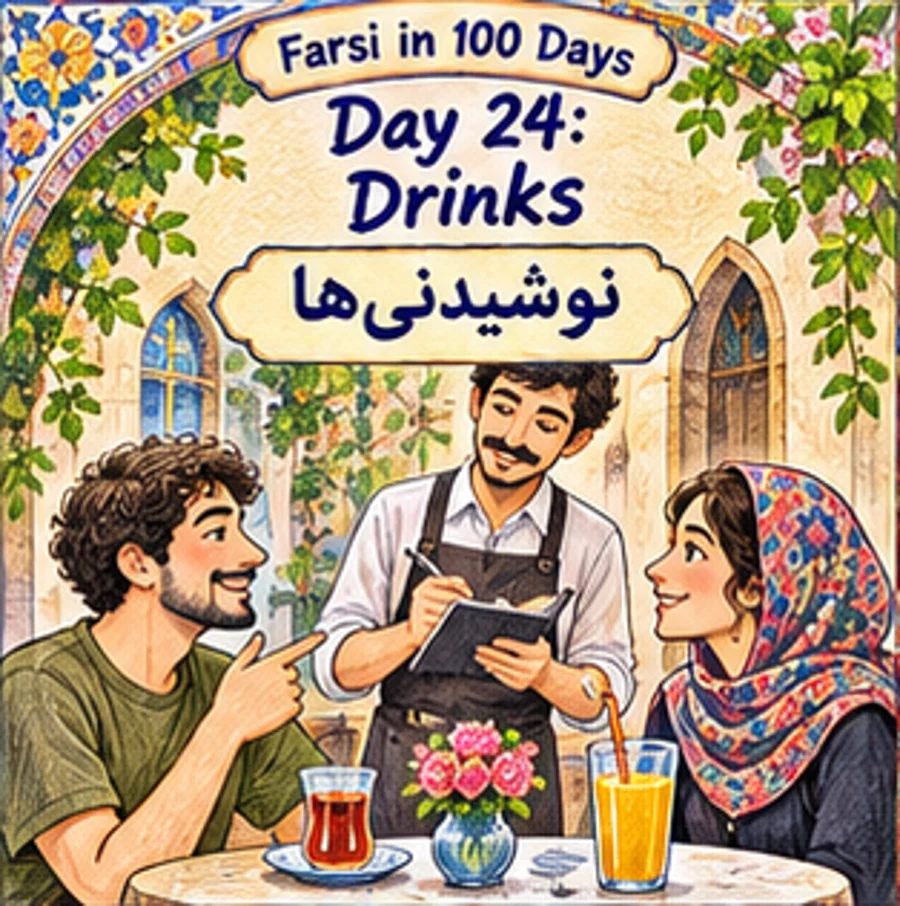
Day 24 of Learn Farsi in 100 Days, our free step-by-step Persian course: Drinks. The lesson has four parts, with every Persian word in Persian script, pronunciation and English, and each part ends with a quick check.
Part 1Grammar and conversation
Day 24, Part 1 shows how از (az, from) joins a personal pronoun ending, as in ازم (azam, from me) and ازشون (azeshun, from them), and gives a conversation about drinks with lines like من خیلی تشنه هستم (man kheyli teshne hastam, I’m so thirsty).
Grammar: از with personal pronoun endings
Instead of از من (az man, from me), Persian often attaches a short personal pronoun ending (ضمیر شخصی, zamir-e shakhsi) straight to the preposition از (az): ازم (azam), ازت (azat), ازش (azash). The plural forms in this box, ازمون، ازتون، ازشون (azemun, azetun, azeshun), are the everyday spoken forms; in writing they are ازمان، ازتان، ازشان (azemân, azetân, azeshân).
| Persian | Pronunciation | English |
|---|---|---|
| از + من = ازم | az + man = azam | from me |
| از + تو = ازت | az + to = azat | from you |
| از + او = ازش | az + u = azash | from him/her |
| از + ما = ازمون | az + mâ = azemun | from us |
| از + شما = ازتون | az + shomâ = azetun | from you (plural/polite) |
| از + آنها = ازشون | az + ân-hâ = azeshun | from them |
Conversation: getting a drink
| Speaker | Persian | English and pronunciation |
|---|---|---|
| Farshad فرشاد | من خیلی تشنه هستم. | I’m so thirsty. man kheyli teshne hastam. |
| Keyvan کیوان | بیا برویم یه نوشیدنی بگیریم. | Let’s go get something to drink. biyâ beravim ye nushidani begirim. |
| Farshad فرشاد | فکر خوبی است. | That’s a good idea. fekr-e khubi ast. |
| Keyvan کیوان | چه نوشیدنیای میخواهی؟ | What drink do you want? che nushidani’i mikhâhi? |
| Farshad فرشاد | من نوشابه میخواهم. | I want a soda. man nushâbe mikhâham. |
| Keyvan کیوان | وقتی خیلی تشنه هستی نباید نوشابه بخوری. | You shouldn’t drink soda when you’re really thirsty. vaghti kheyli teshne hasti nabâyad nushâbe bokhori. |
| Farshad فرشاد | شما چه پیشنهاد میکنید؟ | What do you suggest? shomâ che pishnahâd mikonid? |
| Keyvan کیوان | آب بهترین چیز برای شما است. | Water is what’s best for you. âb behtarin chiz barâ-ye shomâ ast. |
Quick check
- How do you say “from them” in spoken Persian?
Show answer
ازشون (azeshun) - What does ازت (azat) mean?
Show answer
from you - How do you say “I’m so thirsty” in Persian?
Show answer
من خیلی تشنه هستم (man kheyli teshne hastam)
Part 2Speech vs. writing, grammar and word of the day
Day 24, Part 2 compares spoken and written forms such as دیره (dire, it’s late) and نصف شبه (nesf-e shabe, it’s midnight), shows how با (bâ, with) joins pronoun endings as in باهام (bâhâm, with me), and gives the word of the day, زحمت (zahmat, trouble).
Speech vs. writing
In speech است after a noun or adjective shrinks to -e, written ـه (زوده for زود است), and نمیشود becomes نمیشه. The spoken form comes first in each pair, the written form second.
| Spoken | Written | English |
|---|---|---|
| زوده. zude. | زود است. zud ast. | It’s early. |
| دیره. dire. | دیر است. dir ast. | It’s late. |
| نصف شبه. nesf-e shabe. | نصف شب است. nesf-e shab ast. | It’s midnight. |
| آباد نمیشه. âbâd nemishe. | آباد نمیشود. âbâd nemishavad. | It won’t prosper. / It won’t get anywhere. |
Grammar: با with personal pronoun endings
In everyday speech the preposition با (bâ, with) can take a personal pronoun ending (ضمیر شخصی, zamir-e shakhsi) instead of a separate pronoun; an extra هـ (h) sound is added before the ending, so با من (bâ man, with me) becomes باهام (bâhâm). The box gives the singular (مفرد, mofrad) and plural (جمع, jam’) forms.
| Persian | Pronunciation | English |
|---|---|---|
| با + من = باهام | bâ + man = bâhâm | with me (singular) |
| با + تو = باهات | bâ + to = bâhât | with you (singular) |
| با + او = باهاش | bâ + u = bâhâsh | with him/her (singular) |
| با + ما = باهامون | bâ + mâ = bâhâmun | with us (plural) |
| با + شما = باهاتون | bâ + shomâ = bâhâtun | with you (plural/polite) |
| با + آنها = باهاشون | bâ + ân-hâ = bâhâshun | with them (plural) |
Word of the day: زحمت (zahmat)
Meaning: trouble, difficulty, inconvenience
He worked very hard for his job. I found this job with difficulty.
Quick check
- How do you say “with them” in spoken Persian?
Show answer
باهاشون (bâhâshun) - What is the written form of the spoken دیره (dire)?
Show answer
دیر است (dir ast), “It’s late.” - What does زحمت (zahmat) mean?
Show answer
trouble, difficulty
Part 3Drinks, common phrases and idiom of the day
Day 24, Part 3 names eight drinks such as چای (chây, tea) and آب معدنی (âb-e ma’dani, mineral water), everyday phrases like موفق باشید! (movaffagh bâshid!, good luck!), and the idiom تا خراب نشود، آباد نمیشود (no omelette without breaking eggs).
Drinks
| Persian | Pronunciation | English |
|---|---|---|
| چای | chây | tea |
| شکلات داغ | shokolât-e dâgh | hot chocolate |
| آبمیوه | âbmive | juice |
| آب پرتقال | âb-e porteghâl | orange juice |
| شراب | sharâb | wine |
| آب معدنی | âb-e ma’dani | mineral water |
| لیموناد | limunâd | lemonade |
| قهوه | ghahve | coffee |
Common phrases
| Persian | Pronunciation | English |
|---|---|---|
| سفر خوبی داشته باشید! | safar-e khubi dâshte bâshid! | Have a nice trip! |
| موفق باشید! | movaffagh bâshid! | Good luck! |
| زود است. | zud ast. | It is early. |
| نصف شب است. | nesf-e shab ast. | It is midnight. |
| بهموقع است. | be-moghe’ ast. | It’s on time. |
| دیر است. | dir ast. | It is late. |
Idiom of the day
تا خراب نشود، آباد نمیشود.
tâ kharâb nashavad, âbâd nemishavad.
Word for word: Until it is ruined, it will not be rebuilt.
Meaning in Persian: کار، بدون زحمت پیش نمیرود.
Meaning: Work does not move forward without effort.
English equivalent: You can’t make an omelette without breaking eggs.
Quick check
- What is the Persian for “mineral water”?
Show answer
آب معدنی (âb-e ma’dani) - How do you say “Good luck!” in Persian?
Show answer
موفق باشید! (movaffagh bâshid!) - What English saying matches تا خراب نشود، آباد نمیشود?
Show answer
You can’t make an omelette without breaking eggs.
Part 4Reading and new words
Day 24, Part 4 is a reading about the poet حافظ (hâfez, Hafez), his tomb in Shiraz and the yearly ceremony in his honor, followed by 36 new words such as شاعر (shâ’er, poet), ترجمه کردن (tarjome kardan, to translate) and بزرگداشت (bozorgdâsht, commemoration).
Reading: Hafez
حافظ یک شاعر ایرانی است. او دارای شهرت جهانی است. حافظ در شهر شیراز زندگی کردهاست. شعرهای حافظ به زبانهای مختلف ترجمه شدهاست.
Hafez is an Iranian poet. He is world famous. Hafez lived in the city of Shiraz. Hafez’s poems have been translated into many different languages.
آرامگاه حافظ در شهر شیراز قرار دارد. مراسم بزرگداشت حافظ بیستم مهر (سیزده اکتبر) در آرامگاه او برگزار میشود.
Hafez’s tomb is in the city of Shiraz. A ceremony in honor of Hafez is held at his tomb on the 20th of Mehr (October 13).
New words
| Persian | Pronunciation | English |
|---|---|---|
| شاعر | shâ’er | poet |
| مختلف | mokhtalef | different, various |
| ترجمه کردن | tarjome kardan | to translate |
| زحمت | zahmat | trouble |
| پیش رفتن | pish raftan | to progress, to move forward |
| آنجا | ânjâ | there |
| مشکل | moshkel | problem |
| تشکر کردن | tashakkor kardan | to thank |
| امیدوار | omidvâr | hopeful |
| سرودن | sorudan | to compose (a poem) |
| شلوغ | sholugh | crowded, noisy |
| شهرت | shohrat | fame, reputation |
| مراسم | marâsem | ceremony |
| آباد کردن | âbâd kardan | to build up, to develop |
| اوقات | owghât | times |
| جوان | javân | young |
| مسابقه | mosâbeghe | competition |
| مهربان | mehrabân | kind |
| جمعیت | jam’iyyat | population, crowd |
| جهان | jahân | world |
| بیشتر | bishtar | more |
| کسب کردن | kasb kardan | to gain, to earn |
| دفتر | daftar | notebook |
| شعر | she’r | poem |
| بزرگداشت | bozorgdâsht | commemoration |
| برابر | barâbar | equal |
| اینجا | injâ | here |
| افتضاح | eftezâh | scandal, disaster |
| اکنون | aknun | now |
| تصویر | tasvir | picture |
| عضو | ozv | member |
| اگر | agar | if |
| محبوب | mahbub | popular, beloved |
| رود | rud | river |
Quick check
- In which city is Hafez’s tomb?
Show answer
Shiraz: شیراز (shirâz) - What does شاعر (shâ’er) mean?
Show answer
poet - How do you say “to translate” in Persian?
Show answer
ترجمه کردن (tarjome kardan)
Take this lesson further

Study with the book
Learn Farsi in 100 Days: The Ultimate Crash Course to Learning Farsi Fast
This free lesson is part of Learn Farsi in 100 Days. The book puts the whole series in one printable PDF you can study offline.
Serious about Persian? Get all 30 of our Persian learning books for $199.99 (0% less than buying them one by one).
Free Persian Starter Pack: Alphabet + 100 Core Words
Get the 14-page printable Starter Pack (all 32 letters, a 7-day reading plan, 100 core words and 20 survival phrases) and a short 5-email course. Free.
Free. Every morning: that day’s four videos and the full lessons, with every Persian word, its pronunciation and its English meaning. Stop or pause with one click.