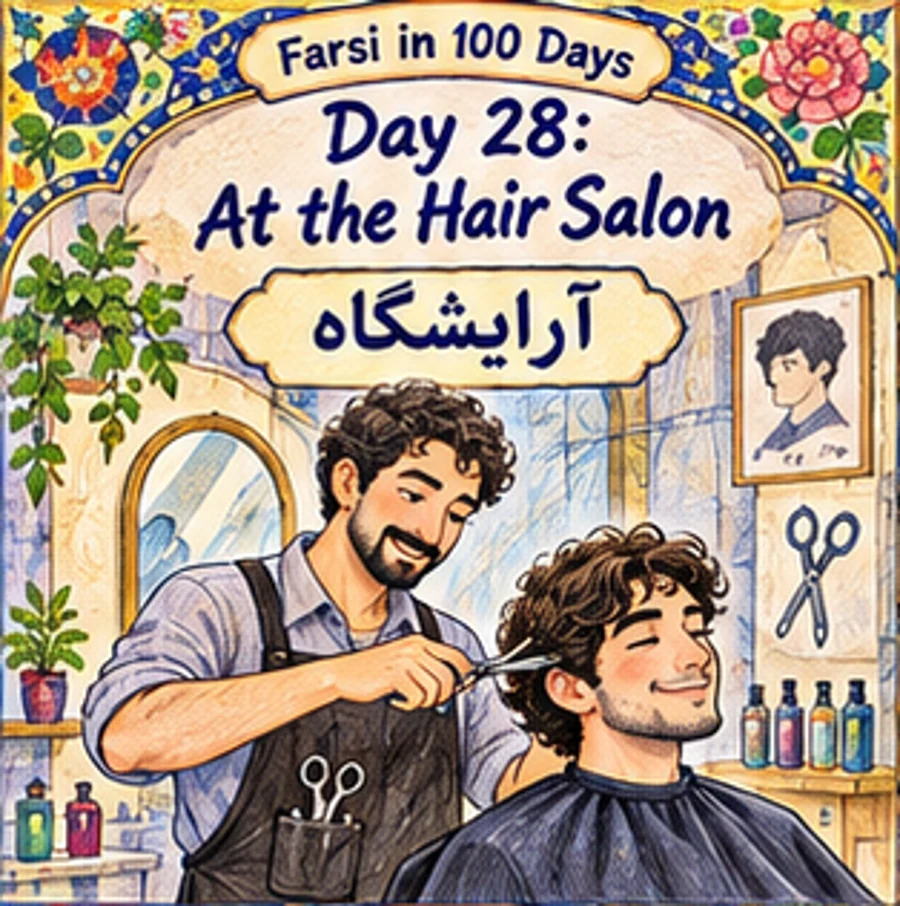
Day 28 of Learn Farsi in 100 Days, our free step-by-step Persian course: At the Hair Salon. The lesson has four parts, with every Persian word in Persian script, pronunciation and English, and each part ends with a quick check.
Part 1Grammar and conversation
Day 28, Part 1 teaches Persian question tags, نه؟ (na?) and مگر نه؟ (magar na?), as in تو فردا کلاس داری، نه؟ (you have class tomorrow, don’t you?), and a conversation at the barber’s with phrases like میخواهم موهایم را کوتاه کنم (I want to have a haircut).
Grammar: question tags
A question tag (برچسب سوال, barchasb-e so’âl) turns a statement into a question that asks for confirmation, like English “…, don’t you?” or “…, isn’t it?”. Persian does not change the tag to match the verb: it simply adds نه؟ (na?) or مگر نه؟ (magar na?) at the end of the sentence. The answer is بله (bale, yes) or نه (na, no), followed by the verb if you like: بله دارم (yes, I do).
Examples
You have class tomorrow, don’t you? Yes, I do.
We have an exam tomorrow, don’t we? No, we don’t.
Conversation: At the barber’s
| Speaker | Persian | English and pronunciation |
|---|---|---|
| Customer مشتری | سلام آقا، میخواهم موهایم را کوتاه کنم. | Hello sir, I want to have a haircut. salâm âghâ, mikhâham muhâyam râ kutâh konam. |
| Hair stylist آرایشگر | چطور میخواهید باشد؟ | How would you like it? chetor mikhâhid bâshad? |
| Customer مشتری | فقط یک کم کوتاهش کنید. | Just tidy it up a bit, please. faghat yek kam kutâhash konid. |
| Hair stylist آرایشگر | موهای شما خشک است، میخواهید کمی روغن به موهایتان بزنم؟ | Your hair is dry. Shall I put some oil on it? muhâ-ye shomâ khoshk ast, mikhâhid kami roghan be muhâyetân bezanam? |
| Customer مشتری | بله، ممنون. ممکن است ریش و سبیلم را هم مرتب کنید؟ | Yes, thanks. Would you please trim my mustache and beard, too? bale, mamnun. momken ast rish-o sebilam râ ham morattab konid? |
| Hair stylist آرایشگر | بله حتما. | Yes, sure. bale hatman. |
Quick check
- Which two question tags does Persian use?
Show answer
نه؟ (na?) and مگر نه؟ (magar na?) - How do you say “We have an exam tomorrow, don’t we?” in Persian?
Show answer
ما فردا امتحان داریم، نه؟ (mâ fardâ emtehân dârim, na?) - How do you tell a barber “I want to have a haircut”?
Show answer
میخواهم موهایم را کوتاه کنم. (mikhâham muhâyam râ kutâh konam.)
Part 2Speech vs. writing, grammar, conversation and word of the day
Day 28, Part 2 teaches the negative imperative, as in نرو (naro, don’t go) and نگیرید (nagirid, don’t take), spoken forms like موهاتون for موهایتان (your hair), a short talk about curly hair, موهای فر (muhâ-ye fer), and the word of the day تهدید (tahdid, threat).
Speech vs. writing
In speech است after a word is shortened to -e (خوب است becomes خوبه), the h of کوتاه drops (کوتاهش becomes کوتاش), and -etân becomes -etun (موهایتان becomes موهاتون). The spoken form is on the left of each pair, the written form on the right.
| Spoken | Written | English |
|---|---|---|
| خوبه khube | خوب است khub ast | it’s good |
| خشکه khoshke | خشک است khoshk ast | it’s dry |
| کوتاش kutâsh | کوتاهش kutâhash | (make) it short |
| موهاتون muhâtun | موهایتان muhâyetân | your hair |
Grammar: the negative imperative
The negative imperative (فعل نهی, fe’l-e nahy) tells someone not to do something. Put نـ (na-) before the present stem: رو (rav, go) becomes نرو (naro, don’t go). For the plural or polite form add –ید (-id): نروید (naravid). The prefix مـ (ma-), as in مرو (maro), is an old literary form you will meet in poetry.
| Persian | Pronunciation | English |
|---|---|---|
| نرو | naro | don’t go (singular) |
| نروید | naravid | don’t go (plural/polite) |
| نگیر | nagir | don’t take (singular) |
| نگیرید | nagirid | don’t take (plural/polite) |
Conversation: Getting a perm
| Speaker | Persian | English and pronunciation |
|---|---|---|
| Marjan مرجان | من تصمیم دارم موهایم را فر کنم. | I have decided to have my hair permed. man tasmim dâram muhâyam râ fer konam. |
| Setare ستاره | واقعا؟ من موهای فر را دوست دارم. | Really? I like curly hair. vâghe’an? man muhâ-ye fer râ dust dâram. |
| Marjan مرجان | باید یک آرایشگر خوب پیدا کنم. | I should find a good hairdresser. bâyad yek ârâyeshgar-e khub peydâ konam. |
Word of the day: تهدید (tahdid)
Meaning: threat, threatening
The thief threatened me with a gun.
Quick check
- How do you say “don’t go” to one friend?
Show answer
نرو (naro) - What is the written form of the spoken خشکه (khoshke)?
Show answer
خشک است (khoshk ast), “it’s dry” - What does تهدید کردن (tahdid kardan) mean?
Show answer
to threaten
Part 3At the hair salon, common phrases and idiom of the day
Day 28, Part 3 names hair salon services such as رنگ کردن (rang kardan, to color) and هایلایت (hâylâyt, highlights), gives salon phrases like چه مدت باید منتظر بمانم؟ (che moddat bâyad montazer bemânam?, how long will I have to wait?), and the idiom وقت، طلاست (time is gold).
At the hair salon
| Persian | Pronunciation | English |
|---|---|---|
| فر کردن | fer kardan | to curl |
| اپیلاسیون | epilâsiyon | epilation, hair removal |
| رنگ کردن | rang kardan | to color |
| ماسک صورت | mâsk-e surat | face mask |
| کوتاه کردن | kutâh kardan | to cut (short) |
| ماساژ | mâsâzh | massage |
| هایلایت | hâylâyt | highlights |
| ترمیم ناخن | tarmim-e nâkhon | nail repair |
Common phrases
| Persian | Pronunciation | English |
|---|---|---|
| لطفا پوستم را تمیز کنید. | lotfan pustam râ tamiz konid. | Please clean my skin (I’d like a facial). |
| لطفا موهای من را کوتاه کنید و سشوار بکشید. | lotfan muhâ-ye man râ kutâh konid va seshvâr bekeshid. | Please cut and blow-dry my hair. |
| شما اپیلاسیون میکنید؟ | shomâ epilâsiyon mikonid? | Do you do hair removal? |
| چه مدت باید منتظر بمانم؟ | che moddat bâyad montazer bemânam? | How long will I have to wait? |
Idiom of the day
وقت، طلاست!
vaght, talâst!
Word for word: Time is gold!
Meaning in Persian: زمان، با ارزش است.
Meaning: Time is valuable.
English equivalent: Time is money.
Quick check
- What does هایلایت (hâylâyt) mean?
Show answer
highlights - How do you ask “How long will I have to wait?” in Persian?
Show answer
چه مدت باید منتظر بمانم؟ (che moddat bâyad montazer bemânam?) - What is the Persian version of “Time is money”?
Show answer
وقت، طلاست! (vaght, talâst!), literally “time is gold”
Part 4Reading and new words
Day 28, Part 4 is a reading about Isfahan, its river زایندهرود (Zâyande Rud) and the great square نقش جهان (Naghsh-e Jahân), followed by new words such as آثار (âsâr, historic works), سالن زیبایی (sâlon-e zibâyi, beauty salon) and سشوار (seshvâr, hairdryer).
Reading: Isfahan
اصفهان یکی از شهرهای بزرگ ایران است. این شهر در مرکز ایران قرار دارد. از وسط شهر اصفهان یک رودخانه، به نام زایندهرود میگذرد.
Isfahan is one of the big cities of Iran. This city is located in the center of Iran. A river called the Zayandeh Rud flows through the middle of the city of Isfahan.
این شهر زیبا و تاریخی دارای آثار تاریخی زیادی است. بسیاری از این آثار در سازمان یونسکو ثبت شدهاست. شهر اصفهان دارای یک میدان بزرگ به نام «نقش جهان» است. این میدان یکی از بزرگترین میدانهای جهان است.
This beautiful, historic city has many historic monuments. Many of these monuments have been registered with UNESCO. The city of Isfahan has a large square called “Naqsh-e Jahan”. This square is one of the largest squares in the world.
New words
| Persian | Pronunciation | English |
|---|---|---|
| وسط | vasat | middle |
| آثار | âsâr | works, monuments; effects |
| میدان | meydân | square |
| طلا | talâ | gold |
| شامپو | shâmpu | shampoo |
| سالن زیبایی | sâlon-e zibâyi | beauty salon |
| آرایش | ârâyesh | makeup |
| رنگ | rang | color |
| سشوار | seshvâr | hairdryer |
| صابون | sâbun | soap |
| لاک زدن | lâk zadan | to put on nail polish |
| با ارزش | bâ arzesh | valuable |
| نقره | noghre | silver |
| اتو | otu | iron (for clothes) |
| رژ لب | rozh-e lab | lipstick |
| ریش | rish | beard |
| چون | chon | because |
| برای | barâye | for |
| ظاهر | zâher | appearance |
| مساوی | mosâvi | equal |
| عاشق | âshegh | lover; in love |
| تالار | tâlâr | hall |
| مشاهده کردن | moshâhede kardan | to observe |
| سبیل | sebil | mustache |
| آیینه | âyine | mirror |
| مصنوعی | masnu’i | artificial |
| لباس | lebâs | dress, clothes |
| کفش | kafsh | shoe |
| تنوع | tanavvo’ | variety |
| حتی | hattâ | even |
| چهره | chehre | face |
| مرتب کردن | morattab kardan | to tidy, to organize; to trim |
| مگر | magar | unless; (in questions) isn’t it? |
| لطفا | lotfan | please |
| مژه | mozhe | eyelash |
Quick check
- Which river flows through Isfahan?
Show answer
زایندهرود (Zâyande Rud) - What is the name of Isfahan’s great square?
Show answer
نقش جهان (Naghsh-e Jahân) - What does سشوار (seshvâr) mean?
Show answer
hairdryer
Take this lesson further

Study with the book
Learn Farsi in 100 Days: The Ultimate Crash Course to Learning Farsi Fast
This free lesson is part of Learn Farsi in 100 Days. The book puts the whole series in one printable PDF you can study offline.
Serious about Persian? Get all 30 of our Persian learning books for $199.99 (55% less than buying them one by one).
Free Persian Starter Pack: Alphabet + 100 Core Words
Get the 14-page printable Starter Pack (all 32 letters, a 7-day reading plan, 100 core words and 20 survival phrases) and a short 5-email course. Free.
Free. Every morning: that day’s four videos and the full lessons, with every Persian word, its pronunciation and its English meaning. Stop or pause with one click.