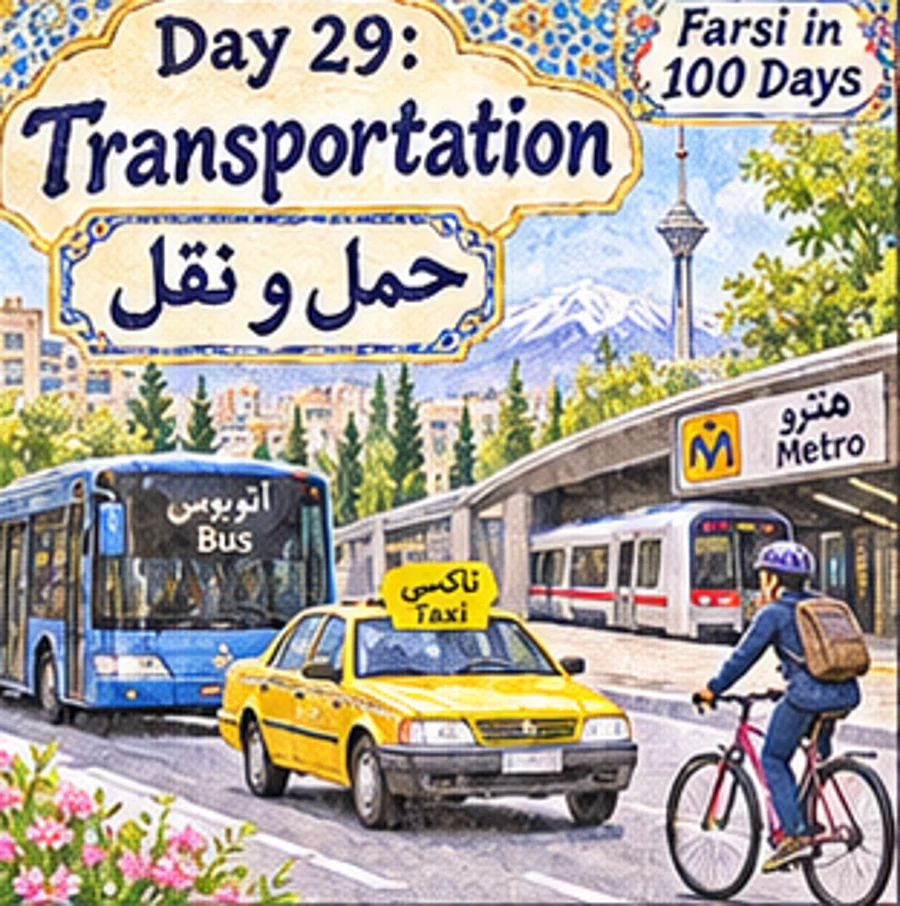
Day 29 of Learn Farsi in 100 Days, our free step-by-step Persian course: Transportation. The lesson has four parts, with every Persian word in Persian script, pronunciation and English, and each part ends with a quick check.
Part 1Grammar and conversation
Day 29, Part 1 introduces passive tenses, comparing او نامه مینویسد (u nâme minevisad, he writes a letter) with نامه نوشته میشود (nâme neveshte mishavad, the letter is written), and a conversation about getting to the فرودگاه (forudgâh, airport) by مترو (metro, subway).
Grammar: passive tenses
A verb is active (معلوم, ma’lum) when the doer is the subject, and passive (مجهول, majhul) when the doer is left out and the object becomes the subject. Persian makes the passive with the past participle of the main verb, such as نوشته (neveshte, written), plus the matching form of شدن (shodan, to become): میشود (mishavad) in the simple present, شود (shavad) in the present subjunctive.
| Persian | Pronunciation | English |
|---|---|---|
| او نامه مینویسد | u nâme minevisad | he/she writes a letter (simple present, active) |
| نامه نوشته میشود | nâme neveshte mishavad | the letter is written (simple present, passive) |
| او نامه بنویسد | u nâme benevisad | (that) he/she writes a letter (present subjunctive, active) |
| نامه نوشته شود | nâme neveshte shavad | (that) the letter be written (present subjunctive, passive) |
Conversation: Getting to the airport
| Speaker | Persian | English and pronunciation |
|---|---|---|
| A الف | من میخواهم به فرودگاه بروم. ممکن است به من بگویید چطور میتوانم آنجا بروم؟ | I want to go to the airport. Can you tell me how to get there? man mikhâham be forudgâh beravam. momken ast be man beguyid chetor mitavânam ânjâ beravam? |
| B ب | نه، متأسفم. نمیدانم. | No, sorry. I don’t know. na, mota’assefam. nemidânam. |
| A الف | من فکر میکنم با مترو میتوانم بروم. شما میدانید مترو کجاست؟ | I think I can take the subway to the airport. Do you know where the subway is? man fekr mikonam bâ metro mitavânam beravam. shomâ midânid metro kojâst? |
| B ب | بله، آنجا است. | Yes, it’s over there. bale, ânjâ ast. |
| A الف | ممنون. | Thanks. mamnun. |
Quick check
- Make او نامه مینویسد (he writes a letter) passive.
Show answer
نامه نوشته میشود (nâme neveshte mishavad), “the letter is written” - Which helping verb forms the Persian passive?
Show answer
شدن (shodan, to become), after the past participle - How do you say “I want to go to the airport”?
Show answer
من میخواهم به فرودگاه بروم. (man mikhâham be forudgâh beravam.)
Part 2Speech vs. writing, grammar, conversation and word of the day
Day 29, Part 2 continues the passive with the future نامه نوشته خواهد شد (nâme neveshte khâhad shod, the letter will be written) and the simple past نامه نوشته شد, a taxi conversation asking کرایه چند است؟ (kerâye chand ast?, how much is the fare?), and the word توافق (tavâfogh, agreement).
Speech vs. writing
Speech attaches the object pronoun to the verb (تو را ندیدم becomes ندیدمت), drops sounds in the plural (کلاسهایم becomes کلاسام), uses -in for -id (بگویید becomes بگین), and turns â before n into u (نمیدانم becomes نمیدونم). The spoken form is on the left of each pair, the written form on the right.
| Spoken | Written | English |
|---|---|---|
| ندیدمت nadidamet | تو را ندیدم to râ nadidam | I didn’t see you |
| بگین begin | بگویید beguyid | (please) say, tell |
| کلاسام kelâsâm | کلاسهایم kelâs-hâyam | my classes |
| نمیدونم nemidunam | نمیدانم nemidânam | I don’t know |
Grammar: passive in the future and simple past
The passive (مجهول, majhul) works the same way in every tense: keep the past participle نوشته (neveshte, written) and put شدن (shodan) in the tense you need. In the future (آینده, âyande) use خواهد شد (khâhad shod); in the simple past (گذشتهی ساده, gozashte-ye sâde) use شد (shod). Compare the active (معلوم, ma’lum) forms with the doer او (u, he/she).
| Persian | Pronunciation | English |
|---|---|---|
| او نامه خواهد نوشت | u nâme khâhad nevesht | he/she will write a letter (future, active) |
| نامه نوشته خواهد شد | nâme neveshte khâhad shod | the letter will be written (future, passive) |
| او نامه نوشت | u nâme nevesht | he/she wrote a letter (simple past, active) |
| نامه نوشته شد | nâme neveshte shod | the letter was written (simple past, passive) |
Conversation: Taking a taxi
| Speaker | Persian | English and pronunciation |
|---|---|---|
| Shima شیما | چقدر طول میکشد ما را به فرودگاه ببرید؟ | How long does it take to take us to the airport? cheghadr tul mikeshad mâ râ be forudgâh bebarid? |
| Taxi driver راننده تاکسی | فقط ده دقیقه. | It’s only ten minutes. faghat dah daghighe. |
| Shima شیما | کرایه چند است؟ | How much is the fare? kerâye chand ast? |
| Taxi driver راننده تاکسی | ده هزار تومان. | Ten thousand tomans. dah hezâr tomân. |
Word of the day: توافق (tavâfogh)
Meaning: agreement
The boss reached an agreement with me about the salary.
Quick check
- How do you say “the letter was written” in Persian?
Show answer
نامه نوشته شد (nâme neveshte shod) - What is the written form of the spoken ندیدمت (nadidamet)?
Show answer
تو را ندیدم (to râ nadidam), “I didn’t see you” - How do you ask a taxi driver “How much is the fare?”
Show answer
کرایه چند است؟ (kerâye chand ast?)
Part 3Transportation, common phrases and idiom of the day
Day 29, Part 3 names means of transportation such as قطار (ghatâr, train) and هواپیما (havâpeymâ, airplane), gives travel questions like نزدیکترین ایستگاه مترو کجاست؟ (where is the nearest subway station?), and explains the idiom وقتی آبها از آسیاب افتاد (when the dust has settled).
Transportation
| Persian | Pronunciation | English |
|---|---|---|
| تاکسی | tâksi | taxi |
| قطار | ghatâr | train |
| اتوبوس | otobus | bus |
| مترو | metro | subway |
| هواپیما | havâpeymâ | airplane |
| دوچرخه | docharkhe | bike |
Common phrases
| Persian | Pronunciation | English |
|---|---|---|
| نزدیکترین ایستگاه مترو کجاست؟ | nazdik-tarin istgâh-e metro kojâst? | Where is the nearest subway station? |
| کدام اتوبوس به مرکز شهر میرود؟ | kodâm otobus be markaz-e shahr miravad? | Which bus goes downtown? |
| میتوانم یک بلیط یک ماهه بخرم؟ | mitavânam yek belit-e yek mâhe bekharam? | Can I buy a monthly pass? |
| لطفا به من بگویید کجا پیاده شوم. | lotfan be man beguyid kojâ piyâde shavam. | Please tell me where to get off. |
Idiom of the day
وقتی آبها از آسیاب افتاد.
vaghti âb-hâ az âsiyâb oftâd.
Word for word: When the waters fell from the mill.
Meaning in Persian: زمانی که شرایط آرام شد.
Meaning: When the situation calmed down.
English equivalent: When the dust has settled.
Quick check
- What is the Persian word for “train”?
Show answer
قطار (ghatâr) - How do you ask “Where is the nearest subway station?”
Show answer
نزدیکترین ایستگاه مترو کجاست؟ (nazdik-tarin istgâh-e metro kojâst?) - What does the idiom وقتی آبها از آسیاب افتاد mean?
Show answer
When things have calmed down (“when the dust has settled”).
Part 4Reading and new words
Day 29, Part 4 is a reading about the Tehran metro, which carries more than three million مسافر (mosâfer, passengers) a day, followed by new words such as تردد کردن (taraddod kardan, to commute), ایستگاه (istgâh, station) and بینالمللی (beynolmelali, international).
Reading: The Tehran metro
تهران دارای پنج خط مترو است. چهار خط آن درون شهر و یک خط آن بیرون از شهر تردد میکنند. متروی تهران هر روز بیش از سه میلیون مسافر را جابهجا میکند.
Tehran has five metro lines. Four of them run inside the city and one runs outside the city. The Tehran metro carries more than three million passengers every day.
در گذشته مردم تهران از اتوبوس، مینیبوس، تاکسی، موتورسیکلت و خودروی شخصی برای حمل و نقل شهری استفاده میکردند.
In the past, the people of Tehran used buses, minibuses, taxis, motorcycles and private cars for city transportation.
New words
| Persian | Pronunciation | English |
|---|---|---|
| تردد کردن | taraddod kardan | to commute, to come and go |
| مینیبوس | minibus | minibus |
| موتورسیکلت | motorsiklet | motorcycle |
| خودرو | khodro | car |
| خط | khat | line |
| درون | darun | inside |
| آسیاب | âsiyâb | mill |
| ایستگاه | istgâh | station |
| نامه | nâme | letter |
| فرودگاه | forudgâh | airport |
| چپ | chap | left |
| جابهجا کردن | jâbejâ kardan | to move, to carry |
| استفاده کردن | estefâde kardan | to use |
| آرام شدن | ârâm shodan | to calm down |
| بازدید کردن | bâzdid kardan | to visit |
| همیشه | hamishe | always |
| فراهم کردن | farâham kardan | to provide, to prepare |
| رقابت | reghâbat | competition |
| انتظار | entezâr | expectation; waiting |
| با ادب | bâ adab | polite |
| طولانی | tulâni | long |
| اندازه | andâze | size |
| شخصی | shakhsi | personal, private |
| متر | metr | meter |
| هزاران | hezârân | thousands |
| مناسب | monâseb | appropriate, suitable |
| جلو | jelo | front |
| ارائه کردن | erâ’e kardan | to present |
| بینالمللی | beynolmelali | international |
| راست | râst | right |
| انتها | entehâ | end |
| گوناگون | gunâgun | various |
| لازم داشتن | lâzem dâshtan | to need |
Quick check
- How many metro lines does Tehran have, according to the reading?
Show answer
Five: پنج خط مترو (panj khat-e metro) - How many passengers does the Tehran metro carry each day?
Show answer
More than three million: بیش از سه میلیون مسافر (bish az se milyun mosâfer) - What does ایستگاه (istgâh) mean?
Show answer
station
Take this lesson further

Study with the book
Learn Farsi in 100 Days: The Ultimate Crash Course to Learning Farsi Fast
This free lesson is part of Learn Farsi in 100 Days. The book puts the whole series in one printable PDF you can study offline.
Serious about Persian? Get all 30 of our Persian learning books for $199.99 (55% less than buying them one by one).
Free Persian Starter Pack: Alphabet + 100 Core Words
Get the 14-page printable Starter Pack (all 32 letters, a 7-day reading plan, 100 core words and 20 survival phrases) and a short 5-email course. Free.
Free. Every morning: that day’s four videos and the full lessons, with every Persian word, its pronunciation and its English meaning. Stop or pause with one click.