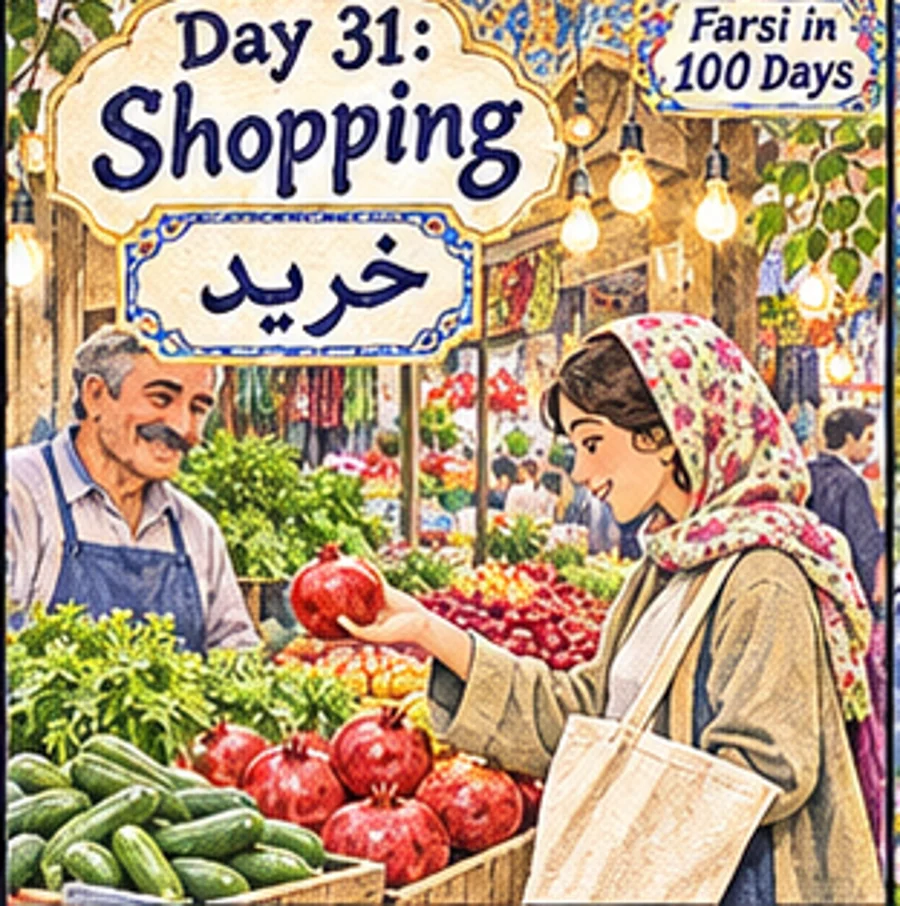
Day 31 of Learn Farsi in 100 Days, our free step-by-step Persian course: Shopping. The lesson has four parts, with every Persian word in Persian script, pronunciation and English, and each part ends with a quick check.
Part 1Grammar and conversation
Day 31, Part 1 teaches the two kinds of Persian ordinal numbers, دوم (dovvom, second) and دومین (dovvomin, second), and a shopping conversation in which Shayan plans to buy مواد غذایی (mavâd-e ghazâyi, groceries) and pay with a کارت اعتباری (kârt-e e’tebâri, credit card).
Grammar: ordinal numbers with -om and -omin
Persian makes ordinal numbers (اعداد ترتیبی, a’dâd-e tartibi) by adding ـم (-om) to the cardinal number: ده (dah, ten) becomes دهم (dahom, tenth). An ordinal with -om comes after the noun, like an adjective with ezâfe: کلاس دوم (kelâs-e dovvom, the second class). Adding ـمین (-omin) gives a second form that comes before the noun with no ezâfe: دومین سالگرد (dovvomin sâlgard, the second anniversary). Note that two and three become دوم (dovvom) and سوم (sevvom); for ‘first’ the -om form is usually اول (avval), while the -omin form is یکمین (yekomin) or نخستین (nakhostin).
| Persian | Pronunciation | English |
|---|---|---|
| دوم | dovvom | second |
| سوم | sevvom | third |
| چهارم | chahârom | fourth |
| دهم | dahom | tenth |
| یازدهم | yâzdahom | eleventh |
| دوازدهم | davâzdahom | twelfth |
| صدم | sadom | hundredth |
| یکمین | yekomin | first |
| دومین | dovvomin | second |
| سومین | sevvomin | third |
| یازدهمین | yâzdahomin | eleventh |
| صدمین | sadomin | hundredth |
Examples
the second class (second grade)
the fourth person
the second anniversary
the tenth person
Conversation: going grocery shopping
| Speaker | Persian | English and pronunciation |
|---|---|---|
| Baharak بهارک | برنامهی امروز تو چیست؟ | What is your plan for today? barnâme-ye emruz-e to chist? |
| Shayan شایان | تصمیم دارم به فروشگاه بروم و مقداری مواد غذایی بخرم. | I’ve decided to go to the store and buy some groceries. tasmim dâram be forushgâh beravam va meghdâri mavâd-e ghazâyi bekharam. |
| Baharak بهارک | ممکن است برای من دو بسته ماکارانی بخری؟ | Could you buy two packs of pasta for me? momken ast barâ-ye man do baste mâkârâni bekhari? |
| Shayan شایان | حتما، چیز دیگری لازم نداری؟ | Sure. Don’t you need anything else? hatman, chiz-e digari lâzem nadâri? |
| Baharak بهارک | نه، پول کافی همراه خود داری؟ | No. Do you have enough money with you? na, pul-e kâfi hamrâh-e khod dâri? |
| Shayan شایان | فکر میکنم دارم، حدود ۷۰ هزار تومان دارم. | I think so. I have about 70,000 tomans. fekr mikonam dâram, hodud-e haftâd hezâr tomân dâram. |
| Baharak بهارک | به نظر من کم است. | I think that’s not enough. be nazar-e man kam ast. |
| Shayan شایان | فکر نمیکنم، من یک کارت اعتباری هم دارم. | I don’t think so. I also have a credit card. fekr nemikonam, man yek kârt-e e’tebâri ham dâram. |
| Baharak بهارک | اجازه بدهید من ده هزار تومان برای ماکارانی به شما بدهم. | Let me give you ten thousand tomans for the pasta. ejâze bedahid man dah hezâr tomân barâ-ye mâkârâni be shomâ bedaham. |
| Shayan شایان | ممنون. | Thanks. mamnun. |
Quick check
- How do you say “the fourth person” using the -om ordinal?
Show answer
نفر چهارم (nafar-e chahârom) - Does an ordinal ending in -omin, like دومین (dovvomin), come before or after the noun?
Show answer
Before the noun, with no ezâfe: دومین سالگرد (dovvomin sâlgard), “the second anniversary” - What does Shayan say he has besides cash?
Show answer
یک کارت اعتباری (yek kârt-e e’tebâri), “a credit card”
Part 2Speech vs. writing, grammar, common phrases and word of the day
Day 31, Part 2 shows spoken shortcuts such as بدم (bedam) for بدهم (bedaham, I give), teaches ordinals used as nouns like اولی (avvali, the first one), gives two phrases for finding shops, and the word of the day, مغازه (maghâze, shop).
Speech vs. writing
In speech, هم (ham, also) shrinks to -am and attaches to the word before it, and the h in verbs like بدهم (bedaham) drops out. The spoken form is on the left of each pair, the written form on the right.
| Spoken | Written | English |
|---|---|---|
| کارت اعتباریم دارم kârt-e e’tebâri-am dâram | کارت اعتباری هم دارم kârt-e e’tebâri ham dâram | I also have a credit card |
| بدم bedam | بدهم bedaham | (that) I give |
Grammar: ordinal numbers with -i
Adding ـی (-i) to an ordinal number turns it into a noun meaning ‘the first one’, ‘the second one’ and so on: اولی (avvali), دومی (dovvomi), سومی (sevvomi). These forms stand alone in place of a person or thing and are common in everyday speech, especially when listing people or items one after another.
| Persian | Pronunciation | English |
|---|---|---|
| اولی | avvali | the first one |
| دومی | dovvomi | the second one |
| سومی | sevvomi | the third one |
| دهمی | dahomi | the tenth one |
| صدمی | sadomi | the hundredth one |
Examples
The first one spoke, the second one laughed, the third one asked.
Common phrases
| Persian | Pronunciation | English |
|---|---|---|
| منطقهی خرید کجاست؟ | mantaghe-ye kharid kojâst? | Where is the shopping area? |
| نزدیکترین مغازهی کفشفروشی کجاست؟ | nazdik-tarin maghâze-ye kafsh-forushi kojâst? | Where is the nearest shoe store? |
Word of the day: مغازه (maghâze)
Meaning: shop, store
We went to the clothing store today.
Quick check
- What is the written form of the spoken بدم (bedam)?
Show answer
بدهم (bedaham), “(that) I give” - How do you say “the second one” in Persian?
Show answer
دومی (dovvomi) - How do you ask “Where is the nearest shoe store?”
Show answer
نزدیکترین مغازهی کفشفروشی کجاست؟ (nazdik-tarin maghâze-ye kafsh-forushi kojâst?)
Part 3Shopping, conversation and idiom of the day
Day 31, Part 3 gives the names of shops such as سوپرمارکت (supermârket, supermarket) and کتاب فروشی (ketâb forushi, bookstore), a conversation between two friends planning a shopping trip to a store with تخفیف (takhfif, discounts), and the idiom یکی به دو کردن (yeki be do kardan, to argue back).
Shopping
| Persian | Pronunciation | English |
|---|---|---|
| سوپرمارکت | supermârket | supermarket |
| مغازه | maghâze | store |
| مرکز خرید | markaz-e kharid | mall |
| جواهر فروشی | javâher forushi | jewelry store |
| فروشگاه پوشاک | forushgâh-e pushâk | clothing store |
| مغازهی عتیقه فروشی | maghâze-ye atighe forushi | antique store |
| کتاب فروشی | ketâb forushi | bookstore |
| حراج | harâj | clearance sale |
Conversation: planning a shopping trip
| Speaker | Persian | English and pronunciation |
|---|---|---|
| Nazila نازیلا | دوست داری عصر برویم خرید؟ | Would you like to go shopping this afternoon? dust dâri asr beravim kharid? |
| Anita آنیتا | آره خیلی دوست دارم. شنیدهام مغازهی آسمان اجناسش را تخفیف زدهاست. | Yes, I’d love to. I’ve heard the Aseman store has put its goods on sale. âre kheyli dust dâram. shenide-am maghâze-ye âsemân ajnâsash râ takhfif zade ast. |
| Nazila نازیلا | واقعا، چه خوب. من یک پیراهن برای مهمانی آخر هفته لازم دارم. | Really? How nice. I need a dress for the party this weekend. vâghe’an, che khub. man yek pirâhan barâ-ye mehmâni-ye âkhar-e hafte lâzem dâram. |
| Anita آنیتا | من کیف، کفش و دامن لازم دارم. | I need a bag, shoes and a skirt. man kif, kafsh va dâman lâzem dâram. |
| Nazila نازیلا | به مغازهی جواهر فروشی هم برویم. | Let’s go to the jewelry store too. be maghâze-ye javâher forushi ham beravim. |
| Anita آنیتا | حتما، چه چیزی لازم داری؟ | Sure. What do you need? hatman, che chizi lâzem dâri? |
| Nazila نازیلا | میخواهم یک انگشتر برای دوستم بخرم. | I want to buy a ring for my friend. mikhâham yek angoshtar barâ-ye dustam bekharam. |
| Anita آنیتا | میتوانیم به جواهر فروشی در مرکز شهر برویم چون قیمتهای اجناس آنجا مناسبتر است. | We can go to the jewelry store downtown, because the prices there are more reasonable. mitavânim be javâher forushi dar markaz-e shahr beravim chon gheymat-hâ-ye ajnâs ânjâ monâseb-tar ast. |
Idiom of the day
یکی به دو کردن
yeki be do kardan
Word for word: to make one into two
Meaning in Persian: بحث کردن، دعوا کردن، مجادله کردن.
Meaning: to argue, to quarrel, to bicker
English equivalent: Argue the toss.
Quick check
- What is a حراج (harâj)?
Show answer
a clearance sale - What does Nazila want to buy for her friend?
Show answer
یک انگشتر (yek angoshtar), “a ring” - What does the idiom یکی به دو کردن (yeki be do kardan) mean?
Show answer
to argue or quarrel (“argue the toss”)
Part 4Reading and new words
Day 31, Part 4 is a short reading about the old Tehran bazaar, where people from all over come to buy اجناس گوناگون (ajnâs-e gunâgun, all kinds of goods), followed by a vocabulary list with words like شلوغ (sholugh, busy) and تخفیف (takhfif, discount).
Reading: The Tehran bazaar
بازار تهران یک بازار قدیمی است. این بازار در مرکز شهر تهران قرار دارد. مردم از نقاط مختلف تهران و یا شهرهای دیگر به این بازار مراجعه میکنند.
The Tehran bazaar is an old bazaar. It is located in the center of Tehran. People from different parts of Tehran, or from other cities, come to this bazaar.
بعضی روزها که بازار شلوغ است رفت و آمد به سختی انجام میشود. این بازار بزرگ قسمتهای متنوعی دارد. در این بازار اجناس گوناگون مانند لباس، کفش، وسایل خانه، مبلمان و … عرضه میشود.
On some days, when the bazaar is crowded, it is hard to get around. This large bazaar has many different sections. All kinds of goods are sold here, such as clothes, shoes, household items, furniture and more.
New words
| Persian | Pronunciation | English |
|---|---|---|
| تصمیم گرفتن | tasmim gereftan | to decide |
| مقداری | meghdâri | some, a quantity of |
| مواد | mavâd | materials |
| بسته | baste | package, pack |
| حتما | hatman | sure, certainly |
| لازم داشتن | lâzem dâshtan | to need |
| منطقه | mantaghe | area |
| نقاط | noghât | points, places |
| همراه | hamrâh | along, with |
| کافی | kâfi | enough |
| بحث کردن | bahs kardan | to discuss, to argue |
| متنوع | motenavve’ | diverse, varied |
| حدود | hodud | about, approximately |
| فکر کردن | fekr kardan | to think |
| اجازه دادن | ejâze dâdan | to permit, to let |
| دعوا کردن | da’vâ kardan | to fight, to quarrel |
| بهسختی | be-sakhti | with difficulty, hardly |
| گوناگون | gunâgun | various |
| مجادله کردن | mojâdele kardan | to debate, to argue |
| مختلف | mokhtalef | different |
| مبلمان | moblemân | furniture |
| عرضه کردن | arze kardan | to offer (for sale) |
| وسایل | vasâyel | things, equipment |
| شلوغ | sholugh | busy, crowded |
| واقعا | vâghe’an | really |
| اجناس | ajnâs | goods, products |
| مراجعه کردن | morâje’e kardan | to go to, to visit (a place) |
| بازار | bâzâr | market, bazaar |
| خلوت | khalvat | quiet, uncrowded; privacy |
| جواهر | javâher | jewels, jewelry |
| قیمت | gheymat | price |
| تخفیف | takhfif | discount |
| انگشتر | angoshtar | ring |
| مناسب | monâseb | appropriate, reasonable |
| دامن | dâman | skirt |
| پیراهن | pirâhan | shirt, dress |
| گردنبند | gardanband | necklace |
Quick check
- Where is the Tehran bazaar located?
Show answer
در مرکز شهر تهران (dar markaz-e shahr-e tehrân), in the center of Tehran - What is the opposite of شلوغ (sholugh, crowded)?
Show answer
خلوت (khalvat), quiet or uncrowded - What does گردنبند (gardanband) mean?
Show answer
necklace
Take this lesson further

Study with the book
Learn Farsi in 100 Days: The Ultimate Crash Course to Learning Farsi Fast
This free lesson is part of Learn Farsi in 100 Days. The book puts the whole series in one printable PDF you can study offline.
Serious about Persian? Get all 30 of our Persian learning books for $199.99 (55% less than buying them one by one).
Free Persian Starter Pack: Alphabet + 100 Core Words
Get the 14-page printable Starter Pack (all 32 letters, a 7-day reading plan, 100 core words and 20 survival phrases) and a short 5-email course. Free.
Free. Every morning: that day’s four videos and the full lessons, with every Persian word, its pronunciation and its English meaning. Stop or pause with one click.