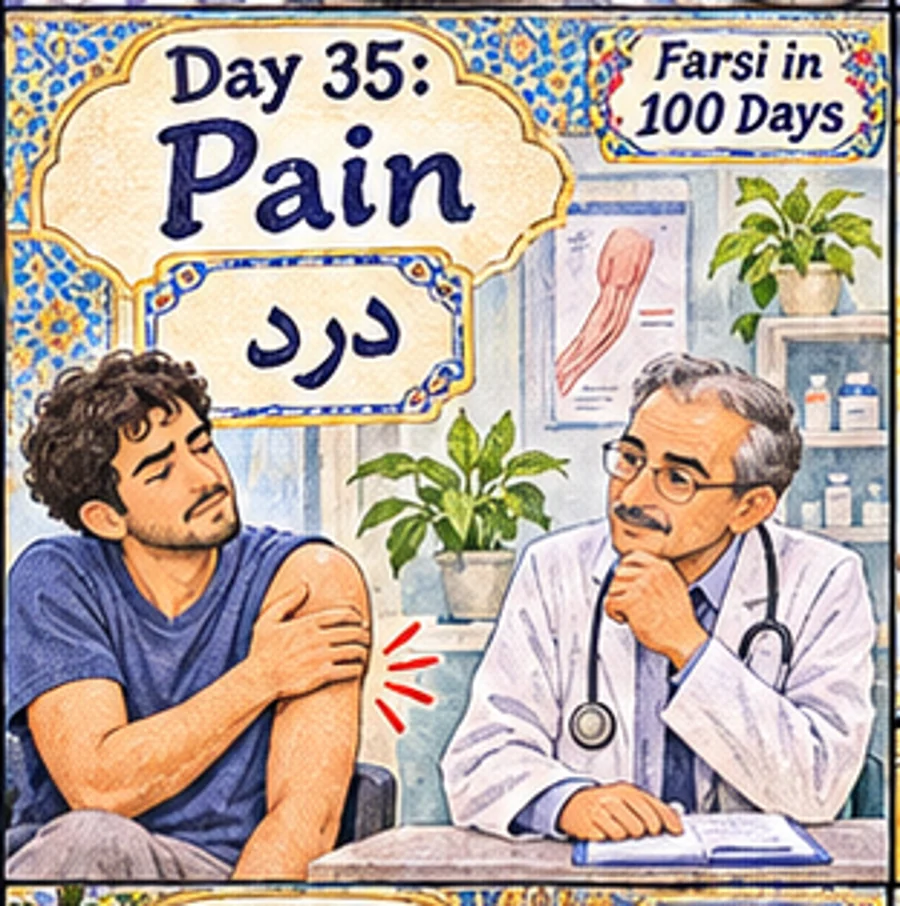
Day 35 of Learn Farsi in 100 Days, our free step-by-step Persian course: Pain. The lesson has four parts, with every Persian word in Persian script, pronunciation and English, and each part ends with a quick check.
Part 1Grammar and conversation
Day 35, Part 1 shows how چه (che) joins personal endings to ask what is wrong with someone, as in spoken شما چهتونه؟ (shomâ chetune?, what’s wrong with you?), and a doctor’s visit in which Homa has دل درد (del dard, stomachache) and an infected throat.
Grammar: چه + personal pronoun endings
Adding a possessive pronoun ending (ضمیر شخصی, zamir-e shakhsi) to چه (che, what) gives a short question meaning ‘what’s wrong with …?’: چهت (chet) is ‘what’s wrong with you?’. In everyday speech the verb ending ـه (-e, ‘is’) is added, so the questions sound like چه ته؟ (chete?) and شما چه تونه؟ (shomâ chetune?). This is a common way to ask someone whether they are ill or upset.
| Persian | Pronunciation | English |
|---|---|---|
| چه + م = چهم | che + -am = cham | what’s wrong with me |
| چه + ت = چهت | che + -at = chet | what’s wrong with you |
| چه + ش = چهش | che + -ash = chesh | what’s wrong with him/her |
| چه + مان = چهمان | che + -mân = chemân | what’s wrong with us |
| چه + تان = چهتان | che + -tân = chetân | what’s wrong with you (plural/polite) |
| چه + شان = چهشان | che + -shân = cheshân | what’s wrong with them |
Examples
What’s wrong with me? (spoken)
What’s wrong with you? (spoken)
What’s wrong with him/her? (spoken)
What’s wrong with us? (spoken)
What’s wrong with you? (plural/polite, spoken)
What’s wrong with them? (spoken)
What’s wrong with you? Why are you making so much noise?
Conversation: at the doctor’s
| Speaker | Persian | English and pronunciation |
|---|---|---|
| Doctor دکتر | مشکلتان چیست؟ | What’s the problem? moshkeletân chist? |
| Homa هما | دل درد و سردرد دارم. | I have a stomachache and a headache. del dard va sardard dâram. |
| Doctor دکتر | از کی؟ | Since when? az key? |
| Homa هما | از دیشب. | Since last night. az dishab. |
| Doctor دکتر | به نظرت سرما نخوردی؟ | Do you think you might have caught a cold? be nazarat sarmâ nakhordi? |
| Homa هما | نمیدانم، فکر نمیکنم. | I don’t know. I don’t think so. nemidânam, fekr nemikonam. |
| Doctor دکتر | خوب بگذارید گلویتان را ببینم. دهانتان را باز کنید. اوه! چرک کرده است. | Well, let me look at your throat. Open your mouth. Oh! It’s infected. khob bogzârid galuyetân râ bebinam. dahânetân râ bâz konid. ouh! cherk karde ast. |
| Homa هما | واقعا؟ | Really? vâghe’an? |
| Doctor دکتر | بله! من برایتان دارو و یک آمپول تجویز میکنم. | Yes! I’ll prescribe you some medicine and an injection. bale! man barâyetân dâru va yek âmpul tajviz mikonam. |
| Homa هما | ممنون. | Thank you. mamnun. |
| Doctor دکتر | باید خوب استراحت کنید و داروها را به موقع مصرف کنید. | You need to rest well and take your medicine on time. bâyad khub esterâhat konid va dâru-hâ râ be mowghe’ masraf konid. |
| Homa هما | حتما آقای دکتر. | Of course, doctor. hatman âghâ-ye doktor. |
Quick check
- How do you ask a friend “What’s wrong with you?” in spoken Persian?
Show answer
چه ته؟ (chete?), or to several people / politely: شما چه تونه؟ (shomâ chetune?) - What symptoms does Homa have?
Show answer
دل درد و سردرد (del dard va sardard), a stomachache and a headache - What does the doctor prescribe?
Show answer
دارو و یک آمپول (dâru va yek âmpul), medicine and an injection
Part 2Grammar, common phrases, joke and word of the day
Day 35, Part 2 compares the present perfect رفتهام (rafte-am, I have gone) with the past perfect رفته بودم (rafte budam, I had gone), gives phrases for talking to a doctor such as چقدر طول میکشد تا خوب شوم؟ (how long until I recover?), a Mulla joke, and the word بیمارستان (bimârestân, hospital).
Grammar: present perfect vs. past perfect
The present perfect (گذشتهی نقلی, gozashte-ye naghli) is the past participle plus the short endings ـام، ـای، است… : رفتهام (rafte-am, I have gone). It describes a past action whose result still matters now. The past perfect (گذشتهی بعید, gozashte-ye ba’id) is the past participle plus the past of بودن (budan, to be): رفته بودم (rafte budam, I had gone). It describes an action completed before another past moment.
| Persian | Pronunciation | English |
|---|---|---|
| رفتهام | rafte-am | I have gone |
| رفتهای | rafte-i | you have gone |
| رفته است | rafte ast | he/she has gone |
| رفتهایم | rafte-im | we have gone |
| رفتهاید | rafte-id | you (plural/polite) have gone |
| رفتهاند | rafte-and | they have gone |
| رفته بودم | rafte budam | I had gone |
| رفته بودی | rafte budi | you had gone |
| رفته بود | rafte bud | he/she had gone |
| رفته بودیم | rafte budim | we had gone |
| رفته بودید | rafte budid | you (plural/polite) had gone |
| رفته بودند | rafte budand | they had gone |
Common phrases
| Persian | Pronunciation | English |
|---|---|---|
| ممکن است چیزی برای قطع شدن درد به من بدهید؟ | momken ast chizi barâ-ye ghat’ shodan-e dard be man bedahid? | Can you give me something to stop the pain? |
| چقدر طول میکشد تا خوب شوم؟ | cheghadr tul mikeshad tâ khub shavam? | How long will it take me to recover? |
| من از این دارو استفاده میکنم. | man az in dâru estefâde mikonam. | I am taking this medicine. |
Joke
روزی شخصی به خانهی ملا آمد و مهمان او شد. ملا برای او غذا آورد و آن مرد بعد از خوردن غذا گفت: در شهر ما رسم است که پس از خوردن غذا مقداری هم میوه میخورند. ملا سرش را تکان داد و گفت: برعکس در شهر ما این کار بسیار بد و زشت است.
One day a man came to Mulla’s house as his guest. Mulla brought him some food, and after eating, the man said: “In our town it is the custom to eat some fruit after a meal.” Mulla shook his head and said: “Quite the opposite: in our town that is considered very bad manners.”
Word of the day: بیمارستان (bimârestân)
Meaning: hospital
My spouse is a nurse and works at the hospital.
Quick check
- How do you say “they had gone” in Persian?
Show answer
رفته بودند (rafte budand) - What is the difference between رفتهام (rafte-am) and رفته بودم (rafte budam)?
Show answer
رفتهام is the present perfect, “I have gone”; رفته بودم is the past perfect, “I had gone” - How do you ask “How long will it take me to recover?”
Show answer
چقدر طول میکشد تا خوب شوم؟ (cheghadr tul mikeshad tâ khub shavam?)
Part 3Pains, conversation and idiom of the day
Day 35, Part 3 names ten aches and injuries such as سردرد (sardard, headache) and سرفه (sorfe, cough), a conversation in which Arta has a bad stomachache and Sadaf wonders if he is مسموم (masmum, poisoned), and the idiom الان ذکر خیرت بود (speak of the devil).
Pains
| Persian | Pronunciation | English |
|---|---|---|
| گلو درد | galu dard | sore throat |
| شکم درد | shekam dard | stomachache, bellyache |
| سردرد | sardard | headache |
| شکستگی | shekastegi | fracture |
| سوختگی | sukhtegi | burn |
| سرماخوردگی | sarmâkhordegi | cold (illness) |
| سرفه | sorfe | cough |
| بریدگی | boridegi | cut |
| نیش حشره | nish-e hashare | insect bite, insect sting |
| ورم | varam | swelling |
Conversation: a bad stomachache
| Speaker | Persian | English and pronunciation |
|---|---|---|
| Arta آرتا | سلام صدف خوبی؟ | Hi Sadaf, how are you? salâm sadaf, khubi? |
| Sadaf صدف | خوب هستم ممنون کجا میروی؟ | I’m fine, thanks. Where are you going? khub hastam mamnun, kojâ miravi? |
| Arta آرتا | میخواهم بروم دکتر. از دیروز دل درد شدیدی دارم. | I want to go to the doctor. I’ve had a bad stomachache since yesterday. mikhâham beravam doktor. az diruz del dard-e shadidi dâram. |
| Sadaf صدف | چرا؟ شاید مسموم شده باشی. | Why? Maybe you’ve got food poisoning. cherâ? shâyad masmum shode bâshi. |
| Arta آرتا | فکر نمیکنم چون چیز خاصی نخوردهام. | I don’t think so, because I haven’t eaten anything unusual. fekr nemikonam chon chiz-e khâssi nakhorde-am. |
| Sadaf صدف | میخواهی تا درمانگاه همراه تو بیایم؟ | Do you want me to come with you to the clinic? mikhâhi tâ darmângâh hamrâh-e to biyâyam? |
| Arta آرتا | نه! ممنون با تاکسی میروم. | No, thanks! I’ll take a taxi. na! mamnun, bâ tâksi miravam. |
Idiom of the day
الان ذکر خیرت بود.
al’ân zekr-e kheyret bud.
Word for word: Just now there was good mention of you.
Meaning in Persian: هماکنون در مورد تو صحبت میشد.
Meaning: We were just talking about you.
English equivalent: Talk of the devil and the devil appears.
Quick check
- What is the Persian word for “cough”?
Show answer
سرفه (sorfe) - Where does Arta want to go, and how will he get there?
Show answer
To the doctor (دکتر, doktor), by taxi: با تاکسی میروم (bâ tâksi miravam) - When would you say الان ذکر خیرت بود (al’ân zekr-e kheyret bud)?
Show answer
When someone arrives just as you were talking about them, like “speak of the devil”
Part 4Reading and new words
Day 35, Part 4 is a reading about Falak-ol-Aflak castle, a قلعه (ghal’e, castle) on a تپه (tappe, hill) in the center of Khorramabad, followed by a vocabulary list with medical words such as زخم (zakhm, wound), خونریزی (khunrizi, bleeding) and پانسمان (pânsemân, bandage).
Reading: Falak-ol-Aflak castle
قلعهی فلکالافلاک یکی از معروفترین مکانهای تاریخی و گردشگری در ایران است. این قلعه در بالای تپه و در مرکز شهر خرمآباد قرار دارد. از تاریخ ساخت قلعهی فلکالافلاک اطلاعات دقیقی وجود ندارد.
Falak-ol-Aflak castle is one of the most famous historical and tourist sites in Iran. The castle stands on top of a hill in the center of the city of Khorramabad. There is no exact information about when Falak-ol-Aflak castle was built.
این قلعه بر فراز صخرههای سنگی قرار دارد و در کنار یک دره واقع شده است. نام این دره، درهی خرمآباد است. در تپه چشمهای وجود دارد. اسم این چشمه، چشمهی گلستان است.
The castle sits on top of rocky cliffs and is located beside a valley. The valley is called the Khorramabad valley. There is a spring on the hill. The spring is called the Golestan spring.
New words
| Persian | Pronunciation | English |
|---|---|---|
| سر و صدا | sar o sedâ | noise |
| قطع شدن | ghat’ shodan | to stop, to be cut off |
| اطلاعات | ettelâ’ât | information |
| واقع شدن | vâghe’ shodan | to be located |
| مرکز | markaz | center |
| دره | darre | valley |
| وجود داشتن | vojud dâshtan | to exist, there to be |
| فراز | farâz | top, above |
| مکان | makân | place |
| مسموم | masmum | poisoned |
| دیشب | dishab | last night |
| استراحت کردن | esterâhat kardan | to rest |
| قلعه | ghal’e | castle, fortress |
| همسر | hamsar | spouse |
| شدید | shadid | severe |
| مصرف کردن | masraf kardan | to consume, to take (medicine) |
| به موقع | be mowghe’ | on time |
| استفاده کردن | estefâde kardan | to use |
| درمانگاه | darmângâh | clinic |
| ذکر | zekr | mention |
| مشکل | moshkel | problem |
| تپه | tappe | hill |
| معروفترین | ma’ruf-tarin | most famous |
| دقیق | daghigh | exact |
| حال | hâl | now, the present; condition |
| متوقف کردن | motevaghghef kardan | to stop |
| جاری شدن | jâri shodan | to flow |
| خفیف | khafif | slight, mild |
| در مورد | dar mored-e | about |
| خیر | kheyr | good |
| دارو | dâru | medicine |
| آمپول | âmpul | injection, shot |
| زخم | zakhm | wound |
| خونریزی | khunrizi | bleeding |
| پانسمان | pânsemân | bandage, dressing |
Quick check
- In which city is Falak-ol-Aflak castle?
Show answer
خرمآباد (khorram-âbâd), Khorramabad - What is the name of the spring on the hill?
Show answer
چشمهی گلستان (cheshme-ye golestân), the Golestan spring - What does خونریزی (khunrizi) mean?
Show answer
bleeding
Take this lesson further

Study with the book
Learn Farsi in 100 Days: The Ultimate Crash Course to Learning Farsi Fast
This free lesson is part of Learn Farsi in 100 Days. The book puts the whole series in one printable PDF you can study offline.
Serious about Persian? Get all 30 of our Persian learning books for $199.99 (55% less than buying them one by one).
Free Persian Starter Pack: Alphabet + 100 Core Words
Get the 14-page printable Starter Pack (all 32 letters, a 7-day reading plan, 100 core words and 20 survival phrases) and a short 5-email course. Free.
Free. Every morning: that day’s four videos and the full lessons, with every Persian word, its pronunciation and its English meaning. Stop or pause with one click.