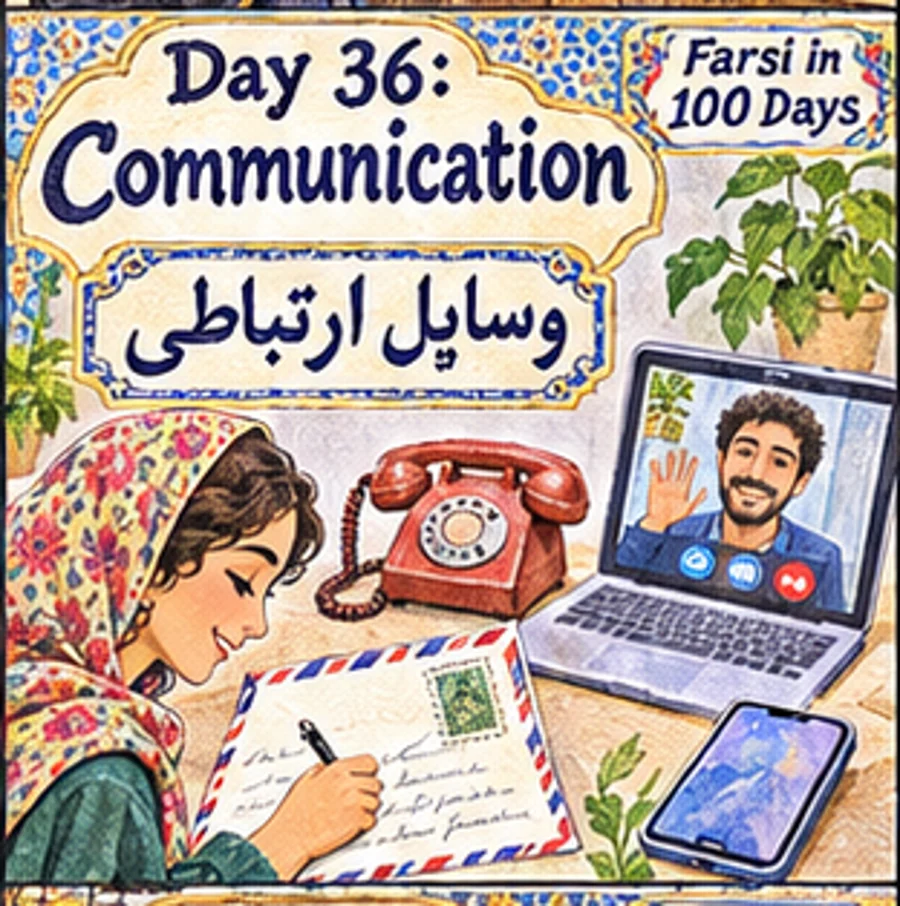
Day 36 of Learn Farsi in 100 Days, our free step-by-step Persian course: Means of Communication. The lesson has four parts, with every Persian word in Persian script, pronunciation and English, and each part ends with a quick check.
Part 1Grammar and conversation
Day 36, Part 1 introduces four common Persian suffixes, such as ـستان (-estân, “place of”) in دبیرستان (dabirestân, high school) and ـگاه (-gâh) in دانشگاه (dâneshgâh, university), then follows Pegah and Shahab talking about the post office (ادارهی پست, edâre-ye post) and buying a laptop.
Grammar: suffixes (پسوندها)
Persian builds many new words by adding a suffix (پسوند, pasvand) to a noun, adjective or verb stem. ـان (-ân) makes adjectives and adverbs from verb stems or nouns (گریان, geryân, crying); ـچه (-che) makes small things (قالیچه, ghâliche, a small rug); ـستان (-estân/-stân) and ـگاه (-gâh) mean “place of” or “time of” (کوهستان, kuhestân, mountainous area; سحرگاه, sahargâh, dawn).
| Persian | Pronunciation | English |
|---|---|---|
| گریان | geryân | crying, in tears (-ân) |
| نگران | negarân | worried (-ân) |
| بهاران | bahârân | springtime (-ân) |
| قالیچه | ghâliche | small rug (-che) |
| دریاچه | daryâche | lake (-che, “small sea”) |
| تاریخچه | târikhche | brief history (-che) |
| هنرستان | honarestân | vocational/technical school (-estân) |
| دبیرستان | dabirestân | high school (-estân) |
| کوهستان | kuhestân | mountainous region (-estân) |
| سحرگاه | sahargâh | dawn, daybreak (-gâh) |
| دانشگاه | dâneshgâh | university (-gâh) |
| خوابگاه | khâbgâh | dormitory (-gâh) |
Conversation: going to the post office
| Speaker | Persian | English and pronunciation |
|---|---|---|
| Pegah پگاه | تو امروز نمیخواهی بروی به ادارهی پست؟ | Aren’t you going to the post office today? to emruz nemikhâhi beravi be edâre-ye post? |
| Shahab شهاب | ادارهی پست نه، اما اگر کاری داری آنجا میتوانم برایت انجام بدهم. | Not the post office, but if you have something to do there, I can do it for you. edâre-ye post na, ammâ agar kâri dâri ânjâ mitavânam barâyat anjâm bedaham. |
| Pegah پگاه | نه، برایت زحمت میشود خودم فردا میروم. | No, it would be a bother for you. I’ll go myself tomorrow. na, barâyat zahmat mishavad khodam fardâ miravam. |
| Shahab شهاب | مشکلی نیست ادارهی پست نزدیک فروشگاهی است که میخواهم بروم. | No problem, the post office is near the store I want to go to. moshkeli nist edâre-ye post nazdik-e forushgâhi ast ke mikhâham beravam. |
| Pegah پگاه | واقعا؟ چه فروشگاهی؟ | Really? What store? vâghe’an? che forushgâhi? |
| Shahab شهاب | فروشگاه کامپیوتر، میخواهم یک لپ تاپ بخرم. | A computer store. I want to buy a laptop. forushgâh-e kâmpyuter, mikhâham yek lap tâp bekharam. |
| Pegah پگاه | خوب است، میدانی کدام برند بهتر است؟ | Good. Do you know which brand is better? khub ast, midâni kodâm berand behtar ast? |
| Shahab شهاب | در مورد آن زیاد تحقیق کردم اما هنوز نمیدانم کدام برند بهتر است. | I’ve researched it a lot, but I still don’t know which brand is better. dar mored-e ân ziyâd tahghigh kardam ammâ hanuz nemidânam kodâm berand behtar ast. |
| Pegah پگاه | برادر من در این مورد اطلاعات خوبی دارد از او برایت سوال میکنم. | My brother knows a lot about this. I’ll ask him for you. barâdar-e man dar in mored ettelâ’ât-e khubi dârad az u barâyat so’âl mikonam. |
| Shahab شهاب | ممنونم! لطف میکنی. | Thanks! That’s kind of you. mamnunam! lotf mikoni. |
Quick check
- What does the suffix ـگاه (-gâh) add to دانش (dânesh, knowledge) in دانشگاه?
Show answer
It means “place of”: دانشگاه (dâneshgâh) is a university, a “place of knowledge”. - What does Shahab want to buy?
Show answer
یک لپ تاپ (yek lap tâp), a laptop, from a computer store. - How do you say “post office” in Persian?
Show answer
ادارهی پست (edâre-ye post)
Part 2Grammar, common phrases, joke and word of the day
Day 36, Part 2 shows four kinds of reported speech (نقل قول, naghl-e ghol), gives phrases for sending a message (پیغام, peyghâm) by e-mail or fax, tells a Mulla Nasreddin joke about 2,000 lashes, and teaches the word of the day مجازی (majâzi, virtual).
Grammar: direct and indirect speech
Persian has four ways to report what someone said. Direct speech (نقل قول مستقیم, naghl-e ghol-e mostaghim) repeats the exact words after a colon; indirect speech (نقل قول غیرمستقیم, naghl-e ghol-e gheyr-e mostaghim) adds که (ke, that) and changes the person of the verb (میروم becomes میرود). Questions (نقل قول سوالی, soâli) are reported with پرسید (porsid, asked), and commands (نقل قول امری, amri) keep the imperative verb.
| Persian | Pronunciation | English |
|---|---|---|
| نقل قول مستقیم | naghl-e ghol-e mostaghim | direct speech |
| نقل قول غیرمستقیم | naghl-e ghol-e gheyr-e mostaghim | indirect speech |
| نقل قول سوالی | naghl-e ghol-e soâli | reported question |
| نقل قول امری | naghl-e ghol-e amri | reported command |
Examples
Ali told Sara, “I’m going on a trip tomorrow.” (direct)
Ali told Sara that he was going on a trip the next day. (indirect)
Ali asked, “Where were you?” (question)
He told me, “Close the window.” (command)
Common phrases
| Persian | Pronunciation | English |
|---|---|---|
| من میخواهم یک پیغام با ایمیل بفرستم. | man mikhâham yek peyghâm bâ imeyl befrestam. | I want to send a message by e-mail. |
| من میخواهم یک پیغام با فکس بفرستم. | man mikhâham yek peyghâm bâ faks befrestam. | I want to send a message by fax. |
Joke: Mulla Nasreddin and the king
ملانصرالدین را نزد پادشاه بردند تا او را تنبیه کند.
They took Mulla Nasreddin before the king so that he would punish him.
پادشاه گفت: او را ۲۰۰۰ ضربه شلاق بزنید!!!
The king said, “Give him 2,000 lashes!!!”
ملا گفت: تو یا شلاق نخوردهای یا حساب بلد نیستی.
The Mulla said, “Either you’ve never been whipped, or you can’t count.”
Word of the day: مجازی (majâzi)
Meaning: virtual
With the internet we enter a virtual world.
Quick check
- Turn the direct speech علی گفت: فردا به مسافرت میروم into indirect speech.
Show answer
علی گفت که فردا به مسافرت میرود (ali goft ke fardâ be mosâferat miravad), “Ali said that he was going on a trip the next day.” - How do you say “I want to send a message by e-mail”?
Show answer
من میخواهم یک پیغام با ایمیل بفرستم (man mikhâham yek peyghâm bâ imeyl befrestam). - What does مجازی (majâzi) mean?
Show answer
virtual
Part 3Furniture, conversation and idiom of the day
Day 36, Part 3 names household furniture such as فرش (farsh, carpet) and کولر (kuler, air conditioner), follows Roya and Arezoo arranging to e-mail party photos (ایمیل کردن, imeyl kardan), and explains the idiom آنچه بر دل فرود آید، بر زبان آید (what the heart feels, the tongue speaks).
Furniture (وسایل خانه)
| Persian | Pronunciation | English |
|---|---|---|
| کولر | kuler | air conditioner |
| تخت خواب | takht-e khâb | bed |
| فرش | farsh | carpet |
| کاناپه | kânâpe | couch |
| کمد | komod | cupboard, wardrobe |
| پرده | parde | curtains |
| پنکه | panke | fan |
| بالش | bâlesh | pillow |
Conversation: sending photos by e-mail
| Speaker | Persian | English and pronunciation |
|---|---|---|
| Roya رویا | عکسهایی را که از مراسم مهمانی گرفتهای، ممکن است به من هم بدهی؟ | Could you give me the photos you took at the party too? aks-hâyi râ ke az marâsem-e mehmâni gerefte’i, momken ast be man ham bedahi? |
| Arezoo آرزو | حتما، اما من فردا به مدت دو هفته به مسافرت میروم. | Sure, but tomorrow I’m going on a trip for two weeks. hatman, ammâ man fardâ be moddat-e do hafte be mosâferat miravam. |
| Roya رویا | اوه! پس من باید تا دو هفته برای دیدن عکسها منتظر بمانم. | Oh! So I’ll have to wait two weeks to see the photos. ooh! pas man bâyad tâ do hafte barâ-ye didan-e aks-hâ montazer bemânam. |
| Arezoo آرزو | نه اگر ایمیل داشته باشی من میتوانم آنها را برای تو ایمیل کنم. | No, if you have e-mail, I can e-mail them to you. na agar imeyl dâshte bâshi man mitavânam ân-hâ râ barâ-ye to imeyl konam. |
| Roya رویا | آره دارم! یادداشت کن. | Yes, I do! Write it down. âre dâram! yâddâsht kon. |
| Arezoo آرزو | باشد، من امشب برای تو عکسها را ارسال خواهم کرد. | OK, I’ll send you the photos tonight. bâshad, man emshab barâ-ye to aks-hâ râ ersâl khâham kard. |
| Roya رویا | چه خوب! ممنون. | Great! Thanks. che khub! mamnun. |
Idiom of the day
آنچه بر دل فرود آید، بر زبان آید.
ân-che bar del forud âyad, bar zabân âyad.
Word for word: Whatever comes down onto the heart comes onto the tongue.
Meaning in Persian: به هرچیزی که فکری میکنی آن را به زبانی خواهی آورد.
Meaning: Whatever you think about, you will end up saying it out loud.
English equivalent: What the heart feels the tongue speaks.
Quick check
- What is the Persian word for “carpet”?
Show answer
فرش (farsh) - How does Arezoo offer to send the photos to Roya?
Show answer
By e-mail: من میتوانم آنها را برای تو ایمیل کنم (man mitavânam ân-hâ râ barâ-ye to imeyl konam), “I can e-mail them to you.” - What is the English equivalent of آنچه بر دل فرود آید، بر زبان آید?
Show answer
What the heart feels the tongue speaks.
Part 4Reading and new words
Day 36, Part 4 is a short reading on the history of communication, from smoke and fire to carrier pigeons (کبوترهای نامهرسان, kabutar-hâ-ye nâme-resân) and cellphones (گوشی موبایل, gushi-ye mobâyl), plus the day’s vocabulary list, including ارسال کردن (ersâl kardan, to send) and رایانه (râyâne, computer).
Reading: Means of communication
دود و آتش اولین وسیلههای ارتباطی بودند. آتش در شب و دود نیز در روز بهکار برده میشد. در گذشته از کبوترهای نامهرسان برای اطلاعرسانی نیز استفاده میشد.
Smoke and fire were the first means of communication. Fire was used at night and smoke during the day. In the past, carrier pigeons were also used to send news.
از روشهای قدیمی، ارسال نامه از طریق ادارهی پست است. تلفن و تلویزیون نیز از اختراعهای انسان است که برای ارتباط برقرار کردن استفاده میشود. امروزه رایانهها و گوشیهای موبایل راههای ارتباطی را گسترش دادهاند.
One of the old methods is sending letters through the post office. The telephone and television are also human inventions used for communicating. Today, computers and cellphones have expanded the ways we communicate.
New words
| Persian | Pronunciation | English |
|---|---|---|
| کوهستان | kuhestân | mountainous region, mountains |
| گسترش دادن | gostaresh dâdan | to extend, to expand |
| ایمیل | imeyl | |
| یادداشت کردن | yâddâsht kardan | to note down, to write down |
| زحمت | zahmat | trouble, bother |
| تاریخچه | târikhche | (brief) history |
| دود | dud | smoke |
| اطلاع رسانی | ettelâ’ resâni | notification, informing |
| از طریق | az tarigh-e | through, by way of |
| برند | berand | brand |
| تحقیق کردن | tahghigh kardan | to research |
| آتش | âtash | fire |
| رایانه | râyâne | computer |
| فکس | faks | fax |
| قالیچه | ghâliche | rug |
| دبیرستان | dabirestân | high school |
| خوابگاه | khâbgâh | dorm |
| لطف کردن | lotf kardan | to do a favor, to be kind |
| پیغام | peyghâm | message |
| سوال کردن | so’âl kardan | to ask |
| گریان | geryân | crying |
| اختراع | ekhterâ’ | invention |
| گوشی موبایل | gushi-ye mobâyl | cellphone |
| نگران | negarân | worried |
| ارسال کردن | ersâl kardan | to send |
| وارد شدن | vâred shodan | to enter |
| ادارهی پست | edâre-ye post | post office |
| ارتباطی | ertebâti | communication (adj.), communicational |
| اتصال | ettesâl | connection |
| انتظار داشتن | entezâr dâshtan | to expect |
| به کار بردن | be kâr bordan | to use |
| تلفن | telefon | phone |
| نامهرسان | nâme-resân | mailman |
| کشیدن | keshidan | to draw, to pull |
Quick check
- According to the reading, what were the first means of communication?
Show answer
دود و آتش (dud va âtash), smoke and fire: fire at night and smoke during the day. - What is the Persian word for “cellphone”?
Show answer
گوشی موبایل (gushi-ye mobâyl) - What does ارسال کردن (ersâl kardan) mean?
Show answer
to send
Take this lesson further

Study with the book
Learn Farsi in 100 Days: The Ultimate Crash Course to Learning Farsi Fast
This free lesson is part of Learn Farsi in 100 Days. The book puts the whole series in one printable PDF you can study offline.
Serious about Persian? Get all 30 of our Persian learning books for $199.99 (55% less than buying them one by one).
Free Persian Starter Pack: Alphabet + 100 Core Words
Get the 14-page printable Starter Pack (all 32 letters, a 7-day reading plan, 100 core words and 20 survival phrases) and a short 5-email course. Free.
Free. Every morning: that day’s four videos and the full lessons, with every Persian word, its pronunciation and its English meaning. Stop or pause with one click.