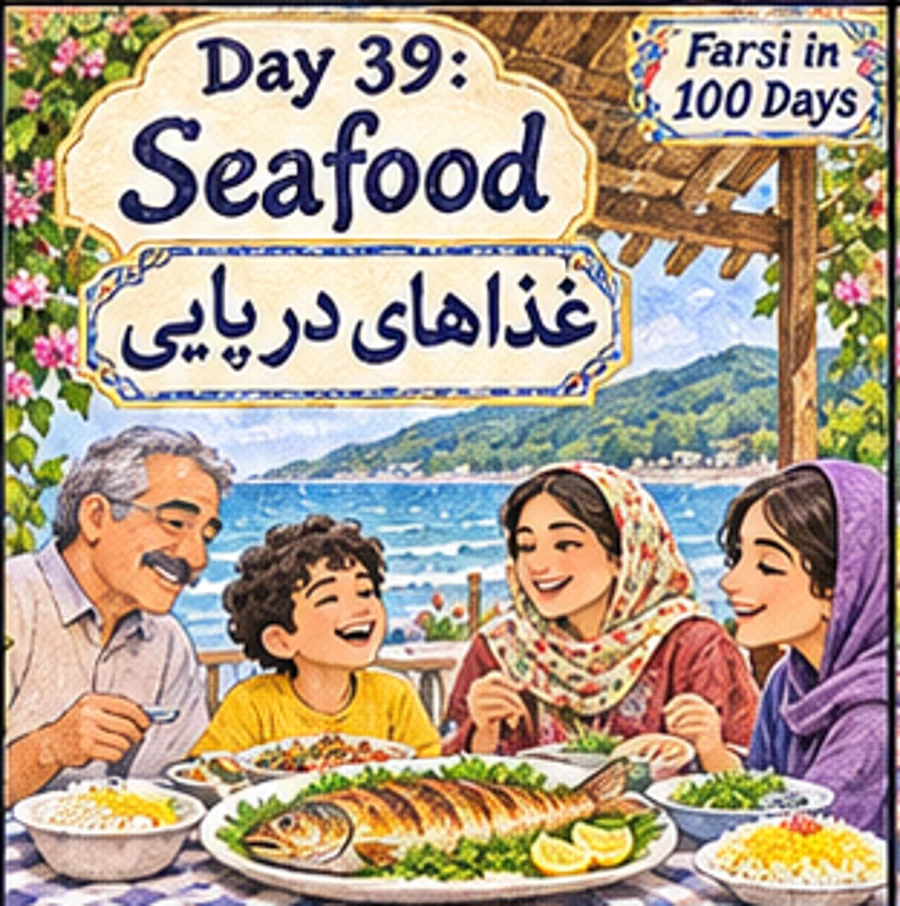
Day 39 of Learn Farsi in 100 Days, our free step-by-step Persian course: Seafood. The lesson has four parts, with every Persian word in Persian script, pronunciation and English, and each part ends with a quick check.
Part 1Grammar and conversation
Day 39, Part 1 shows the helping verb بودن (budan) in the past perfect, as in رفته بودم (rafte budam, I had gone), then follows Mazdak ordering at a restaurant: ماهی سفید (mâhi-ye sefid, whitefish), vegetable soup (سوپ سبزیجات, sup-e sabzijât) and a small soft drink.
Grammar: helping verbs, بودن in the past perfect
A helping verb (فعل کمکی, fe’l-e komaki) joins a main verb to build a tense. The past perfect (گذشتهی بعید, gozashte-ye ba’id) uses the past participle of the main verb (رفته, rafte, gone) followed by the simple past of بودن (budan, to be): بودم، بودی، بود… It describes an action that had already happened before another past moment.
| Persian | Pronunciation | English |
|---|---|---|
| رفته بودم | rafte budam | I had gone |
| رفته بودی | rafte budi | you had gone |
| رفته بود | rafte bud | he/she had gone |
| رفته بودیم | rafte budim | we had gone |
| رفته بودید | rafte budid | you (plural/polite) had gone |
| رفته بودند | rafte budand | they had gone |
Conversation: ordering fish at a restaurant
| Speaker | Persian | English and pronunciation |
|---|---|---|
| Waiter پیشخدمت | خوش آمدید، چی میخواهید سفارش بدهید؟ | Welcome. What would you like to order? khosh âmadid, chi mikhâhid sefâresh bedahid? |
| Mazdak مزدک | برای غذای اصلی ماهی میخواهم. | I’d like fish for the main course. barâ-ye ghazâ-ye asli mâhi mikhâham. |
| Waiter پیشخدمت | بسیار خوب، چه نوعی از ماهی میخواهید؟ | Very well. What kind of fish would you like? besyâr khub, che no’i az mâhi mikhâhid? |
| Mazdak مزدک | چه نوع ماهیای دارید؟ | What kinds of fish do you have? che no’ mâhi’i dârid? |
| Waiter پیشخدمت | ماهی سفید، ماهی آزاد و شاه ماهی. | Whitefish, salmon and herring. mâhi-ye sefid, mâhi-ye âzâd va shâh mâhi. |
| Mazdak مزدک | ماهی سفید لطفا، سوپ هم دارید؟ | Whitefish, please. Do you have soup too? mâhi-ye sefid lotfan, sup ham dârid? |
| Waiter پیشخدمت | بله امروز دو نوع سوپ داریم، سوپ سبزیجات و سوپ مرغ. | Yes, today we have two kinds of soup: vegetable soup and chicken soup. bale emruz do no’ sup dârim, sup-e sabzijât va sup-e morgh. |
| Mazdak مزدک | سوپ سبزیجات برایم بیاورید. | Bring me the vegetable soup, please. sup-e sabzijât barâyam biyâvarid. |
| Waiter پیشخدمت | چیز دیگری نمیخواهید؟ | Would you like anything else? chiz-e digari nemikhâhid? |
| Mazdak مزدک | یک نوشابه کوچک لطفا. | A small soft drink, please. yek nushâbe-ye kuchak lotfan. |
Quick check
- How do you say “we had gone” in Persian?
Show answer
رفته بودیم (rafte budim) - What three kinds of fish does the restaurant have?
Show answer
ماهی سفید، ماهی آزاد و شاه ماهی (mâhi-ye sefid, mâhi-ye âzâd va shâh mâhi): whitefish, salmon and herring. - Which soup does Mazdak order?
Show answer
سوپ سبزیجات (sup-e sabzijât), vegetable soup.
Part 2Grammar, common phrases, joke and word of the day
Day 39, Part 2 shows the short helping endings of the present perfect, as in رفتهام (rafte’am, I have gone), gives questions about restaurant hours such as رستوران کی باز میشود؟ (when does the restaurant open?), a Mulla joke about marriage, and the word غروب (ghorub, sunset).
Grammar: helping verbs in the present perfect
The present perfect (گذشتهی نقلی, gozashte-ye naghli) describes a past action whose result still matters now, like “I have gone”. It is made from the past participle (رفته, rafte) plus the short forms of “to be” as helping endings: ام، ای، است، ایم، اید، اند (-am, -i, ast, -im, -id, -and). After the final silent ه they are written with a zero-width space and a hamza sound: رفتهام (rafte’am).
| Persian | Pronunciation | English |
|---|---|---|
| رفتهام | rafte’am | I have gone |
| رفتهای | rafte’i | you have gone |
| رفته است | rafte ast | he/she has gone |
| رفتهایم | rafte’im | we have gone |
| رفتهاید | rafte’id | you (plural/polite) have gone |
| رفتهاند | rafte’and | they have gone |
Common phrases
| Persian | Pronunciation | English |
|---|---|---|
| رستوران کی باز میشود؟ | restorân key bâz mishavad? | When does the restaurant open? |
| رستوران کی تعطیل میشود؟ | restorân key ta’til mishavad? | When does the restaurant close? |
Joke: the Mulla’s son gets married
پسر ملا در سن ۱۵ سالگی ازدواج میکند.
The Mulla’s son gets married at the age of 15.
مردم به ملا میگویند: پسر تو هنوز بچه است و عاقل نیست.
People tell the Mulla, “Your son is still a child and isn’t wise yet.”
ملا میگوید: اگر عاقل بود که ازدواج نمیکرد.
The Mulla says, “If he were wise, he wouldn’t have gotten married!”
Word of the day: غروب (ghorub)
Meaning: sunset
We watched a beautiful sunset by the sea.
Quick check
- How do you say “they have gone” in Persian?
Show answer
رفتهاند (rafte’and) - How do you ask “When does the restaurant close?”
Show answer
رستوران کی تعطیل میشود؟ (restorân key ta’til mishavad?) - What does غروب (ghorub) mean?
Show answer
sunset
Part 3Seafoods, conversation and idiom of the day
Day 39, Part 3 names seafood such as میگو (meygu, shrimp), خرچنگ (kharchang, crab) and خاویار (khâviyâr, caviar), follows Sahand booking a dinner table for six by the window, and explains the idiom اوضاع شیر تو شیر شد (owzâ’ shir tu shir shod, things fell into chaos).
Seafoods (غذاهای دریایی)
| Persian | Pronunciation | English |
|---|---|---|
| ماهی | mâhi | fish |
| میگو | meygu | shrimp |
| خرچنگ | kharchang | crab |
| ماهی تن | mâhi-ye ton | tuna |
| ماهی سفید | mâhi-ye sefid | whitefish |
| خاویار | khâviyâr | caviar |
| صدف | sadaf | oyster, shellfish |
| حلزون | halazun | snail |
Conversation: booking a table
| Speaker | Persian | English and pronunciation |
|---|---|---|
| Receptionist منشی | به رستوران ما خوش آمدید، میتوانم کمکتان کنم؟ | Welcome to our restaurant. May I help you? be restorân-e mâ khosh âmadid, mitavânam komaketân konam? |
| Sahand سهند | میخواهم برای شام امشب یک میز رزرو کنم. | I’d like to reserve a table for dinner tonight. mikhâham barâ-ye shâm-e emshab yek miz rezerv konam. |
| Receptionist منشی | بسیار خوب، چند نفر هستید؟ | Very well. How many people are you? besyâr khub, chand nafar hastid? |
| Sahand سهند | ۶ نفر هستیم اما ممکن است دو نفر دیگر هم اضافه شوند. | We are six, but two more people may join us. shesh nafar hastim ammâ momken ast do nafar-e digar ham ezâfe shavand. |
| Receptionist منشی | باشد، میز کنار پنجره خوب است؟ | All right. Is a table by the window OK? bâshad, miz-e kenâr-e panjere khub ast? |
| Sahand سهند | عالی است. | That’s perfect. âli ast. |
| Receptionist منشی | اسم شما چیست؟ | What is your name? esm-e shomâ chist? |
| Sahand سهند | سهند امیری. | Sahand Amiri. sahand-e amiri. |
| Receptionist منشی | یک میز به نام شما رزرو شد. | A table has been reserved in your name. yek miz be nâm-e shomâ rezerv shod. |
| Sahand سهند | ممنونم. | Thank you. mamnunam. |
Idiom of the day
اوضاع شیر تو شیر شد.
owzâ’ shir tu shir shod.
Word for word: Things became lion-in-lion.
Meaning in Persian: شرایط بد شد.
Meaning: The situation got bad; everything fell into chaos and confusion.
English equivalent: When the shit hits the fan. (vulgar; a milder equivalent is “all hell broke loose”)
Quick check
- What is the Persian word for “shrimp”?
Show answer
میگو (meygu) - How many people is Sahand booking for?
Show answer
Six, ۶ نفر (shesh nafar), though two more may join. - What does اوضاع شیر تو شیر شد mean?
Show answer
The situation got bad and chaotic (شرایط بد شد, sharâyet bad shod).
Part 4Reading and new words
Day 39, Part 4 is a reading about Mashhad (مشهد, mashhad), Iran’s second most populous city, with its area, population and mild climate (آب و هوای معتدل, âb-o havâ-ye mo’tadel), plus the day’s vocabulary list, including حداکثر (hadd-e aksar, maximum) and سفارش دادن (sefâresh dâdan, to order).
Reading: Mashhad
مشهد یک شهر بزرگ در شمال شرقی ایران و مرکز استان خراسان رضوی است. این شهر در زمان افشاریان، پایتخت ایران بود.
Mashhad is a large city in northeastern Iran and the capital of Razavi Khorasan province. Under the Afsharid dynasty, it was the capital of Iran.
مشهد با چهار میلیون نفر جمعیت، دومین شهر پرجمعیت ایران بعد از تهران است. مساحت شهر مشهد حدود ۲۸۹ کیلومتر مربع است.
With a population of four million, Mashhad is the second most populous city in Iran after Tehran. The city covers about 289 square kilometers.
آب و هوای مشهد معتدل است. حداکثر درجهی حرارت در تابستانها ۴۳ درجه سانتیگراد بالای صفر و کمترین آن در زمستانها به چند درجه زیر صفر میرسد.
Mashhad has a mild climate. The highest temperature in summer is 43 degrees Celsius above zero, and the lowest in winter drops to a few degrees below zero.
New words
| Persian | Pronunciation | English |
|---|---|---|
| خوش آمدید | khosh âmadid | welcome |
| حداکثر | hadd-e aksar | maximum |
| سفارش دادن | sefâresh dâdan | to order |
| ماهی سفید | mâhi-ye sefid | whitefish |
| شاه ماهی | shâh mâhi | herring |
| سبزیجات | sabzijât | vegetables |
| نوشابه | nushâbe | soft drink, beverage |
| عاقل | âghel | wise, sensible |
| ازدواج کردن | ezdevâj kardan | to get married |
| مردم | mardom | people |
| مساحت | masâhat | area |
| اضافه شدن | ezâfe shodan | to be added |
| کلان شهر | kalân shahr | metropolis |
| اوضاع | owzâ’ | situation, conditions |
| حداقل | hadd-e aghal | at least, minimum |
| شمال شرقی | shomâl-e sharghi | northeast |
| معتدل | mo’tadel | mild, moderate |
| درجه حرارت | daraje-ye harârat | temperature |
| پیش خدمت | pish khedmat | waiter |
| دریا | daryâ | sea |
| صدف | sadaf | shell, oyster |
| ساحل | sâhel | beach, shore |
| پس از | pas az | after |
| سانتیگراد | sântigerâd | centigrade, Celsius |
| بایگانی | bâygâni | archive |
| متوسط | motavasset | average |
| خنک | khonak | cool |
| تازه | tâze | fresh |
| له شده | leh shode | mashed |
| نیم پز | nim paz | medium (cooked), half-cooked |
| آب پز شده | âb paz shode | boiled, poached |
| پوره | pure | puree |
| رسیده | reside | ripe |
Quick check
- Which city is more populous than Mashhad in Iran?
Show answer
Tehran (تهران, tehrân); Mashhad is the second most populous city. - What is Mashhad’s climate like?
Show answer
Mild: آب و هوای مشهد معتدل است (âb-o havâ-ye mashhad mo’tadel ast). - What does سفارش دادن (sefâresh dâdan) mean?
Show answer
to order
Take this lesson further

Study with the book
Learn Farsi in 100 Days: The Ultimate Crash Course to Learning Farsi Fast
This free lesson is part of Learn Farsi in 100 Days. The book puts the whole series in one printable PDF you can study offline.
Serious about Persian? Get all 30 of our Persian learning books for $199.99 (55% less than buying them one by one).
Free Persian Starter Pack: Alphabet + 100 Core Words
Get the 14-page printable Starter Pack (all 32 letters, a 7-day reading plan, 100 core words and 20 survival phrases) and a short 5-email course. Free.
Free. Every morning: that day’s four videos and the full lessons, with every Persian word, its pronunciation and its English meaning. Stop or pause with one click.