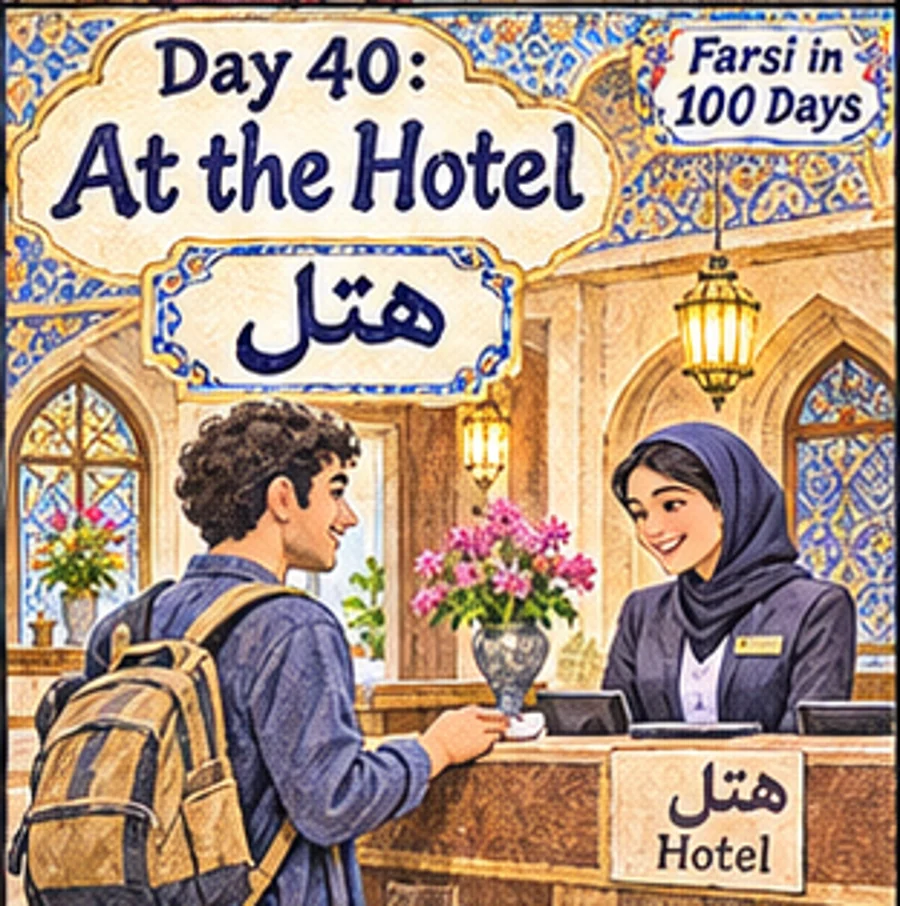
Day 40 of Learn Farsi in 100 Days, our free step-by-step Persian course: At the Hotel. The lesson has four parts, with every Persian word in Persian script, pronunciation and English, and each part ends with a quick check.
Part 1Grammar and conversation
Day 40, Part 1 shows how the helping verb خواستن (khâstan) forms the future tense, as in خواهم رفت (khâham raft, I will go), then gives two hotel dialogues: Nastaran asks for a double room (اتاق دوتخته, otâgh-e dotakhte) and Laleh checks into a room she had reserved.
Grammar: helping verbs, خواستن in the future tense
The formal future tense (آینده, âyande) uses the helping verb خواستن (khâstan) in its present forms without می: خواهم، خواهی، خواهد، خواهیم، خواهید، خواهند. These are followed by the short past stem of the main verb (رفت, raft), which never changes. In everyday speech Iranians usually use the simple present for the future instead (فردا میروم, fardâ miravam, I’ll go tomorrow).
| Persian | Pronunciation | English |
|---|---|---|
| خواهم رفت | khâham raft | I will go |
| خواهی رفت | khâhi raft | you will go |
| خواهد رفت | khâhad raft | he/she will go |
| خواهیم رفت | khâhim raft | we will go |
| خواهید رفت | khâhid raft | you (plural/polite) will go |
| خواهند رفت | khâhand raft | they will go |
Conversation: at the hotel reception (two dialogues)
| Speaker | Persian | English and pronunciation |
|---|---|---|
| Receptionist (dialogue 1) منشی | سلام خوش آمدید، بفرمایید. | Hello, welcome. How can I help you? salâm khosh âmadid, befarmâyid. |
| Nastaran نسترن | قیمت اتاقهای شما چند است؟ | How much are your rooms? gheymat-e otâgh-hâ-ye shomâ chand ast? |
| Receptionist منشی | اتاقهای ما از ۵۰ هزار تومان شروع میشود. | Our rooms start at 50,000 tomans. otâgh-hâ-ye mâ az panjâh hezâr tomân shoru’ mishavad. |
| Nastaran نسترن | من یک اتاق دوتخته میخواهم. | I’d like a twin room. man yek otâgh-e dotakhte mikhâham. |
| Receptionist منشی | چند روز میمانید؟ | How many days will you stay? chand ruz mimânid? |
| Nastaran نسترن | چهار روز. | Four days. chahâr ruz. |
| Receptionist منشی | اتاق شمارهی ۷۸ را برایتان آماده میکنیم. | We’ll get room 78 ready for you. otâgh-e shomâre-ye haftâd-o hasht râ barâyetân âmâde mikonim. |
| Laleh (dialogue 2) لاله | سلام من قبلا اتاق رزرو کرده بودم. | Hello, I had reserved a room. salâm man ghablan otâgh rezerv karde budam. |
| Receptionist منشی | اسم شما چیست؟ | What is your name? esm-e shomâ chist? |
| Laleh لاله | لاله ستوده. | Laleh Sotudeh. lâle sotude. |
| Receptionist منشی | بله، اتاق شما شمارهی ۳۰۷ است. | Yes, your room is number 307. bale, otâgh-e shomâ shomâre-ye sisad-o haft ast. |
| Laleh لاله | ممکن است چمدانهای من را به اتاقم بیاورید. | Could you bring my suitcases to my room? momken ast chamedân-hâ-ye man râ be otâgham biyâvarid. |
| Receptionist منشی | بله حتما. | Yes, of course. bale hatman. |
Quick check
- How do you say “we will go” in Persian?
Show answer
خواهیم رفت (khâhim raft) - How long will Nastaran stay at the hotel?
Show answer
Four days: چهار روز (chahâr ruz). - What is Laleh’s room number?
Show answer
۳۰۷ (sisad-o haft), 307
Part 2Grammar, common phrases, joke and word of the day
Day 40, Part 2 shows the helping verb باشد (bâshad) in the present and past subjunctive, as in رفته باشم (rafte bâsham, that I may have gone), gives hotel phrases like مرکز شهر از کدام طرف است؟ (which way is downtown?), a Mulla dream joke, and the word جذاب (jazzâb, attractive).
Grammar: helping verbs, باشد in the subjunctive
The forms of باشد (bâshad, from بودن, to be) are used in two subjunctive tenses. In the present subjunctive (حال التزامی, hâl-e eltezâmi) they stand alone and mean “(that) I be, you be…”: باشم، باشی، باشد… In the past subjunctive (گذشتهی التزامی, gozashte-ye eltezâmi) they follow a past participle to talk about something that may have happened: رفته باشم (rafte bâsham, that I may have gone).
| Persian | Pronunciation | English |
|---|---|---|
| باشم | bâsham | (that) I be |
| باشی | bâshi | (that) you be |
| باشد | bâshad | (that) he/she be |
| باشیم | bâshim | (that) we be |
| باشید | bâshid | (that) you (plural/polite) be |
| باشند | bâshand | (that) they be |
| رفته باشم | rafte bâsham | (that) I may have gone |
| رفته باشی | rafte bâshi | (that) you may have gone |
| رفته باشد | rafte bâshad | (that) he/she may have gone |
| رفته باشیم | rafte bâshim | (that) we may have gone |
| رفته باشید | rafte bâshid | (that) you (plural/polite) may have gone |
| رفته باشند | rafte bâshand | (that) they may have gone |
Common phrases
| Persian | Pronunciation | English |
|---|---|---|
| لطفا یک ماشین به هتل من بفرستید. | lotfan yek mâshin be hotel-e man befrestid. | Please send a car to my hotel. |
| مرکز شهر از کدام طرف است؟ | markaz-e shahr az kodâm taraf ast? | Which way is downtown? |
Joke: the Mulla’s dream
یک شب ملانصرالدین خواب دید که شخصی ۹ تومان به او میدهد. اما او اصرار میکند که ۱۰ تومان بدهد.
One night Mulla Nasreddin dreamed that someone was giving him 9 tomans. But he insisted on getting 10 tomans.
در همین لحظه از خواب بیدار میشود و میبیند چیزی در دستش نیست. پشیمان میشود و چشمهایش را میبندد و میگوید: «قبول، همان ۹ تومان را بده».
At that very moment he wakes up and sees there is nothing in his hand. He regrets it, shuts his eyes and says, “All right, just give me the 9 tomans.”
Word of the day: جذاب (jazzâb)
Meaning: attractive, captivating
His book had captivating stories.
Quick check
- How do you say “(that) they may have gone” in Persian?
Show answer
رفته باشند (rafte bâshand) - How do you ask “Which way is downtown?”
Show answer
مرکز شهر از کدام طرف است؟ (markaz-e shahr az kodâm taraf ast?) - What does جذاب (jazzâb) mean?
Show answer
attractive, captivating
Part 3At the hotel, conversation and idiom of the day
Day 40, Part 3 names hotel staff and services such as باربر (bârbar, bellboy) and پذیرش (paziresh, reception desk), follows Laleh handing in her room key before going out until nine, and explains the idiom با سرنوشت نمیتوان جنگید (you can’t fight fate).
At the hotel (در هتل)
| Persian | Pronunciation | English |
|---|---|---|
| باربر | bârbar | bellboy, porter |
| مستخدم زن | mostakhdem-e zan | chambermaid |
| پذیرش | paziresh | reception desk |
| متصدی پذیرش | motesaddi-ye paziresh | desk clerk |
| اتاق با غذا | otâgh bâ ghazâ | full board |
| اتاق با صبحانه و شام | otâgh bâ sobhâne va shâm | half board (room with breakfast and dinner) |
| دربان هتل | darbân-e hotel | doorman |
| مسئول پارک ماشینها | mas’ul-e pârk-e mâshin-hâ | valet (parking attendant) |
Conversation: leaving the key at reception
| Speaker | Persian | English and pronunciation |
|---|---|---|
| Laleh لاله | سلام صبح بخیر. | Hello, good morning. salâm sobh bekheyr. |
| Receptionist منشی | صبح بخیر، چیزی لازم دارید؟ | Good morning. Do you need anything? sobh bekheyr, chizi lâzem dârid? |
| Laleh لاله | من تا ساعت نه بیرون هستم. میخواستم کلید اتاق را تحویل بدهم. | I’ll be out until nine o’clock. I wanted to hand in my room key. man tâ sâ’at-e noh birun hastam. mikhâstam kelid-e otâgh râ tahvil bedaham. |
| Receptionist منشی | بله حتما، کار دیگری ندارید؟ | Yes, of course. Is there anything else? bale hatman, kâr-e digari nadârid? |
| Laleh لاله | فقط اگر کسی تماس گرفت بگویید ساعت نه برمیگردد. | Just, if anyone calls, tell them I’ll be back at nine. faghat agar kasi tamâs gereft beguyid sâ’at-e noh barmigardad. |
| Receptionist منشی | حتما روز خوبی داشته باشید. | Certainly. Have a nice day. hatman ruz-e khubi dâshte bâshid. |
Idiom of the day
با سرنوشت نمیتوان جنگید.
bâ sarnevesht nemitavân jangid.
Word for word: One cannot fight with fate.
Meaning in Persian: آنچه که تقدیر است اتفاق خواهد افتاد.
Meaning: Whatever is destined will happen.
English equivalent: Accidents will happen.
Quick check
- What is the Persian word for “bellboy”?
Show answer
باربر (bârbar) - Until what time will Laleh be out?
Show answer
Until nine: تا ساعت نه (tâ sâ’at-e noh). - What does با سرنوشت نمیتوان جنگید mean?
Show answer
“You can’t fight fate”: whatever is destined will happen.
Part 4Reading and new words
Day 40, Part 4 is a reading about the University of Tehran (دانشگاه تهران, dâneshgâh-e tehrân), Iran’s first center of higher education with 25 faculties, followed by the day’s vocabulary list, including تأسیس شدن (ta’sis shodan, to be established) and سرنوشت (sarnevesht, fate).
Reading: The University of Tehran
دانشگاه تهران بزرگترین مرکز آموزشی در ایران است. این دانشگاه بیش از هشتاد سال پیش در تهران تأسیس شد. این دانشگاه اولین مرکز آموزش عالی در ایران بود.
The University of Tehran is the largest educational center in Iran. It was founded in Tehran more than eighty years ago. It was the first center of higher education in Iran.
در حال حاضر دانشگاه تهران با ۲۵ دانشکده یکی از بزرگترین دانشگاههای خاورمیانه است.
Today, with 25 faculties, the University of Tehran is one of the largest universities in the Middle East.
گشایش دانشگاه تهران با آغاز آشنایی جدی ایرانیان با فرهنگ غربی همراه بود. از آغاز فعالیتهای آموزشی دانشگاه تهران تاکنون همواره افراد شایسته و شخصیتهای برجسته و چهرههای معروف در آن تحصیل کردهاند.
The opening of the University of Tehran coincided with the beginning of Iranians’ serious acquaintance with Western culture. Since it began teaching, talented people, prominent figures and famous faces have always studied there.
New words
| Persian | Pronunciation | English |
|---|---|---|
| حاضر کردن | hâzer kardan | to prepare |
| لحظه | lahze | moment |
| شخصیت | shakhsiyat | character, personality, figure |
| اتفاق افتادن | ettefâgh oftâdan | to happen |
| نگهبان | negahbân | guard |
| پارکینگ | pârking | parking |
| سرنوشت | sarnevesht | fate, destiny |
| آموزشی | âmuzeshi | educational, training |
| آغاز | âghâz | beginning |
| همواره | hamvâre | always |
| روی دادن | ruy dâdan | to occur |
| رخ دادن | rokh dâdan | to happen |
| کلید | kelid | key |
| پشیمان شدن | pashimân shodan | to regret |
| لازم داشتن | lâzem dâshtan | to need |
| تقدیر | taghdir | fate, destiny |
| غربی | gharbi | western |
| شایسته | shâyeste | worthy, competent, proper |
| گشایش | goshâyesh | opening |
| تحصیل کردن | tahsil kardan | to study |
| جدی | jeddi | serious |
| متصدی | motesaddi | clerk, person in charge |
| جنگیدن | jangidan | to fight |
| اصرار کردن | esrâr kardan | to insist |
| تأسیس شدن | ta’sis shodan | to be established |
| افتخار | eftekhâr | honor, pride |
| برجسته | barjaste | prominent, outstanding |
| انقلاب | enghelâb | revolution |
| پژوهشی | pazhuheshi | research (adj.) |
| نهاد | nahâd | institution |
| دانشمند | dâneshmand | scientist |
| آزمایشگاه | âzmâyeshgâh | laboratory |
| دقایق | daghâyegh | minutes |
| پیروی کردن | peyrovi kardan | to follow |
Quick check
- How many faculties (دانشکده, dâneshkade) does the University of Tehran have, according to the reading?
Show answer
۲۵ (bist-o panj), 25 - What does تأسیس شدن (ta’sis shodan) mean?
Show answer
to be established, to be founded - Give two Persian words from the list that mean “fate”.
Show answer
سرنوشت (sarnevesht) and تقدیر (taghdir)
Take this lesson further

Study with the book
Learn Farsi in 100 Days: The Ultimate Crash Course to Learning Farsi Fast
This free lesson is part of Learn Farsi in 100 Days. The book puts the whole series in one printable PDF you can study offline.
Serious about Persian? Get all 30 of our Persian learning books for $199.99 (55% less than buying them one by one).
Free Persian Starter Pack: Alphabet + 100 Core Words
Get the 14-page printable Starter Pack (all 32 letters, a 7-day reading plan, 100 core words and 20 survival phrases) and a short 5-email course. Free.
Free. Every morning: that day’s four videos and the full lessons, with every Persian word, its pronunciation and its English meaning. Stop or pause with one click.