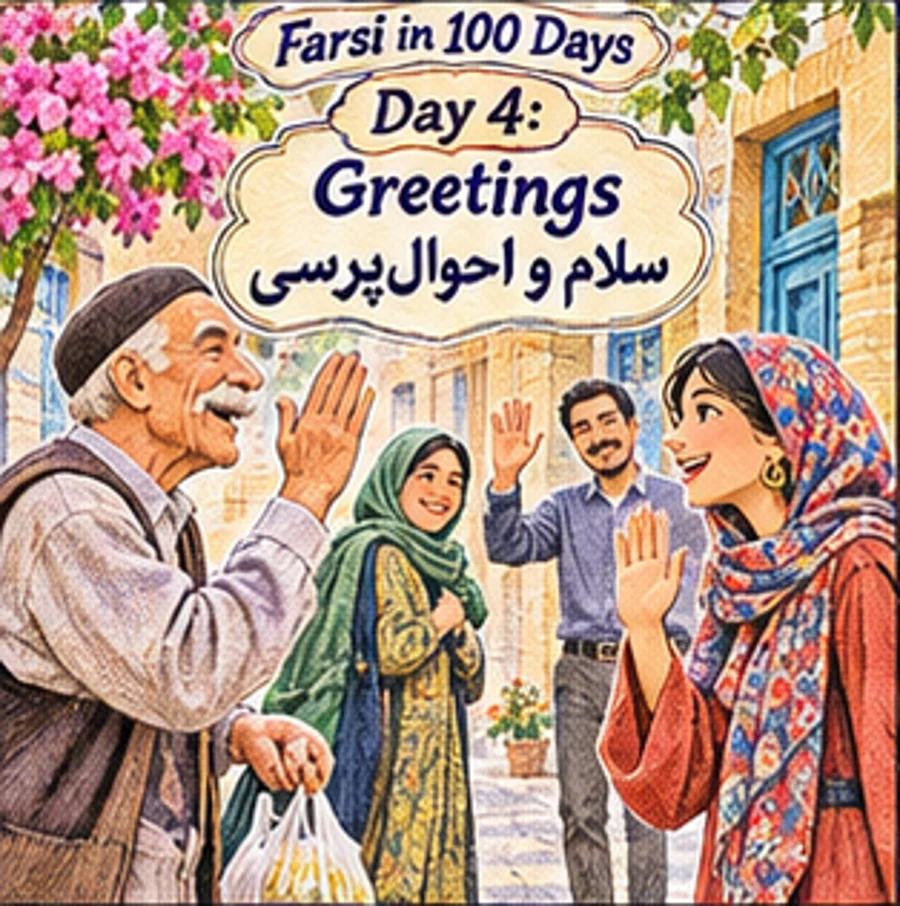
Day 4 of Learn Farsi in 100 Days, our free step-by-step Persian course: Greetings. The lesson has four parts, with every Persian word in Persian script, pronunciation and English, and each part ends with a quick check.
Part 1Grammar and conversation
Day 4, Part 1 teaches the Persian personal pronouns, from من (man, I) to آنها (ânhâ, they), and a first greeting between Pedram and Sina using سلام (salâm, hi) and چطور هستی؟ (chetor hasti?, how are you?).
Grammar: personal pronouns
Persian has six personal pronouns. تو (to) is the singular, informal “you”, used with family and friends; شما (shomâ) is the plural “you” and also the polite form for one person. او (u) means both “he” and “she”, because Persian has no grammatical gender. For “they”, آنها (ânhâ) is the everyday form and ایشان (ishân) is formal and respectful.
| Persian | Pronunciation | English |
|---|---|---|
| من | man | I |
| تو | to | you (singular) |
| او | u | he/she |
| ما | mâ | we |
| شما | shomâ | you (plural or polite) |
| آنها – ایشان | ânhâ – ishân | they |
Conversation: saying hello
| Speaker | Persian | English and pronunciation |
|---|---|---|
| Pedram پدرام | سلام. | Hi. salâm. |
| Sina سینا | سلام، چطور هستی؟ | Hi, how are you? salâm, chetor hasti? |
| Pedram پدرام | خوب هستم، تو چطور هستی؟ | I am fine, and you? khub hastam, to chetor hasti? |
| Sina سینا | عالی هستم، ممنون. | I am great, thanks. âli hastam, mamnun. |
Quick check
- Which Persian pronoun means both “he” and “she”?
Show answer
او (u) - How do you ask a friend “How are you?” in Persian?
Show answer
چطور هستی؟ (chetor hasti?) - What does عالی هستم (âli hastam) mean?
Show answer
I am great.
Part 2Speech vs. writing, grammar and word of the day
Day 4, Part 2 shows how spoken Persian shortens هستم to -am (خوبم, khubam, “I’m fine”), conjugates the present tense of “to be” (من هستم, man hastam, I am), and gives the word of the day, دانشجو (dâneshju, student).
Speech vs. writing
In speech, the verb هستم (hastam, I am) is usually dropped and only its ending -am is attached to the word before it, and چطور هستی؟ shrinks to چطوری؟. The spoken form is on the left of each pair, the written form on the right.
| Spoken | Written | English |
|---|---|---|
| چطوری؟ chetori? | چطور هستی؟ chetor hasti? | How are you? |
| خوشحالم! khoshhâlam! | خوشحال هستم! khoshhâl hastam! | I’m happy! |
| خوبم! khubam! | خوب هستم! khub hastam! | I’m fine! |
| ناراحتم! nârâhatam! | ناراحت هستم! nârâhat hastam! | I’m upset! |
| عالیم! âliyam! | عالی هستم! âli hastam! | I’m great! |
| غمگینم! ghamginam! | غمگین هستم! ghamgin hastam! | I’m sad! |
Grammar: simple present of “to be”
The present tense of “to be” is built on the stem هست (hast) plus a personal ending: -am, -i, (nothing), -im, -id, -and. The he/she form is just هست (hast); in writing, است (ast) is also very common for “is”. Because the ending already shows the person, the pronoun (من، تو…) can be left out.
| Persian | Pronunciation | English |
|---|---|---|
| من هستم. | man hastam. | I am. |
| تو هستی. | to hasti. | You (singular) are. |
| او هست. | u hast. | He/She is. |
| ما هستیم. | mâ hastim. | We are. |
| شما هستید. | shomâ hastid. | You (plural or polite) are. |
| آنها هستند. | ânhâ hastand. | They are. |
Word of the day: دانشجو (dâneshju)
Meaning: (university) student
I am a student. You are a student. The student is in the classroom.
Quick check
- What is the spoken form of خوب هستم (khub hastam)?
Show answer
خوبم (khubam), “I’m fine” - How do you say “we are” in Persian?
Show answer
ما هستیم (mâ hastim) - What does دانشجو (dâneshju) mean?
Show answer
(university) student
Part 3Numbers 1 to 10, common phrases and idiom of the day
Day 4, Part 3 teaches the Persian numbers 1 to 10, from یک (yek, one) to ده (dah, ten), with Persian digits, everyday phrases such as صبح بخیر (sobh bekheyr, good morning) and خواهش میکنم (khâhesh mikonam, you’re welcome), and the idiom دررفتن (dar raftan, to slip away).
Numbers 1 to 10
Numbers are written from left to right in Persian.
| Number | Persian digit | Persian word | Pronunciation |
|---|---|---|---|
| 1 | ۱ | یک | yek |
| 2 | ۲ | دو | do |
| 3 | ۳ | سه | se |
| 4 | ۴ | چهار | chahâr |
| 5 | ۵ | پنج | panj |
| 6 | ۶ | شش | shesh |
| 7 | ۷ | هفت | haft |
| 8 | ۸ | هشت | hasht |
| 9 | ۹ | نه | noh |
| 10 | ۱۰ | ده | dah |
Common phrases
| Persian | Pronunciation | English |
|---|---|---|
| چطوری؟ | chetori? | How are you? |
| عصر بخیر! | asr bekheyr! | Good evening! (late afternoon) |
| چه خبر؟ | che khabar? | What’s up? (literally: what news?) |
| خواهش میکنم. | khâhesh mikonam. | You’re welcome. |
| خوبی؟ | khubi? | Are you fine? / Are you well? |
| خیلی ممنون. | kheyli mamnun. | Thank you very much. |
| صبح بخیر! | sobh bekheyr! | Good morning! |
| مرسی. | mersi. | Thank you! |
Idiom of the day
دررفتن.
dar raftan.
Word for word: to go out
Meaning in Persian: فرار کردن، گریختن.
Meaning: to run away, to escape, to slip away. Example: او از کلاس دررفت. (u az kelâs dar raft.) He/She slipped out of class.
English equivalent: To take it on the lam.
Quick check
- How do you say “seven” in Persian?
Show answer
هفت (haft), written ۷ - What can you say in Persian when someone thanks you?
Show answer
خواهش میکنم (khâhesh mikonam), “You’re welcome.” - What does the idiom دررفتن (dar raftan) mean?
Show answer
To run away or escape (فرار کردن, farâr kardan).
Part 4Reading and vocabulary
Day 4, Part 4 is a short reading of “to be” sentences such as من دانشجو هستم (man dâneshju hastam, I am a student) and او شاد است (u shâd ast, he is happy), followed by the day’s vocabulary, from ممنون (mamnun, thankful) to امروز (emruz, today).
Reading: who we are
من دانشجو هستم. تو مهندس هستی. ما استاد هستیم. آنها پزشک هستند. او دانشجو است.
I am a student. You are an engineer. We are professors. They are doctors. He/She is a student.
شما خوشحال هستید. او شاد است. ما عالی هستیم. من خوب هستم. آنها دانشجو هستند.
You are happy. He/She is cheerful. We are great. I am fine. They are students.
Vocabulary
| Persian | Pronunciation | English |
|---|---|---|
| ممنون | mamnun | thankful; thanks |
| شاد | shâd | happy, cheerful |
| خوشحال | khoshhâl | happy, glad |
| دیدن | didan | to see |
| را | râ | object marker |
| به | be | to |
| با | bâ | with |
| خواندن | khândan | to read |
| نوشتن | neveshtan | to write |
| شب | shab | night |
| دختر | dokhtar | girl |
| چطوری؟ | chetori? | How are you? |
| فردا | fardâ | tomorrow |
| از | az | from |
| و | va | and |
| آن | ân | that |
| سلام | salâm | hello, hi |
| آب | âb | water |
| خوب | khub | good |
| بله | bale | yes |
| خیلی | kheyli | very |
| نه | na | no |
| زن | zan | woman; wife |
| مهندس | mohandes | engineer |
| استاد | ostâd | professor, master |
| پزشک | pezeshk | doctor |
| عالی | âli | excellent, great |
| بد | bad | bad |
| فرار کردن | farâr kardan | to escape, to run away |
| صبح | sobh | morning |
| عصر | asr | evening, late afternoon |
| ظهر | zohr | noon |
| پسر | pesar | boy; son |
| خانه | khâne | house, home |
| دیروز | diruz | yesterday |
| امروز | emruz | today |
Quick check
- How do you say “They are doctors” in Persian?
Show answer
آنها پزشک هستند. (ânhâ pezeshk hastand.) - What does مهندس (mohandes) mean?
Show answer
engineer - How do you say “yesterday” and “today” in Persian?
Show answer
دیروز (diruz) and امروز (emruz)
Take this lesson further

Study with the book
Learn Farsi in 100 Days: The Ultimate Crash Course to Learning Farsi Fast
This free lesson is part of Learn Farsi in 100 Days. The book puts the whole series in one printable PDF you can study offline.
Serious about Persian? Get all 30 of our Persian learning books for $199.99 (55% less than buying them one by one).
Free Persian Starter Pack: Alphabet + 100 Core Words
Get the 14-page printable Starter Pack (all 32 letters, a 7-day reading plan, 100 core words and 20 survival phrases) and a short 5-email course. Free.
Free. Every morning: that day’s four videos and the full lessons, with every Persian word, its pronunciation and its English meaning. Stop or pause with one click.