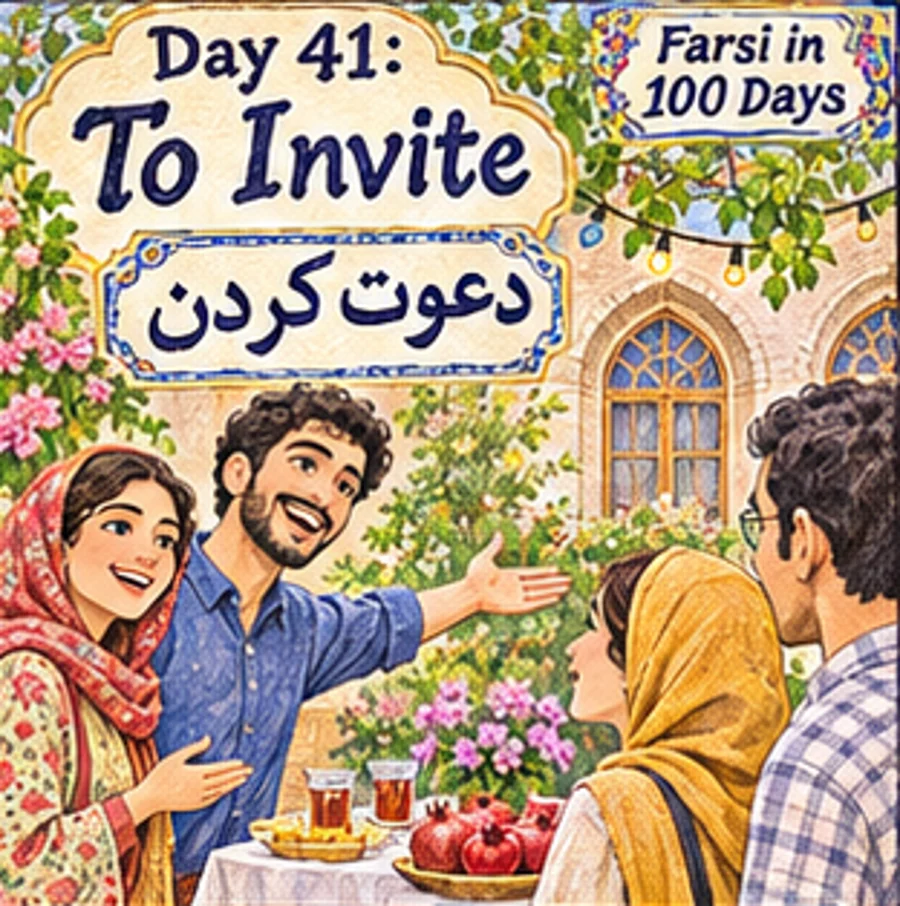
Day 41 of Learn Farsi in 100 Days, our free step-by-step Persian course: Invitations. The lesson has four parts, with every Persian word in Persian script, pronunciation and English, and each part ends with a quick check.
Part 1Grammar and conversation
Day 41, Part 1 shows how داشتن (dâshtan, to have) works as a helping verb for actions in progress, as in دارم میروم (dâram miravam, I am going) and داشتم میرفتم (dâshtam miraftam, I was going), then uses it in a dinner invitation between Mehrdad and Parivash.
Grammar: داشتن as a helping verb (present and past progressive)
In everyday Persian, داشتن (dâshtan, to have) is used as a helping verb (فعل کمکی, fe’l-e komaki) to stress that an action is happening right now or was happening at a certain moment. For the present progressive (حال استمراری, hâl-e estemrâri), put the present form of داشتن (dâram, dâri, dârad…) before the ordinary present tense with می. For the past progressive (گذشتهی استمراری, gozashte-ye estemrâri), put the simple past of داشتن (dâshtam, dâshti, dâsht…) before the past continuous with می. Both verbs take the same personal ending, and this helping داشتن has no negative form.
| Persian | Pronunciation | English |
|---|---|---|
| دارم میروم | dâram miravam | I am going |
| داری میروی | dâri miravi | you are going |
| دارد میرود | dârad miravad | he/she is going |
| داریم میرویم | dârim miravim | we are going |
| دارید میروید | dârid miravid | you (plural/polite) are going |
| دارند میروند | dârand miravand | they are going |
| داشتم میرفتم | dâshtam miraftam | I was going |
| داشتی میرفتی | dâshti mirafti | you were going |
| داشت میرفت | dâsht miraft | he/she was going |
| داشتیم میرفتیم | dâshtim miraftim | we were going |
| داشتید میرفتید | dâshtid miraftid | you (plural/polite) were going |
| داشتند میرفتند | dâshtand miraftand | they were going |
Conversation: A dinner invitation
| Speaker | Persian | English and pronunciation |
|---|---|---|
| Mehrdad مهرداد | دوست داری امشب شام برویم رستوران؟ | Would you like to go to a restaurant for dinner tonight? dust dâri emshab shâm beravim restorân? |
| Parivash پریوش | پیشنهاد خوبی است، چه ساعتی برویم؟ | That’s a good idea. What time shall we go? pishnahâd-e khubi ast, che sâ’ati beravim? |
| Mehrdad مهرداد | ساعت نه چطور است؟ | How about nine o’clock? sâ’at-e noh chetor ast? |
| Parivash پریوش | خیلی دیر است، ساعت هفت خوب است. | That’s too late. Seven o’clock is good. kheyli dir ast, sâ’at-e haft khub ast. |
| Mehrdad مهرداد | بسیار خوب، چه رستورانی دوست داری برویم؟ | Very well. Which restaurant would you like to go to? besyâr khub, che restorâni dust dâri beravim? |
| Parivash پریوش | رستوران ایتالیایی در خیابان داریوش. | The Italian restaurant on Dariush Street. restorân-e itâliyâyi dar khiyâbân-e dâriyush. |
| Mehrdad مهرداد | خوب است، پس ساعت هفت در رستوران تو را میبینم. | Good, so I’ll see you at the restaurant at seven. khub ast, pas sâ’at-e haft dar restorân to râ mibinam. |
| Parivash پریوش | حتما، خداحافظ. | Definitely. Goodbye. hatman, khodâhâfez. |
Quick check
- How do you say “we are going” using the helping verb داشتن?
Show answer
داریم میرویم (dârim miravim) - What is the past progressive “they were going” in Persian?
Show answer
داشتند میرفتند (dâshtand miraftand) - What time do Mehrdad and Parivash agree to meet?
Show answer
ساعت هفت (sâ’at-e haft), seven o’clock
Part 2Grammar, common phrases, joke and word of the day
Day 41, Part 2 sorts Persian sentences into four types, from questions (جملهی پرسشی, jomle-ye porseshi) to commands (جملهی امری, jomle-ye amri), gives two polite invitations such as دوست دارید برویم نوشیدنی بخوریم؟ (would you like to go for a drink?), a Mulla joke, and the word عذرخواهی (ozrkhâhi, apology).
Grammar: the four types of sentences
Persian grammar names four kinds of sentence. A question (جملهی پرسشی, jomle-ye porseshi) asks something and ends with ؟. A statement (جملهی خبری, jomle-ye khabari) simply gives information. An exclamation (جملهی عاطفی, jomle-ye âtefi) shows a feeling such as delight or disappointment, often with چه (che, what a) and an exclamation mark. A command (جملهی امری, jomle-ye amri) tells someone to do or not to do something, using the imperative.
| Persian | Pronunciation | English |
|---|---|---|
| جملهی پرسشی | jomle-ye porseshi | interrogative sentence (question) |
| جملهی خبری | jomle-ye khabari | declarative sentence (statement) |
| جملهی عاطفی | jomle-ye âtefi | exclamatory sentence |
| جملهی امری | jomle-ye amri | imperative sentence (command) |
Examples
Where is Sara? (question)
What is this? (question)
Which city is bigger? (question)
The weather is hot. (statement)
Tomorrow will be rainy. (statement)
The professor comes at ten o’clock. (statement)
What nice weather! (exclamation)
Wow! / How lovely! (exclamation)
What delicious food! (exclamation)
Oh, what a bad day! (exclamation)
Don’t smoke. (command)
Bring the book. (command)
Don’t touch the fire. (command)
Common phrases
| Persian | Pronunciation | English |
|---|---|---|
| دوست دارید برویم نوشیدنی بخوریم؟ | dust dârid beravim nushidani bokhorim? | Would you like to go for a drink? |
| دوست دارید برای غذا بیرون برویم؟ | dust dârid barâye ghazâ birun beravim? | Would you like to go out for a meal? |
Joke
پسر ملا به مردی ناسزا گفته بود. ملا وقتی شنید برای عذرخواهی نزد آن شخص رفت و گفت: او مانند پسر شما است و خر است! بهتر است او را ببخشید و از او کینهای نداشته باشید.
The Mulla’s son had insulted a man. When the Mulla heard about it, he went to that man to apologize and said: “He is just like your son, he’s a donkey! You had better forgive him and not hold a grudge against him.”
(The joke: trying to excuse his son, the Mulla accidentally calls the man’s own son a donkey as well.)
Word of the day: عذرخواهی (ozrkhâhi)
Meaning: apology
The father apologized for his son’s bad behavior.
Quick check
- What type of sentence is چه هوای خوبی! (che havâ-ye khubi!)?
Show answer
جملهی عاطفی (jomle-ye âtefi), an exclamatory sentence: “What nice weather!” - How do you ask “Would you like to go out for a meal?” in Persian?
Show answer
دوست دارید برای غذا بیرون برویم؟ (dust dârid barâye ghazâ birun beravim?) - What does عذرخواهی کردن (ozrkhâhi kardan) mean?
Show answer
to apologize; عذرخواهی (ozrkhâhi) is “apology”
Part 3Kitchen accessories, conversation and idiom of the day
Day 41, Part 3 names twelve kitchen items such as چنگال (changâl, fork) and ماهیتابه (mâhitâbe, frying pan), follows Afshin inviting Nadia to a traditional restaurant, and explains the idiom با یک گل بهار نمیشود (one flower doesn’t make spring).
Kitchen accessories
| Persian | Pronunciation | English |
|---|---|---|
| مخلوطکن | makhlutkon | blender |
| کاسه | kâse | bowl |
| چنگال | changâl | fork |
| ساطور | sâtur | cleaver |
| آبکش | âbkesh | colander |
| فنجان | fenjân | cup |
| ماهیتابه | mâhitâbe | frying pan |
| لیوان | livân | glass |
| رنده | rande | grater |
| کتری | ketri | kettle |
| چاقو | châghu | knife |
| فر | fer | oven |
Conversation: Dinner at a traditional restaurant
| Speaker | Persian | English and pronunciation |
|---|---|---|
| Afshin افشین | داری کجا میروی؟ | Where are you going? dâri kojâ miravi? |
| Nadia نادیا | دارم میروم دانشگاه. | I’m going to the university. dâram miravam dâneshgâh. |
| Afshin افشین | دوست داری امشب برای شام به یک رستوران برویم؟ | Would you like to go to a restaurant for dinner tonight? dust dâri emshab barâye shâm be yek restorân beravim? |
| Nadia نادیا | پیشنهاد خوبی است، کدام رستوران برویم؟ | That’s a good idea. Which restaurant shall we go to? pishnahâd-e khubi ast, kodâm restorân beravim? |
| Afshin افشین | رستوران سنتی دوست داری؟ | Do you like traditional restaurants? restorân-e sonnati dust dâri? |
| Nadia نادیا | آره، خوب است. چه ساعتی برویم؟ | Yes, that’s good. What time shall we go? âre, khub ast. che sâ’ati beravim? |
| Afshin افشین | ساعت هفت چطور است؟ | How about seven o’clock? sâ’at-e haft chetor ast? |
| Nadia نادیا | خوب است. | That’s fine. khub ast. |
Idiom of the day
با یک گل بهار نمیشود.
bâ yek gol bahâr nemishavad.
Word for word: With one flower it does not become spring.
Meaning in Persian: از یک مورد، نتیجهی کلی نمیتوان گرفت.
Meaning: You cannot draw a general conclusion from a single case.
English equivalent: One swallow does not make a summer.
Quick check
- What is the Persian word for “frying pan”?
Show answer
ماهیتابه (mâhitâbe) - What kind of restaurant does Afshin suggest to Nadia?
Show answer
رستوران سنتی (restorân-e sonnati), a traditional restaurant - What does the idiom با یک گل بهار نمیشود mean?
Show answer
You can’t draw a general conclusion from one case; like “One swallow does not make a summer.”
Part 4Reading and new words
Day 41, Part 4 is a reading about Tehran’s برج آزادی (borj-e âzâdi, Azadi Tower), designed by the architect Hossein Amanat, followed by a list of 36 new words such as نماد (namâd, symbol), معمار (me’mâr, architect) and بخشیدن (bakhshidan, to forgive).
Reading: The Azadi Tower
برج آزادی یکی از نمادهای شهر تهران است. این برج بیش از چهل سال پیش، توسط یک معمار ایرانی طراحی شد. نام این معمار، حسین امانت بود. در ابتدا نام این برج، برج شهیاد بود.
The Azadi (Freedom) Tower is one of the symbols of the city of Tehran. This tower was designed more than forty years ago by an Iranian architect. The architect’s name was Hossein Amanat. At first, the tower was called the Shahyad Tower.
این بنا به مناسبت جشنهای دوهزار و پانصد سالهی شاهنشاهی ایران ساخته شد. میدان آزادی که برج آزادی در آن قرار دارد، بزرگترین میدان شهر تهران است.
The building was built for the celebrations of 2,500 years of the Persian Empire. Azadi Square, where the Azadi Tower stands, is the largest square in Tehran.
برج شهیاد، پس از انقلاب ایران در سال ۱۹۷۹ میلادی به نام «برج آزادی» معروف شد. این برج در ایران، نمونهای از نماد و نشانههای شهری است. برج آزادی دارای معماری منحصربهفرد است که آن را به نمادی زیبا تبدیل کرده است.
After the Iranian Revolution in 1979, the Shahyad Tower became known as the “Azadi Tower.” In Iran, this tower is an example of urban symbols and landmarks. The Azadi Tower has a unique architecture that has turned it into a beautiful symbol.
New words
| Persian | Pronunciation | English |
|---|---|---|
| نماد | namâd | symbol |
| ناسزا | nâsezâ | insult, profanity |
| بخشیدن | bakhshidan | to forgive |
| کینه | kine | grudge |
| تبدیل شدن | tabdil shodan | to turn into, to become |
| گناه | gonâh | sin |
| خوشمزه | khoshmaze | delicious |
| جای گرفتن | jâ-y gereftan | to be placed, to fit |
| نشانه | neshâne | sign |
| یادبود | yâdbud | memorial |
| بنا | banâ | building |
| طراحی کردن | tarrâhi kardan | to design |
| بدل شدن | badal shodan | to turn into, to be converted |
| توسط | tavassot-e | by (someone) |
| مقصر | moghasser | guilty, at fault |
| زشت | zesht | ugly |
| علامت | alâmat | sign |
| هویت | hoviyyat | identity |
| شاهنشاهی | shâhanshâhi | imperial |
| معمار | me’mâr | architect |
| مناسبت | monâsebat | occasion |
| بهخاطر | be khâter-e | because of |
| دلیل | dalil | reason |
| دلخور شدن | delkhor shodan | to get upset |
| بهخاطر آوردن | be khâter âvardan | to remember |
| بنا کردن | banâ kardan | to build |
| ویژگی | vizhegi | feature, characteristic |
| حافظه | hâfeze | memory |
| دست زدن | dast zadan | to touch |
| رفتار | raftâr | behavior |
| نادیده گرفتن | nâdide gereftan | to ignore |
| تنبیه کردن | tanbih kardan | to punish |
| تقصیر | taghsir | fault |
| قضاوت کردن | ghezâvat kardan | to judge |
| توجیه کردن | towjih kardan | to justify |
Quick check
- What was the Azadi Tower called at first?
Show answer
برج شهیاد (borj-e shahyâd), the Shahyad Tower - Who designed the Azadi Tower?
Show answer
The Iranian architect حسین امانت (hoseyn-e amânat), Hossein Amanat - What does کینه (kine) mean?
Show answer
grudge
Take this lesson further

Study with the book
Learn Farsi in 100 Days: The Ultimate Crash Course to Learning Farsi Fast
This free lesson is part of Learn Farsi in 100 Days. The book puts the whole series in one printable PDF you can study offline.
Serious about Persian? Get all 30 of our Persian learning books for $199.99 (55% less than buying them one by one).
Free Persian Starter Pack: Alphabet + 100 Core Words
Get the 14-page printable Starter Pack (all 32 letters, a 7-day reading plan, 100 core words and 20 survival phrases) and a short 5-email course. Free.
Free. Every morning: that day’s four videos and the full lessons, with every Persian word, its pronunciation and its English meaning. Stop or pause with one click.