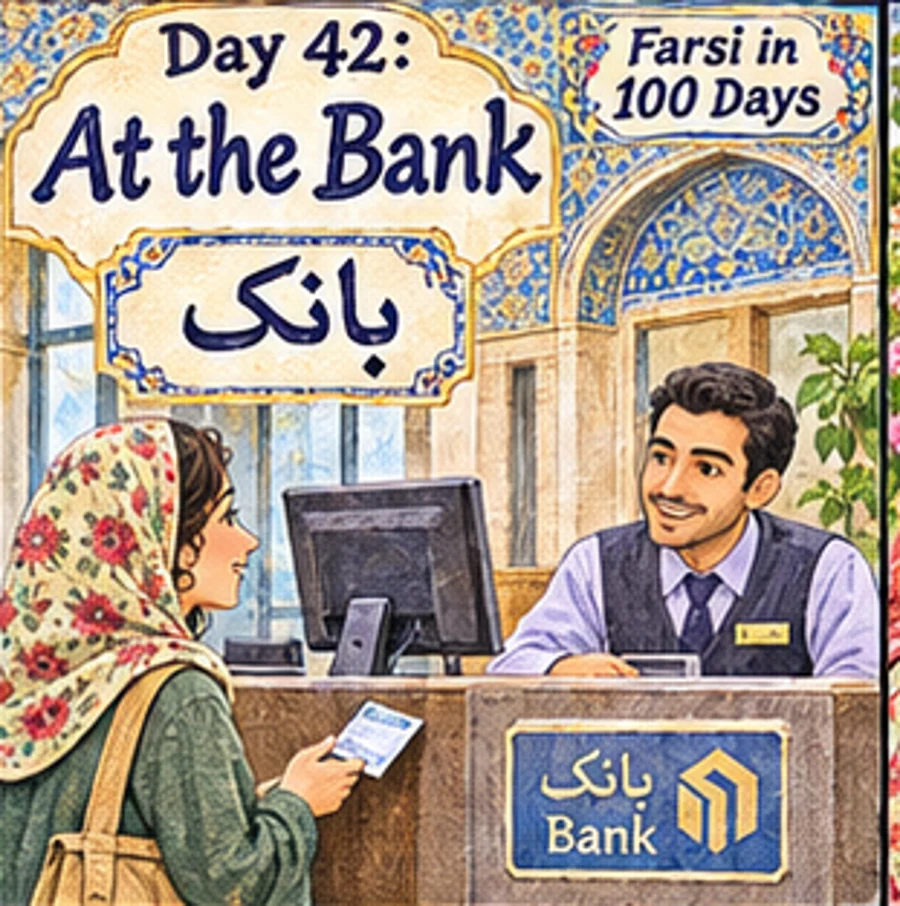
Day 42 of Learn Farsi in 100 Days, our free step-by-step Persian course: The Bank. The lesson has four parts, with every Persian word in Persian script, pronunciation and English, and each part ends with a quick check.
Part 1Grammar and conversation
Day 42, Part 1 covers the three Persian plural endings ها (-hâ), ان (-ân) and جات (-jât), as in پدرها (pedar-hâ, fathers) and سبزیجات (sabzijât, vegetables), then follows Mahsa as she opens a savings account (حساب پسانداز, hesâb-e pasandâz) at a bank.
Grammar: plural markers
Persian makes nouns plural with a suffix (علامت جمع, alâmat-e jam’). The ending ها (-hâ) is the most common and works with almost any noun, especially in speech. The ending ان (-ân) is more formal and is used mainly for people and living things; after a word ending in a vowel ی it often becomes -yân (ایرانیان, irâniyân). The ending جات (-jât) is used with a small group of words, mostly foods and goods, such as سبزیجات (sabzijât, vegetables).
| Persian | Pronunciation | English |
|---|---|---|
| پدرها، مادرها، ایرانیها | pedar-hâ, mâdar-hâ, irâni-hâ | fathers, mothers, Iranians (with -hâ) |
| پدران، مادران، ایرانیان | pedarân, mâdarân, irâniyân | fathers, mothers, Iranians (with -ân) |
| سبزیجات، مرباجات، شیرینیجات | sabzijât, morabbâjât, shirinijât | vegetables, jams, sweets (with -jât) |
Conversation: Opening a bank account
| Speaker | Persian | English and pronunciation |
|---|---|---|
| Bank clerk کارمند بانک | بفرمایید، میتوانم کمکتان کنم؟ | Yes, please. Can I help you? befarmâyid, mitavânam komaketân konam? |
| Mahsa مهسا | میخواهم در این بانک حساب باز کنم. | I’d like to open an account at this bank. mikhâham dar in bânk hesâb bâz konam. |
| Bank clerk کارمند بانک | چه حسابی؟ حساب پسانداز یا حساب جاری؟ | What kind of account? A savings account or a checking account? che hesâbi? hesâb-e pasandâz yâ hesâb-e jâri? |
| Mahsa مهسا | حساب پسانداز. | A savings account. hesâb-e pasandâz. |
| Bank clerk کارمند بانک | لطفا این برگه را پر کنید. کارت شناسایی همراه خود دارید؟ | Please fill out this form. Do you have your ID card with you? lotfan in barge râ por konid. kârt-e shenâsâyi hamrâh-e khod dârid? |
| Mahsa مهسا | بله بفرمایید. میخواهم مبلغی پول هم، به حساب واریز کنم. | Yes, here you are. I’d also like to deposit some money into the account. bale befarmâyid. mikhâham mablaghi pul ham, be hesâb vâriz konam. |
| Bank clerk کارمند بانک | این برگه را هم پر کنید و مبلغ را بنویسید. | Fill out this form too and write the amount. in barge râ ham por konid va mablagh râ benevisid. |
| Mahsa مهسا | نرخ سود در این بانک چند درصد است؟ | What is the interest rate at this bank? nerkh-e sud dar in bânk chand dar sad ast? |
| Bank clerk کارمند بانک | ۵ درصد است. | It’s 5 percent. panj dar sad ast. |
Quick check
- Give the -ân plural of مادر (mâdar, mother).
Show answer
مادران (mâdarân) - What kind of account does Mahsa open?
Show answer
حساب پسانداز (hesâb-e pasandâz), a savings account - How do you say “to deposit into the account”?
Show answer
به حساب واریز کردن (be hesâb vâriz kardan)
Part 2Grammar, common phrases, joke and word of the day
Day 42, Part 2 adds the Arabic plural endings ون (-un), ین (-in) and ات (-ât), as in حیوانات (heyvânât, animals), gives banking phrases such as من یک قبض واریز میخواهم (I need a deposit slip), a Mulla joke, and the word پاسخ (pâsokh, response).
Grammar: Arabic plural markers
Some Persian nouns, mostly borrowed from Arabic, take Arabic plural endings (علامتهای جمع, alâmat-hâ-ye jam’). The endings ون (-un) and ین (-in) are used for groups of people, such as انقلابیون (enghelâbiyun, revolutionaries) and ساکنین (sâkenin, residents). The ending ات (-ât) is used for many Arabic loanwords, both things and animals, such as حیوانات (heyvânât, animals). These forms are common in formal and written Persian; in everyday speech the ending ها is often used instead.
| Persian | Pronunciation | English |
|---|---|---|
| انقلابیون، اجتماعیون، سیاسیون | enghelâbiyun, ejtemâ’iyun, siyâsiyun | revolutionaries, social activists, politicians (with -un) |
| سارقین، غایبین، ساکنین | sâreghin, ghâyebin, sâkenin | thieves, absentees, residents (with -in) |
| حیوانات، عملیات، حشرات | heyvânât, amaliyât, hasharât | animals, operations, insects (with -ât) |
Common phrases
| Persian | Pronunciation | English |
|---|---|---|
| میخواهم مقداری پول واریز کنم. | mikhâham meghdâri pul vâriz konam. | I would like to deposit some money. |
| صرافی تا کی باز است؟ | sarrâfi tâ key bâz ast? | How late is the currency exchange office open? |
| میخواهم مقداری پول برداشت کنم. | mikhâham meghdâri pul bardâsht konam. | I would like to withdraw some money. |
| من یک قبض برداشت میخواهم. | man yek ghabz-e bardâsht mikhâham. | I need a withdrawal slip. |
| من یک قبض واریز میخواهم. | man yek ghabz-e vâriz mikhâham. | I need a deposit slip. |
| نزدیکترین صرافی کجاست؟ | nazdiktarin sarrâfi kojâst? | Where is the nearest currency exchange office? |
Joke
ملا تازه وارد شهری شده بود و در بازار میگشت. مردی به سمت ملا رفت و از او پرسید: امروز چند شنبه است؟ ملا جواب داد: نمیدانم، من تازه وارد این شهر شدهام و جایی را بلد نیستم.
The Mulla had just arrived in a town and was wandering around the bazaar. A man went up to him and asked, “What day of the week is it today?” The Mulla answered, “I don’t know. I’ve just arrived in this town and I don’t know my way around.”
Word of the day: پاسخ (pâsokh)
Meaning: response, answer
He didn’t know the answers to the questions.
Quick check
- Which plural ending does حشره (hashare, insect) take in حشرات?
Show answer
ات (-ât): حشرات (hasharât), insects - How do you say “I would like to withdraw some money”?
Show answer
میخواهم مقداری پول برداشت کنم. (mikhâham meghdâri pul bardâsht konam.) - What does پاسخ (pâsokh) mean?
Show answer
response, answer
Part 3At the bank, conversation and idiom of the day
Day 42, Part 3 teaches banking words such as دستگاه خودپرداز (dastgâh-e khodpardâz, ATM) and موجودی (mowjudi, balance), a talk between Arshia and Rambod about a bank loan (وام, vâm), and the idiom بار کج به منزل نمیرسد (a crooked load never reaches home).
At the bank
| Persian | Pronunciation | English |
|---|---|---|
| چک کشیدن | chek keshidan | to write (draw) a check |
| دستگاه خودپرداز | dastgâh-e khodpardâz | ATM |
| موجودی | mowjudi | balance |
| برات | barât | bill of exchange |
| سفته | safte | promissory note |
| چک مدتدار | chek-e moddatdâr | post-dated check |
| حوالهی بانکی | havâle-ye bânki | bank draft |
| چک سفید امضا | chek-e sefid emzâ | blank check (signed, with no amount) |
Conversation: Not enough money for a house
| Speaker | Persian | English and pronunciation |
|---|---|---|
| Arshia عرشیا | چیزی شده است؟ ناراحتی! | Has something happened? You look upset! chizi shode ast? nârâhati! |
| Rambod رامبد | برای خرید خانه پول کم دارم. | I don’t have enough money to buy a house. barâye kharid-e khâne pul kam dâram. |
| Arshia عرشیا | خب! چرا از بانک وام نمیگیری؟ | Well! Why don’t you get a loan from the bank? khob! cherâ az bânk vâm nemigiri? |
| Rambod رامبد | سود وام خیلی زیاد است توانایی پرداختش را ندارم. | The interest on the loan is very high; I can’t afford to pay it. sud-e vâm kheyli ziyâd ast tavânâyi-ye pardâkhtash râ nadâram. |
| Arshia عرشیا | اوه چه بد! خب بهتر است در این شرایط به فکر اجاره کردن خانه باشی. | Oh, that’s too bad! Well, in this situation you’d better think about renting a house. oh che bad! khob behtar ast dar in sharâyet be fekr-e ejâre kardan-e khâne bâshi. |
| Rambod رامبد | آره، باید دنبال یک خانه برای اجاره باشم. | Yes, I should look for a house to rent. âre, bâyad donbâl-e yek khâne barâye ejâre bâsham. |
Idiom of the day
بار کج به منزل نمیرسد.
bâr-e kaj be manzel nemiresad.
Word for word: A crooked load does not reach the destination.
Meaning in Persian: کار از پایه خراب است، نتیجهای ندارد.
Meaning: When something is wrong from the start (dishonest or badly done), it comes to nothing.
English equivalent: Winners never cheat and cheaters never win.
Quick check
- What is the Persian for “ATM”?
Show answer
دستگاه خودپرداز (dastgâh-e khodpardâz) - Why doesn’t Rambod want a bank loan?
Show answer
The interest is too high: سود وام خیلی زیاد است (sud-e vâm kheyli ziyâd ast). - What does the idiom بار کج به منزل نمیرسد mean?
Show answer
Something wrong or dishonest from the start won’t succeed; like “Cheaters never win.”
Part 4Reading and new words
Day 42, Part 4 is a short reading about the internet (اینترنت, internet) as a means of communication that makes banking and shopping easier, followed by a list of new words such as منتشر کردن (montasher kardan, to publish), سود (sud, profit) and خسیس (khasis, stingy).
Reading: The internet
اینترنت یک وسیلهی ارتباطی است. هر شخص در هرجای دنیا که باشد میتواند با استفاده از اینترنت با دیگران ارتباط برقرار کند. او میتواند از مطلبهای موجود در اینترنت استفاده کند و مطلبهای خود را نیز در اینترنت منتشر کند.
The internet is a means of communication. Wherever a person is in the world, they can communicate with others by using the internet. They can use the material available on the internet and also publish their own material on it.
در اینترنت، کتابها و مقالههای زیادی وجود دارد. اینترنت موجب راحتی بسیاری از کارها مانند عملیات بانکی، خرید و فروش و … شده است. همچنین اینترنت بسیار سرگرمکننده و جذاب است.
There are many books and articles on the internet. The internet has made many tasks easier, such as banking, buying and selling, and so on. The internet is also very entertaining and attractive.
New words
| Persian | Pronunciation | English |
|---|---|---|
| نشر دادن | nashr dâdan | to publish |
| بلد بودن | balad budan | to know (how to), to know one’s way |
| اساس | asâs | basis |
| گشتن | gashtan | to search; to wander around |
| توانایی | tavânâyi | ability |
| اجاره کردن | ejâre kardan | to rent |
| موجب | mowjeb | cause |
| عملیات | amaliyât | operations |
| سرگرمکننده | sargarmkonande | entertaining, fun |
| مطالب | matâleb | contents, articles, posts |
| منتشر کردن | montasher kardan | to publish |
| دنبال کردن | donbâl kardan | to follow |
| سود | sud | profit; interest |
| راست | râst | right; true; straight |
| ظرفیت | zarfiyat | capacity |
| پایه | pâye | foundation, base |
| کج | kaj | crooked, bent |
| ارتباط برقرار کردن | ertebât bargharâr kardan | to communicate |
| مقاله | maghâle | article |
| فروش | forush | sale |
| بانکی | bânki | bank (adjective), banking |
| باعث | bâ’es | cause |
| جستجو کردن | jostoju kardan | to search |
| سؤال | so’âl | question |
| غایب | ghâyeb | absent |
| سارق | sâregh | thief |
| حشره | hashare | insect |
| سیاست | siyâsat | policy; politics |
| جماعت | jamâ’at | congregation, crowd |
| مربا | morabbâ | jam |
| دخالت کردن | dekhâlat kardan | to interfere |
| بار | bâr | load |
| یادگیری | yâdgiri | learning |
| خسیس | khasis | stingy; miser |
| ظریف | zarif | delicate |
Quick check
- Name two tasks the reading says the internet has made easier.
Show answer
عملیات بانکی (amaliyât-e bânki, banking) and خرید و فروش (kharid va forush, buying and selling) - What does ارتباط برقرار کردن (ertebât bargharâr kardan) mean?
Show answer
to communicate - How do you say “thief” in Persian?
Show answer
سارق (sâregh)
Take this lesson further

Study with the book
Learn Farsi in 100 Days: The Ultimate Crash Course to Learning Farsi Fast
This free lesson is part of Learn Farsi in 100 Days. The book puts the whole series in one printable PDF you can study offline.
Serious about Persian? Get all 30 of our Persian learning books for $199.99 (0% less than buying them one by one).
Free Persian Starter Pack: Alphabet + 100 Core Words
Get the 14-page printable Starter Pack (all 32 letters, a 7-day reading plan, 100 core words and 20 survival phrases) and a short 5-email course. Free.
Free. Every morning: that day’s four videos and the full lessons, with every Persian word, its pronunciation and its English meaning. Stop or pause with one click.