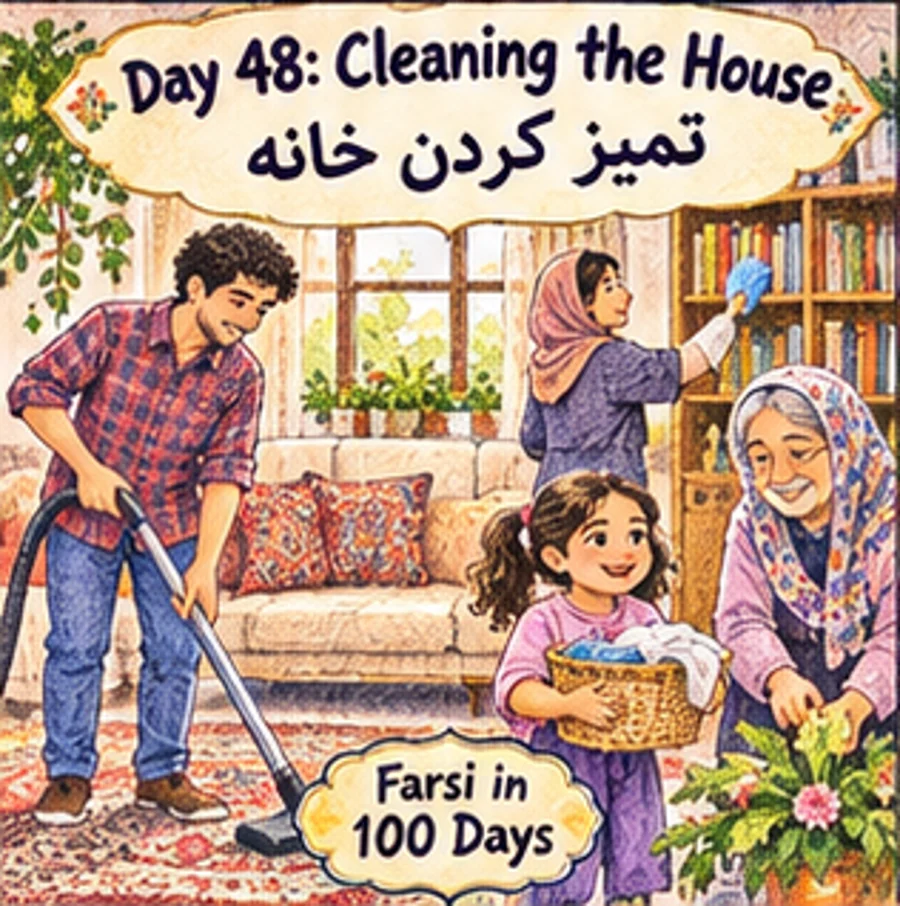
Day 48 of Learn Farsi in 100 Days, our free step-by-step Persian course: Cleaning the House. The lesson has four parts, with every Persian word in Persian script, pronunciation and English, and each part ends with a quick check.
Part 1Grammar and conversation
Day 48, Part 1 explains indirect speech (نقل قول غیرمستقیم, naghl-e ghol-e gheyr-e mostaghim), usually introduced with که (ke, that), as in علی به سارا گفت که فردا به مسافرت میرود, and a conversation about cleaning the bathroom (حمام, hammâm) together.
Grammar: indirect speech
In indirect speech, نقل قول غیرمستقیم (naghl-e ghol-e gheyr-e mostaghim), we report what someone said instead of quoting it, usually after the conjunction که (ke, that). There are no quotation marks, and the person of the verb and pronouns change to fit the reporter: Ali’s “I am going” (میروم, miravam) becomes “he is going” (میرود, miravad). Persian keeps the original tense; it does not shift it back as English often does.
Examples
Ali told Sara that he was going on a trip tomorrow.
Sara told me to read her a book.
Conversation: who cleans what
| Speaker | Persian | English and pronunciation |
|---|---|---|
| A الف | امروز باید خانه را تمیز کنیم. چند روز است تمیز نکردهایم. | We have to clean the house today. We haven’t cleaned it for several days. emruz bâyad khâne râ tamiz konim. chand ruz ast tamiz nakarde-im. |
| B ب | بله، خیلی کثیف است. | Yes, it’s very dirty. bale, kheyli kasif ast. |
| A الف | تو میتوانی به من کمک کنی. | You can help me. to mitavâni be man komak koni. |
| B ب | چرا من؟ | Why me? cherâ man? |
| A الف | چون تو در کثیف کردن آن کمک کردهای. | Because you helped make it dirty. chon to dar kasif kardan-e ân komak karde-i. |
| B ب | بسیار خوب! تو میخواهی من چه کاری انجام بدهم؟ | All right! What do you want me to do? besyâr khub! to mikhâhi man che kâri anjâm bedaham? |
| A الف | من میخواهم تو حمام را تمیز کنی. | I want you to clean the bathroom. man mikhâham to hammâm râ tamiz koni. |
| B ب | خوب است! آن کار آسانی است. | Fine! That’s an easy job. khub ast! ân kâr-e âsâni ast. |
| A الف | سینک، وان و توالت را هم باید تمیز کنی. | You also have to clean the sink, the bathtub and the toilet. sink, vân va tuvâlet râ ham bâyad tamiz koni. |
| B ب | همهی این کارها را من باید انجام بدهم؟ | Do I have to do all of this? hame-ye in kâr-hâ râ man bâyad anjâm bedaham? |
| A الف | این تمام کارها نیست! کارهای زیاد دیگری است که من انجام میدهم! | That’s not all the work! There are lots of other jobs that I’m doing! in tamâm-e kâr-hâ nist! kâr-hâ-ye ziyâd-e digari ast ke man anjâm midaham! |
Quick check
- Which conjunction usually introduces indirect speech in Persian?
Show answer
که (ke), “that” - Change to indirect speech: علی گفت: “فردا به مسافرت میروم.“
Show answer
علی گفت که فردا به مسافرت میرود. (ali goft ke fardâ be mosâferat miravad.) - What does کثیف (kasif) mean?
Show answer
dirty
Part 2Grammar, common phrases, poetry and word of the day
Day 48, Part 2 shows the stems of infinitives ending in -dan, such as آوردن (âvardan, to bring) with stems آور and آورد, camping phrases like برای یک چادر جا دارید؟ (Do you have space for a tent?), a poem by Saadi, and the word چرب زبان (charb-zabân, glib).
Grammar: infinitives ending in -dan
Some infinitives (مصدر, masdar) end in ـدن (-dan) after a consonant, like آوردن (âvardan) and خوردن (khordan). Drop the final ـن (-an) to get the past stem (ستاک گذشته, setâk-e gozashte): آورد, خورد. Drop ـدن (-dan) to get the present stem (ستاک حال, setâk-e hâl): آور, خور. So you get آوردم (âvardam, I brought) but میآورم (miâvaram, I bring).
| Persian | Pronunciation | English |
|---|---|---|
| آوردن ، آور ، آورد | âvardan, âvar, âvard | to bring: infinitive, present stem, past stem |
| خوردن ، خور ، خورد | khordan, khor, khord | to eat: infinitive, present stem, past stem |
Common phrases
| Persian | Pronunciation | English |
|---|---|---|
| ممکن است اینجا اردو بزنیم؟ | momken ast injâ ordu bezanim? | May we camp out here? |
| برای یک چادر جا دارید؟ | barâye yek châdor jâ dârid? | Do you have space for a tent? |
| کجا ماهیگیری مجاز است؟ | kojâ mâhigiri mojâz ast? | Where is fishing allowed? |
Poetry: a ghazal by Saadi
Two couplets by Saadi in which the lover says that even in death, and on the Day of Resurrection, he will still be longing for the beloved.
| Persian | Pronunciation | English |
|---|---|---|
| در آن نفس که بمیرم در آرزوی تو باشم | dar ân nafas ke bemiram dar ârezu-ye to bâsham | With the breath in which I die, may I be longing for you; |
| بدان امید دهم جان که خاک کوی تو باشم | bedân omid daham jân ke khâk-e ku-ye to bâsham | I give my life in the hope of becoming the dust of your street. |
| به وقت صبح قیامت که سر ز خاک برآرم | be vaght-e sobh-e ghiyâmat ke sar ze khâk barâram | On the morning of Resurrection, when I raise my head from the dust, |
| به گفت و گوی تو خیزم به جست و جوی تو باشم | be goft-o-gu-ye to khizam, be jost-o-ju-ye to bâsham | I will rise talking of you and go searching for you. |
Word of the day: چرب زبان (charb-zabân)
Meaning: glib, smooth-talking
He is a smooth talker.
Quick check
- What are the present and past stems of خوردن (khordan, to eat)?
Show answer
present stem خور (khor), past stem خورد (khord) - How do you ask “Do you have space for a tent?” in Persian?
Show answer
برای یک چادر جا دارید؟ (barâye yek châdor jâ dârid?) - What does چرب زبان (charb-zabân) mean?
Show answer
glib, smooth-talking (literally “oily-tongued”)
Part 3Daily tasks, conversation and idiom of the day
Day 48, Part 3 teaches everyday chores and routines such as ظرف شستن (zarf shostan, to wash dishes) and شام پختن (shâm pokhtan, to cook dinner), a conversation between Shiva and Shadi about housework before a picnic, and the idiom تخممرغ دزد؛ شتر دزد میشود.
Daily tasks (کارهای روزانه)
| Persian | Pronunciation | English |
|---|---|---|
| شام پختن | shâm pokhtan | to cook dinner |
| قهوه نوشیدن | ghahve nushidan | to drink coffee |
| صبحانه خوردن | sobhâne khordan | to eat breakfast |
| ورزش کردن | varzesh kardan | to exercise |
| به تختخواب رفتن | be takhtkhâb raftan | to go to bed |
| رفتن به مدرسه | raftan be madrese | to go to school |
| اخبار خواندن | akhbâr khândan | to read the news |
| مطالعه کردن | motâle’e kardan | to study |
| تماشای تلویزیون | tamâshâ-ye televizyon | watching TV |
| تمیز کردن خانه | tamiz kardan-e khâne | cleaning the house |
| ظرف شستن | zarf shostan | to wash the dishes |
| لباس شستن | lebâs shostan | to do the laundry |
Conversation: chores before the picnic
| Speaker | Persian | English and pronunciation |
|---|---|---|
| Shiva شیوا | امروز میخواهم با دوستانم به پیکنیک بروم. | Today I want to go on a picnic with my friends. emruz mikhâham bâ dustânam be piknik beravam. |
| Shadi شادی | نه، امروز باید کارهای خانه را انجام بدهیم. | No, today we have to do the housework. na, emruz bâyad kâr-hâ-ye khâne râ anjâm bedahim. |
| Shiva شیوا | چه کاری؟ | What work? che kâri? |
| Shadi شادی | شستن ظرفها، شستن لباسها، جارو کردن … | Washing the dishes, washing the clothes, vacuuming … shostan-e zarf-hâ, shostan-e lebâs-hâ, jâru kardan … |
| Shiva شیوا | نه! من با دوستانم قرار گذاشتهام. | No! I’ve made plans with my friends. na! man bâ dustânam gharâr gozâshte-am. |
| Shadi شادی | خوب میتوانی زودتر کارهای خانه را انجام بدهی تا بتوانی با دوستانت به پیکنیک بروی. | Well, you can do the housework sooner so that you can go on the picnic with your friends. khob, mitavâni zudtar kâr-hâ-ye khâne râ anjâm bedahi tâ betavâni bâ dustânat be piknik beravi. |
Idiom of the day
تخممرغ دزد؛ شتر دزد میشود.
tokhm-e morgh dozd, shotor dozd mishavad.
Word for word: An egg thief becomes a camel thief.
Meaning in Persian: کسی که کارهای خلاف کوچکی انجام میدهد، در نهایت کارهای بد بزرگی انجام خواهد داد.
Meaning: Someone who does small wrong things will end up doing big bad things.
English equivalent: Be the thin end of the wedge.
Quick check
- How do you say “to wash the dishes” in Persian?
Show answer
ظرف شستن (zarf shostan) - Why can’t Shiva stay home in the conversation?
Show answer
She has made plans with her friends: من با دوستانم قرار گذاشتهام (man bâ dustânam gharâr gozâshte-am). - What does the idiom تخممرغ دزد؛ شتر دزد میشود mean?
Show answer
Someone who starts with small wrongs will end up doing big ones (literally “An egg thief becomes a camel thief”).
Part 4Reading and new words
Day 48, Part 4 is a reading about the Safavid Garden (باغ صفوی, bâgh-e safavi) in Qazvin, which runs from the Ali Qapu gate to Chehel Sotun palace, and a vocabulary list with words like وسعت (vos’at, area, extent) and یادگار (yâdegâr, keepsake).
Reading: the Safavid Garden of Qazvin
باغ صفوی در شهر قزوین قرار دارد. این باغ، بیش از ۶ هکتار وسعت دارد. باغ صفوی از سردر عالی قاپو آغاز میشود و در آخر به محوطهی کاخ چهلستون متصل میشود. در طول مسیر باغ، آثار تاریخی مختلفی نیز قابل مشاهده است.
The Safavid Garden is in the city of Qazvin. The garden covers more than 6 hectares. It begins at the Ali Qapu gateway and ends at the grounds of Chehel Sotun palace. Along the garden’s path you can also see various historical monuments.
محدودهی اصلی باغ دارای هفت در ورودی است که فقط یک در از آنها به نام سردر عالی قاپو به یادگار مانده است.
The main area of the garden had seven entrance gates, of which only one, called the Ali Qapu gateway, has survived.
New words
| Persian | Pronunciation | English |
|---|---|---|
| یادگار | yâdegâr | memento, keepsake; something left as a memorial |
| مسیر | masir | route, path |
| آثار | âsâr | works, monuments; effects |
| مختلف | mokhtalef | different, various |
| تخممرغ | tokhm-e morgh | egg |
| نهایت | nahâyat | end, extreme (در نهایت, dar nahâyat: finally) |
| خلاف | khalâf | wrongdoing, offense; contrary |
| مجاز | mojâz | allowed |
| آوردن | âvardan | to bring |
| دورهمی | dorehami | get-together, gathering |
| پیکنیک | piknik | picnic |
| قیامت | ghiyâmat | Resurrection, Judgment Day |
| محوطه | mohavate | grounds, enclosed area |
| وسعت | vos’at | area, extent |
| اردو زدن | ordu zadan | to camp |
| تاریخی | târikhi | historical |
| قابل مشاهده | ghâbel-e moshâhede | visible |
| متصل شدن | mottasel shodan | to be connected, to join |
| ورودی | vorudi | entrance |
| شامل | shâmel | including, consisting of |
| فرهنگی | farhangi | cultural |
| پهلوان | pahlavân | champion, hero (traditional strongman) |
| دردسر | dardesar | trouble |
| خیزم | khizam | I rise, I get up (poetic) |
| هکتار | hektâr | hectare |
| شتر | shotor | camel |
| چادر زدن | châdor zadan | to pitch a tent |
| خروجی | khoruji | exit; output |
| اجتماعی | ejtemâ’i | social |
| باقی ماندن | bâghi mândan | to remain |
| باغ | bâgh | garden |
| پایان یافتن | pâyân yâftan | to come to an end |
| گریختن | gorikhtan | to escape, to flee |
| انتقاد | enteghâd | criticism |
| متوجه شدن | motavajjeh shodan | to notice, to pay attention |
Quick check
- According to the reading, which of the garden’s seven gates still survives?
Show answer
the Ali Qapu gateway, سردر عالی قاپو (sardar-e âli ghâpu) - What does وسعت (vos’at) mean?
Show answer
area, extent - How do you say “to pitch a tent” in Persian?
Show answer
چادر زدن (châdor zadan)
Take this lesson further

Study with the book
Learn Farsi in 100 Days: The Ultimate Crash Course to Learning Farsi Fast
This free lesson is part of Learn Farsi in 100 Days. The book puts the whole series in one printable PDF you can study offline.
Serious about Persian? Get all 30 of our Persian learning books for $199.99 (55% less than buying them one by one).
Free Persian Starter Pack: Alphabet + 100 Core Words
Get the 14-page printable Starter Pack (all 32 letters, a 7-day reading plan, 100 core words and 20 survival phrases) and a short 5-email course. Free.
Free. Every morning: that day’s four videos and the full lessons, with every Persian word, its pronunciation and its English meaning. Stop or pause with one click.