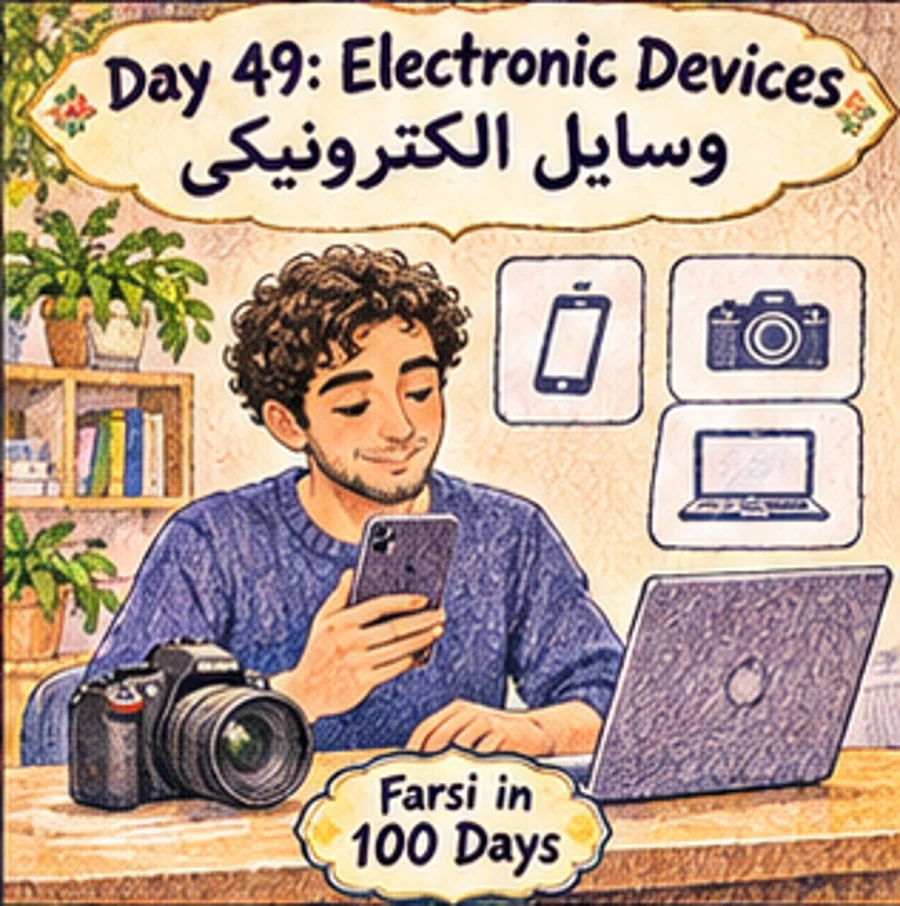
Day 49 of Learn Farsi in 100 Days, our free step-by-step Persian course: Electronic Devices. The lesson has four parts, with every Persian word in Persian script, pronunciation and English, and each part ends with a quick check.
Part 1Grammar and conversation
Day 49, Part 1 covers infinitives ending in -ftan, whose present stems are irregular, such as گفتن (goftan, to say) with stems گو and گفت and رفتن (raftan, to go) with رو and رفت, plus a conversation about a slow laptop (لپتاپ کند, lap-tâp-e kond).
Grammar: infinitives ending in -ftan
For infinitives (مصدر, masdar) ending in ـفتن (-ftan), the past stem (ستاک گذشته, setâk-e gozashte) is regular: drop the final ـن (-an), so گفتن becomes گفت. The present stem (ستاک حال, setâk-e hâl) is irregular and must be learned with each verb: گو (gu), گیر (gir), رو (rav). For example, گفتم (goftam, I said) but میگویم (miguyam, I say).
| Persian | Pronunciation | English |
|---|---|---|
| گفتن ، گو ، گفت | goftan, gu, goft | to say: infinitive, present stem, past stem |
| گرفتن ، گیر ، گرفت | gereftan, gir, gereft | to take, to get: infinitive, present stem, past stem |
| رفتن ، رو ، رفت | raftan, rav, raft | to go: infinitive, present stem, past stem |
Conversation: a slow laptop
| Speaker | Persian | English and pronunciation |
|---|---|---|
| A الف | مدتی است لپتاپم خیلی کند شدهاست. | My laptop has been really slow for a while. moddati ast lap-tâpam kheyli kond shode ast. |
| B ب | یک لپتاپ جدید بخر. | Buy a new laptop. yek lap-tâp-e jadid bekhar. |
| A الف | اگر پول داشتم خریده بودم. | If I had the money, I would have bought one already. agar pul dâshtam kharide budam. |
| B ب | چرا کند است؟ | Why is it slow? cherâ kond ast? |
| A الف | نمیدانم مشکلش چیست. | I don’t know what’s wrong with it. nemidânam moshkelash chist. |
| B ب | آیا آن را به یک فروشگاه کامپیوتر بردهای؟ | Have you taken it to a computer store? âyâ ân râ be yek forushgâh-e kâmpyuter borde-i? |
| A الف | اگر پول داشتم برده بودم. | If I had the money, I would have taken it already. agar pul dâshtam borde budam. |
| B ب | من فکر میکنم که تو باید آن را تحمل کنی. | I think you’ll just have to put up with it. man fekr mikonam ke to bâyad ân râ tahammol koni. |
| A الف | گاهی اوقات میخواهم آن را از پنجره پرت کنم بیرون. | Sometimes I want to throw it out the window. gâhi oghât mikhâham ân râ az panjere part konam birun. |
Quick check
- What is the present stem of گرفتن (gereftan, to take)?
Show answer
گیر (gir), as in میگیرم (migiram, I take) - How do you say “My laptop has become very slow” in Persian?
Show answer
لپتاپم خیلی کند شدهاست. (lap-tâpam kheyli kond shode ast.) - What does تحمل کردن (tahammol kardan) mean?
Show answer
to put up with, to tolerate
Part 2Grammar, common phrases, poetry and word of the day
Day 49, Part 2 shows how to report a question, turning علی پرسید: کجا بودی؟ into علی پرسید که کجا بودم (Ali asked where I had been), gives shopping phrases such as گارانتی دارد؟ (gârânti dârad?, Does it have a guarantee?), a poem by Shahriar, and the word خنگ (khang, stupid).
Grammar: reported questions
A question can be quoted directly or reported indirectly (نقل قول سؤالی, naghl-e ghol-e so’âli). In direct speech the question is repeated exactly after پرسید (porsid, asked): کجا بودی؟ (kojâ budi?, Where were you?). In indirect speech, که (ke) is added, the question mark is dropped, and the person changes to fit the reporter: بودی (you were) becomes بودم (I was) when Ali is asking me.
Examples
(direct) Ali asked, “Where were you?”
(indirect) Ali asked where I had been.
Common phrases
| Persian | Pronunciation | English |
|---|---|---|
| ممکن است به من بگویید چطور کار میکند؟ | momken ast be man beguyid chetor kâr mikonad? | Could you tell me how it works? |
| گارانتی دارد؟ | gârânti dârad? | Does it have a guarantee? |
| من دنبال یک دوربین میگردم. | man donbâl-e yek durbin migardam. | I’m looking for a camera. |
Poetry: Shahriar, “Why now?”
Lines by the poet Shahriar, reproaching a beloved who came too late. The third line refers to the Shahnameh story in which the healing potion (نوشدارو, nushdâru) reached Sohrab only after he had died.
| Persian | Pronunciation | English |
|---|---|---|
| آمدی جانم به قربانت ولی حالا چرا؟ | âmadi jânam be ghorbânat vali hâlâ cherâ? | You came, my dear, I’d give my life for you, but why now? |
| بیوفا حالا که من افتادهام از پا چرا؟ | bi-vafâ, hâlâ ke man oftâde-am az pâ cherâ? | Faithless one, why now, when I can no longer stand? |
| نوشدارویی و بعد از مرگ سهراب آمدی | nushdâru-yi va ba’d az marg-e sohrâb âmadi | You are the healing potion that came after Sohrab’s death. |
| سنگدل! این زودتر میخواستی، حالا چرا؟ | sangdel! in zudtar mikhâsti, hâlâ cherâ? | Hard-hearted one! You should have wanted this sooner; why now? |
Word of the day: خنگ (khang)
Meaning: stupid, slow-witted
The teacher told the student that he was very slow-witted.
Quick check
- Report this question indirectly: علی پرسید: کجا بودی؟
Show answer
علی پرسید که کجا بودم. (ali porsid ke kojâ budam.), “Ali asked where I had been.” - How do you say “I’m looking for a camera” in Persian?
Show answer
من دنبال یک دوربین میگردم. (man donbâl-e yek durbin migardam.) - What does خنگ (khang) mean?
Show answer
stupid, slow-witted
Part 3Spices, conversation and idiom of the day
Day 49, Part 3 names common spices such as زعفران (za’farân, saffron) and دارچین (dârchin, cinnamon), has Homayoun and Khosrow talk about buying a camera (دوربین, durbin), and teaches the idiom دروغگو، خود، خویش را رسوا میکند (a liar gives himself away).
Spices (ادویهجات)
| Persian | Pronunciation | English |
|---|---|---|
| فلفل قرمز | felfel-e ghermez | chili, red pepper |
| زعفران | za’farân | saffron |
| زردچوبه | zardchube | turmeric |
| کنجد | konjed | sesame |
| آویشن | âvishan | thyme |
| دارچین | dârchin | cinnamon |
| هل | hel | cardamom |
| زنجبیل | zanjebil | ginger |
Conversation: choosing a camera
| Speaker | Persian | English and pronunciation |
|---|---|---|
| Homayoun همایون | خسرو! اینجا چهکار میکنی؟ | Khosrow! What are you doing here? khosrow! injâ che kâr mikoni? |
| Khosrow خسرو | سلام همایون، من دنبال یک دوربین میگردم، پیشنهادی نداری؟ | Hi Homayoun, I’m looking for a camera. Do you have any suggestions? salâm homâyun, man donbâl-e yek durbin migardam, pishnahâdi nadâri? |
| Homayoun همایون | سامسونگ چطور است؟ | How about Samsung? sâmsung chetor ast? |
| Khosrow خسرو | بد نیست، ارزان هم است. نظرت در مورد سونی چیست؟ | It’s not bad, and it’s cheap too. What do you think of Sony? bad nist, arzân ham ast. nazaret dar mored-e soni chist? |
| Homayoun همایون | آن هم خیلی خوب است، اما من در مورد دوربین زیاد اطلاعاتی ندارم. | That’s very good too, but I don’t know much about cameras. ân ham kheyli khub ast, ammâ man dar mored-e durbin ziyâd ettelâ’âti nadâram. |
| Khosrow خسرو | باید کمی در مورد آن تحقیق کنم. | I should do a bit of research on it. bâyad kami dar mored-e ân tahghigh konam. |
| Homayoun همایون | دوربین قبلی تو چی شد؟ | What happened to your old camera? durbin-e ghabli-ye to chi shod? |
| Khosrow خسرو | خراب شد. | It broke. kharâb shod. |
Idiom of the day
دروغگو، خود، خویش را رسوا میکند.
doruggu, khod, khish râ rosvâ mikonad.
Word for word: A liar disgraces himself, by himself.
Meaning in Persian: دروغگو کم حافظه است.
Meaning: A liar has a poor memory (and so sooner or later gives himself away).
English equivalent: A liar ought to have a good memory.
Quick check
- What does زعفران (za’farân) mean?
Show answer
saffron - How do you ask “What happened to your old camera?” in Persian?
Show answer
دوربین قبلی تو چی شد؟ (durbin-e ghabli-ye to chi shod?) - Which English saying matches دروغگو، خود، خویش را رسوا میکند?
Show answer
“A liar ought to have a good memory.”
Part 4Reading and new words
Day 49, Part 4 is a reading about Iranian food, from regional dishes to national favorites like چلوکباب (chelow-kabâb, rice with kebab) and جوجه کباب (juje kabâb, chicken kebab), followed by a vocabulary list with herbs, fruits and words such as لذیذ (laziz, delicious).
Reading: Iranian food
غذاهای ایرانی بسیار متنوع و لذیذ هستند. هر منطقه از ایران غذاهای مخصوص به خود را دارد. اما بعضی از غذاها، غذاهای ملی به شمار میروند و در همه جای کشور تهیه و خورده میشوند.
Iranian food is very varied and delicious. Each region of Iran has its own special dishes. But some dishes count as national dishes and are made and eaten all over the country.
یکی از غذاهای خوشمزه و معروف ایرانی، چلوکباب است که با برنج و گوشت گوسفند یا گاو تهیه میشود. جوجه کباب، چلو خورشت و چلو مرغ هم از غذاهای رایج ایرانی هستند.
One of the tasty and famous Iranian dishes is chelow kabab, which is made with rice and lamb or beef. Chicken kebab, rice with stew and rice with chicken are also common Iranian dishes.
New words
| Persian | Pronunciation | English |
|---|---|---|
| چرب | charb | oily, greasy |
| دروغگو | doruggu | liar |
| حافظه | hâfeze | memory |
| برملا شدن | barmalâ shodan | to be revealed, to come out |
| دعوت کردن | da’vat kardan | to invite |
| بابونه | bâbune | chamomile |
| جعفری | ja’fari | parsley |
| نعنای تند | na’nâ-ye tond | spearmint |
| ملی | melli | national |
| تهیه کردن | tahiye kardan | to prepare, to make |
| مخفی شدن | makhfi shodan | to hide |
| بیوفا | bi-vafâ | unfaithful, disloyal |
| رسوا کردن | rosvâ kardan | to disgrace, to expose |
| گشنیز | geshniz | coriander, cilantro |
| ریحان | reyhân | basil |
| به شمار رفتن | be shomâr raftan | to be counted as, to be considered |
| چلوکباب | chelow-kabâb | rice with kebab |
| جوجه کباب | juje kabâb | chicken kebab |
| مرغ | morgh | chicken |
| معروف | ma’ruf | famous |
| ترکیبات | tarkibât | compounds, combinations |
| شکر | shekar | sugar |
| ترشی | torshi | pickled vegetables |
| زیره | zire | cumin |
| لذیذ | laziz | delicious |
| منطقه | mantaghe | region, area |
| مخصوص | makhsus | special, particular |
| مشهور | mashhur | famous |
| هندوانه | hendevâne | watermelon |
| ریواس | rivâs | rhubarb |
| خیارشور | khiyârshur | pickled cucumber, pickle |
| هلو | holu | peach |
| نمک | namak | salt |
| سیر | sir | garlic |
Quick check
- According to the reading, what is چلوکباب (chelow-kabâb) made with?
Show answer
rice and lamb or beef: برنج و گوشت گوسفند یا گاو (berenj va gusht-e gusfand yâ gâv) - What does لذیذ (laziz) mean?
Show answer
delicious - How do you say “garlic” in Persian?
Show answer
سیر (sir)
Take this lesson further

Study with the book
Learn Farsi in 100 Days: The Ultimate Crash Course to Learning Farsi Fast
This free lesson is part of Learn Farsi in 100 Days. The book puts the whole series in one printable PDF you can study offline.
Serious about Persian? Get all 30 of our Persian learning books for $199.99 (55% less than buying them one by one).
Free Persian Starter Pack: Alphabet + 100 Core Words
Get the 14-page printable Starter Pack (all 32 letters, a 7-day reading plan, 100 core words and 20 survival phrases) and a short 5-email course. Free.
Free. Every morning: that day’s four videos and the full lessons, with every Persian word, its pronunciation and its English meaning. Stop or pause with one click.