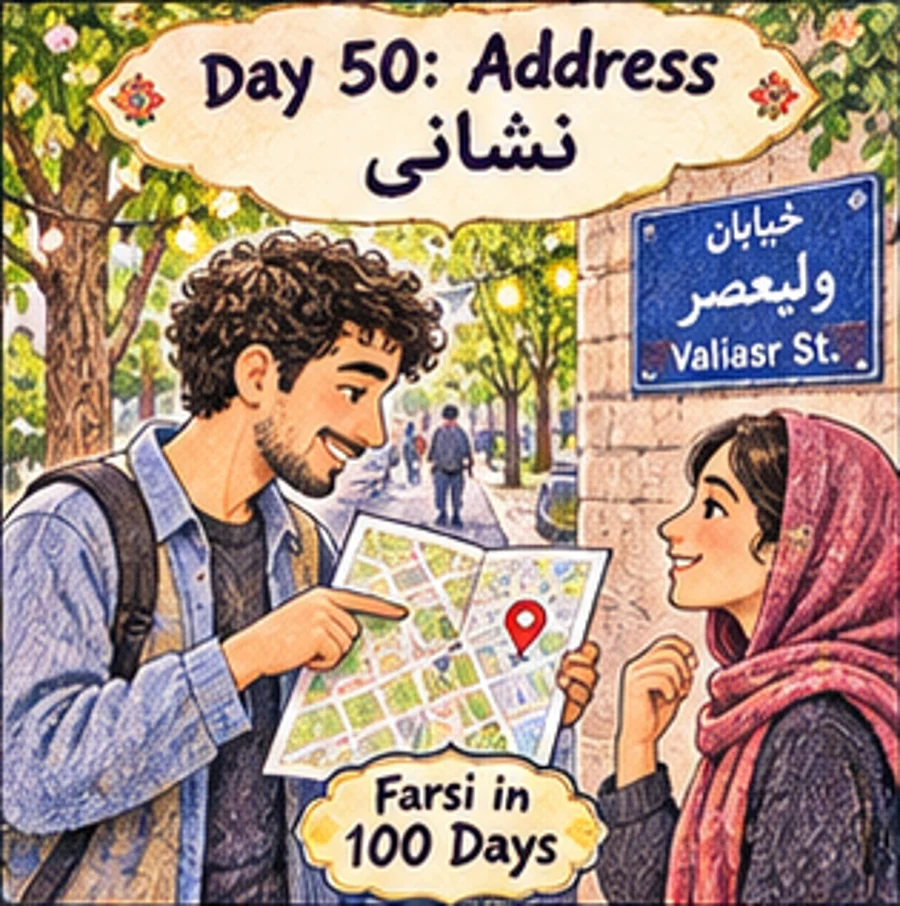
Day 50 of Learn Farsi in 100 Days, our free step-by-step Persian course: Addresses. The lesson has four parts, with every Persian word in Persian script, pronunciation and English, and each part ends with a quick check.
Part 1Conversation and grammar
Day 50, Part 1 has a conversation about finding an address on Hakhamanesh Street (خیابان هخامنش, khiyâbân-e hakhâmanesh), and shows how to report a command: به من گفت: پنجره را ببند becomes به من گفت که پنجره را ببندم (he told me to close the window).
Conversation: looking for an address
| Speaker | Persian | English and pronunciation |
|---|---|---|
| A الف | ببخشید من دنبال آموزشگاه کامپیوتر پارس هستم، شما میدانید کجاست؟ | Excuse me, I’m looking for the Pars Computer School. Do you know where it is? bebakhshid, man donbâl-e âmuzeshgâh-e kâmpyuter-e pârs hastam, shomâ midânid kojâst? |
| B ب | آدرس آن را دارید؟ | Do you have its address? âdres-e ân râ dârid? |
| A الف | بله دارم، خیابان هخامنش کوچهی شمارهی ۱۲. | Yes, I do: Hakhamanesh Street, Alley No. 12. bale dâram, khiyâbân-e hakhâmanesh, kuche-ye shomâre-ye davâzdah. |
| B ب | خیابان هخامنش یک خیابان بالاتر از اینجا است. | Hakhamanesh Street is one street up from here. khiyâbân-e hakhâmanesh yek khiyâbân bâlâtar az injâ ast. |
| A الف | از اینجا خیلی دور است؟ | Is it very far from here? az injâ kheyli dur ast? |
| B ب | تقریبا، بهتر است با تاکسی بروید. | Fairly far. You’d better take a taxi. taghriban, behtar ast bâ tâksi beravid. |
| A الف | از راهنمایی شما ممنونم. | Thank you for your directions. az râhnamâyi-ye shomâ mamnunam. |
| B ب | خواهش میکنم. | You’re welcome. khâhesh mikonam. |
Grammar: reported commands
A command can also be quoted directly or reported (نقل قول امری, naghl-e ghol-e amri). In direct speech the imperative stays as it was: ببند (beband, close!). In indirect speech, که (ke) is added and the imperative becomes a subjunctive verb whose person matches the one who was told: ببندم (bebandam, that I close) when said to me, بخواند (bekhânad, that she study) when said to Sara.
Examples
(direct) He said to me, “Close the window.”
(indirect) He told me to close the window.
(direct) He said to Sara, “Study.”
(indirect) He told Sara to study.
Quick check
- Report this command indirectly: به من گفت: پنجره را ببند.
Show answer
به من گفت که پنجره را ببندم. (be man goft ke panjere râ bebandam.), “He told me to close the window.” - How do you say “Thank you for your directions” in Persian?
Show answer
از راهنمایی شما ممنونم. (az râhnamâyi-ye shomâ mamnunam.) - What does آموزشگاه (âmuzeshgâh) mean?
Show answer
a school or training institute (for a skill, such as computers)
Part 2Idiom of the day, common phrases, poetry and word of the day
Day 50, Part 2 explains the proverb بادمجان بم آفت ندارد (bâdemjân-e bam âfat nadârad, “a bad eggplant never spoils”), gives phrases for asking for a phone number or address, Saadi’s famous poem بنی آدم (Bani Adam), and the word جراحت (jerâhat, wound).
Idiom of the day
بادمجان بم آفت ندارد.
bâdemjân-e bam âfat nadârad.
Word for word: A bad eggplant has no blight.
Meaning in Persian: این عبارت را وقتی بهکار میبرند که تصور کنند مشکلی برای شخص خطاکار پیش نمیآید. این عبارت را برای اشخاص بدجنس هم به کار میبرند.
Meaning: People use this saying when they think that nothing bad will happen to a wrongdoer. It is also used about mean, wicked people, who seem never to come to harm. (Compare the English “Ill weeds grow apace.”)
Common phrases
| Persian | Pronunciation | English |
|---|---|---|
| میتوانم شمارهی تلفن شما را بگیرم؟ | mitavânam shomâre-ye telefon-e shomâ râ begiram? | May I have your telephone number? |
| میتوانم آدرس شما را داشته باشم؟ | mitavânam âdres-e shomâ râ dâshte bâsham? | Could I have your address? |
Poetry: Saadi, “Bani Adam”
These lines from Saadi’s Golestan are among the best-known verses in Persian; they are often quoted to say that all people share one humanity.
| Persian | Pronunciation | English |
|---|---|---|
| بنی آدم اعضای یک پیکرند | bani âdam a’zâ-ye yek peykarand | Human beings are members of one body, |
| که در آفرینش ز یک گوهرند | ke dar âfarinesh ze yek goharand | for in creation they come from one essence. |
| چو عضوی به درد آورد روزگار | cho ozvi be dard âvarad ruzgâr | When fate brings pain to one member, |
| دگر عضوها را نماند قرار | degar ozv-hâ râ namânad gharâr | the other members cannot rest. |
Word of the day: جراحت (jerâhat)
Meaning: wound, injury
His hand was injured because of the accident.
Quick check
- When do people say بادمجان بم آفت ندارد (bâdemjân-e bam âfat nadârad)?
Show answer
When they think nothing bad will happen to a wrongdoer or a wicked person. - How do you ask “May I have your telephone number?” in Persian?
Show answer
میتوانم شمارهی تلفن شما را بگیرم؟ (mitavânam shomâre-ye telefon-e shomâ râ begiram?) - What does جراحت (jerâhat) mean?
Show answer
wound, injury
Part 3Giving directions, conversation and idiom of the day
Day 50, Part 3 teaches phrases for giving directions, such as سمت چپ خیابان (samt-e chap-e khiyâbân, on the left side of the street) and مستقیم (mostaghim, straight ahead), a conversation about getting to a shopping center, and the idiom فضول را بردند جهنم، گفت هیزمش تر است.
Giving directions (آدرس دادن)
| Persian | Pronunciation | English |
|---|---|---|
| پایین خیابان | pâyin-e khiyâbân | down the street, at the lower end of the street |
| سمت چپ خیابان | samt-e chap-e khiyâbân | on the left side of the street |
| در گوشهی خیابان | dar gushe-ye khiyâbân | on the street corner |
| آنطرف خیابان | ân taraf-e khiyâbân | across the street, on the other side of the street |
| سمت راست خیابان | samt-e râst-e khiyâbân | on the right side of the street |
| اینطرف خیابان | in taraf-e khiyâbân | on this side of the street |
| بالای خیابان | bâlâ-ye khiyâbân | up the street, at the upper end of the street |
| بعد از میدان | ba’d az meydân | after the square |
| مستقیم | mostaghim | straight ahead |
Conversation: the way to the shopping center
| Speaker | Persian | English and pronunciation |
|---|---|---|
| A الف | ببخشید شما میدانید چطور میتوانم به مرکز خرید بروم؟ | Excuse me, do you know how I can get to the shopping center? bebakhshid, shomâ midânid chetor mitavânam be markaz-e kharid beravam? |
| B ب | بله، مستقیم بروید، به اولین چهارراه که رسیدید به خیابان سمت چپ بروید. حدود صد متر بروید جلو، مرکز خرید در سمت راست خیابان است. | Yes. Go straight, and when you reach the first intersection, take the street on the left. Go about a hundred meters ahead; the shopping center is on the right side of the street. bale, mostaghim beravid, be avvalin chahârrâh ke residid be khiyâbân-e samt-e chap beravid. hodud-e sad metr beravid jelo, markaz-e kharid dar samt-e râst-e khiyâbân ast. |
| A الف | ممنون از راهنمایی شما. | Thanks for your directions. mamnun az râhnamâyi-ye shomâ. |
| B ب | خواهش میکنم. | You’re welcome. khâhesh mikonam. |
Idiom of the day
فضول را بردند جهنم، گفت هیزمش تر است.
fozul râ bordand jahannam, goft hizomash tar ast.
Word for word: They took the busybody to hell, and he said its firewood was wet.
Meaning in Persian: دربارهی کسی که بسیار ایرادگیر است.
Meaning: Said about someone who is very nosy and finds fault with everything, even where it makes no sense.
English equivalent: Curiosity killed the cat.
Quick check
- How do you say “on the right side of the street” in Persian?
Show answer
سمت راست خیابان (samt-e râst-e khiyâbân) - In the conversation, where is the shopping center?
Show answer
about a hundred meters down the street on the left after the first intersection, on the right side of the street: در سمت راست خیابان (dar samt-e râst-e khiyâbân) - What kind of person is the idiom فضول را بردند جهنم، گفت هیزمش تر است about?
Show answer
a nosy person who finds fault with everything
Part 4Reading and new words
Day 50, Part 4 is a reading about the Kurds of Iran and their rain-asking custom, بارانخواهی (bârân-khâhi), held in years of drought (خشکسالی, khoshksâli), followed by a vocabulary list with words like چهارراه (chahârrâh, intersection) and روبهروی (ruberu-ye, in front of).
Reading: the Kurds and the rain ceremony
کردها در سراسر ایران وجود دارند ولی بیشتر در استانهای کردستان، استان کرمانشاه و آذربایجان غربی قرار دارند.
Kurds live all over Iran, but most of them are in the provinces of Kurdistan, Kermanshah and West Azerbaijan.
از آداب و رسوم معروف در میان مردم کرد، بارانخواهی است. این مراسم در ایام خشکسالی یا سالهایی که میزان بارندگی آن کم است اجرا میشود.
One of the well-known customs among the Kurdish people is bârân-khâhi, praying for rain. This ceremony is held in times of drought or in years when there is little rainfall.
New words
| Persian | Pronunciation | English |
|---|---|---|
| آفت | âfat | blight, pest |
| خطاکار | khatâkâr | wrongdoer |
| اشخاص | ashkhâs | people, persons |
| بدجنس | badjens | wicked, mean |
| پیکر | peykar | body |
| آفرینش | âfarinesh | creation |
| گوهر | gohar | jewel, gem; essence |
| گوشه | gushe | corner |
| آنطرف | ân taraf | the other side |
| اینطرف | in taraf | this side |
| مستقیم | mostaghim | straight |
| ابتدا | ebtedâ | beginning; at first |
| چهارراه | chahârrâh | intersection, crossroads |
| متر | metr | meter |
| فضول | fozul | nosy person, busybody |
| جهنم | jahannam | hell |
| هیزم | hizom | firewood |
| تر | tar | wet |
| ایرادگیر | irâdgir | fault-finding, nitpicker |
| سراسر | sarâsar | throughout, all over |
| در میان | dar miyân-e | among |
| ایام | ayyâm | days, times |
| خشکسالی | khoshksâli | drought |
| روبهروی | ruberu-ye | in front of, opposite |
| میزان | mizân | amount, level |
| اجرا کردن | ejrâ kardan | to perform, to carry out |
| کامل | kâmel | complete, full |
| همینطور | hamintor | as well, likewise |
| سختگیر | sakhtgir | strict |
| تدریس | tadris | teaching |
| بزهکار | bezahkâr | offender, delinquent |
| خیال کردن | khiyâl kardan | to imagine, to suppose |
| مستمند | mostamand | needy |
| کوچه | kuche | alley, lane |
| مقصد | maghsad | destination |
Quick check
- According to the reading, when is the بارانخواهی (bârân-khâhi) ceremony held?
Show answer
in times of drought, ایام خشکسالی (ayyâm-e khoshksâli), or in years with little rainfall - What does خشکسالی (khoshksâli) mean?
Show answer
drought - How do you say “intersection” in Persian?
Show answer
چهارراه (chahârrâh)
Take this lesson further

Study with the book
Learn Farsi in 100 Days: The Ultimate Crash Course to Learning Farsi Fast
This free lesson is part of Learn Farsi in 100 Days. The book puts the whole series in one printable PDF you can study offline.
Serious about Persian? Get all 30 of our Persian learning books for $199.99 (55% less than buying them one by one).
Free Persian Starter Pack: Alphabet + 100 Core Words
Get the 14-page printable Starter Pack (all 32 letters, a 7-day reading plan, 100 core words and 20 survival phrases) and a short 5-email course. Free.
Free. Every morning: that day’s four videos and the full lessons, with every Persian word, its pronunciation and its English meaning. Stop or pause with one click.