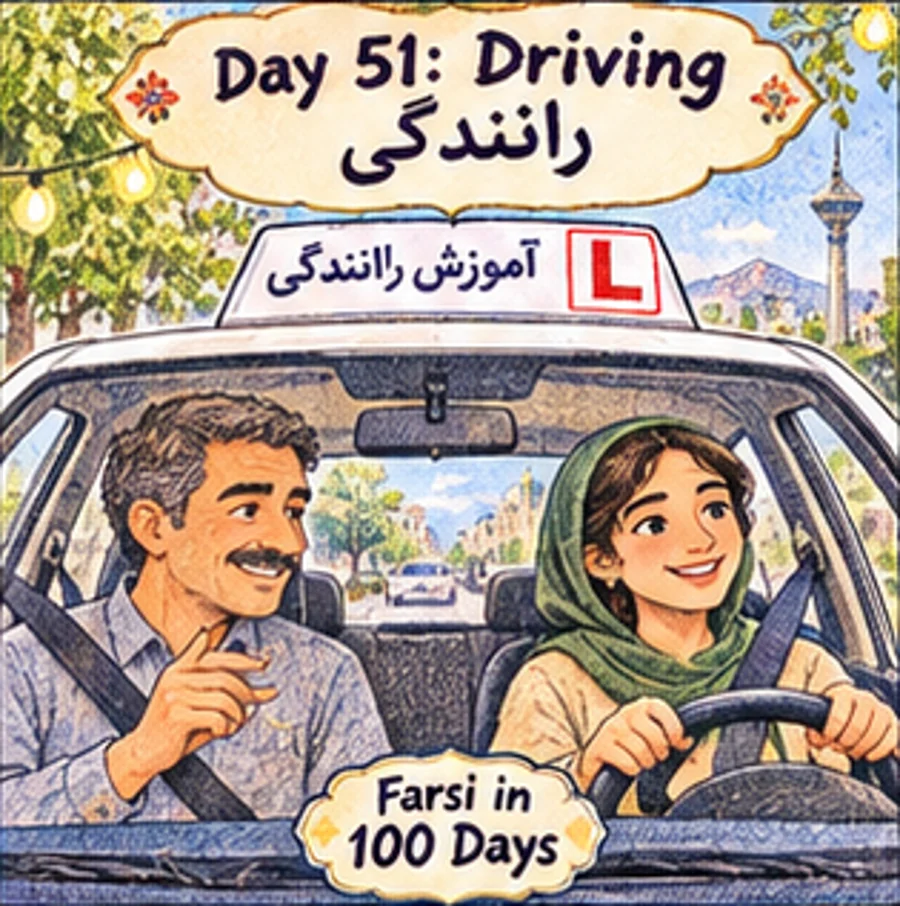
Day 51 of Learn Farsi in 100 Days, our free step-by-step Persian course: Driving. The lesson has four parts, with every Persian word in Persian script, pronunciation and English, and each part ends with a quick check.
Part 1Conversation and grammar
Day 51, Part 1 has a conversation with a fast driver who says من عاشق سرعت هستم (man âshegh-e sor’at hastam, I love speed), and introduces two kinds of nouns: common nouns, اسم عام (esm-e âm), like مرد (mard, man), and proper nouns, اسم خاص (esm-e khâs), like ایران (irân).
Conversation: driving too fast
| Speaker | Persian | English and pronunciation |
|---|---|---|
| A الف | چرا اینقدر با سرعت رانندگی میکنی؟ | Why do you drive so fast? cherâ inghadr bâ sor’at rânandegi mikoni? |
| B ب | سرعتم زیاد نیست. | I’m not going fast. sor’atam ziyâd nist. |
| A الف | سرعتت برای داخل شهر زیاد است. | Your speed is too high for inside the city. sor’atat barâ-ye dâkhel-e shahr ziyâd ast. |
| B ب | من عاشق سرعت هستم. نمیتوانم آهسته رانندگی کنم. | I love speed. I can’t drive slowly. man âshegh-e sor’at hastam. nemitavânam âheste rânandegi konam. |
| A الف | پس بهتر است رانندگی نکنی. | Then you’d better not drive. pas behtar ast rânandegi nakoni. |
| B ب | من از اینکه منتظر اتوبوس یا تاکسی باشم متنفرم. | I hate waiting for a bus or a taxi. man az in ke montazer-e otobus yâ tâksi bâsham motenafferam. |
| A الف | اما ممکن است با رانندگی به خودت و دیگران صدمه بزنی. | But you might hurt yourself and others with your driving. ammâ momken ast bâ rânandegi be khodat va digarân sadame bezani. |
| B ب | من تا حالا تصادف نکردهام. | I’ve never had an accident so far. man tâ hâlâ tasâdof nakarde-am. |
| A الف | باید همیشه مراقب بود، احتیاط شرط عقل است. | One should always be careful; caution is the wise thing (literally, caution is a condition of reason). bâyad hamishe morâgheb bud, ehtiyât shart-e aghl ast. |
Grammar: common nouns and proper nouns
Persian nouns (اسمها, esm-hâ) are of two kinds. A common noun (اسم عام, esm-e âm) can refer to any member of a group, like مرد (mard, man) or کتاب (ketâb, book). A proper noun (اسم خاص, esm-e khâs) refers to only one particular person, place or thing, like ایران (irân, Iran) or سارا (sârâ, Sara). Persian has no capital letters, so proper nouns look the same as other words.
| Persian | Pronunciation | English |
|---|---|---|
| اسم عام: بر همه چیز دلالت میکند. | esm-e âm: bar hame chiz delâlat mikonad. | Common noun: it refers to all things (of its kind). |
| اسم خاص: تنها به یک چیز اشاره دارد. | esm-e khâs: tanhâ be yek chiz eshâre dârad. | Proper noun: it refers to only one thing. |
Examples
Common nouns: man, woman, book, people
Proper nouns: Iran, Sara, the Gospel (the Bible)
Quick check
- Is کتاب (ketâb, book) a common noun or a proper noun?
Show answer
a common noun, اسم عام (esm-e âm) - How do you say “I love speed” in Persian?
Show answer
من عاشق سرعت هستم. (man âshegh-e sor’at hastam.) - What does the saying احتیاط شرط عقل است (ehtiyât shart-e aghl ast) mean?
Show answer
Caution is the wise thing to do.
Part 2Idiom of the day, common phrases, poetry and word of the day
Day 51, Part 2 gives two proverbs about good sense, such as عقلش پارهسنگ برداشته است (aghlash pâre-sang bardâshte ast, he has lost his mind), phrases for drivers like نزدیکترین پمپ بنزین کجاست؟ (where is the nearest gas station?), a poem by Sohrab Sepehri and the word جادوگر (jâdugar, magician).
Idiom of the day
عقل که نیست، جان در عذاب است.
aghl ke nist, jân dar azâb ast.
Word for word: When there is no sense, the soul is in torment.
Meaning in Persian: نادان خود را به سختی میاندازد. اشتباه باعث دردسرهای زیادی میشود.
Meaning: A foolish person gets himself into trouble. Mistakes cause a lot of headaches.
Idiom of the day
عقلش پارهسنگ برداشته است.
aghlash pâre-sang bardâshte ast.
Word for word: His mind has picked up a piece of stone.
Meaning in Persian: دیوانه است. احمق است.
Meaning: He is crazy. He is a fool.
English equivalent: He has lost his marbles.
Common phrases
| Persian | Pronunciation | English |
|---|---|---|
| نزدیکترین پمپ بنزین کجاست؟ | nazdiktarin pomp-e benzin kojâst? | Where is the nearest gas station? |
| خروجی به بزرگراه کجاست؟ | khoruji be bozorgrâh kojâst? | Where is the exit to the highway? |
Poetry
Lines by the modern Iranian poet Sohrab Sepehri (سهراب سپهری, sohrâb sepehri).
| Persian | Pronunciation | English |
|---|---|---|
| هر کجا هستم باشم | har kojâ hastam bâsham | Wherever I may be, |
| آسمان مال من است | âsemân mâl-e man ast | the sky is mine. |
| پنجره، فکر، هوا، عشق، زمین مال من است | panjere, fekr, havâ, eshgh, zamin mâl-e man ast | Window, thought, air, love, earth are mine. |
| چه اهمیت دارد | che ahammiyat dârad | What does it matter |
| گاه اگر میرویند | gâh agar miruyand | if at times there grow |
| قارچهای غربت؟ | ghârch-hâ-ye ghorbat? | the mushrooms of homesickness and exile? |
Word of the day: جادوگر (jâdugar)
Meaning: magician, sorcerer
A magician lived in that house.
Quick check
- How do you ask “Where is the nearest gas station?” in Persian?
Show answer
نزدیکترین پمپ بنزین کجاست؟ (nazdiktarin pomp-e benzin kojâst?) - What does عقلش پارهسنگ برداشته است (aghlash pâre-sang bardâshte ast) mean?
Show answer
He is crazy; he has lost his mind. - What does جادوگر (jâdugar) mean?
Show answer
magician, sorcerer
Part 3Driving, conversation and idiom of the day
Day 51, Part 3 teaches driving words such as گواهینامهی رانندگی (govâhinâme-ye rânandegi, driver’s license) and چراغ راهنما (cherâgh-e râhnamâ, traffic lights), a conversation about a fine for not wearing a seat belt (کمربند, kamarband), and the idiom دست بالای دست بسیار است.
Driving (رانندگی)
| Persian | Pronunciation | English |
|---|---|---|
| گواهینامهی رانندگی | govâhinâme-ye rânandegi | driver’s license |
| پیچ | pich | turn, bend (in the road) |
| چهارراه | chahârrâh | crossroads, intersection |
| جادهی عوارضی | jâdde-ye avârezi | toll road |
| سرعتسنج | sor’at-sanj | speedometer |
| چراغ راهنما | cherâgh-e râhnamâ | traffic lights |
| تونل | tunel | tunnel |
| عابر پیاده | âber-e piyâde | pedestrian |
Conversation: a traffic fine
| Speaker | Persian | English and pronunciation |
|---|---|---|
| Pejman پژمان | چرا اینقدر ناراحت هستی؟ | Why are you so upset? cherâ inghadr nârâhat hasti? |
| Keyvan کیوان | امروز هنگام رانندگی جریمه شدم. | I got a ticket while driving today. emruz hengâm-e rânandegi jarime shodam. |
| Pejman پژمان | چرا؟ سرعتت زیاد بود؟ | Why? Were you speeding? cherâ? sor’atat ziyâd bud? |
| Keyvan کیوان | نه کمربند نبسته بودم. | No, I hadn’t fastened my seat belt. na, kamarband nabaste budam. |
| Pejman پژمان | کمربند برای ایمنی خودت است. | The seat belt is for your own safety. kamarband barâ-ye imeni-ye khodat ast. |
| Keyvan کیوان | میدانم، اما امروز تنبلی کردم. | I know, but today I was lazy. midânam, ammâ emruz tanbali kardam. |
Idiom of the day
دست بالای دست بسیار است!
dast bâlâ-ye dast besyâr ast!
Word for word: There are many hands above a hand!
Meaning in Persian: به زیردستان ظلم نکن چون قدرتمندتر از شما هم هست.
Meaning: Don’t mistreat those below you, because there are people more powerful than you too.
English equivalent: The biter bit.
Quick check
- How do you say “driver’s license” in Persian?
Show answer
گواهینامهی رانندگی (govâhinâme-ye rânandegi) - Why did Keyvan get a fine?
Show answer
He hadn’t fastened his seat belt: کمربند نبسته بودم (kamarband nabaste budam). - What does عابر پیاده (âber-e piyâde) mean?
Show answer
pedestrian
Part 4Reading and new words
Day 51, Part 4 is a reading about Ferdowsi, the poet of the Shahnameh (شاهنامه, shâhnâme), whose day of commemoration (بزرگداشت, bozorgdâsht) falls on 25 Ordibehesht, followed by a vocabulary list with words like خروجی (khoruji, exit) and آیینه (âyine, mirror).
Reading: Ferdowsi
حکیم ابوالقاسم فردوسی طوسی در طوس خراسان به دنیا آمد. او یکی از معروفترین شاعران ایران و سرایندهی شاهنامه است. بسیاری، فردوسی را بزرگترین شاعر فارسیزبان دانستهاند.
Hakim Abolghasem Ferdowsi Tusi was born in Tus, in Khorasan. He is one of Iran’s most famous poets and the author of the Shahnameh (the Book of Kings). Many people consider Ferdowsi the greatest Persian-language poet.
نام و شهرت فردوسی در همه جای جهان شناخته شدهاست و شاهنامهی فردوسی به بسیاری از زبانهای زندهی جهان ترجمه شدهاست. در ایران روز ۲۵ اردیبهشت (پانزدهم ماه می) به نام روز بزرگداشت فردوسی نامگذاری شده است.
Ferdowsi’s name and fame are known all over the world, and his Shahnameh has been translated into many of the world’s living languages. In Iran, the 25th of Ordibehesht (May 15) has been named Ferdowsi Commemoration Day.
New words
| Persian | Pronunciation | English |
|---|---|---|
| عام | âm | general, common |
| دلالت | delâlat | indication, reference |
| چیز | chiz | thing |
| اشاره | eshâre | reference, pointing; hint |
| انجیل | enjil | the Gospel, the Bible |
| پمپ بنزین | pomp-e benzin | gas station |
| خواننده | khânande | singer |
| آشنا | âshnâ | familiar; acquaintance |
| مانند | mânand | like, such as |
| سرعت | sor’at | speed |
| غرب | gharb | west |
| خروجی | khoruji | exit |
| زیردستان | zirdastân | subordinates |
| ظلم | zolm | oppression, injustice |
| قدرتمندتر | ghodratmandtar | more powerful, stronger |
| به دنیا آمدن | be donyâ âmadan | to be born |
| جنوب | jonub | south |
| سراینده | sorâyande | poet, composer (of a poem) |
| بسیاری | besyâri | many |
| شناخته شده | shenâkhte shode | known, well-known |
| زنده | zende | alive, living |
| بزرگداشت | bozorgdâsht | commemoration |
| شاعر | shâ’er | poet |
| خاص | khâs | special, specific |
| نامگذاری کردن | nâmgozâri kardan | to name |
| شمال | shomâl | north |
| ترجمه کردن | tarjome kardan | to translate |
| شعر | she’r | poem, poetry |
| شرق | shargh | east |
| عقب | aghab | rear, back |
| آیینه | âyine | mirror |
| داشبورد | dâshbord | dashboard |
| علامت | alâmat | sign, mark |
| ساختمان | sâkhtemân | building |
Quick check
- Where was Ferdowsi born, according to the reading?
Show answer
in Tus, in Khorasan: در طوس خراسان (dar tus-e khorâsân) - What does بزرگداشت (bozorgdâsht) mean?
Show answer
commemoration - How do you say “to be born” in Persian?
Show answer
به دنیا آمدن (be donyâ âmadan)
Take this lesson further

Study with the book
Learn Farsi in 100 Days: The Ultimate Crash Course to Learning Farsi Fast
This free lesson is part of Learn Farsi in 100 Days. The book puts the whole series in one printable PDF you can study offline.
Serious about Persian? Get all 30 of our Persian learning books for $199.99 (55% less than buying them one by one).
Free Persian Starter Pack: Alphabet + 100 Core Words
Get the 14-page printable Starter Pack (all 32 letters, a 7-day reading plan, 100 core words and 20 survival phrases) and a short 5-email course. Free.
Free. Every morning: that day’s four videos and the full lessons, with every Persian word, its pronunciation and its English meaning. Stop or pause with one click.