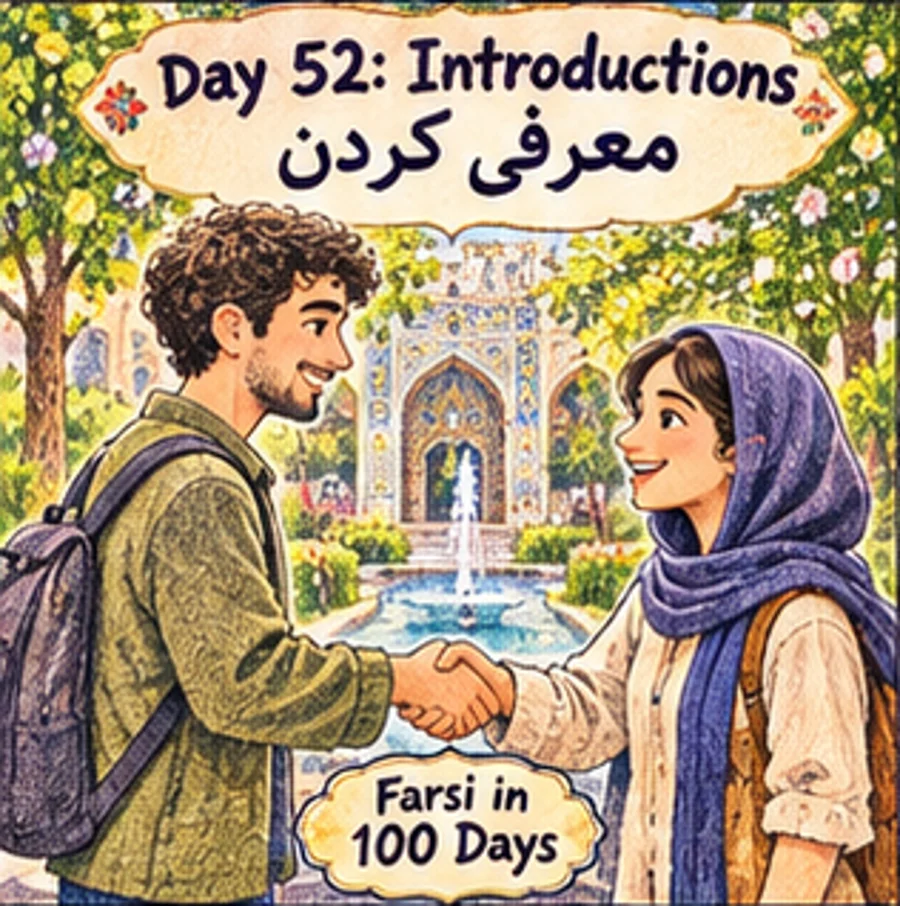
Day 52 of Learn Farsi in 100 Days, our free step-by-step Persian course: Introductions. The lesson has four parts, with every Persian word in Persian script, pronunciation and English, and each part ends with a quick check.
Part 1Conversation and grammar
Day 52, Part 1 has a conversation in which Sara introduces her teacher to her mother with ایشان استاد من هستند (ishân ostâd-e man hastand, this is my teacher), and explains definite nouns, اسم معرفه (esm-e ma’refe), such as آن مداد (ân medâd, that pencil).
Conversation: meeting Sara’s teacher
| Speaker | Persian | English and pronunciation |
|---|---|---|
| Sara سارا | مامان، ایشان استاد من هستند، آقای کیانی. | Mom, this is my teacher, Mr. Kiani. mâmân, ishân ostâd-e man hastand, âghâ-ye kiyâni. |
| Mrs. Danaei خانم دانایی | از دیدنتان خوشبختم آقای کیانی. | Pleased to meet you, Mr. Kiani. az didanetân khoshbakhtam âghâ-ye kiyâni. |
| Mr. Kiani آقای کیانی | همچنین، اجازه بدهید شما را به همسرم مریم معرفی کنم، … مریم ایشان خانم دانایی هستند و دخترشان. | Likewise. Let me introduce you to my wife, Maryam… Maryam, this is Mrs. Danaei and her daughter. hamchenin, ejâze bedahid shomâ râ be hamsaram maryam mo’arrefi konam, … maryam, ishân khânom-e dânâyi hastand va dokhtareshân. |
| Mrs. Danaei خانم دانایی | از دیدنتان خوشبختم. | Pleased to meet you. az didanetân khoshbakhtam. |
| Mrs. Kiani خانم کیانی | من هم همینطور، تعریف دخترتان را از همسرم زیاد شنیدهام، دختر بسیار باهوشی دارید. | Me too. I’ve heard a lot of good things about your daughter from my husband. You have a very smart daughter. man ham hamintor, ta’rif-e dokhtaretân râ az hamsaram ziyâd shenide-am, dokhtar-e besyâr bâhushi dârid. |
| Mrs. Danaei خانم دانایی | نظر لطف شما است. | That’s very kind of you. nazar-e lotf-e shomâ ast. |
Grammar: definite nouns
A definite noun (اسم معرفه, esm-e ma’refe) names something the reader or listener already knows. Persian has no word for “the”, so a plain noun becomes definite with a word like آن (ân, that) or این (in, this), with the ezâfe and a known owner (خانهی سارا, khâne-ye sârâ, Sara’s house), or because it is a name.
| Persian | Pronunciation | English |
|---|---|---|
| مداد ← آن مداد | medâd → ân medâd | pencil → that pencil (definite) |
| سارا ← خانهی سارا | sârâ → khâne-ye sârâ | Sara → Sara’s house (definite) |
Examples
Definite noun: the name of things that are familiar to the reader or listener.
Quick check
- How do you say “Pleased to meet you” in Persian?
Show answer
از دیدنتان خوشبختم. (az didanetân khoshbakhtam.) - Is آن مداد (ân medâd) a definite noun?
Show answer
Yes, it is اسم معرفه (esm-e ma’refe): “that pencil”, a pencil the listener knows. - What does Mrs. Danaei say to a compliment?
Show answer
نظر لطف شما است. (nazar-e lotf-e shomâ ast.), “That’s very kind of you.”
Part 2Idiom of the day, common phrases, poetry and word of the day
Day 52, Part 2 gives three proverbs, including شیره به سر کسی مالیدن (shire be sar-e kasi mâlidan, to fool someone), phrases for saying who you are with, such as با همسرم هستم (bâ hamsaram hastam, I am with my wife), a couplet by Hafez and the word چاره (châre, remedy).
Idiom of the day
شیره به سر کسی مالیدن
shire be sar-e kasi mâlidan
Word for word: to rub syrup on someone’s head
Meaning in Persian: کسی را فریب دادن.
Meaning: To deceive someone.
English equivalent: to pull the wool over someone’s eyes
Idiom of the day
شیطان را درس دادن
sheytân râ dars dâdan
Word for word: to teach the devil a lesson (to give the devil lessons)
Meaning in Persian: بسیار حیلهگر بودن.
Meaning: To be extremely cunning.
English equivalent: to be as sly as a fox
Idiom of the day
صابونش به تن من هم خورده
sâbunash be tan-e man ham khorde
Word for word: His soap has touched my body too.
Meaning in Persian: به من هم ضرر زده است.
Meaning: He has harmed me too (I have also suffered at his hands).
Common phrases
| Persian | Pronunciation | English |
|---|---|---|
| چه کسی همراه شما است؟ | che kasi hamrâh-e shomâ ast? | Who are you with? |
| با همسرم هستم. | bâ hamsaram hastam. | I am with my wife (my husband). |
| من با فرزندانم هستم. | man bâ farzandânam hastam. | I am with my children. |
Poetry
A couplet by Hafez (حافظ, hâfez). The book’s English verse translation: “O heart! the grief of love, again, thou sawest what it did, / When the heart-ravisher went; and with the beloved, fidelity-observing, what it did.”
| Persian | Pronunciation | English |
|---|---|---|
| دیدی ای دل که غم عشق دگربار چه کرد؟ | didi ey del ke gham-e eshgh degarbâr che kard? | O heart, did you see what the sorrow of love did once again? |
| چون بشد دلبر و با یار وفادار چه کرد؟ | chon beshod delbar va bâ yâr-e vafâdâr che kard? | When the beloved left, what it did to the faithful lover? |
Word of the day: چاره (châre)
Meaning: remedy, solution
He found a fix for the broken refrigerator.
Quick check
- How do you say “I am with my children” in Persian?
Show answer
من با فرزندانم هستم. (man bâ farzandânam hastam.) - What does شیره به سر کسی مالیدن (shire be sar-e kasi mâlidan) mean?
Show answer
to deceive someone - What does چاره (châre) mean?
Show answer
remedy, solution
Part 3Groceries, conversation and idiom of the day
Day 52, Part 3 teaches grocery words such as آبنبات (âbnabât, candy) and پسته (peste, pistachios), a conversation in which Sara shows Neda her photo album and introduces her big sister Lida, and the idiom جواب های، هوی است (javâb-e hây, huy ast).
Groceries (خواروبار)
| Persian | Pronunciation | English |
|---|---|---|
| آبنبات | âbnabât | candy |
| گردو | gerdu | walnuts |
| شکلات | shokolât | chocolate |
| پسته | peste | pistachios |
| بستنی | bastani | ice cream |
| بادام زمینی | bâdâm zamini | peanuts |
| آجیل | âjil | mixed nuts |
| فندق | fandogh | hazelnuts |
Conversation: the photo album
| Speaker | Persian | English and pronunciation |
|---|---|---|
| Neda ندا | چرا بلند شدی سارا؟ | Why did you get up, Sara? cherâ boland shodi sârâ? |
| Sara سارا | میخواهم آلبوم عکسهایم را به تو نشان بدهم. | I want to show you my photo album. mikhâham âlbom-e aks-hâyam râ be to neshân bedaham. |
| Neda ندا | خوب است؛ این کیست؟ | Great. Who is this? khub ast; in kist? |
| Sara سارا | این خواهر بزرگم لیدا است در شیراز زندگی میکند. | This is my big sister, Lida. She lives in Shiraz. in khâhar-e bozorgam lidâ ast, dar shirâz zendegi mikonad. |
| Neda ندا | واقعا؟ این بچه کیست؟ چقدر بانمک است! | Really? Who is this child? How cute! vâghe’an? in bachche kist? cheghadr bâmanak ast! |
| Sara سارا | بچهی لیدا است. | It’s Lida’s child. bachche-ye lidâ ast. |
| Neda ندا | چند سال دارد؟ | How old is he? chand sâl dârad? |
| Sara سارا | حالا هفت سال دارد. اما در این عکس پنج سال دارد. | He’s seven now, but in this photo he’s five. hâlâ haft sâl dârad. ammâ dar in aks panj sâl dârad. |
Idiom of the day
جواب های، هوی است.
javâb-e hây, huy ast.
Word for word: The answer to “hey” is “hoy.”
Meaning in Persian: جواب حرف بد هم حرف بد است.
Meaning: The answer to rude words is rude words too.
English equivalent: Answer one in his own language.
Quick check
- How do you say “pistachios” in Persian?
Show answer
پسته (peste) - Where does Sara’s sister Lida live?
Show answer
in Shiraz: در شیراز زندگی میکند (dar shirâz zendegi mikonad) - How do you ask “How old is he?” in Persian?
Show answer
چند سال دارد؟ (chand sâl dârad?)
Part 4Reading and new words
Day 52, Part 4 is a reading about Iranian architecture, with its precise calculations (محاسبات دقیق, mohâsebât-e daghigh), high porches (ایوان, eyvân) and courtyards (حیاط, hayât), followed by a vocabulary list with words like باهوش (bâhush, clever) and زشت (zesht, ugly).
Reading: Iranian architecture
معماری ایرانی ویژگیهای منحصربهفردی دارد. ویژگیهایی مانند: محاسبات دقیق، طراحی مناسب، ایوانهای بلند و تزئینات زیبا، معرف معماری ایرانی است.
Iranian architecture has unique features. Features such as precise calculations, good design, high porches (eyvâns) and beautiful decorations are the hallmarks of Iranian architecture.
در معماری ایرانی تلاش میشود که کار بیهوده انجام نشود. در این نوع معماری از اسراف پرهیز میشود. معماری ایرانی شامل حیاط، باغچه و شبستان و کلاه فرنگی و … است.
In Iranian architecture, care is taken that no useless work is done. In this kind of architecture, waste is avoided. Iranian architecture includes the courtyard, the garden bed, the shabestân (a pillared hall) and the kolâh-farangi (a garden pavilion), among other things.
New words
| Persian | Pronunciation | English |
|---|---|---|
| تعریف | ta’rif | definition; praise |
| باهوش | bâhush | clever, smart |
| مالیدن | mâlidan | to rub |
| فریب دادن | farib dâdan | to deceive, to cheat |
| حیلهگر | hilegar | crafty, cunning |
| صابون | sâbun | soap |
| ضرر | zarar | harm, damage |
| فرزند | farzand | child (son or daughter) |
| دلبر | delbar | beloved, sweetheart |
| یار | yâr | sweetheart; friend |
| زشت | zesht | ugly |
| بانمک | bâmanak | cute |
| محاسبات | mohâsebât | calculations |
| دقیق | daghigh | exact, precise |
| ایوان | eyvân | porch, veranda (eyvân) |
| معرف | mo’arref | defining feature, hallmark; introducer |
| اسراف | esrâf | waste, extravagance |
| پرهیز | parhiz | avoidance, abstinence |
| شبستان | shabestân | pillared hall (in a mosque); bedchamber |
| کلاه فرنگی | kolâh-farangi | garden pavilion, gazebo |
| حیاط | hayât | yard, courtyard |
| محاسبه کردن | mohâsebe kardan | to calculate |
| تزئینات | taz’inât | decorations |
| خودداری کردن | khoddâri kardan | to refrain, to hold back |
| معشوق | ma’shugh | beloved |
| آسیب | âsib | damage, injury |
| ذکاوت | zekâvat | intelligence |
| بار دیگر | bâr-e digar | again, once more |
| باغچه | bâghche | small garden, garden bed |
| اعطا کردن | e’tâ kardan | to grant, to award |
| نهادن | nahâdan | to set, to put |
Quick check
- Name two features of Iranian architecture from the reading.
Show answer
for example محاسبات دقیق (mohâsebât-e daghigh, precise calculations) and ایوانهای بلند (eyvân-hâ-ye boland, high porches) - What does حیاط (hayât) mean?
Show answer
yard, courtyard - How do you say “cute” in Persian?
Show answer
بانمک (bâmanak)
Take this lesson further

Study with the book
Learn Farsi in 100 Days: The Ultimate Crash Course to Learning Farsi Fast
This free lesson is part of Learn Farsi in 100 Days. The book puts the whole series in one printable PDF you can study offline.
Serious about Persian? Get all 30 of our Persian learning books for $199.99 (55% less than buying them one by one).
Free Persian Starter Pack: Alphabet + 100 Core Words
Get the 14-page printable Starter Pack (all 32 letters, a 7-day reading plan, 100 core words and 20 survival phrases) and a short 5-email course. Free.
Free. Every morning: that day’s four videos and the full lessons, with every Persian word, its pronunciation and its English meaning. Stop or pause with one click.